Iberian Swords — The Blades So Deadly Rome Copied Them
Iberian swords are the blades of ancient and medieval Spain and Portugal — the forward-curved falcata, the straight gladius hispaniensis, the Moorish jineta, the legendary steel of Toledo, and the Spanish cup-hilt rapier. For more than two thousand years the Iberian Peninsula forged the swords the rest of the world wanted, and the proof sits in the most disciplined army in history: when Rome met the Iberian sword in the Punic Wars, it lost enough men to it to do something Rome almost never did — it copied the design outright and issued it to the legions.
That sword became the gladius hispaniensis, the "Spanish sword," and it conquered the ancient world in Roman hands. But it was only one of Iberia's blades. Because Spain sat at the crossroads of Celtic, Roman, Moorish and Christian Europe, it produced a wider range of swords than almost anywhere on earth. This is the story of those blades — and how to own a hand-forged one today.
Every sword linked below is hand-forged in Tokha-3, Kathmandu, Nepal from 5160 high-carbon spring steel, full tang, water-tempered and sharpened, with a fitted scabbard. Ready to buy rather than read? Jump straight to the hand-forged falcatas →
What Are Iberian Swords?
"Iberian swords" is not a single design but a two-thousand-year tradition spanning the Iberian Peninsula — modern Spain and Portugal. Five blades define it, each from a different chapter of the peninsula's history:
- The falcata — the forward-curved single-edged sword of the pre-Roman Iberian tribes.
- The gladius hispaniensis — the straight double-edged sword Rome adopted from Iberian warriors and made its legionary standard.
- The jineta — the richly decorated sword of Moorish Granada during nearly eight centuries of Muslim rule.
- Toledo steel — not one sword but a metallurgical reputation, the finest blade steel in Europe for centuries.
- The Spanish cup-hilt rapier — the thrusting sword of Spain's Golden Age and its geometric fencing school.
What unites them is that each, in its own age, was considered among the best in the world. Below, each in turn.
The Falcata — Iberia's Forward-Curved Killer
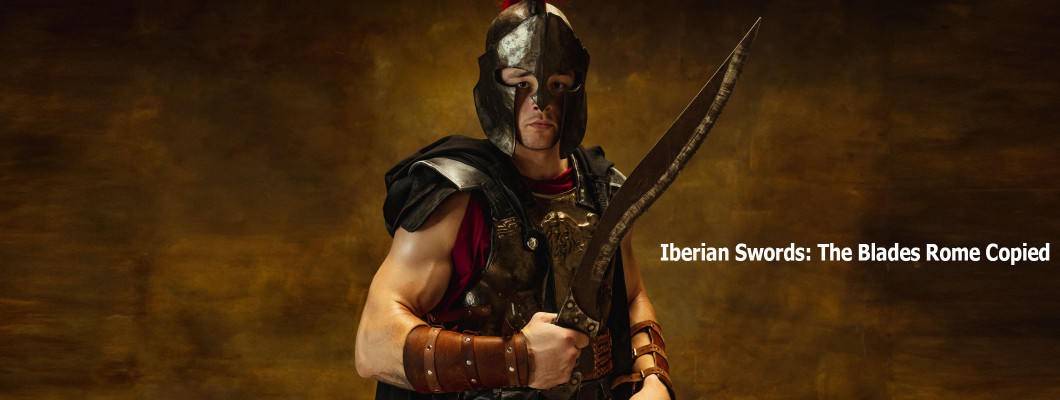
The falcata is the sword most people picture when they think of ancient Iberia, and rightly so — it is one of the most distinctive silhouettes in the entire history of the sword. Carried by the Celtiberian and Iberian tribes from around the fifth century BC, its blade is unmistakable: single-edged, curving forward, narrow near the hilt and widening toward the tip, so the weight sits out front like an axe.
That forward weight is the whole point. It lets a falcata cut with terrible force — Roman writers described the blade splitting shields and cleaving helmets — while the concave edge nearer the point still allowed a thrust. The hilt curves back to hook around the hand, protecting it and locking the grip, and on finer examples it ends in a sculpted horse or bird's head.
Iberian smiths were not only shaping steel well; they were selecting it with a rigour that impressed even the Romans, who recorded the practice of burying iron plates to let the weaker metal rust away, leaving only the best steel to forge. Falcatas armed Hannibal's Carthaginian troops against Rome in the Second Punic War and stayed in use into the first century BC.
Hand-forged falcatas
The Gladius Hispaniensis — The Sword Rome Copied
Alongside the curved falcata, the Iberian warriors carried something quite different: a straight, double-edged sword with a long tapering point, built as much for the thrust as the cut. The Romans met it in the Punic Wars, fighting Iberian mercenaries in Carthaginian service — and decided it was better than what they carried.
So they took it. Rome adopted the weapon outright and named it after its origin: the gladius hispaniensis, the "Spanish sword." It became the standard sidearm of the legions, the blade that carved out the Roman Empire, and the ancestor of every later gladius pattern. Few weapons have shaped world history more, and it began in Iberian hands. When people say the Iberians made a sword so good that Rome copied it, this is the sword they mean.
The Roman gladius that grew from it — the Mainz, the Pompeii — is a category in its own right, and we forge the type in full.
Browse the hand-forged Roman Gladius collection →
The Kopis — The Greek Cousin That Came First
The falcata did not appear from nowhere. Its closest relative is the Greek kopis, a forward-curved single-edged sword that emerged in Greece from around the sixth century BC — a generation or two before the Iberian falcata — and almost certainly influenced it. The two are so alike in profile that historians still debate the exact line of descent, and modern smiths forge them side by side.
The kopis was the chopping sidearm of the Greek hoplite and the Macedonian cavalryman, the heavy cutting answer to the straight thrusting xiphos. Where the falcata is Iberia's, the kopis is Greece's — the same brutal forward-weighted geometry, the same battlefield logic. If the falcata interests you, its Greek cousin is worth knowing, and Everest Forge keeps the largest dedicated hand-forged kopis range online.
Hand-forged kopis swords
There are sixteen kopis variants in all, including customizable and machete-profile builds. See the complete hand-forged Greek Kopis collection, or read the deeper history in our Xiphos vs Kopis guide.
The Jineta — The Sword of Moorish Spain
From 711 to 1492, much of the peninsula was under Muslim rule, and Iberian sword-making took a wholly different direction. The sword of the Nasrid kingdom of Granada was the espada jineta: a straight, double-edged blade with an unmistakable hilt — short quillons curving sharply down toward the blade, a spherical or disc pommel, and, on the finest examples, lavish decoration in gold, enamel and ivory.
The jineta was as much a statement of status as a weapon. The sword of Boabdil, the last Muslim king of Granada, survives in Spanish museums and is counted among the most beautiful swords ever made. Christian knights prized captured jinetas as trophies, and the style shaped Spanish hilt design for centuries after Granada fell.
The jineta is not a stock pattern in our range — but it is exactly the kind of historically specific, richly decorated blade our smiths build to commission. If you want an espada jineta with authentic down-curved quillons and period decoration, that is a custom forge project, and one we would relish.
Toledo Steel — The Name That Became a Brand
No account of Iberian swords is complete without Toledo. The city has forged blades since Roman times, but its legend grew through the Middle Ages and peaked in the sixteenth and seventeenth centuries, when a Toledo blade was the most prized sword in Europe.
The reputation rested on real metallurgy — careful ore selection, repeated forging, and a controlled tempering process guarded by the city's guild — amplified by Spain's status as the dominant military power of the age. Toledo smiths signed their blades, and their marks were forged and faked across Europe, which is its own backhanded proof of value: no one counterfeits a name that does not sell. The Royal Arms Factory of Toledo, founded in 1761, carried the tradition into the modern era.
"Toledo steel" became shorthand for the best a sword could be. We do not claim the Toledo name — but we do share its underlying conviction, that a sword's worth is decided in the steel and the temper, not the decoration. You can read how we forge and heat-treat every blade on how your blade is forged and the Everest Forge Battle Ready Standard.
The Spanish Rapier and the Cup Hilt
Spain's Golden Age gave Europe la verdadera destreza — "the true skill" — a geometric school of swordsmanship that dominated the seventeenth century. Its weapon was the cup-hilt rapier: a long, narrow thrusting blade beneath a deep steel bowl that protected the hand, with long straight quillons for control and binding.
The cup hilt is the most recognisably Spanish sword of all, and it stayed in service in Spain and its colonies long after the rest of Europe had moved on to the lighter smallsword. Like the jineta, it is not a stock item in our catalogue — but a cup-hilt rapier is a natural custom commission for a collector who wants the definitive blade of the Spanish school.
The Recurved Blade Family — How the Falcata Compares
The falcata belongs to a family of forward-curved blades that appeared independently across the ancient world, and they are frequently confused. Here is how the four most famous actually differ.
| Sword | Origin | Blade | Note |
|---|---|---|---|
| Falcata | Iberia, 5th c. BC | Forward-curved, single-edged | Iberia's own; likely descended from the kopis |
| Kopis | Greece, 6th c. BC | Forward-curved, single-edged | The older Greek cousin that influenced the falcata |
| Khopesh | Egypt, Bronze Age | Sickle-hooked, single-edged | The far older ancestor form, a hooked cutting blade |
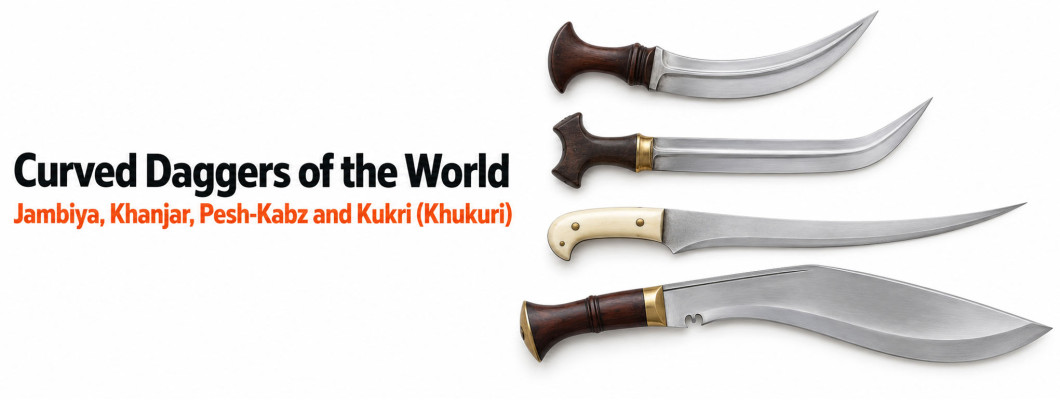
| Kukri | Nepal, 16th c. on | Forward-curved, single-edged | The living descendant, still forged and carried today |
We forge all four families in the same workshop. Explore the Egyptian Khopesh, the Nepalese Kukri and Khukuri, or step across to the straight Greek Xiphos the kopis fought beside.
Owning an Iberian Sword Today
Iberian blades reward the collector who wants something beyond the usual Viking or katana. The falcata in particular is one of the most distinctive silhouettes in the sword world, and a hand-forged one is a genuine conversation piece as well as a functional blade. Ours are forged from 5160 spring steel, water-tempered and sharpened, and shipped with a fitted scabbard.
For the falcata and its Greek cousin the kopis, we have a full stock range you can order today. For the jineta and the cup-hilt rapier — the two Iberian swords we do not keep as stock patterns — the custom forge is the route, and both are builds our smiths would be glad to take on.
One practical note: the gladius hispaniensis, the jineta and the rapier are double-edged, and double-edged blades face stricter carry and import rules in some countries than single-edged ones. If you are ordering internationally, it is worth a look at our guide to whether knives and blades are legal, country by country, before you buy.
Commission an Iberian Sword
Want an espada jineta with down-curved quillons, a cup-hilt rapier of the Spanish school, a period-accurate falcata, or a gladius hispaniensis reconstruction? Send us the blade type, length, decoration and any reference plates or sketches. Every custom sword is hand-forged in Nepal from 5160 spring steel, full tang, water-tempered and sharpened. We reply to every request within 24 to 48 hours with a free quote.
Request a Custom Sword →Frequently Asked Questions
What is an Iberian sword?
An Iberian sword is any of the swords of the Iberian Peninsula (Spain and Portugal) across history: the ancient falcata and gladius hispaniensis, the Moorish jineta of medieval Granada, the blades of Toledo, and the Spanish cup-hilt rapier. The term describes a two-thousand-year tradition rather than a single design.
Did the Romans really copy a Spanish sword?
Yes. During the Punic Wars, Rome encountered the straight, double-edged Iberian sword carried by warriors in Carthaginian service, judged it superior to their own, and adopted it outright as the gladius hispaniensis, the "Spanish sword." It became the standard sidearm of the Roman legions and the ancestor of every later gladius pattern.
What is a falcata?
A falcata is a forward-curving, single-edged sword of the pre-Roman Iberian tribes, used from about the fifth century BC. Its weight sits toward the tip like an axe, giving devastating cutting power, while its hooked hilt locks the grip and often ends in a carved horse or bird's head. Hannibal's Carthaginian troops carried falcatas against Rome.
What is the difference between a falcata and a kopis?
They are near-identical forward-curved single-edged swords from different places. The Greek kopis appeared around the sixth century BC; the Iberian falcata around the fifth, and is generally considered a descendant influenced by the kopis. In practice the falcata is the Iberian member of the same recurved-blade family, and the two are often built to the same profile.
Why is Toledo steel famous?
Toledo smiths developed a guild-controlled process of ore selection, repeated forging and controlled tempering that produced exceptionally strong, flexible blades. Combined with Spain's military dominance in the sixteenth and seventeenth centuries, this made a Toledo sword the most prized in Europe, so much so that Toledo makers' marks were faked across the continent.
What is a jineta sword?
The espada jineta was the sword of the Nasrid kingdom of Granada during Moorish rule of Spain, roughly the thirteenth to fifteenth centuries. It has a straight, double-edged blade and a distinctive hilt with short quillons curving down toward the blade, often richly decorated in gold, enamel and ivory. The sword of Boabdil, last king of Granada, is the most famous example.
What is a cup-hilt rapier?
The signature Spanish rapier of the seventeenth century, with a long narrow thrusting blade and a deep steel bowl guard protecting the hand. It was the weapon of the Spanish fencing school known as la verdadera destreza and remained in use in Spain and its colonies long after the rest of Europe adopted the smallsword.
Are these Iberian swords battle-ready or display pieces?
Battle-ready. Every falcata and kopis in the range is hand-forged from 5160 high-carbon spring steel, full tang, water-tempered and edge-finished by hand, with a fitted scabbard. They are functional blades built to our Battle Ready Standard, suited equally to collection, reenactment and display.
Can you forge a custom falcata, jineta or Spanish rapier?
Yes. The falcata is available both as a stock blade and as a custom commission with your chosen length and decoration. The jineta and the cup-hilt rapier, which we do not keep as stock patterns, are natural custom-forge builds. Submit a custom sword request with your specification or reference images for a free quote within 24 to 48 hours.
Shop Hand-Forged Iberian & Recurved Swords
The Blades of Spain, Hand-Forged in Nepal
Falcatas, kopis swords and Roman gladii forged from 5160 spring steel, full tang, water-tempered and sharpened, each with a fitted scabbard. Order a stock blade today, or commission a jineta or cup-hilt rapier built to your specification.
Shop Falcata & Kopis Swords →