How to Identify a Real Celtic Sword: Tips for Collectors
Celtic sword, one of the ancient weapons that was discovered in the early European region, is one of the tools that carries a deep history. The history behind the sword is unknown, with many believing in different origin stories. The sword is named after the Indo-European people, “Celts”.The design reflected both the usefulness in fighting and the beauty of the workmanship. Such swords were not produced in large quantities. Each one was made with great care, thus every single piece was different from the others. The Celtic sword remains a symbol of virtue, character, and cultural heritage. It reflected both the past and the present, continuing to fascinate historians and collectors.
Who were the Celts, and how did they originate?
The Celts were the earliest European tribe. They are also called the Indo-European people who resided in the central and eastern part of Europe. The Celts were a group of tribes. They were connected through similar languages and culture. They were known for their metal works and artwork. Later on, they are believed to have moved to Ireland. They had no one-nation concept; rather, they considered themselves as tribes whose common language, thoughts, and cultural practices united them. Their metal works, jewelry, and ornaments were of high quality as they never compromised, and swords were their greatest masterpiece. The Celts bravely and honorably fought for what they considered valuable, and they essentially saw their swords as a symbol of these three qualities. Gradually, their artistic legacy became very influential in the history of Europe, leaving traces in the arts, wars, and even legends.
Role of swords in Celtic culture
In Celtic culture, swords were more than just weapons. They were the symbols of status. A warrior's identity was embodied by the Celtic sword. These swords were used not just for survival but for many other occasions and ceremonies. The Celtic swords were used for slashing and thrusting. Owning a Celtic sword was a symbol of power and wealth in society. The sword of a warrior was his emblem of the highest rank, bravery, and allegiance to his people. Such swords were technically thrown into rivers or lakes as gifts to the gods, signifying that they had a great spiritual value. When fighting, these blades were shaped similarly to a leaf to be both cut and stabbed, thus they were very handy in the battle. In addition to fighting, these swords were exhibited during the rituals, inheritance was handed down, and they were put in the graves of the dead as a sign of everlasting honor. Having a Celtic sword was to have the power, the respect, and a close relationship with the gods.
History of the Celtic sword
The culture of the tribe evolved during 1,200 BC. After this, the use of Celtic swords was more prominent in society. But the early uses of the sword were around 800 BC. This period was also known as the Iron Age. The sword was made of bronze. After this, the bronze sword slowly evolved into the iron sword. After 1200 BC, the Celtic sword became more prominent in society. When tribes grew in number and had conflicts with nearby civilizations, the Celtic sword was not only used as the main weapon in war but also as a symbol of culture. A lot of these swords were found in ancient tombs, and the research shows that these weapons were very valuable.
Influence of Celtic swords on European weaponry and craftsmanship
Celtic swords originated in Europe. The blacksmiths who once made Celtic swords were highly skilled. The design of the Celtic sword later influenced many types of weapons that later originated in Europe. A Celtic blade is usually leaf-shaped. This inspired many sword designs in Roman and medieval Europe. The technique of having balance in the sword and creating designs was copied by many other cultures as well. These selves helped create different swords that were both practical and artistic.
Importance of authentic Celtic swords
The Celtic sword carries a history that still hasn't been well-dressed. Its formation and evolution carry cultural values. To anyone who owns a Celtic Sword, they are holding a piece of history. The authentic ones are rare and valuable. It carries the identity of true blacksmiths. Celtic Sword preserves the legacy of the Celts and helps us connect with Europe's past. Many people around the world keep the sword as a collector's piece. For a true weapon enthusiast, the sword is historical fantasy.
The Influence of Celtic Swords on European Weaponry and Craftsmanship
In the history of European arms, a lot of weapons have emerged with different functions. Bracing the gap between functional warfare tools and highly developed works of craftsmanship, the Celtic sword holds a unique position in the history of European arms. It showcased the advanced use of iron and steel in weapon-making. The Celtic sword not only enhanced the effectiveness of the sword in battle but also set new standards that influenced weapon-making across the continent. Celtic smiths were master metalworkers. They developed unique techniques such as pattern welding, tank construction, and sophisticated methods of blade tampering. They emphasized both durability and artistry. The legacy of Celtic smiths influenced many other weapons and their building techniques in Europe. This design directly inspired the neighboring cultures, including the Romans and the Germanic tribes. The legacy of Celtic swords can be traced in the evolution of later European weaponry. The medieval long swords were highly influenced by the Celtic sword. Beyond the battlefield, Celtic craftsmanship influenced European decorative metalwork tradition.
Common Characteristics of Authentic Celtic Swords: Anatomy
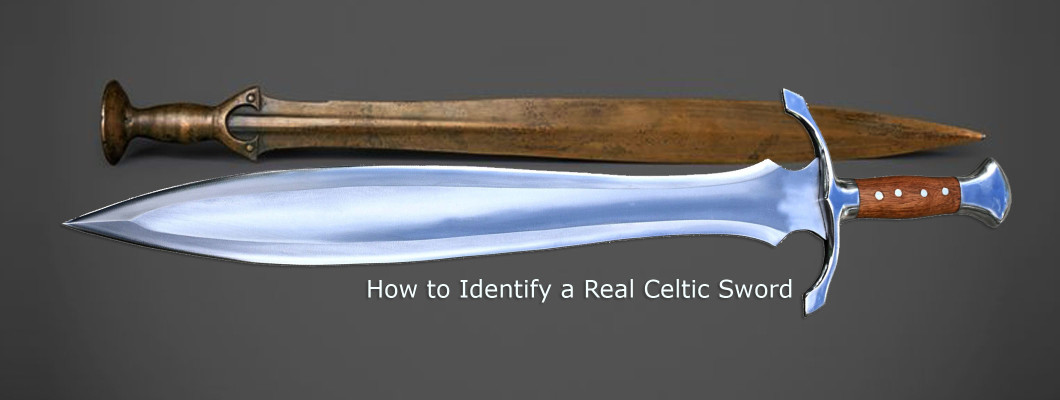
- Blade: A Celtic sword has a sharp blade. It has a recognizable feature of an authentic blade. The blades are mainly broad and leaf-shaped. It has a wide body and a pointed end. The shape of the blade makes it an excellent weapon for cutting and thrusting. You can find different variations of the blade of a Celtic sword. This type of blade evolved according to the Celtic craftsmanship over time. Usually, the length of a Celtic sword is from 60 cm to 90 cm. This sword has a perfect blade that can be used in the combat field.

Leaf-shaped Blade — Celtic sword profile (illustration)
- Edge: A Celtic sword has sharp edges on both sides. This sharp double-edged sword is effective in any function. This also makes it a perfect tool for combat. Before, the edge used to be made of bronze. But now we can see iron double-edged swords. The authentic Celtic swords have their edges designed with skilled craftsmanship.
- Material used to create the sword: In the earliest days, bronze was easily available, due to which the Selectic Swords were made of it. It was crafted through casting and hammering the sword. With the evolution to the Iron Age, Selectic Swords were made of Iron. This made the sword even stronger and more durable. Now, the swords are also made up of steel so that the blades don't rust over time.
- Hilt / Handle of Celtic Sword: The handles of Celtic swords are unique. It has a simple design. Generally, this part is made of wood, bone, or horn. It is often wrapped with leather so that the handler of the sword can have a firm grip on the sword. This section of the sword has different parts. The end part is called a ring-shaped pommel. Similarly, the sword has a grip, guide, and ricasso section in the middle.
- Design and structure of the sword: The Celtic sword can have different kinds of designs. The simple Scylletic sword may have a simple design near the hilt area. The Pommel, Grip, Guard, and Ricasso that are the hilt of the sword, can vary in different designs depending on the skill of the craftsman. Also, the blades can be decorated with designs or simply be unique by having a pattern, making them aesthetically pleasing. These engravings not only enhance the aesthetic of the sword but also represent the concepts of strength and safety.
- Weight and Balance of the Sword: Celtic swords are good for slashing and thrusting. The blade part of the sword is quite long. It is the main part of the sword. Usually, the average weight of a Celtic sword is around 1-1.5 kg. Since the blades of a Celtic sword are long, it uses a well-balanced technique so that warriors can move quickly with the sword.
Identifying Celtic Sword Materials and Craftsmanship
As Celtic Swords carry history, we need to recognize the authentic Celtic leaf Sword. With the passage of time, many replicas are easily available on the market. We must understand the materials and craftsmanship of an authentic Celtic Sword. The Celtic sword not only carries history, but also is the dedication of craftsmen who use their skill to make this sword distinctive.
- Iron Forging Technique. The Celts efficiently used the iron forging technique. To create an authentic Celtic sword, one must master the art of iron forging. This technique helps to produce blades that are strong and functional. Pattern welding is a commonly used approach. The iron strips are folded, twisted, and pressed together throughout this procedure. The authentic Celtic sword has a blade strong and flexible due to this technique. This process has faded over the years. A collector or historian can spot the difference in the forging technique. The Celtic sword will display natural imperfections if it is authentic. It will have uneven patterns near the blade and hammer strikes that denote the handcraft used by smiths.
- Materials used to make the sword. In the late Bronze Age, bronze was heavily used. So they were made from bronze. Later on, with the Iron Age, the Celtic swords were made of iron. An authentic Celtic sword, which carries history, is usually made of these two materials. Later on, we can see Celtic swords that are made up of steel, which are not authentic to their core craftsmanship. Even though they are more durable than an iron sword or a bronze sword, these swords don't carry the real art behind the Celtic sword.
- Signs of Handcrafting and Local Techniques used to make the sword. The authentic Celtic sword carries a different structure. It has the handcrafted shapes of the ancient blacksmiths. These blacksmiths are well-trained to make this kind of sword. There are marks of hammers and tiny irregular patterns along the blade and hilt. These irregular patterns create the authentic Celtic swords. The fake sword has a perfect shape and sharp and shiny designs. Ancient swords are not perfectly made, which is a true sign of authenticity. Even though the sword may appear asymmetrical, it still has a cultural touch to it.
- Patina and corrosion patterns typical of ancient iron and bronze: Irons and bronze easily react with the natural environment. If the sword is ancient, then they have the sign of rust or corrosion. One of the strongest indicators of authenticity is patina. It is a layer formed over the metal due to the long period of oxidation. It is a natural process. For iron swords, the patina may look dark rust brown in color. For a bronze sword, the patina often looks green or bluish. These are the result of the natural oxidation process, which can be seen only on the authentic Celtic swords. For anyone who likes collecting swords, they should avoid over-polished swords, which look shiny and are easily available on the market. The corrosion patterns are the symbol that makes the sword valuable and historically significant.
- Metallurgical Test to Check the Authenticity of the Sword. The best method for the collector can confirm the authenticity is by scientifically testing it. Many types of authentication techniques can be used. Some of the commonly used techniques are radiography and microscopic examination. This helps to uncover the internal structure and identify the surface wear pattern so that the real sword can be detected. Even though there are high-quality replicas, this technique helps us to distinguish between the real and the high-quality replicas.
Recognizing Authentic Celtic Sword Blade Patterns and Engravings
Celtic swords are a piece of art. They are the work of highly skilled craftsmen. To recognize an authentic Celtic sword, one must study the blade patterns and engravings. The design part of the sword carries deep meaning for the cells. They are created with a skill that the modern replicas cannot copy. Some of the main things to look for while examining the engravings and design patterns are:
- Common Celtic motifs: Motifs carry the image and idea behind the art. The Celts used to decorate their swords. They used to love having symbols taken from nature, religion, and daily life. These were not just random decorations, but they were designs with meaning. Some of the common Celtic motifs were spirals, northward, and animals, which were used to symbolize different intentions behind the sword. These motifs in a real sword simplify all the powerful forms in the world.
- The placements of engraving on the sword: The designs on the sword are made in different places on the sword. The placement of this design helps us identify whether the sword is real or not. The cells carefully choose the placement. With each placement of engraving, there is a special meaning hidden. If the engravings look randomly placed without meaning, then the sword doesn't carry the authentic value. Usually, the distinctive areas that are used to place the engravings are near the hilt, on the blade edge or flat surfaces, and on the pommel or cross guard.
- Engraving techniques used: There are different kinds of engraving techniques. The techniques have been modified with the evolution of the sword. The cells used different kinds of methods to decorate their swords. This process depended on the materials and tools available to them. Some of the common engraving techniques are etching, carving, and inlays. Etching processes are often shallow but detailed. Carving processes have designs that look rougher but are more durable compared to other techniques. Inlays used different kinds of metals to make their swords shine. You can easily identify these engraving techniques, which helps you to look at an authentic sword.
- Ancient vs. Modern Engraving: The ancient engravings are not always perfect. They may be slightly different and often fade in some areas than others. The lines that are used to engrave may look uneven, but the sword still carries the beauty and the balance. Some patterns may be rarely visible because of centuries of wear on ancient, authentic Celtic swords. This design carries culture and history. Modern engravings are often too sharp, too deep, and completely uniform. They are made shiny and lack the rough texture of handwork.

Hilt designs of a Celtic Leaf Sword
Looking at the Hilt, Grip, and Pommel to identify the authentic sword
Celtic swords are among the most fascinating weapons that carry a history. It is known for its functionality and also for its artistic beauty. The artistry and beauty are due to its construction and its structure. The structure can be closely identified with the hilt, grip, and pommel present on the sword. These components possess specific features and have been made with different materials and techniques, and have a different wear that helps us to recognize whether it is an authentic one.
1. The Hilt
- Materials: Most authentic Celtic hilts use iron or bronze. This material showcases whether the Celtic swords are authentic or not. Bronze was common in the earlier era, whereas iron became dominant in the later La Tene period.
- Design: The structure of hilts has evolved with time. The medieval swords had a complex hilt construction. The earlier hilts had a simple construction with minimal cross-guard design. The hilts on authentic swords are slightly flared or shaped to provide a firm stop for the hand.
- Signs of Age: An original sword hilt may exhibit corrosion signs, a protective layer, or uneven wear due to the sword's age. A hilt that is completely smooth or polished probably would indicate that the sword is a replica of a Celtic weapon rather than an authentic one
2. The grip
Grip is the part where the warrior holds the sword. The design of the grip is crucial so that it will be comfortable to use the sword. This part of the sword helps to gain the amount of control to balance the sword. The Celtic sword grips are usually shorter than the modern ones.
- Materials: Genuine Celtic sword handles commonly consist of either wood, bone, horn, or leather that has been wrapped around it. In due course, the wood typically gets smaller or gets cracks. The leather can also become brittle and can get worn out. The bones or horn can showcase scratches or surface wear due to age. These natural signs of aging cannot be replicated.
- Construction: The grips are constructed with the use of local craftsmanship. There might be slight irregularities in shape or alignment in an authentic Celtic sword. Modern replicas, however, can use synthetic materials. These materials, like resin or plastic, can lack the natural texture of the grip.
- Signs of age and wear: The authentic sword can have grips that may have fingerprints or signs of wear. Specifically, the leather wrappings may appear cracked, while the woods can reveal the signs of shrinkage or slight damage due to age. These imperfections add to the character of the sword. It serves as strong evidence of authenticity.
- Authenticity clues: If the grip appears flawless or overly polished or is made up of synthetic material, then the sword is not an authentic one. True Celtic swords have marks of centuries of handling, storage, and exposure to the elements.
3. The pommel
The pommel is the ending part of the sword. It has a unique structure. It is the counterbalance at the end of the sword. Usually, the pommel is often simple but has a distinct shape.
- Design, and structure: Most of the typical Celtic pomal designs are ring-shaped. They are practical and help to balance the weight of the sword. The modern and unauthentic Celtic pommels are lighter in design.
- Materials: The authentic pommels were made of iron or bronze. These were often made by local smiths. Over time, the iron pommels and the bronze pomal showed signs of cohesion and patina.
- Construction methods: The authentic Celtic pommels are made using of ancient technique. This technique is also known as tang attachment. The technique uses the peen method at the end to hold the pommel in place. These ends appear uneven or hammered. This is a strong indication of authenticity.
How to Spot Fake or Replica Celtic Swords
Knowing how to understand whether the sword is real or not is important. It helps to find the authentic ones and conserve the art that has been continued through the ages. To spot a fake or replica Celtic sword, one needs to consider different factors.
- Looking at the construction of the blade: The blade of an authentic sword has some imperfections. The material used for it is iron or bronze. The modern sword can be of steel and can look shiny (shine like of mirror) or freshly polished.
- Examining the designs and motifs: The accuracy of design in a replica sword can be consistent. The authentic sword has designs on a particular region of the sword with an inconsistent design. If the design doesn't have the factor of local craftsmanship, then it can be a replica.
- Craftsmanship quality: the craftsmanship used in the authentic sword is centuries old. It is curated by a diverse group, “Celts”. The replica or fake swords are machine-made made look flawless, and lack the marks of hammering. But the real sword has the touch of blacksmiths and their skill.
- Lack of provenance or documentation: The authentic Celtic sword is sold with the documentation of authenticity, providing evidence that it is real. The fake ones don’t provide credible documents when sold. The experts can easily identify if the sword is real or not.
- Consideration of price: When buying the Celtic sword, one must consider the price. If the price is too good to be true, then the sword might be fake. The real Celtic swords are rare to find and expensive. The price of a sword is a strong indicator of the authenticity of the sword.
Preserving an Authentic Celtic Sword
Owning an authentic Celtic sword is like holding a piece of history. These ancient swords, often crafted through custom forges, hold immense value not only in monetary form but also in their impact on the evolution of culture and history. To preserve the authentic Celtic sword, one can
- Preserve with cleaning: A Celtic sword should be cleaned with the proper method. Strong chemical agents shall be avoided while cleaning the sword. Adhesive cleaners or industrial polishes can damage the material of the sword.
- Use of oils: To prevent the metal of the sword oil should be used. It prevents the corrosion of the metal. The oil should be used in less quantity so that the dust won’t be attracted to the sword.
- Safe storage of the sword: The Celtic sword shall be safely stored with proper climate control. The humidity and temperature shall be maintained so that the sword won’t react to the environmental conditions.
- Proper restoration method: The Celtic sword shall be inspected regularly. The preservation method is an ongoing process. Owners shall look for the signs of rusting, deterioration, or corrosion. It is important to consult with experts to restore the Celtic sword.
Authentic high-quality sword from Everest Forge
At Everest Forge, we take pride in being trusted sellers of authentic and high-quality swords. These Celtic swords carry history, artistry, and craftsmanship. Each piece in our collection is carefully curated, with attention to detail. You'll not just receive a weapon, but also a timeless work of art. Our catalogue features a wide range of options to suit your preferences. Whether you are seeking a historical piece or a medieval reproduction of a Celtic sword, you'll find a wide range of Celtic swords.
- Celtic Etched Viking sword: The Celtic Etched Viking Sword is a 27-inch Viking-inspired sword. It is crafted from durable 5160 carbon steel. It features a 21-inch water-tempered blade. It balances artistry with functionality. The sword has a rosewood full-tang handle and pommel, which ensures control over the sword. This is a battle-ready piece, ideal for collectors or weapon enthusiasts. It can be perfect for ceremonial gifting or practical use.
- Tactical Leaf Sword: The Tactical Leaf Sword is a 21-inch sword that is hand forged. It has a white wood handle and is made of high-carbon steel. It is inspired by the legendary warriors of Iron Age Europe. It is perfect for collectors, re-enactors, or for practical use. It has battle-ready eyes, which make it functional for use. Similarly, its full-time construction ensures superior durability.
- Celtic Seax Cleaver: The Celtic Seax is a versatile, modern functioning sword hand forged by Everest Forge. It has 16 16-inch blades made of Carbon steel. The length of the Celtic Seax makes it ideal for chopping, cutting, or outdoor survival activities. The rosewood tang handle makes the grip firm to do heavy-duty tasks.
- Celtic Leaf Sword: Celtic Leaf Sword is a 20-inch sword that is hand-forged and fully functional. It is made from 5160 high-carbon spring steel. The sword has great strength and flexibility. The leaf-shaped blade delivers excellent cutting and thrusting performance. Similarly, the handle is made of rosewood, ensuring a comfortable and balanced grip for practical use.

Celtic Leaf Sword with Flower Pattern – Everest Forge
Conclusion:
Celtic swords are a part of ancient stories. They symbolize an aspect of Celtic history. Through the progression and changes with time, the Celtic sword has changed greatly in its appearance, the way it was made, and the materials used. Knowing the real thing is the core of the whole matter, as the true swords are the vehicles of several hundred years of tradition. The genuine sword has a quality of exquisite workmanship and talent. If anyone is interested in purchasing the sword, it becomes essential for them to understand the methods of conservation, the history, and the authenticity of the Celtic sword.