Egypt Fought for Two Thousand Years With Maces, Axes, Spears and Bows; the Sword Arrived Late, and the Khopesh Was Its Only Famous Form
Ancient Egypt had no swords for most of its history. The armies of the Old and Middle Kingdoms fought with the mace, the axe, the spear and the bow, and the copper or bronze dagger was a sidearm. The sword only became an Egyptian weapon in the New Kingdom, after about 1550 BC, and when it did it took the shape of the khopesh, the sickle-sword borrowed from the Levant, alongside a handful of straight bronze swords late in the period. This guide walks through the full arsenal of the pharaohs in the order it developed, from the pear-shaped mace of the first kings to the khopesh, the composite bow and the chariot, with the tomb finds that tell us what these weapons really looked like and what a hand-forged reproduction can and cannot recreate.
For the khopesh on its own, our khopesh history and design guide goes deeper than this overview can; for what it meant, read the symbolism behind the khopesh. This post is the wider picture those two sit inside.
Egyptian Weapons at a Glance
| Weapon | Period | Material | Role | Best-known example |
|---|---|---|---|---|
| Mace (pear-shaped head) | Predynastic to Old Kingdom; ceremonial after | Stone head on a wooden haft | Close combat; the royal smiting weapon in art | The Narmer Palette, c. 3100 BC, shows the king raising one |
| Flint and copper knives | Predynastic to Old Kingdom | Ripple-flaked flint; later copper | Sidearm, ritual | The Gebel el-Arak knife, ivory-handled flint, c. 3300 BC |
| Dagger | All periods | Copper, then bronze; rare iron and gold | Sidearm and status object | Tutankhamun's two daggers, one with a meteoritic iron blade |
| Axe | Old Kingdom to New Kingdom | Copper, then bronze, lashed or socketed to wood | The main close-combat weapon before the sword | The Middle Kingdom epsilon axe; Ahhotep's ceremonial axe |
| Spear and javelin | All periods | Copper or bronze head, wooden shaft | Infantry, hunting, chariot runners | Wooden soldier models from the tomb of Mesehti, c. 2000 BC |
| Bow | All periods; composite bow from c. 1600 BC | Self bow of wood; composite of wood, horn and sinew | Egypt's decisive weapon; archers won battles | Tutankhamun was buried with over thirty bows |
| Khopesh | c. 1600 to 1100 BC | Cast bronze | Sickle-sword for infantry and chariot crews; royal symbol | Two khopeshes from Tutankhamun's tomb |
| Straight bronze sword | Late New Kingdom | Bronze | Thrusting and cutting; partly Sea Peoples influence | A sword bearing the cartouche of Merneptah, found at Ugarit |
| Shield | All periods | Cowhide on a wooden frame, round-topped | Infantry protection | Ceremonial shields from Tutankhamun's tomb |
| Chariot | From c. 1600 BC | Light wood, leather and bronze fittings | Mobile archery platform | Six dismantled chariots in Tutankhamun's tomb |
The Mace: The First Royal Weapon
The earliest Egyptian weapon of war was the mace: a heavy stone head, at first disc-shaped and then pear-shaped, on a short wooden haft. It cracks skulls, and that is exactly how the first kings had themselves shown. On the Narmer Palette, around 3100 BC, the king grips a kneeling enemy by the hair and raises a pear-headed mace above him, and the "smiting the enemy" pose stays in Egyptian royal art for three thousand years. By the Old Kingdom the mace was losing ground on the battlefield to the axe, which reaches further and cuts as well as crushes, but it never left the iconography. When a pharaoh of the New Kingdom is carved smiting foreigners on a temple pylon, he is often still holding a mace.
Axes: The Real Fighting Weapon of the Old and Middle Kingdoms
For a thousand years before the sword, the axe was Egypt's main hand weapon. Old Kingdom axes had a semicircular copper blade lashed through slots in a wooden haft, light enough to swing with one hand and paired with a shield. The Middle Kingdom produced the most distinctive form, the epsilon axe, named for its shape: a wide crescent blade attached to the haft at three points, like the Greek letter. It cut well against unarmoured bodies and is the axe that Egyptian soldiers carry in the wooden army models from the tombs of the period. In the New Kingdom, with bronze now standard, narrower, longer-bladed axes appear that bite deeper, a response to opponents who now wore leather and scale armour. The ceremonial axe of Queen Ahhotep, gold and inlaid, shows the type at its most elaborate.
Spears, Bows and the Army That Won With Archers
Egyptian infantry carried spears in every period, with copper and then bronze heads on wooden shafts, and hunted with them as much as they fought. The tomb of the nomarch Mesehti at Asyut, around 2000 BC, held two companies of painted wooden soldiers, one of Egyptian spearmen with hide shields and one of Nubian archers, and they are the best picture we have of a Middle Kingdom army.
The archers are the point. Egypt's armies won with the bow. For most of the period this was a self bow of a single piece of wood, and Nubia, "the land of the bow" in Egyptian texts, supplied many of the best bowmen. The composite bow, laminated from wood, horn and sinew, arrived with the Hyksos around 1600 BC and roughly doubled the effective range. Combined with the chariot, it turned the New Kingdom army into one of the most effective forces of the ancient world; Tutankhamun was buried with more than thirty bows and hundreds of arrows.
The Hyksos and the New Kingdom Reforms
Around 1650 BC a population of Western Asian origin, the Hyksos, took control of the Nile Delta and ruled it for about a century. Egyptian tradition remembered them as invaders; archaeology suggests a more gradual takeover. Either way they brought with them the light horse-drawn chariot, the composite bow, new forms of bronze axe and dagger, and the sickle-sword from which the khopesh developed. When the Theban kings Kamose and then Ahmose drove them out around 1550 BC, they did it with the Hyksos' own weapons, and the New Kingdom that followed built its power on them.
The New Kingdom created Egypt's first standing professional army: infantry divisions named after gods, a chariot corps, scribes for logistics, and foreign auxiliaries. Thutmose III used it to win at Megiddo in 1457 BC and carry Egyptian control to the Euphrates; Ramesses II fought the Hittites to a standstill at Kadesh in 1274 BC, the largest chariot battle of the ancient world. The khopesh belongs to this army.
The Khopesh: Egypt's Sword
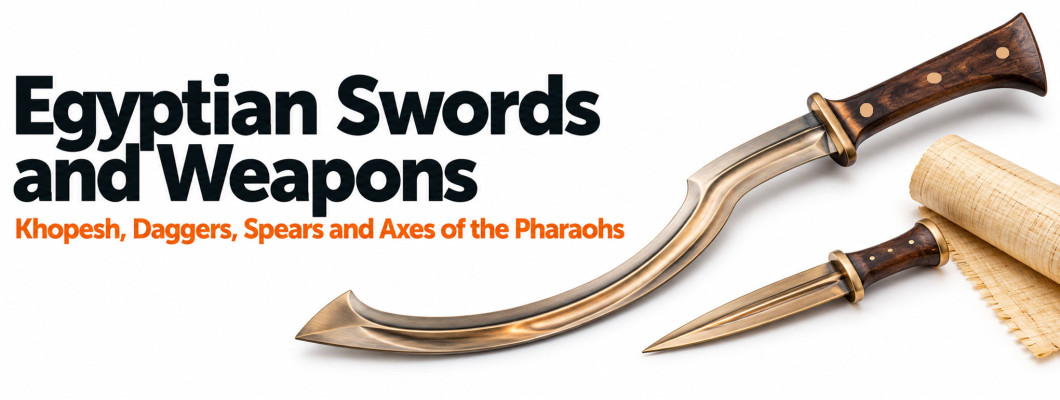
The khopesh began as the Mesopotamian and Canaanite sickle-sword and was taken up in Egypt during or just after the Hyksos period. Cast in bronze and 50 to 60 cm long, it has a straight section from the grip, then a long crescent with the cutting edge on the outside of the curve and a hooked tip. It slices with a drawing cut and its inner curve can hook a shield rim or a limb; it does not thrust and it does not chop with any great weight. In art the gods hand it to the king, and it became a symbol of royal victory as much as a working sword. The two khopeshes buried with Tutankhamun, one large and one small, are the best-known surviving examples.
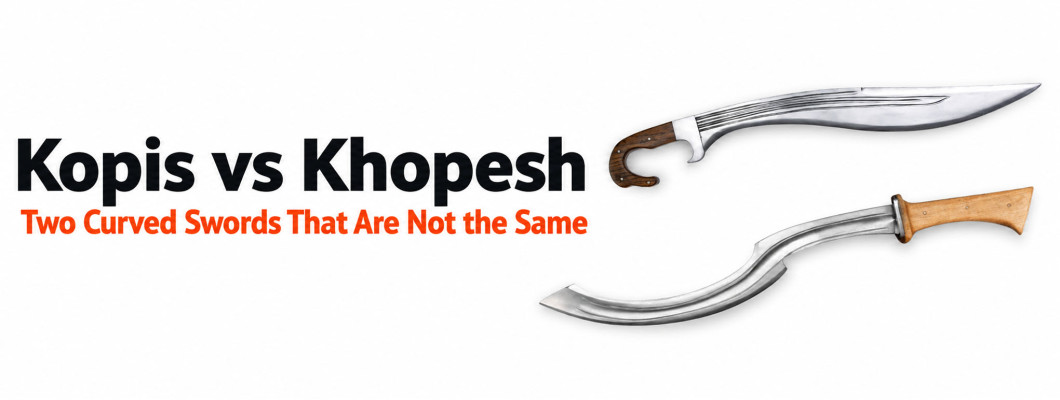
The khopesh is often confused with the Greek kopis, a completely different iron sword with the edge on the inside of a forward curve, and with the Ethiopian shotel, a far later sickle-sword with a much deeper curve. Our kopis vs khopesh comparison and khopesh vs shotel guide set those differences out side by side. By around 1100 BC the khopesh had gone out of military use, replaced by straight bronze swords, some of them influenced by the Naue II type carried by the Sea Peoples whom Ramesses III fought in the Delta. A straight bronze sword bearing the name of Merneptah, found at Ugarit in Syria, shows that Egyptian kings were having such swords made by the end of the thirteenth century BC.
Daggers and Tutankhamun's Iron Blade
The dagger was carried in every period and is where Egyptian metalwork is at its finest. Predynastic ripple-flaked flint knives such as the Gebel el-Arak knife, with its carved ivory handle, are among the most skilled stone tools ever made. Copper and then bronze daggers followed, and by the New Kingdom elite daggers had gold hilts, inlaid grips and decorated sheaths. Our guide to holy and ritual daggers places the Egyptian examples among other sacred blades.
The most famous are the two daggers found on Tutankhamun's body, one with a gold blade and one with an iron blade, in a period when iron-working was barely known in Egypt. A 2016 study using X-ray fluorescence found the iron blade's nickel and cobalt content matched meteoritic iron, and a later study suggested the dagger may have arrived as a diplomatic gift from the Mitanni kingdom, which matches a letter in the Amarna archive recording an iron dagger sent to Egypt. It is a blade, in other words, made from a meteorite and given to a pharaoh by a foreign king.
Reproducing Egyptian Weapons Today
Everest Forge forges the khopesh family on demand, in the ancient and classical swords collection, from mono-steel 5160 spring steel with a full tang. Nothing is held in stock; every blade is forged after the order is placed. There are five khopesh builds, each following a different reading of the type:
- The hand-forged khopesh, the standard New Kingdom form with the straight grip section and long crescent.
- The Egyptian khopesh sword, a heavier build closer to the larger of Tutankhamun's two.
- The original-pattern Egyptian khopesh, the closest of the five to surviving museum examples in proportion.
- The Sekhmet khopesh, named for the lion-headed war goddess, a decorative build for display and ceremony.
- The short khopesh, after the smaller of the two Tutankhamun pieces: lighter, quicker, and the easiest to handle.
Blade length, finish and handle are selectable on each, and the blade configurator shows the combination before you order. Any khopesh can be ordered left-handed by writing "Left Handed" in the order note, or to stage-combat specification with a blunt edge and rounded tip the same way, which is how most of our theatre and re-enactment customers order them. Catalogue builds dispatch in 2 to 3 business days; custom builds take 4 to 6 weeks at the forge; shipping is DHL or FedEx, tracked, 7 to 14 business days worldwide.
Maces, epsilon axes, spearheads and New Kingdom daggers are not catalogue items, but all of them are within the forge's range as custom work: send a museum reference or a drawing to the custom forge and we will quote it.
An honest note. Every original Egyptian weapon in this guide was stone, copper, bronze, gold or, once, meteoritic iron, and the bronze ones were cast, not forged. Everest Forge does not cast bronze, and it does not make pattern-welded, folded or laminated steel. A 5160 khopesh is a forged steel interpretation of a cast bronze form: lighter for its strength, far tougher, and it will not take the green patina of an excavated original. If you need a bronze piece for a museum display, a bronze caster is the right maker; if you want a khopesh you can handle, cut with and keep, steel is the better material.
Related Guides
Commission an Egyptian Blade From a Museum Reference
A khopesh in a specific proportion, a New Kingdom dagger, an epsilon axe head or a spearhead: send the reference, tell us the size and the finish, and the forge quotes it, builds it in 4 to 6 weeks from 5160 spring steel, and ships it tracked worldwide.
Start a Custom Forge RequestFrequently Asked Questions
What swords did ancient Egyptians use?
Mainly the khopesh, a bronze sickle-sword used in the New Kingdom from about 1600 to 1100 BC. Late in the New Kingdom straight bronze swords also appear. Before that, Egypt had no swords; its soldiers fought with maces, axes, spears and bows.
What was the main weapon of the Egyptian army?
The bow. Archers decided most Egyptian battles, and from about 1600 BC the composite bow fired from light chariots made the New Kingdom army one of the strongest of its age. In hand-to-hand fighting the axe was the main weapon before the khopesh.
What is an epsilon axe?
A Middle Kingdom Egyptian battle axe with a broad crescent blade fixed to the haft at three points, giving it the shape of the Greek letter epsilon. It was a cutting weapon used against unarmoured opponents.
Where did the khopesh come from?
From the sickle-swords of Mesopotamia and Canaan. Egypt adopted the form during or after the Hyksos period, around 1650 to 1550 BC, and made it the sword of the New Kingdom.
Was Tutankhamun's dagger really made from a meteorite?
Yes. A 2016 analysis found the iron blade's nickel and cobalt content matches meteoritic iron. Later research suggested it was a diplomatic gift from the Mitanni kingdom, which fits a letter in the Amarna archive recording an iron dagger sent to Egypt.
Who were the Hyksos and what did they bring?
A population of Western Asian origin who ruled the Nile Delta from about 1650 to 1550 BC. They brought the horse-drawn chariot, the composite bow, new bronze weapons and the sickle-sword that became the khopesh. Egypt expelled them using those same weapons.
Did ancient Egyptians use iron weapons?
Only rarely before the Late Period. Iron was a precious material in the New Kingdom; Tutankhamun's iron dagger is meteoritic. Iron weapons became common in Egypt only from about the seventh century BC, partly through Greek and Carian mercenaries.
Is the khopesh the same as the kopis?
No. The khopesh is an Egyptian bronze sickle-sword with the edge on the outside of its crescent. The kopis is a Greek iron sword with the edge on the inside of a forward curve. The names are unrelated.
Does Everest Forge make Egyptian maces, axes or daggers?
Not as catalogue items. The khopesh family is in the catalogue; maces, epsilon axe heads, spearheads and Egyptian-style daggers can be forged as custom work from a museum reference or drawing.
Can I order a khopesh blunt for stage combat or left-handed?
Yes. Write "Left Handed" in the order note for a left-handed build, or ask for stage-combat specification (blunt edge, rounded tip) the same way. Both apply to every khopesh in the catalogue.