You Have an Idea for a Blade. Here Is What Happens Next.
Most people who reach the custom forge page already know what they want. A kukri with a longer blade and a horn handle. A Viking sword built to a specific weight and balance. A survival machete with a thicker spine than anything available off the shelf. A fantasy blade drawn from a sketch they have been sitting on for years. The idea is clear. What is less clear is what actually happens after you submit that request.
This is not a factory. There is no automated system that generates a blade from a dropdown menu. What happens at Everest Forge after you place a custom order is a real conversation, followed by real fire, real steel, and real hands shaping a blade specifically for you. Understanding that process — from the first message to the moment the blade ships — changes how you approach your order and what you get out of it.
Step One — Submitting Your Custom Forge Request
The process begins when you submit your design through the Custom Forge Request form. You do not need a finished technical drawing or a detailed specification sheet. What you need is a clear idea of what you want the blade to do and what you want it to look like.
The more detail you provide at this stage, the more accurate your quote and timeline will be. Useful information includes blade type — sword, kukri, machete, dagger, knife, or spear — intended use, approximate blade length, preferred steel, handle material preferences, and any design references you have. Sketches, photographs of similar blades, screenshots, or even a rough written description all work. If you have a 3D model or technical drawing, that is even better — you can upload files directly through the form or send them by email after submitting.
If you are unsure about specific details like steel type or handle material, that is completely fine. The next step is where those decisions get made together.
Step Two — The Design Consultation
Once your request is received, the Everest Forge team reviews it and comes back to you — typically within 24 to 48 hours — with questions, suggestions, and an initial quote. This is not a form response. It is a real back-and-forth conversation about your blade.
This is where the details get locked in. Blade length and profile. Spine thickness. Grind style — flat, hollow, convex, or scandi. Tang construction — full tang for maximum strength, or a specific style for a particular handle design. Handle material from options including rosewood, whitewood, buffalo horn, bone, antler, micarta, hybrid resin, or custom combinations. Guard and pommel design. Fuller placement and depth, or no fuller at all. Finish — satin, polished, semi-polished, or raw tactical. Scabbard style.
If you want engravings — runes, names, military mottos, Sanskrit, religious symbols, dates, or custom artwork — this is the stage to discuss them. Everest Forge engraves blades, pommels, guards, and scabbards, and those details are factored into the final quote.
Balance is another conversation that happens here. Where the point of balance sits on a sword changes how it handles entirely — a blade balanced closer to the hilt feels faster and more agile, while a forward-balanced blade delivers more chopping power. For martial arts training, survival use, collection, or display, the balance requirements are different, and the smiths adjust the geometry accordingly.
Custom Forge — Everest Forge
Design Your Own Hand-Forged Blade
Sword, kukri, machete, dagger, knife, or spear — submit your idea and our Nepali smiths will forge it to your exact specifications. Real steel, real fire, built for real use.
Submit Your Custom Forge Request →Step Three — Steel Selection and What It Means for Your Blade
The default steel at Everest Forge is 5160 high-carbon spring steel — the same material used in heavy-duty vehicle leaf springs, chosen for its exceptional toughness, shock resistance, and edge retention. It is forgiving under impact, which makes it the right choice for kukris, swords, and machetes that are going to be used rather than displayed. It takes and holds a working edge well, and it sharpens cleanly in the field without specialist equipment.
If your design calls for a different steel — 1095 high carbon for a finer, harder edge, or layered Damascus for its distinctive pattern and visual character — that can be requested and factored into the quote. Damascus steel at Everest Forge is real pattern-welded steel, not an etched finish applied to a single-steel blade. It takes longer to forge and is priced accordingly, but for collectors and those who want a blade with genuine visual and structural character, it is worth the discussion.
Steel choice affects more than just performance. It affects heat treatment, grind style, recommended edge angle, and long-term maintenance requirements. The team will guide you through the right choice for your intended use — not just the most expensive or most visually impressive option.
Step Four — The Forging Begins
Once the design is confirmed and payment is arranged — full payment for smaller orders, milestone-based for larger or more complex commissions — the blade goes into production. This is where it leaves the conversation stage and enters the forge.
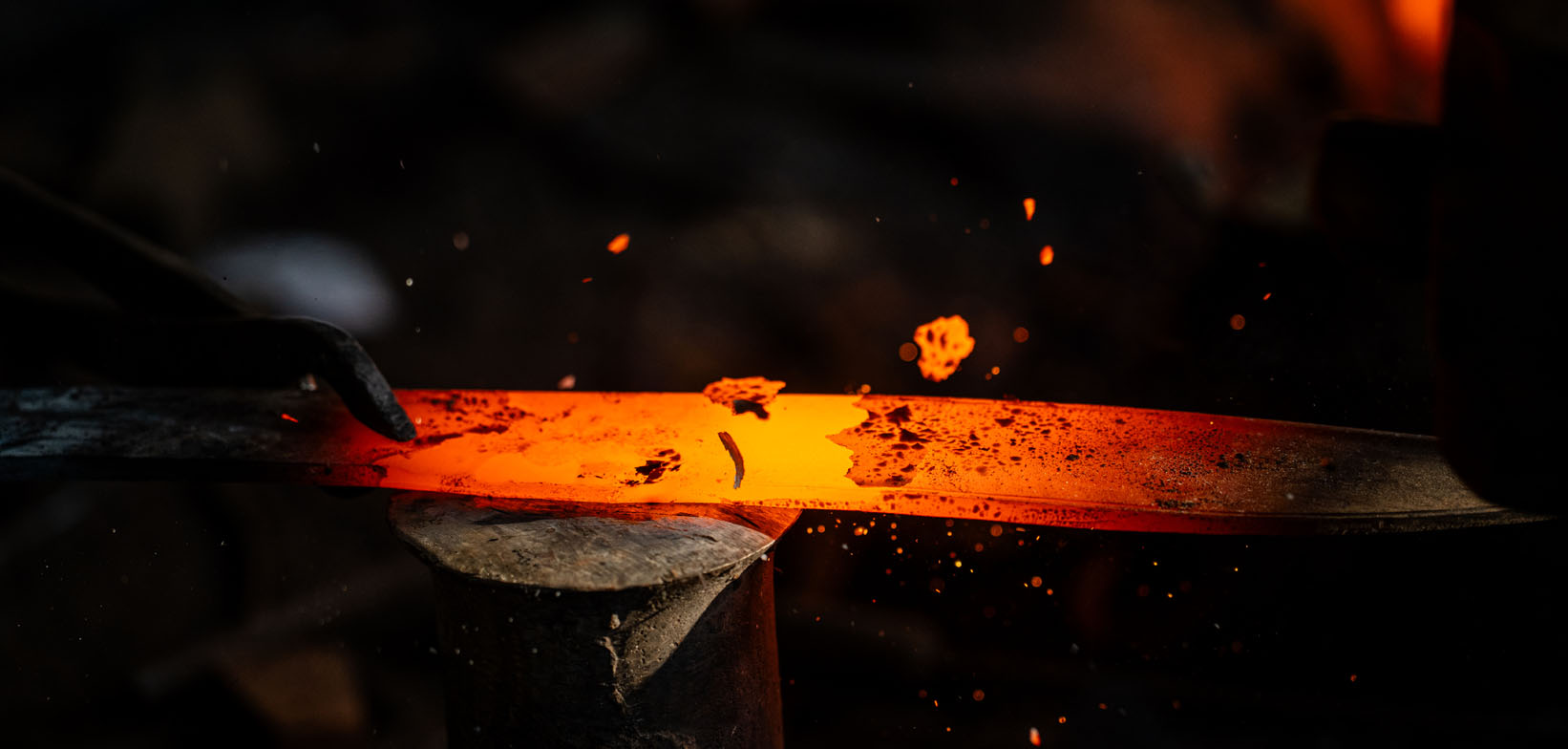
The steel billet is cut to the correct starting dimensions and heated in the forge to working temperature. The smiths at Everest Forge work by eye and by feel, reading the colour of the steel in the fire to judge when it is ready. Every hammer blow is deliberate — drawing out the profile, forming the taper, establishing the geometry of the blade from raw steel. This is not press-forming or die-stamping. Every curve and bevel is hammered in by hand.
After the rough profile is formed, the blade goes through normalising — a process of heating and slow cooling repeated several times to relieve internal stress in the steel and create an even grain structure throughout. This step is not visible in the finished blade, but it is one of the most important for long-term strength and durability.
Grinding and filing follow. The bevel is established, the edge geometry is refined, and the surface is worked progressively through coarser and finer abrasives until the blade reaches its intended finish. Fullers, if specified, are forged or ground in at this stage. The tip geometry is shaped and the spine thickness checked against the original specification.
Step Five — Heat Treatment
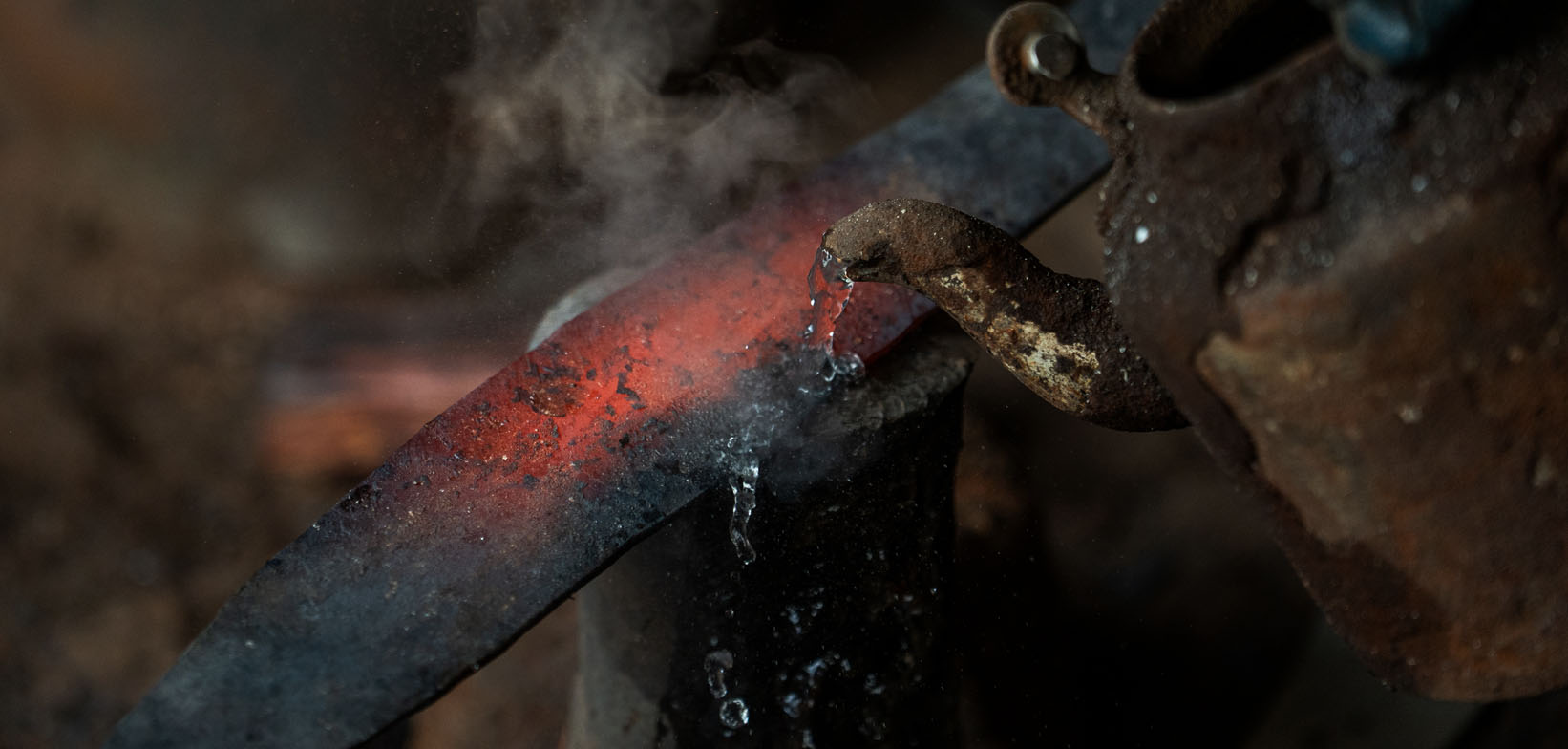
Heat treatment is what separates a functional blade from a decorative one, and it is also where the most critical decisions are made. Every custom blade from Everest Forge is differentially hardened and oil tempered — a process that produces a harder edge capable of holding a sharp angle, combined with a softer, more flexible spine that absorbs impact without cracking.
The blade is brought to critical temperature — the point at which the steel becomes non-magnetic and the carbon is fully in solution — and then quenched rapidly in oil. The speed of quenching locks the edge into a hard martensitic structure while the thicker spine, which cools more slowly, retains more flexibility. The blade then goes through tempering — a lower-temperature heat cycle that reduces brittleness while preserving the hardness gained during quenching.
This is done by the smiths at the forge, by hand, using the same methods that have been used in Nepal for generations. There is no automated oven cycle. The smith reads the temperature and makes the call. That skill is the product of years of experience and cannot be replicated by a machine.
Step Six — Handle Fitting, Assembly, and Finishing
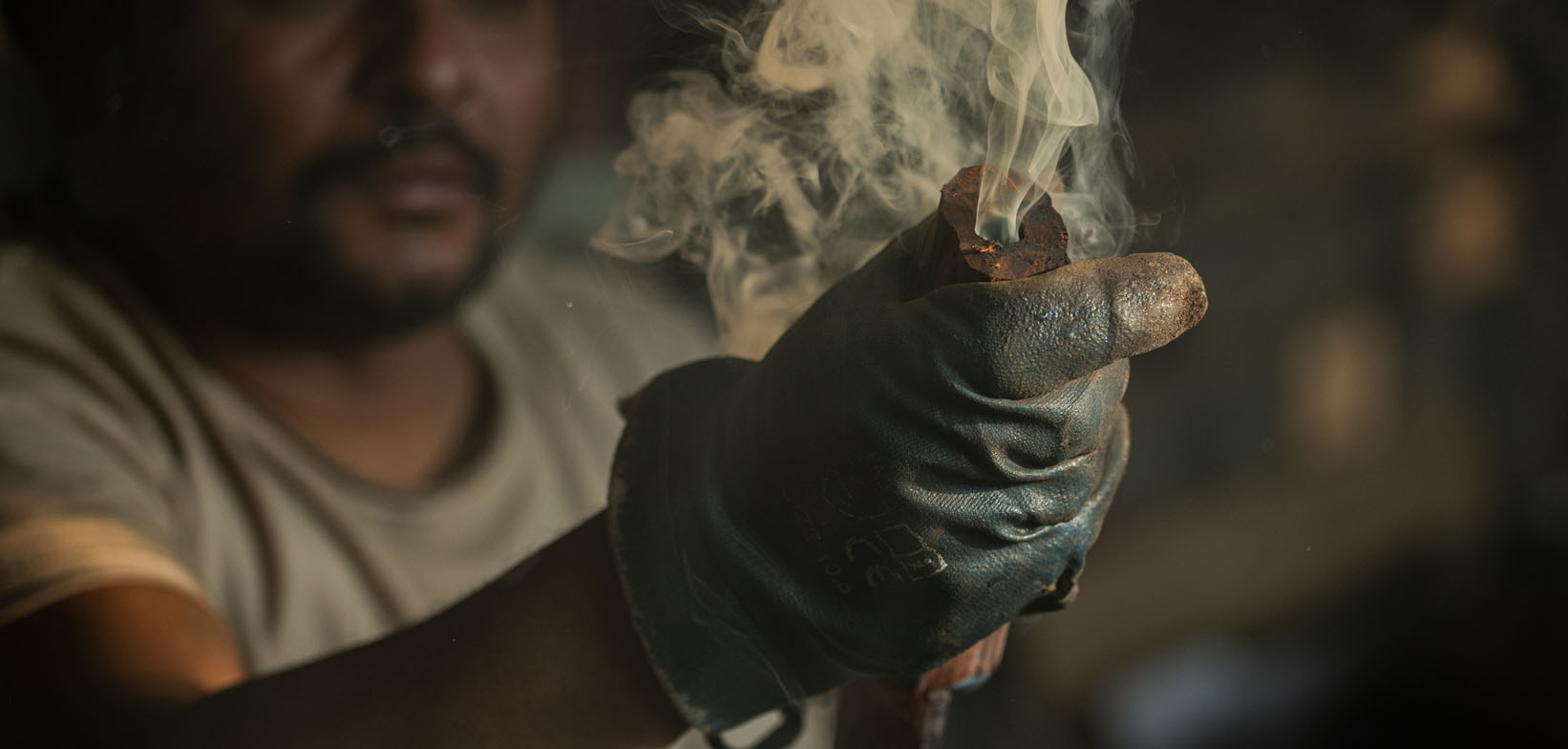
Once the blade passes the heat treatment stage it moves to handle fitting. The tang — whether full, hidden, or rat-tail — is fitted into the chosen handle material and secured. Everest Forge fits handles from rosewood, buffalo horn, bone, antler, micarta, whitewood, and hybrid resin depending on your specification. Each material has a different character in the hand and a different aesthetic, and the team can advise on which suits your blade best.
Guard and pommel components are shaped and fitted to match the design brief. If engravings were specified — on the blade, guard, pommel, or scabbard — they are completed at this stage. The blade goes through a final polish or finish pass depending on whether you selected satin, polished, semi-polished, or raw tactical, and the edge is honed to its final sharpness.
The scabbard or sheath is made to fit the blade specifically — leather, leather-wrapped wood, or a custom configuration depending on what was agreed. Everest Forge also produces custom sheaths with belt loops, shoulder harnesses, frog attachments, and engraved leather panels if those were part of the brief.
Step Seven — Testing Before It Ships
Before a custom blade ships, it is tested. At Everest Forge, this means controlled cuts on bamboo and hardwood to verify edge performance and blade integrity. A blade that chips, flexes incorrectly, or fails to perform to the specification does not ship. The smith signs off on the piece only when it meets the standard.
This is one of the most important differences between a hand-forged custom blade and a mass-produced one. Every blade from a factory is the same as the one before it and the one after it. Every custom blade from Everest Forge is individually inspected and tested before it leaves the workshop.
Step Eight — Packaging and Worldwide Shipping
Custom blades are packaged carefully to protect both the blade and the handle during international transit. Everest Forge ships worldwide using DHL Express — one of the most reliable international courier services available — and provides a tracking number as soon as the shipment is dispatched. Shipping typically takes 7 to 10 business days after dispatch, depending on destination.
Before ordering, it is worth checking the legal requirements for importing blades in your country. Everest Forge ships to Australia, the USA, the UK, Canada, Europe, and most international destinations, but blade import regulations vary by country and sometimes by state or region. The team can advise on common requirements if you are unsure.
Timeline — What to Realistically Expect
Simple knives and standard kukris can be forged in a matter of days once production begins. Larger swords, complex fantasy builds, detailed engravings, or matched pairs take longer — sometimes several weeks. Everest Forge provides a realistic timeline with the quote and keeps you updated through the process. If your order has a deadline — a gift, an event, or a specific date — make that clear at the design consultation stage so the schedule can be planned accordingly.
The timeline also depends on how quickly the design consultation is resolved. Orders where the design details are clear and confirmed quickly move into production faster. Orders where the brief evolves through multiple rounds of revision take longer to get started. Bringing as much detail as possible to the initial submission saves time at both ends.
What You Can Actually Order — The Full Range
The custom forge at Everest Forge covers the full range of blades the workshop produces. Custom swords — historical replicas, fantasy builds, battle-ready designs, matched pairs, and dual-wield sets. Custom kukris — blade length, profile, spine thickness, cho design, handle material, and scabbard all to specification. Custom machetes, survival choppers, bolo-style blades, and camp knives. Custom daggers — medieval, historical, fantasy, and practical field designs. Custom spearheads — thrusting points, throwing spears, and polearm blades. Custom hunting knives, bushcraft blades, and tactical fixed blades.
Everest Forge also forges complete sets — matching sword and dagger, kukri with companion blade, or full kit with custom sheath, belt, and frog. If your idea involves more than one piece, that is a conversation worth having at the design stage.
Everest Forge — Hand-Forged in Nepal
Your Blade. Your Specification. Forged by Hand.
Submit your custom forge request today — sword, kukri, machete, dagger, knife, or spear. Our Nepali smiths will forge it from real 5160 steel to your exact design, heat treated, sharpened, and shipped worldwide.
Start Your Custom Order → Browse Swords → Browse Kukris →Frequently Asked Questions
How long does a custom forged blade take to complete?
Simple knives and standard kukris can be ready within a few days of production starting. Larger swords, detailed engravings, matched sets, or complex fantasy builds take longer — typically several weeks. Everest Forge provides a realistic timeline with every quote and gives progress updates throughout. If you have a deadline, mention it at the design consultation stage.
What information do I need to submit a custom forge request?
You need a clear idea of what you want — blade type, approximate size, intended use, and any design references you have. Sketches, photos, screenshots, or written descriptions all work. You do not need a technical drawing. The design consultation that follows will fill in any missing details. The more specific you are upfront, the faster and more accurate the quote will be.
What steel does Everest Forge use for custom blades?
The standard steel is 5160 high-carbon spring steel — chosen for its toughness, shock resistance, and edge retention. It is the right choice for most kukris, swords, and machetes. 1095 high carbon is available on request for a harder, finer edge. Damascus pattern-welded steel is also available for collectors and those who want the distinctive layered aesthetic alongside genuine structural character.
Can I customise the handle, guard, pommel, and scabbard?
Yes — all of these are part of the custom brief. Handle materials include rosewood, whitewood, buffalo horn, bone, antler, micarta, and hybrid resin. Guards and pommels are shaped to match your design. Scabbards are made to fit the blade specifically, with options for leather, leather-wrapped wood, custom belt loops, shoulder harnesses, and engraved panels.
Does Everest Forge test custom blades before shipping?
Yes. Every custom blade is tested through controlled cuts on bamboo and hardwood before it ships. A blade that does not perform to the agreed specification does not leave the workshop. The smith personally signs off on the piece before it is packaged and dispatched.
Can I order a matching set — sword and dagger, or paired kukris?
Yes. Everest Forge forges complete matched sets, mirrored pairs, twin swords, and dual-wield configurations. Full kits including custom sheaths, belts, and companion blades are also available. Discuss set requirements at the design consultation stage so they can be planned and priced together.
Does Everest Forge ship custom blades worldwide?
Yes. Everest Forge ships worldwide using DHL Express, with tracking provided from dispatch. Delivery typically takes 7 to 10 business days after the blade ships. It is worth checking blade import regulations in your country before ordering, as requirements vary. The team can advise on common requirements for major destinations including the USA, Australia, UK, Canada, and Europe.