Menu
Your Cart

Hand-Forged Sword Breaker Dagger

Hand-Forged Sword Breaker Dagger
$194.99
Ex Tax: $194.99
  • Model: Sword Breaker Dagger
  • Product Code: Breakerdagger017
  • Location: Kathmandu,Nepal

Available Options

A Hand-Forged Sword Breaker Dagger

The sword breaker is one of the rarest forms in European arms, and one of the most misunderstood. A left-hand dagger with a row of deep slots cut into its spine, it belongs to the sixteenth and seventeenth centuries, when a gentleman fought with a rapier in one hand and a parrying dagger in the other. The German name is Degenbrecher — literally sword breaker — and it is a name that has done the form no favours, because it promises something the object cannot deliver.

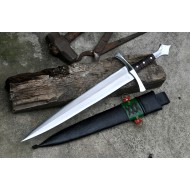
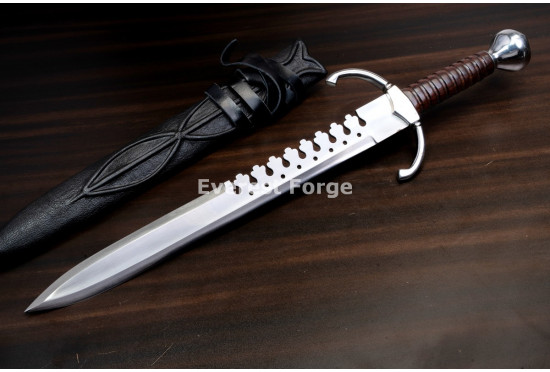
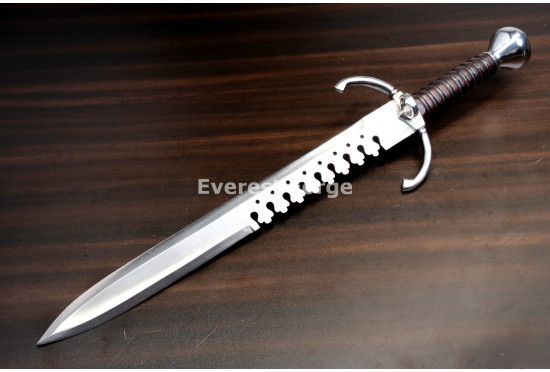
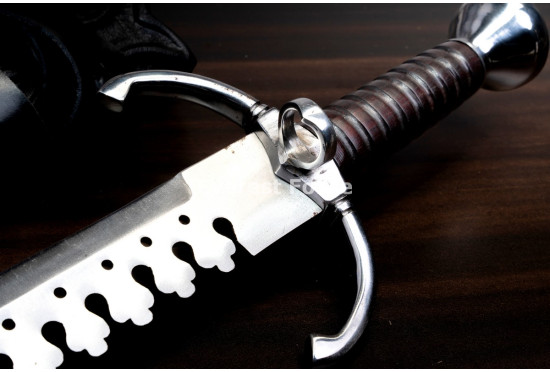
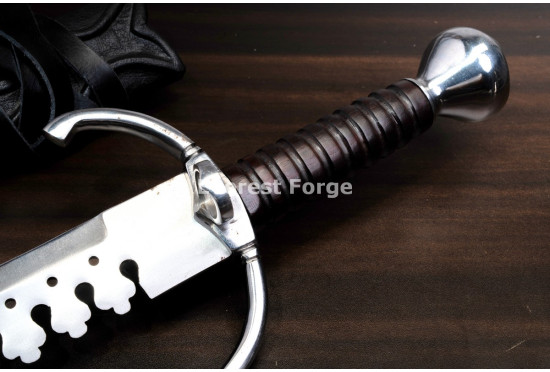
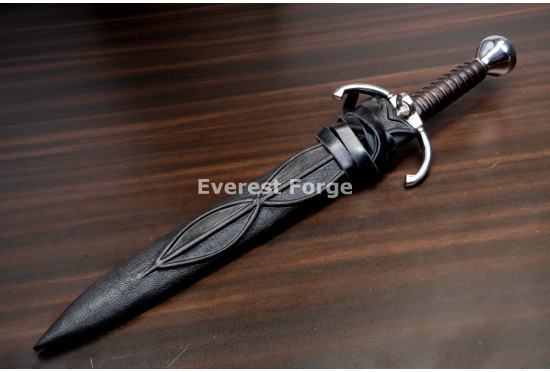
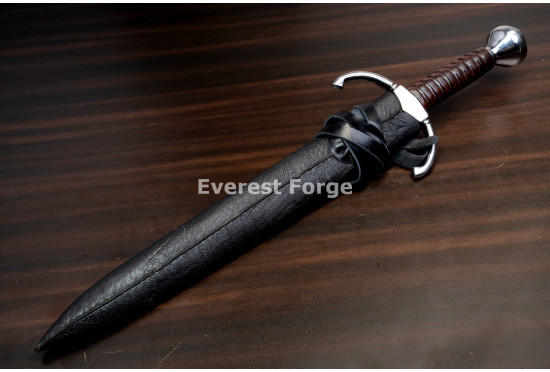
This is a 17 inch blade hand-forged from 5160 high-carbon steel, oil-quenched and tempered, single edged with a long taper to a stiff point. Down the spine runs a comb of nine deep, undercut slots, each opening into a rounded socket. The hilt is 7 inches overall with a 4 inch grip: leather cord wrapped over the tang between a polished steel ring guard and a solid pear pommel, with two curved quillons sweeping in opposite directions. It ships in a black leather scabbard with a tooled panel and a wrapped throat.

An honest note. It does not break swords. No dagger of this type ever did, and any seller telling you otherwise is repeating a Victorian invention rather than a period fact. What the comb actually does is trap a blade — the slots are undercut so an opposing rapier that slides into one is held for a moment rather than sliding free, which buys you the fraction of a second a fencer needs. Even that is debated among historians, and surviving examples are scarce enough that we cannot be certain how often they were used in earnest. We think the true story is more interesting than the myth, so the page tells it that way. If you want the legend, it is not one we are willing to sell.

Custom Forge

Want This Built Your Way?

A different blade length, more or fewer slots, another grip material, a plain-spined main gauche without the comb, or your own drawing entirely. Our smiths in Kathmandu forge to specification and quote before any work begins.

Start a Custom Build

What You Are Looking At

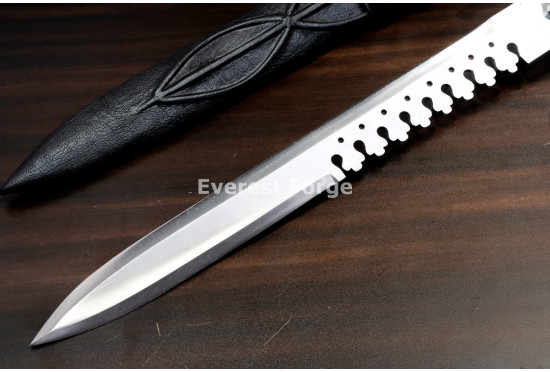
Undercut CombNine slots cut into the spine, each narrowing at the mouth and opening into a rounded socket behind. The undercut is the working part — a straight slot would let a blade slide out again.
Seventeen Inch BladeThe longest blade we list on anything other than a sword. A parrying dagger needed reach to meet an opponent's rapier away from the body.
Stiff Tapered PointLong and single edged, tapering to a point built for thrusting rather than cutting. A parrying dagger was a second weapon, not a knife.
Two Curved QuillonsSweeping in opposite directions, so the guard protects the hand whichever way the dagger is turned. This is a fighting hilt rather than a decorative one.
Ring GuardA side ring above the quillons, protecting the forefinger of a hand hooked over the crossguard — which is how a rapier-period dagger was actually held.
Cord-Wrapped GripLeather cord wound over the tang between ring guard and pear pommel. Grippy in the hand and correct for the period.

Standard Build and Specifications

Blade Length17 inches
Hilt Length7 inches overall
Grip Length4 inches between ring guard and pommel
Total LengthApprox. 24 inches
Blade WeightApprox. 970 grams
Total WeightApprox. 1140 grams
Blade Steel5160 high-carbon spring steel, oil-quenched and tempered
Blade TypeSingle edged, long taper to a stiff point
CombNine undercut slots along the spine (standard build — count selectable)
GuardTwo curved quillons with a side ring
PommelSolid polished steel pear
GripLeather cord wrapped over the tang (standard build — selectable)
FinishPolished (standard build — selectable)
ScabbardBlack leather with tooled panel and wrapped throat
OriginHand-forged in Tokha-3, Kathmandu, Nepal

Blade length, blade finish, grip material and slot count are all selectable, so the figures above describe the standard build rather than every version. Because each piece is forged, ground and fitted by hand, weights and dimensions vary slightly between examples, and the comb varies most — nine slots cut individually will never be identical twice.

Build Options

Slot CountNine as standard. More slots means a longer comb and more cutting; fewer means a shorter comb closer to the guard, which is how several surviving examples are arranged. Each slot is cut and finished by hand, so the count affects the build time directly.
Blade Length17 inches as standard, which is right for the period. Shorter makes it a conventional main gauche; longer starts to become a short sword and changes the balance considerably.
Without the CombWe build the same dagger as a plain-spined main gauche, which is the more common historical form and considerably less work. If you want a parrying dagger rather than specifically a sword breaker, that is worth considering.
Grip MaterialLeather cord wrap as standard, which is period-correct. Wire wrap, plain leather, horn and wood are all available.
Blade FinishPolished as standard. Satin reads more like a working weapon and less like a display piece. A dark forge finish is available but is not period for this form.
ScabbardBlack tooled leather as standard. Other colours, plain leather, a belt frog or a hanger can all be made instead.

Is This the Right Piece for You?

Choose This One If

  • You collect European arms and want a form almost nobody makes
  • You want the comb cut properly — undercut sockets rather than plain notches
  • You are interested in rapier-period fencing and the left-hand dagger
  • You want a forged and hardened blade rather than a cast wall-hanger
  • You would rather have the real history than the legend

Look Elsewhere If

  • You want something that breaks swords — it does not, and nothing ever did
  • You want a using knife — this is a fencing form with no utility purpose whatever
  • You want a strict museum reproduction — ask us and we will quote one properly
  • You want simple maintenance — nine undercut slots are the most awkward surface in our range to clean

How to Order

Decide Comb or No CombThe sword breaker comb is what makes this piece unusual and expensive. A plain-spined main gauche is more common historically and costs considerably less.
Choose Your BuildBlade length, slot count, finish, grip material and scabbard.
Check Your Local LawBlade laws differ by country, state and province, and a 24 inch package is restricted in some places regardless of what it is for. Check before you order — we cannot advise on your jurisdiction and we cannot refund a seizure.
We Forge and ConfirmStock builds dispatch in 2-3 business days. Custom builds take 4-6 weeks, and combed blades sit at the longer end because every slot is cut by hand. We photograph the finished piece before it ships.

Who This Dagger Is For

  • Collectors of European arms who want a form that is genuinely scarce rather than merely old-looking
  • Historical fencers and HEMA practitioners interested in the left-hand dagger and the rapier period
  • Re-enactors working the sixteenth and seventeenth centuries
  • Buyers who like objects with a story — and this one has a better story than the myth attached to it
  • Anyone who wants to see hand work — nine undercut slots is the most labour in any blade we make

What Is Included

  • One hand-forged sword breaker dagger
  • Black leather scabbard with tooled panel and wrapped throat
  • Everest Forge manufacturer warranty
  • Care instructions

More From the Everest Forge Collection

Shipping, Returns and Care

Stock builds dispatch from our workshop within 2-3 business days. Custom and made-to-order builds take 4-6 weeks from confirmation, and we photograph the finished piece before it leaves us. We ship worldwide with DHL and FedEx, fully tracked, typically 7-14 business days in transit. Every blade carries the Everest Forge manufacturer warranty against defects in forging and construction.

Blade laws vary by country, state and province and it is the buyer's responsibility to check local restrictions before ordering. We cannot advise on your jurisdiction and we cannot refund a blade seized in transit.

5160 is a high-carbon steel and it will rust if you let it. Wipe the blade dry after handling rather than only after use, since fingerprints are acidic and will etch a polished surface over months. The comb is the difficulty on this piece and there is no way around it: nine undercut slots means eighteen internal corners and nine rounded sockets, none of which a cloth will reach. Use a cotton bud or a folded corner of oiled cloth and work each slot individually, which takes a few minutes and needs doing properly rather than occasionally. The cord wrap wants a little leather conditioner once or twice a year and should not be stored damp.

Made in Nepal

Forged by Hand, Not Assembled

Every blade we sell is forged, ground, heat-treated and fitted by our own smiths in Kathmandu. If you want something we do not list, we will make it.

Talk to Our Smiths

Frequently Asked Questions

Does it actually break swords?

No, and we would rather lose the sale than pretend otherwise. The idea that a dagger could snap a rapier blade is a Victorian romance that attached itself to these objects long after they stopped being made, and it survives because it is a better story than the truth. Consider the physics for a moment: a rapier blade is spring steel, deliberately made to flex rather than break, and levering one hard enough to snap it would require both an enormous mechanical advantage and an opponent obliging enough to hold still while you applied it. In a fight where both blades are moving, neither condition exists. What the comb does instead is catch and hold, which is a smaller claim and a far more plausible one.

What does the comb actually do?

It traps. Look closely at the slots and you will see they are not simple notches: each one narrows at the mouth and opens into a rounded socket behind, so the opening is undercut. A blade sliding along the spine drops into a socket and the narrowing at the mouth resists it coming straight back out, at least for a moment. In rapier fencing a moment is the whole game — if you can hold an opponent's blade offline for a fraction of a second, your own point is free to work. That is the mechanism, and it is worth saying that even this is debated: surviving sword breakers are scarce, period fencing manuals rarely discuss them specifically, and there is a real argument that they were as much status objects as fighting tools. We think the honest uncertainty is more interesting than a confident myth.

What is a Degenbrecher?

The German term for this form, and the source of the English name. Degen means sword or rapier and Brecher means breaker, so the word itself carries the claim the object cannot support — which tells you something about how these were marketed even at the time. In practice the form belongs to a broader family of left-hand daggers used across Renaissance Europe: the Spanish and Italian main gauche, the parrying daggers with trident blades or sprung side bars, and the plain long-bladed daggers that were far commoner than any of the mechanical varieties. The sword breaker is the rarest branch of that family. Most surviving examples are German or Italian, most date from the later sixteenth and early seventeenth centuries, and there are not many of them.

How was a left-hand dagger held and used?

In the off hand, alongside a rapier held in the right, in a style that dominated civilian European fencing for roughly a century. The dagger's job was defensive: parrying, deflecting and controlling the opponent's blade while your own point looked for an opening. That is why the hilt is built the way it is. The two quillons sweep in opposite directions so the guard covers the hand whichever way the dagger is angled, and the side ring above them protects the forefinger, because the period grip hooked a finger over the crossguard for control rather than holding the grip in a closed fist. Everything about the hilt is arranged around a hand that is going to have another blade slide against it.

Why is the blade so long?

Because reach was the point. Seventeen inches is long for a dagger — it is the longest blade we list on anything that is not a sword — and that is period-correct rather than a modern exaggeration. A parrying dagger had to meet an opponent's rapier well away from your body, since a parry made close in gives you no time and no room. The extra length also means the comb can be long enough to be useful: a short blade would carry two or three slots at most, where this one carries nine along a stretch of spine that an opposing blade can actually be expected to contact. The consequence is that this handles like a very short sword rather than like a knife, which is exactly what it was.

Is this a working knife?

Not in any sense. It is a fencing form with no utility purpose whatever, and we would be misleading you to suggest otherwise. The blade is long, stiff and tapered for thrusting rather than cutting, the comb makes the spine useless for anything you would normally use a spine for, and the hilt is arranged for a fencing grip rather than a working one. You cannot cut with it comfortably, you certainly cannot baton it, and it would be a poor choice for anything a knife is normally asked to do. This is an object to own, study and display, or to use in historical fencing practice if that is your interest. If you want a blade that works, almost everything else in our range is a better answer.

Can I use it for HEMA or re-enactment?

For display, drill and handling, yes. For sparring, no — and this matters. This is a sharp, hardened blade with a fine point, which is exactly what you must not put into a training bout with a partner. Historical fencing at contact speed requires blunt trainers with rebated edges, rolled or flared tips and appropriate flex, and no sharp dagger of any kind belongs in that context regardless of how careful everyone intends to be. What a sharp piece like this is genuinely good for is solo handling, understanding how the form balances and moves, showing people what the comb is, and study. If you want a blunt trainer version we will discuss it, though you should compare it against purpose-built synthetic and steel trainers before deciding.

How historically accurate is it?

The form is right and the construction is modern, and it is worth being precise about which is which. What is accurate: the overall shape, the long single-edged blade, the undercut comb, the two opposed quillons, the side ring, the pear pommel and the cord-wrapped grip are all features you find on surviving examples. What is not: the steel is 5160, a modern homogeneous alloy, where a period blade would have been made from steel of far less consistent quality and often differentially treated. Our proportions are our own interpretation rather than a measured copy of a specific museum piece. And the fit and finish are cleaner than most originals ever were. If you want a documented reproduction of a particular surviving example, tell us which and we will quote it as a research piece.

What steel is it?

5160 high-carbon spring steel, oil-quenched and tempered, the same as everything we forge. It is the family of steel used for vehicle leaf springs and it is chosen for toughness rather than for maximum hardness. On this piece that matters twice over. A long, slim blade with a fine point in very hard, brittle steel is the classic way to snap a point, whereas 5160 at a working temper flexes and returns. And the comb creates nine deliberate discontinuities along the spine, which in a brittle steel would be nine places for a crack to start — a tough steel is much more forgiving of that geometry. It is not stainless and it will rust if neglected.

Do the slots weaken the blade?

They remove material and they create stress concentrations, so the honest answer is that they cost something — but less than you would guess, for two reasons. The slots sit on the spine, which on a single-edged blade is not the surface carrying load when the blade flexes toward its edge, and they are placed along the base half where the blade is thickest. And the sockets are rounded rather than square-cornered, which matters enormously: a sharp internal corner concentrates stress severely where a radius spreads it. Whoever first cut these combs understood that, deliberately or by trial and error, and it is one of the more sophisticated things about the form. That said, this blade is not built for impact and should not be treated as though it were.

How do I clean the comb?

Slowly, and there is no shortcut. Nine undercut slots means eighteen internal corners plus nine rounded sockets, and the undercut that makes the comb work also makes it the single most awkward surface in our range to reach. A cloth drawn along the spine touches the outside of the slots and nothing else. Use a cotton bud, a pipe cleaner or a folded corner of oiled cloth and work each slot individually, front and back, then wipe the flats. It takes a few minutes rather than seconds. Do it every time the piece is handled rather than occasionally, because carbon steel rusts first exactly where you cannot see it, and on this piece there are eighteen such places.

Can I have it with a different comb, or none?

Both. Slot count is open: fewer means a shorter comb sitting closer to the guard, which is how several surviving examples are arranged and which some collectors prefer as the more plausible fighting arrangement; more means a longer comb and more hand cutting. Each slot is cut and finished individually, so the count changes the build time and the price directly. We also make this dagger with a plain spine and no comb at all, which gives you a straightforward main gauche — historically the far commoner weapon and considerably less expensive. If your interest is the rapier-period left-hand dagger generally rather than the sword breaker specifically, that is genuinely worth considering.

Specification
Blade: 17 inches. Hand forged from 5160 carbon steel. Single edged, long taper to a stiff point. Nine undercut slots along the spine
Total Length: 24 inches
Handle: 7 inches overall with a 4 inch grip. Leather cord wrapped over the tang, two curved quillons with a side ring, solid steel pear pommel
Weight: Approx. 970 g blade, approx. 1140 g total
Note: The comb is the most awkward surface we make to clean - nine undercut slots means eighteen internal corners. Work each one individually with a cotton bud and oil.

Write a review

Note: HTML is not translated!
Bad Good
Captcha