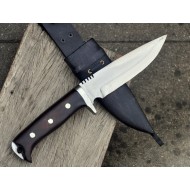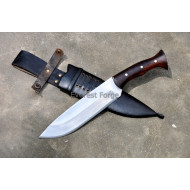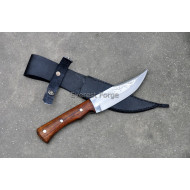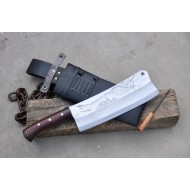


- Model: EDC Knives
- Product Code: SPEARDAGGER
- Location: Kathmandu,Nepal
Available Options
A Hand-Forged Spear Point Dagger
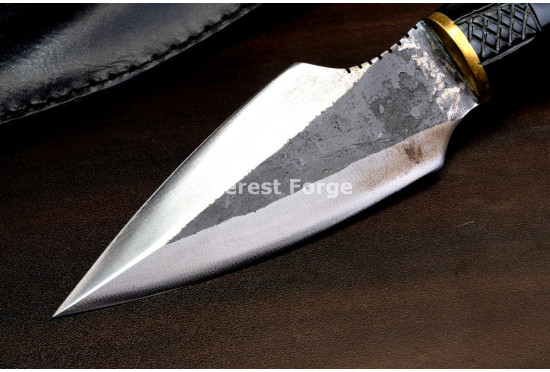
A spear point is the most symmetrical blade shape there is. The point sits dead on the centreline of the blade rather than being pushed up toward the spine or down toward the edge, and both sides taper to it equally, so the profile is a mirror image of itself. On this piece both of those edges are sharpened, which makes it a true dagger rather than a knife with a decorative false edge.
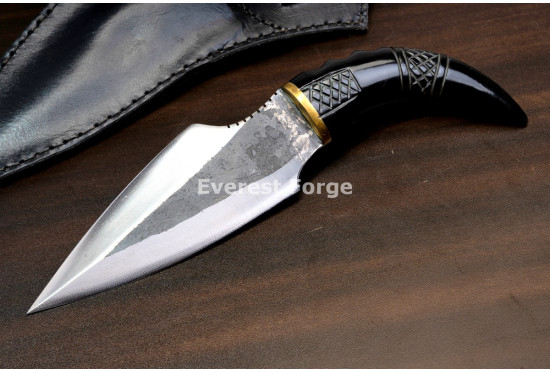
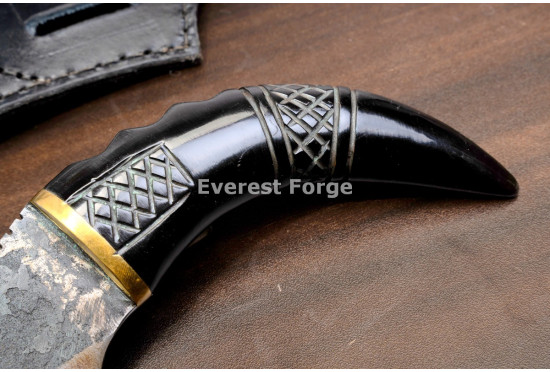
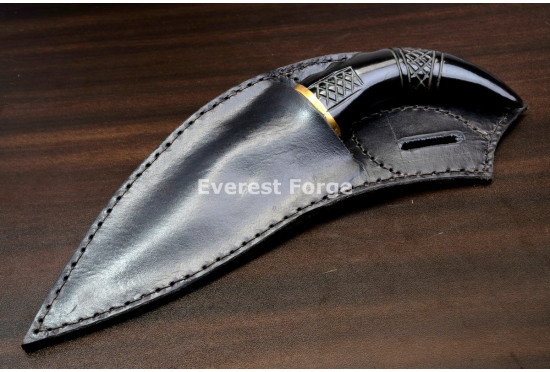
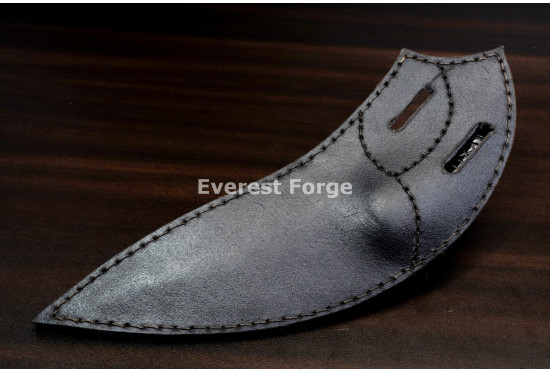
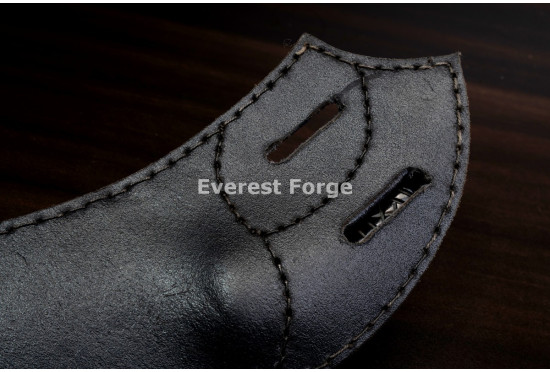
The blade is 6.5 inches, hand-forged from 5160 high-carbon steel, oil-quenched and tempered. A panel of dark forge finish runs down the centre of each face with the bevels ground bright on both sides of it, so the symmetry of the grind is visible at a glance rather than something you have to take on trust. There is filework cut into the spine at the ricasso. The 5 inch grip is carved black horn with a brass ferrule at the blade, cut with diamond panels and incised rings, curving back and away from the hand. It ships in a black leather sheath with two belt slots at the throat.
An honest note, and please read it before ordering. This blade is sharpened on both edges, and that has legal consequences well beyond the ordinary. Double-edged blades are restricted more heavily and in more places than any other feature we build: they are prohibited outright in several US states, restricted for carry across most of the rest, controlled in the UK, and named in Australian import law. In many jurisdictions the statutory test is simply whether a second edge is sharpened at all, so length and intent do not enter into it. We will build this blade single-edged at no extra cost, and for most buyers that is the sensible choice. Say so when you order. We cannot advise on your jurisdiction, we cannot get a seized parcel back, and a listing description is not a defence anywhere.
Want This Built Your Way?
A single-edged version, a different grip material, another blade length, a polished finish, or your own drawing entirely. Our smiths in Kathmandu forge to specification and quote before any work begins.
Start a Custom BuildWhat You Are Looking At
Standard Build and Specifications
Blade length, edge configuration, blade finish and grip material are all selectable, so the figures above describe the standard build rather than every version. Because each piece is forged, ground and carved by hand, weights, dimensions and the exact carving vary slightly between examples, and horn varies naturally in colour and figure.
Build Options
Is This the Right Piece for You?
Choose This One If
- You want a symmetrical blade with a genuinely strong point
- You collect daggers and want a forged one rather than a casting
- You want visible hand work — the carving is the labour on this piece
- You have checked your local law and a double edge is not a problem where you are
- Or you want the same piece single-edged, which we will build at no extra cost
Look Elsewhere If
- You are unsure about the law where you live — order it single-edged or choose another piece
- You want a working camp knife — a dagger has no belly and slices poorly, and our EDC chopper or bushcraft kukri will serve you far better
- You want a push dagger — this is an in-line grip and is not that
- You want a guard — there is none, only the filed spine as a thumb rest
How to Order
Who This Dagger Is For
- Collectors who want a forged, hardened blade rather than a cast display dagger
- Buyers who value hand carving — the grip is where the hours went on this piece
- Anyone wanting a strong point for boring, piercing and detail work, in the single-edged build
- Gift buyers looking for something small with real craftsmanship in it
- Buyers in jurisdictions where a double edge is fine, who have checked rather than assumed
What Is Included
- One hand-forged spear point dagger, sharpened
- Black leather sheath with two belt slots
- Everest Forge manufacturer warranty
- Care instructions
More From the Everest Forge Collection
Shipping, Returns and Care
Stock builds dispatch from our workshop within 2-3 business days. Custom and made-to-order builds take 4-6 weeks from confirmation, and we photograph the finished piece before it leaves us. We ship worldwide with DHL and FedEx, fully tracked, typically 7-14 business days in transit. Every blade carries the Everest Forge manufacturer warranty against defects in forging and construction.
Blade laws vary by country, state and province and it is the buyer's responsibility to check local restrictions before ordering. A double-edged blade is restricted more widely than any other configuration we make, including in jurisdictions where a single-edged knife of the same size is perfectly legal. We cannot advise on your jurisdiction and we cannot refund a blade seized in transit. If in doubt, order the single-edged build.
5160 is a high-carbon steel and it will rust if you let it, and the forge panel is not protection — scale is not a coating. Wipe the blade dry after handling rather than only after use, since fingerprints are acidic and will mark the bright bevels over months. Pay attention to the filework on the spine and to the cut lines of the grip carving, both of which a cloth drawn across the surface will bridge without touching. Horn wants a little oil once or twice a year and should not be left in direct sun or next to a heat source, which dries it and can cause it to crack along the grain.
Forged by Hand, Not Assembled
Every blade we sell is forged, ground, heat-treated, carved and fitted by our own smiths in Kathmandu. If you want something we do not list, we will make it.
Talk to Our SmithsFrequently Asked Questions
Is a double-edged blade legal where I live?
We cannot answer that for you, but we can tell you what to look for, because this is the question that matters most on this listing. Double-edged blades attract more restrictions than any other feature we build. Several US states prohibit them outright rather than merely restricting carry, and many others treat them separately from ordinary knives. The UK controls them. Australian import law names them specifically. Crucially, the statutory test in most of these places is simply whether a second edge is sharpened at all — not how long it is, not what the knife is for, and not what a listing calls it. So the same blade single-edged is legal in a great many places where the double-edged version is not, which is why we build it either way at the same price. Look up your own state, province or country before you order, and if the answer is not clearly yes, order it single-edged.
Can I have it single-edged?
Yes, at no extra cost, and for most buyers it is the better choice. The blade is ground before it is heat-treated and finished, so this has to be specified at the point of order — we cannot take an edge off a finished blade without regrinding the whole flat, which changes the geometry and the appearance. What you lose by choosing one edge is very little in practical terms: the second edge contributes nothing to cutting, slicing or piercing that the first does not, and a single-edged spear point still has a strong centreline tip and a flat spine you can put a thumb on. What you gain is a piece you can own and carry in far more of the world. We would rather sell you the version you can keep.
What is a spear point?
A blade shape where the point sits on the centreline rather than being pushed toward the spine or the edge, with both sides tapering to it symmetrically. It is the strongest point geometry available, because the steel behind the tip is supported from both directions equally rather than being thinned from one side, which is why spear points survive boring and piercing that would snap a fine upswept tip. The trade-off is that a symmetrical blade has no belly — no long curved section for a draw cut — so it slices poorly compared to a knife shape. That is a real limitation rather than a quibble: this is a piercing and detail tool, not a camp knife, and if you want something that cuts well our EDC chopper or bushcraft kukri will do far more for you.
Is this a push dagger?
No. A push dagger has a transverse grip, held crosswise in a closed fist with the blade projecting between the fingers, and this is a conventional in-line grip held the way you hold any knife. We are answering the question directly because it comes up and because the distinction matters legally as well as practically: push daggers are named separately in a number of statutes and import schedules, and are prohibited in places where an ordinary dagger is not. This is not one, we do not describe it as one, and it should not be listed or resold as one. If a push dagger is specifically what you are after, we are not the right forge for it.
What is the carving on the grip?
Diamond panels and incised rings, cut by hand into black horn. Horn is a good material for this kind of work and better than most timbers: it is dense and consistent with no grain direction to fight, so a cut holds its edge crisply instead of fraying, and it takes a polish that makes the cut lines read as dark against the shine. The pattern here is our standard, and like all hand carving it varies between pieces — yours will not be identical to the photographs, which is the nature of the work rather than a defect. If you want a different pattern we will cut it, and if you want the grip smooth and uncarved that is quicker and costs less. The one practical note: carved recesses hold dirt and want cleaning properly rather than wiping.
What is the dark panel down the middle of the blade?
Forge finish — the surface as it came off the anvil, with the scale and hammer marks left in place down the centre of each face while the bevels either side are ground bright. On a symmetrical blade that contrast does something useful beyond looking good: it draws the line where the grind starts on both sides, so you can see at a glance whether the two bevels are even and whether the centre panel runs true down the middle. A crooked grind is very hard to hide on a blade finished this way, which is part of why we do it. What it is not is protection. Forge scale is iron oxide, not a coating, and this blade needs oiling exactly like a polished one.
What is the filework on the spine?
Cut notches where the spine meets the grip, and on this piece they do a real job. A dagger has no guard, so there is nothing but friction stopping your hand sliding forward — and unlike a single-edged knife there is no safe flat spine to put a thumb on, because on the double-edged build both sides are sharp along most of their length. The filed section sits at the ricasso, ahead of the grip and behind where the edges begin, which is the one place a thumb can safely rest. It gives you a positive index point and a bit of grip for pushing. On the single-edged build it does the same job with the added option of running a thumb further along the unsharpened spine.
What steel is it?
5160 high-carbon spring steel, oil-quenched and tempered, the same as every blade we forge. It is the family of steel used for vehicle leaf springs, which is the origin of the Nepali practice of forging blades from them, and it is chosen for toughness rather than for maximum hardness. That matters particularly on a spear point: a fine centreline tip in a very hard, brittle steel is the classic way to snap a point, whereas 5160 at a working temper will flex slightly and come back. It is worth saying plainly that most decorative daggers on the market are cast in soft stainless and never hardened at all. This one is forged, hardened and sharpened. It is not stainless and it will rust if neglected.
Is it a working knife or a display piece?
Honestly, more display than work, and the shape is the reason rather than the quality. The steel, the heat treatment and the edges are all genuine, so it will cut. But a symmetrical double-edged blade with no belly is poor at almost everything a knife normally does: it will not slice, it is awkward on a board, and you cannot put a hand or a baton on the spine because on the standard build there is no unsharpened spine to use. What it is good at is piercing and boring, where the strong centreline point is genuinely better than a knife tip. Buy it as a piece of forged and carved work you want to own. If you want something to use, the single-edged build is considerably more practical, and our working blades more so again.
How do I sharpen a double-edged blade?
Carefully, and twice. Each edge is sharpened exactly as you would sharpen a single-edged blade — lay the bevel on a stone, keep the angle, work along the length — but you have to do the whole thing again on the other side and there is nowhere safe to put your supporting fingers while you do it. On an ordinary knife you can steady the blade with a thumb on the spine; here there is no spine, only a second edge. Use a stone large enough that you can hold the handle only, or clamp the blade. Take particular care at the point, where the two bevels converge and it is easy to round the tip off by rushing. The single-edged build removes all of this, which is another quiet argument for it.
How do I look after it?
Two materials, two routines. The steel is standard carbon care: wipe it dry after handling rather than only after use, because fingerprints are mildly acidic and will etch bright bevels over months, and keep it lightly oiled. Work the oil into the filework on the spine and the cut lines of the grip carving, both of which a cloth drawn across the surface simply bridges. The horn wants less attention but different attention: a little oil once or twice a year to stop it drying, and keep it out of direct sunlight and away from radiators, because heat and dry air are what cause horn to crack along its natural grain. Do not store the piece sheathed for long periods in a damp climate.
Can I have a different size or grip?
Both. On size, we forge this profile shorter and longer, and it is worth knowing that blade length interacts with the legal question — many jurisdictions set a length threshold as well as an edge test, so a shorter blade can be legal where this one is not, quite apart from the single-edged option. On the grip, carved black horn is standard but rosewood, micarta and stacked leather are all available: horn takes fine carving best, micarta ignores humidity entirely, and leather is the one that will change shape with use. Tell us what you want the piece for and where you are, and we will tell you what we would build rather than simply taking the order.
| Specification | |
| Blade: | 6.5 inches. Hand forged from 5160 carbon steel. Symmetrical spear point, point on the centreline. Forge panel down the centre with bevels ground bright either side. Filework at the ricasso |
| Total Length: | 11.5 inches |
| Handle: | 5 inches, carved black yak horn with diamond panels and incised rings, brass ferrule. No guard |
| Weight: | Approx. 330 g blade, approx. 440 g total |
| Note: | Each Razorback EDC Knife is hand-forged and finished by individual bladesmiths. Slight differences in texture and grind reflect its artisanal build. |