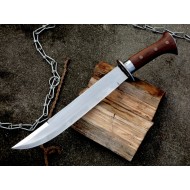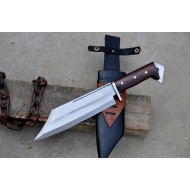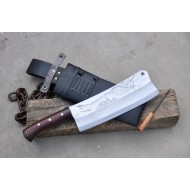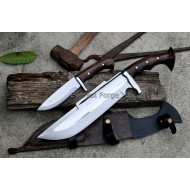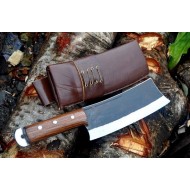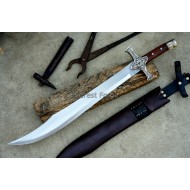


- Model: Seax knife
- Product Code: Seaxknife011
- Location: Kathmandu,Nepal
Available Options
What Is a Seax?
The seax was the everyday knife of early medieval northern Europe, carried by more or less everybody from the fifth century through to the eleventh. It gave the Saxons their name. It was a tool first and a weapon when it had to be, and it survives in graves in enormous numbers, from small utility blades up to pieces long enough to count as short swords.
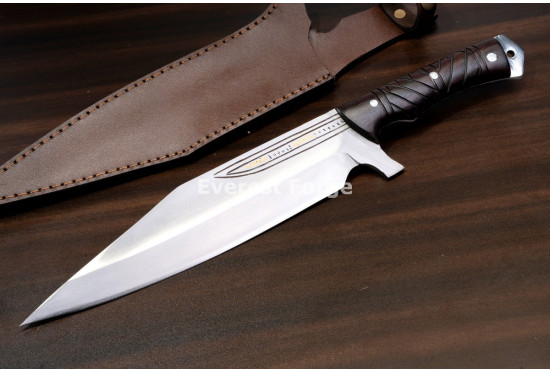
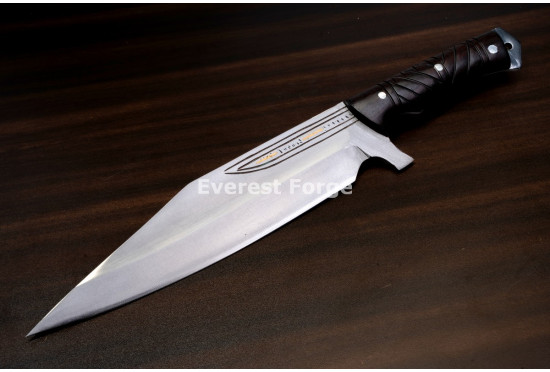
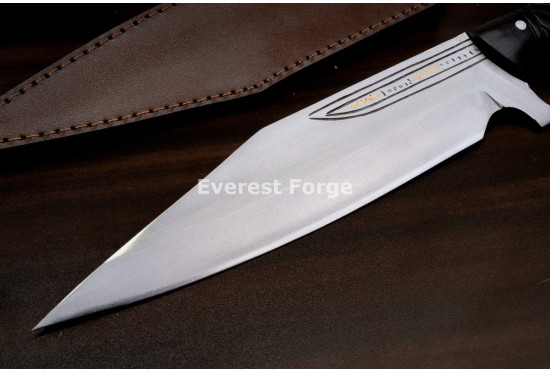
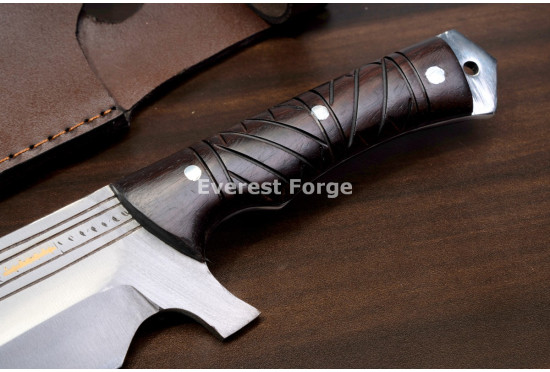
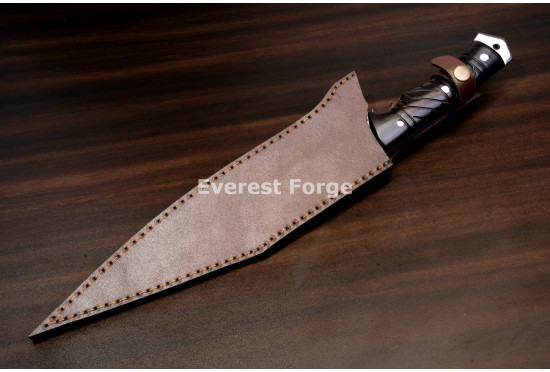
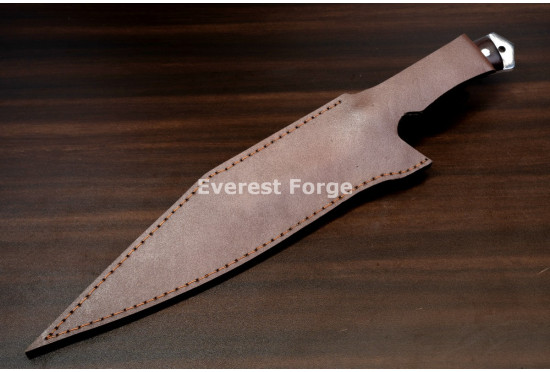
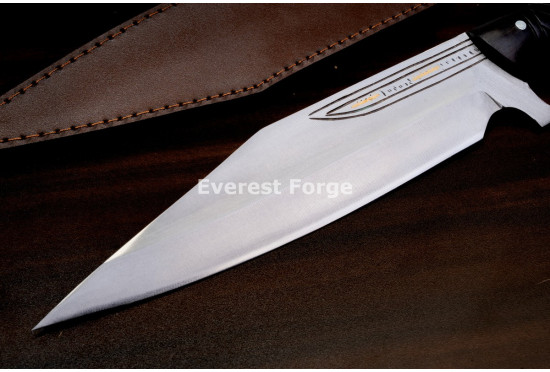
This is an 11 inch example hand-forged from 5160 high-carbon steel, oil-quenched and tempered. The blade carries the broken-back profile that most people picture when they picture a seax: the spine runs straight out from the hilt, then breaks at a distinct angle and drops to meet a long straight edge at the point. A band of etched decoration runs along the upper part of the blade, worked the same way as the patterns on our etched kukris. The 6 inch grip is dark rosewood carved with a spiralling pattern and pinned through with three rivets, fitted with an angular polished steel butt cap drilled for a lanyard, and there is a deep notch cut behind the edge where the blade meets the grip. It ships in a brown leather sheath, stitched, cut to follow the blade's outline.
An honest note. This is a seax in form rather than a museum reproduction, and the difference is worth stating. The profile is right, the proportions are sound, and it is forged and hardened rather than cast. What is not period is the construction: original seaxes were built with a narrow tang running through a grip of horn, wood, antler or bone, usually with no visible pins at all, and their steel was pattern-welded or bloomery iron with a hardened edge rather than a modern homogeneous alloy. This one uses a pinned full tang and 5160 spring steel, which is stronger and far more consistent than anything available in the seventh century but is not what a seventh-century smith made. The etched decoration is modern too. If you want a strict archaeological reproduction, tell us and we will quote one properly rather than sell you this and call it that.
Want This Built Your Way?
A different length, a plain blade with no etching, a closer historical reproduction, another grip material, a period-style sheath, or your own drawing entirely. Our smiths in Kathmandu forge to specification and quote before any work begins.
Start a Custom BuildWhat Makes the Seax Work
Standard Build and Specifications
Blade length, blade finish, grip material and blade decoration are all selectable, so the figures above describe the standard build rather than every version. Because each piece is forged, ground, etched and carved by hand, weights, dimensions and the exact pattern registration vary slightly between examples.
Build Options
Is This the Right Knife for You?
Choose This One If
- You want the seax form done properly, with the broken back and the straight edge it should have
- You want a straight edge — for board work, carving and general cutting it beats a curved one
- You are interested in early medieval material culture and want a forged piece rather than a casting
- You want a knife that is easy to sharpen and stays easy for its whole life
- You are re-enacting, or building a collection around the period
Look Elsewhere If
- You want a strict archaeological reproduction — ask us to build one instead of buying this
- You want a chopper — a straight-edged blade with no belly is the wrong tool, and our kukris are the right one
- You want a fine point for detail work — the broken-back tip is strong rather than delicate
- You want a light knife — at 11 inches this is a substantial piece of steel
How to Order
Who This Knife Is For
- Living history and re-enactment — the right form for the period, forged rather than cast
- Collectors of early medieval material who want a working piece alongside the books
- Bushcrafters who prefer a straight edge — and there is a good case that a straight edge is the better all-round cutting geometry
- Anyone tired of curved blades that are awkward to sharpen and awkward on a cutting board
- Buyers building a varied collection alongside our Nepali blades
What Is Included
- One hand-forged seax, sharpened and ready to use
- Brown leather sheath cut to the blade outline, with studded retaining strap
- Everest Forge manufacturer warranty
- Care instructions
More From the Everest Forge Collection
Shipping, Returns and Care
Stock builds dispatch from our workshop within 2-3 business days. Custom and made-to-order builds take 4-6 weeks from confirmation, and we photograph the finished piece before it leaves us. We ship worldwide with DHL and FedEx, fully tracked, typically 7-14 business days in transit. Every blade carries the Everest Forge manufacturer warranty against defects in forging and construction.
Blade laws vary by country, state and province and it is the buyer's responsibility to check local restrictions before ordering. We cannot advise on your jurisdiction and we cannot refund a blade seized in transit.
5160 is a high-carbon steel and it will rust if you let it. Wipe the blade dry after use, keep it lightly oiled, and do not store it in the sheath for long periods in a damp climate, because leather holds moisture against steel. Two places want more than a wipe along the flat: the etched band, where the relief holds moisture and residue that a cloth drawn across the surface will bridge, and the cut lines of the grip carving. Work oil into both with the corner of a cloth. Sharpen with a stone or a file rather than a powered grinder, which will draw the temper out of an edge faster than you expect.
Forged by Hand, Not Assembled
Every blade we sell is forged, ground, heat-treated and fitted by our own smiths in Kathmandu. If you want something we do not list, we will make it.
Talk to Our SmithsFrequently Asked Questions
What exactly is a seax?
The single-edged knife carried across northern Europe through the early medieval period, roughly the fifth century to the eleventh. The word simply means knife in Old English and related languages, and it is where the Saxons got their name. It was not a specialist weapon or a status object — it was the general-purpose blade that almost everyone owned, used for eating, working, butchery, woodwork and, when required, fighting. Archaeologists classify them by size and profile: small handseaxes for everyday use, longer langseaxes at the size of this one, and larger examples that shade into short swords. They turn up in graves in very large numbers across England, Scandinavia and the Continent, which tells you how ordinary they were.
Why is the back broken?
Because the spine changes direction at an angle instead of curving. Run your eye along the back of this blade: it goes straight out from the hilt, then hits a distinct corner and slopes down to the point. That is the broken-back form, and it is the most recognisable seax type. It is not decoration — it produces a particular kind of knife. Dropping the spine brings the point down closer to the line of the edge, where it is easier to place accurately, and because the drop happens late the steel stays thick almost all the way to the tip, which makes for a strong point rather than a delicate one. The alternative was a straight-backed or gently curved spine, which is also historically correct and produces a knife that thrusts better and pierces worse.
What is the pattern on the blade?
Etched decoration, worked the same way as the patterns on our decorated kukris: the blade is masked with a resist, the design is cut through the resist, and acid eats away the exposed steel to leave the pattern standing in relief. It is not engraving, which cuts the metal with a graver and leaves bright angled walls, and it is not inlay, where wire is hammered into cut channels. We set out the difference between etching and engraving in full on our etched chirra kukri, and it is worth reading if you are comparing decorated blades from any maker. Two honest points about this one. The pattern is ornament and does nothing for the blade's performance. And it is modern — period seaxes carried their decoration as inlaid wire in cut grooves, not as etched work, so a plain blade is the more historically correct choice and costs nothing extra.
Is this historically accurate?
The form is, the construction and the decoration are not, and we would rather draw the line clearly than blur it. What is right: the broken-back profile, the proportions, the long straight edge, and the fact that it is forged and hardened rather than cast. What is not: original seaxes had a narrow tang driven into a grip of horn, antler, bone or wood, usually with no pins visible at all, where this has a full tang with three rivets through it. The steel is modern — 5160 is a homogeneous alloy, where a period blade would be bloomery iron with a steel edge welded on, or pattern-welded. And the etching is a modern technique. So it is a seax the way a modern chair is a chair, not the way a museum copy is. If you want the archaeology, ask us and we will quote a closer reproduction.
What is the notch behind the edge for?
It is a choil, and it does two useful things. First, it gives the edge somewhere to stop. An edge that runs straight into the handle is difficult to sharpen right to its end and tends to leave an unsharpened stub, and worse, it can bite into the front of the grip. A notch terminates it cleanly. Second, it makes room for your index finger. On a knife with an 11 inch blade there are jobs — carving, fine cutting, anything needing control rather than power — where you want your hand as far forward as it will go, and a deep choil lets you place a finger ahead of the grip and effectively shorten the knife in your hand. It is one of the most useful features you can put on a large blade and a surprising number of makers leave it off.
What steel is it?
5160 high-carbon spring steel, oil-quenched and tempered. It is the family of steel used for vehicle leaf springs, and our smiths use it across the range because it is chosen for toughness rather than for maximum hardness. On this pattern that suits the design well: the broken-back point is strong rather than fine, so it is not going to snap the way an acute tip in a brittle steel might, and a tough steel takes the sort of general abuse a knife of this kind was historically expected to absorb. The edge rolls slightly rather than chipping when it meets something hard, and a rolled edge comes back with a few passes on a stone. It is not stainless and it will rust if neglected.
Is a straight edge actually better?
For most cutting, yes, and this is the quiet argument for the whole pattern. A straight edge meets a flat surface along its entire length, which means when you cut on a board, a bench or a stump you get contact everywhere instead of at one point. It slices in a push or a draw without needing to be rocked. And it is the easiest edge in the world to sharpen, because you can lay the whole thing flat on a stone and work it without following a curve or rolling the blade as you go. Curved bellies exist because they concentrate force at a point, which is what you want for chopping and skinning. If your cutting is mostly food, wood and general work rather than felling, a straight edge is genuinely the better tool and the seax has one for good reason.
How does it compare to your kukris?
Opposite tools with opposite geometry. A kukri is forward-curved with mass carried out toward the belly, all of it arranged to deliver energy into wood at a point of impact. This is straight-edged with the weight distributed evenly along the blade, and it is arranged for controlled cutting rather than for chopping. Ask a seax to fell a limb and it will do a poor job compared to any of our kukris. Ask a kukri to carve, to cut on a board, or to do anything requiring the edge to lie flat against a surface, and it will be clumsy where this is easy. Most people who own both find they use the kukri when there is heavy work and the seax the rest of the time.
The karda on one of your kukris is a seax too. What is the difference?
Size and role, not shape. The karda supplied with our kukri-and-karda set uses the same broken-back seax profile, and that is deliberate: it is an excellent geometry for a small utility knife and it is the reason we chose it over the plain drop-point a Nepali karda usually carries. But that blade is a companion, sized to do the small jobs its kukri is too big for, and it lives in the same sheath. This is the full-size article: an 11 inch langseax that is the primary knife rather than the secondary one, with its own sheath and its own purpose. If you like the small one you will probably like this, and the two work well together for exactly the reason the original pairing did.
How do I sharpen it?
Easily, which is one of the real pleasures of a straight-edged knife. Lay the bevel flat on a bench stone, hold the angle, and work along the length. There is no curve to follow, no belly to roll the blade through and no recurve to reach into, so you can maintain the angle consistently in a way that is genuinely difficult on a kukri or anything with a recurve. That means a beginner can put a good edge on this knife, which is not true of most large blades. The choil at the base lets you work the edge right to its end without running the stone into the grip. A medium stone followed by a fine one is all it needs, and a strop afterwards if you want it keen.
How do I look after it?
Standard carbon steel care with two specific additions. The etched band is the thing most likely to catch you out: a cloth drawn along the flat of the blade bridges the relief and skips the floor of the pattern, so water and residue sit in there unseen and that is where rust will start. Work an oiled cloth corner or an old toothbrush into the pattern rather than wiping across it. The same applies to the cut lines of the grip carving, which hold moisture against the wood. Otherwise: wipe dry after use, oil lightly, do not store it sheathed for long periods in a damp climate, and be particularly careful after cutting anything green or acidic.
Can I have it in a different size?
Yes, and with this pattern the size question is more interesting than usual, because the historical family spans a genuinely wide range and the knives at each end are used differently. A short handseax of five or six inches is a utility knife you would carry daily and use for everything. Something in the nine to fourteen inch range, where this sits, is a langseax: a serious general-purpose blade with real capability behind it. Longer again and you are into pieces that functioned as short swords. All three are correct. Tell us what you actually want to do with it rather than just naming a length, and we will tell you which we would build and why. Grip material, finish, decoration and sheath style can all be specified at the same time.
| Specification | |
| Blade: | 11 inches. Hand forged from 5160 carbon steel. Broken-back seax profile with angled spine and long straight edge |
| Total Length: | 17 inches long in total. |
| Handle: | 6 inches, full tang, carved rosewood with spiralling cut pattern, three pins, angular polished steel butt cap with lanyard hole |
| Weight: | Approx. 650 g blade, approx. 840 g total |
| Note: | As each piece is forged, ground, etched and carved by hand, slight variation in weight, dimensions and pattern registration may occur. Work oil INTO the etched pattern rather than across it. |