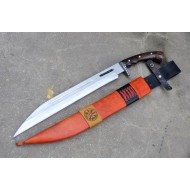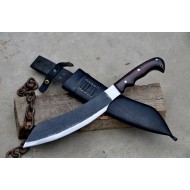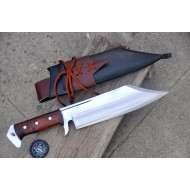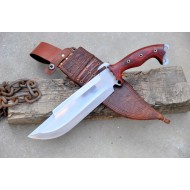


- Model: Bowie knives
- Product Code: Fantasy09
- Location: Kathmandu,Nepal
Available Options
A Large Fantasy Knife, Forged Rather Than Cast
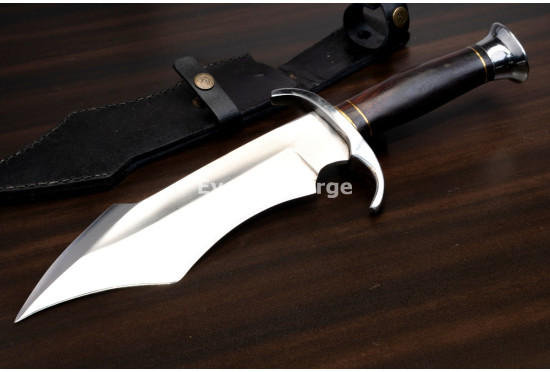
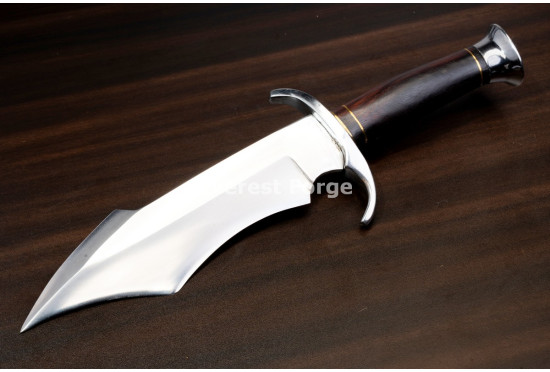
Most fantasy knives are ornaments. They are cast rather than forged, made from soft stainless that was never hardened, given a bevel that was never sharpened, and built to be looked at from four feet away. This one is not that. It is a 9 inch blade hand-forged from 5160 high-carbon steel, oil-quenched, tempered and sharpened, in a design that owes nothing to any historical pattern and does not pretend otherwise.
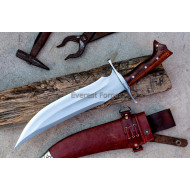
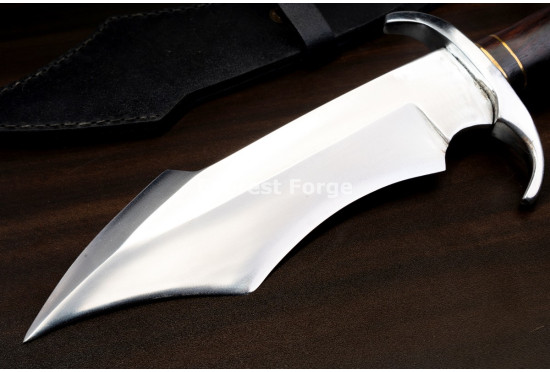
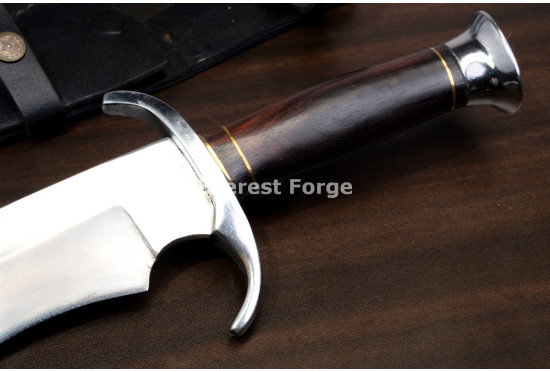
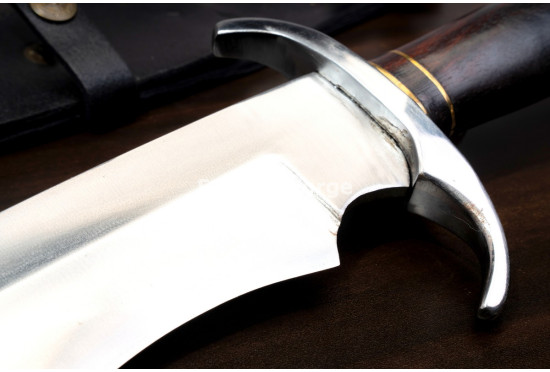
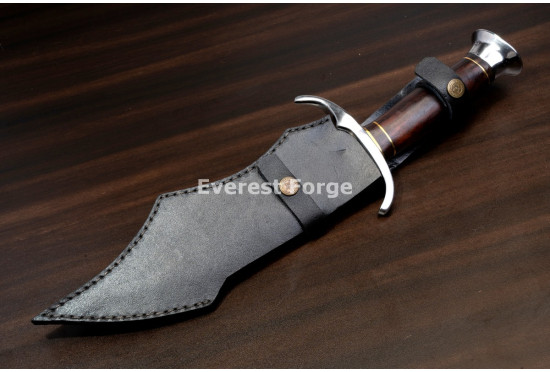
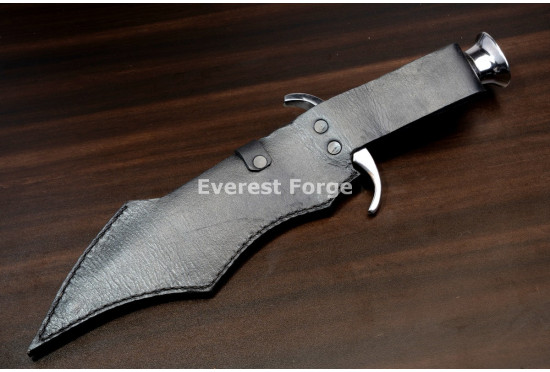
What gives it its character is the grinding. Rather than a single rolled bevel sweeping from spine to edge, the blade is worked into distinct flat planes that meet along a hard central ridge, so the light breaks across it in defined bands instead of gradating smoothly. The profile recurves through the belly and sweeps up to a very acute point. The guard is asymmetric: a long quillon curving up toward the blade on one side, a shorter one hooking down on the edge side. The 6 inch grip is turned rosewood with a brass spacer and a large flared polished steel pommel. It ships in a black leather sheath cut to follow the blade's angular silhouette rather than the usual rounded pouch.
An honest note. We should be straight about what this is and is not. It is not a historical reproduction, it is not based on any regional pattern, and if you are looking for something with provenance behind it this is the wrong page — our Nepali blades are forged to patterns with centuries behind them and we will point you there happily. This is a piece of design. What we will stand behind is that it is a real knife: the same steel, the same forging and the same heat treatment as the blades we sell to people who chop firewood with them, and it arrives with an edge. Whether you use it is your business. The point is that you could.
Want This Built Your Way?
A different length, a different guard, another grip material, a plainer grind, or your own drawing entirely. Design work is what our smiths enjoy most, and we quote before any work begins.
Start a Custom BuildWhat Makes This Blade Different
Standard Build and Specifications
Blade length, blade finish and grip material are selectable, so the figures above describe the standard build rather than every version. Because each piece is forged, ground and fitted by hand, weights and dimensions vary slightly between examples. Individual blade and fitting weights can be measured on your actual piece before dispatch on request.
Build Options
Is This the Right Knife for You?
Choose This One If
- You want a fantasy design that is a genuine forged blade rather than a cast ornament
- You like sculptural work and want to see real grinding skill rather than a mould
- You are buying for display, for a collection, or as a gift with presence
- You want something no one else in your circle will have
- You appreciate that the sheath was cut to fit this blade and no other
Look Elsewhere If
- You want history — this is a design, and our Nepali patterns carry centuries behind them
- You want a working tool — the facets, the recurve and the polish all favour looks over utility
- You want something simple to sharpen — a recurved edge is the fussiest kind to maintain
- You want a light knife — there is a lot of steel in the fittings on this one
How to Order
Who This Knife Is For
- Collectors of modern custom work who want sculptural grinding rather than another traditional pattern
- Gift buyers looking for something with real presence that is not a mass-produced wall ornament
- Fantasy and film enthusiasts who have been disappointed by cast display pieces and want the real thing
- Anyone who likes metalwork — the facets are the part worth looking at closely
- Buyers building a varied collection alongside our traditional Nepali blades
What Is Included
- One hand-forged fantasy knife, sharpened and ready to use
- Black leather sheath cut to the blade silhouette, with studded retaining strap
- Everest Forge manufacturer warranty
- Care instructions
More From the Everest Forge Collection
Shipping, Returns and Care
Stock builds dispatch from our workshop within 2-3 business days. Custom and made-to-order builds take 4-6 weeks from confirmation, and we photograph the finished piece before it leaves us. We ship worldwide with DHL and FedEx, fully tracked, typically 7-14 business days in transit. Every blade carries the Everest Forge manufacturer warranty against defects in forging and construction.
Blade laws vary by country, state and province and it is the buyer's responsibility to check local restrictions before ordering. We cannot advise on your jurisdiction and we cannot refund a blade seized in transit.
5160 is a high-carbon steel and it will rust if you let it, and a mirror-polished faceted blade shows every mark that a working finish would hide. Wipe it down after handling rather than only after use, since fingerprints are acidic and will etch a polished surface over months. Pay attention to the ridge lines where facets meet and to the inside curve of the guard, both of which a cloth drawn along the flat will skip. If this piece is going on a wall, oil it before it goes up and check it a couple of times a year, particularly on an outside wall. Sharpen with a stone or a file rather than a powered grinder.
Forged by Hand, Not Assembled
Every blade we sell is forged, ground, heat-treated and fitted by our own smiths in Kathmandu. If you want something we do not list, we will make it.
Talk to Our SmithsFrequently Asked Questions
Is this a real knife or a display piece?
A real knife, and the distinction matters more in this category than any other. The fantasy knife market is dominated by castings: a mould is filled with soft stainless steel, the piece is never hardened, the edge is never actually sharpened, and the result looks convincing in a photograph and would fold if you leaned on it. This one is forged from 5160 high-carbon steel by the same smiths who make our working blades, quenched in oil, tempered, and sharpened before it ships. You can tell the difference on any piece you are considering: a casting has softly rounded detail everywhere, often a faint mould seam, and identical examples, while forged and ground work has crisp edges and varies slightly piece to piece. That said, we would still call this a piece to own rather than a tool to work with.
What is a faceted grind and why does it matter?
On a conventional knife the bevel is a single surface, usually slightly curved, sweeping from the spine down to the edge, and the light gradates smoothly across it. A faceted grind replaces that with several distinct flat planes meeting along defined lines, so the light breaks in bands rather than flowing. It is much harder to do well. A curved grind is forgiving, because the eye cannot easily see a slight variation in a curve. A flat plane shows everything: if it dips even slightly the reflection bends and you see it instantly, and if the ridge where two planes meet wanders by a fraction of a millimetre it reads as crooked from across a room. So the test for quality is simple and you can apply it to any faceted blade. Sight down the ridge line and check it is dead straight. Then tilt the blade under a light and watch the reflection travel across each facet: on a true flat it moves smoothly and evenly, and on a poorly ground one it stutters.
What does the guard do?
Two different things at its two ends, which is why it is asymmetric rather than a symmetrical crossguard. The long quillon sweeping up toward the blade sits on the spine side and does the conventional job of a guard: it stops the hand travelling forward onto the edge and it shields the back of the fingers. The shorter hook curling down on the edge side is doing something else — it gives the index finger a positive place to sit and stop, so the hand indexes the same way each time and has something to pull against as well as push into. Symmetrical guards do neither job especially well because they compromise between them. The trade-off here is that an asymmetric guard commits the knife to being held one way up, which is fine on a piece like this and would be a nuisance on a working tool.
Why is the sheath shaped like that?
Because a blade with this outline cannot go into an ordinary sheath and look right. The standard approach is a rounded pouch: leather folded and stitched into a simple tapering shape that swallows whatever is put in it, which is quick to make and works acceptably for a blade with a conventional profile. On a knife with a recurve and hard angles, a rounded pouch leaves large voids where the leather stands away from the steel, the knife rattles inside it, and the silhouette is lost entirely. This sheath is cut and stitched to follow the actual outline of the blade, angles and all, so it holds the knife closely and shows its shape while sheathed. It is more work and more waste at the cutting stage, which is why most makers do not bother.
What steel is it?
5160 high-carbon spring steel, oil-quenched and tempered. It is the family of steel used for vehicle leaf springs and it is chosen for toughness rather than for the highest possible hardness. On this piece that matters mostly because of the point: a very acute tip in hard, brittle steel is the classic way to snap a knife, whereas 5160 at a working temper will flex slightly and recover. It is worth stating plainly because it is the specification most fantasy knives quietly avoid mentioning. This is not decorative stainless, it is not unhardened, and it is not a casting. It is also not stainless in the practical sense, so it will rust if neglected, and a polished blade shows it sooner than a satin one.
Why is the pommel so large?
Balance. A 9 inch blade this substantial puts a lot of steel forward of your hand, and without something at the back the knife would feel nose-heavy and awkward, hanging in the grip rather than sitting in it. A large solid pommel pulls the balance point rearward toward the hand, which makes the knife feel controllable and considerably lighter than its total weight suggests. That is why so many large knives across every tradition have substantial butt fittings, and it is a real function rather than a styling choice, though it happens to look well too. The cost is total weight: a pommel like this is a meaningful fraction of what you are holding. We can fit a smaller one if you would rather have a lighter knife with a more forward balance, and we will photograph the difference before dispatch.
How do I sharpen a recurved edge?
With a round or oval sharpening rod rather than a flat stone, and this is the one genuinely fussy thing about the knife. A flat bench stone cannot reach into the concave section of a recurve: the stone bridges the hollow and touches only the two high points either side, so you sharpen the parts that are already sharp and never touch the part that is not. A ceramic rod, a round diamond rod or the edge of a folded abrasive works into the curve properly. Work the concave section with the rod, then finish the convex belly and the point on a flat stone as normal. If that sounds like more trouble than you want, it is worth knowing before you buy rather than after — a recurve is the least convenient edge profile to maintain, and it is the price of the shape.
Is it a bowie knife?
Partly, and only in the loosest sense. It borrows two things from the bowie tradition: a clipped point and a guard, both of which are characteristic of the nineteenth-century American pattern. Everything else departs from it. A bowie has a straight or gently convex edge; this recurves. A bowie has a conventional single bevel; this is faceted. A bowie's guard is symmetrical; this one is not. So calling it a bowie would be stretching a historical term past the point of usefulness, which is why we have not named it one. If you want an actual bowie we make those, forged to the pattern rather than gesturing at it, and they are a different proposition entirely.
Can I actually use it?
Yes, with a clear head about what you are giving up. The steel, the heat treatment and the edge are all genuine, so it will cut and it will hold up. What works against you is everything that makes it look the way it does. The mirror polish scuffs the first time you use it properly, and on a faceted blade those scuffs cut across the reflections and are more visible than on a conventional grind. The recurve is awkward to sharpen. The acute point is easier to damage than a rounded one. And the guard commits you to one grip. None of that stops it working. It simply means that if your actual plan is to use a knife hard, our bushcraft kukri costs less to own and will do the job better, and this piece is worth more to you sitting where you can see it.
How do I look after a polished faceted blade?
More attentively than a working finish, because polish hides nothing. Wipe it after handling rather than only after use: fingerprints are mildly acidic and over months they will etch visible marks into a mirror surface, which is the commonest way a display piece deteriorates without anyone using it at all. Oil it lightly and pay attention to two places a cloth drawn along the flat will skip — the ridge lines where the facets meet, and the inside curve of the guard where it meets the blade. If it is going on a wall, oil it before it goes up and check it twice a year, more often on an outside wall or in a bathroom. Light surface rust comes off with fine steel wool and oil, though on a mirror polish that leaves a duller patch you will then want to bring back.
How does it compare to your other large knives?
It is the design piece. Our Nepali blades — the kukris, the bhojpure, the bushcraft piece — are all forged to patterns with a history, and each one exists because it does a job somebody in Nepal needed doing. This knife exists because somebody drew it. That is not a lesser reason, but it is a different one, and it changes what you should compare it against. If you are weighing it against our kukris on capability it will lose, because they are tools and it is not. If you are weighing it on craftsmanship, the faceted grinding here is the most technically demanding work in this listing and arguably in the range. Buy it for what it is rather than for what it can do.
Can I have a custom version?
Yes, and this is the piece in our catalogue where custom work makes the most sense. A traditional pattern has a right answer that we will steer you toward, but a design piece has none, so there is nothing to be faithful to and you can have exactly what you want. Length, guard shape, pommel, grip material and the facet arrangement itself are all open. Send us a drawing, a reference image or just a description, and we will draw it back to you before anything is forged, at no cost. Two honest cautions: facet arrangements that look striking in a sketch sometimes cannot be ground into a blade of the thickness you want, and we will tell you that up front rather than deliver something that has quietly been simplified.
| Specification | |
| Blade: | 9 inches. Hand forged from 5160 carbon steel. Faceted grind with flat planes meeting at a central ridge, recurved belly, acute point |
| Total Length: | 15 inches |
| Handle: | 6 inches, turned rosewood with brass spacer, asymmetric steel guard, large flared polished steel pommel |
| Weight: | Approx. 860 g total |
| Note: | As each piece is forged, ground and fitted by hand, slight variation in weight, dimensions and finish may occur. Wipe after handling, not just after use - fingerprints etch a polished surface over time. |