

- Model: Forged Knives
- Product Code: BIGKNIFE0010
- Location: Kathmandu,Nepal
Available Options
A Large Belt Knife That Carries Four Ways
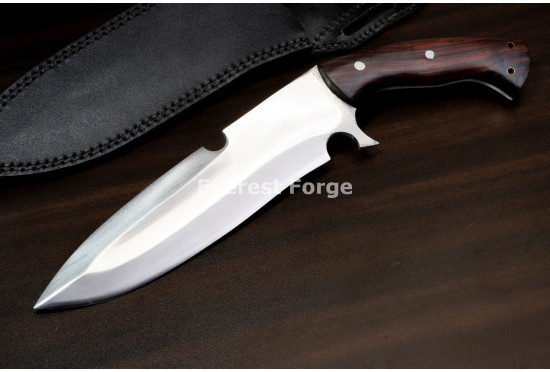
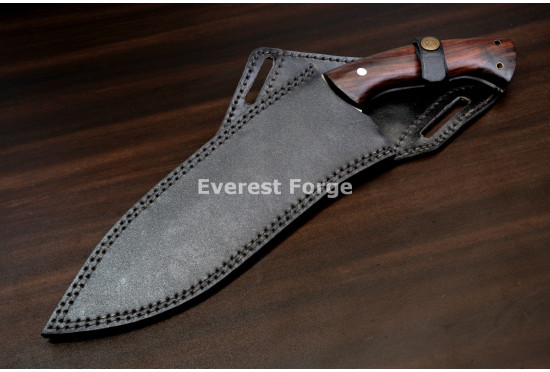
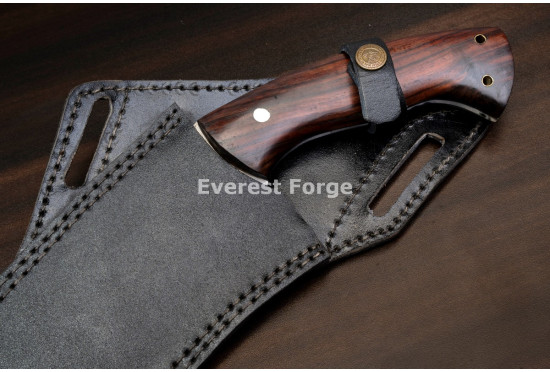
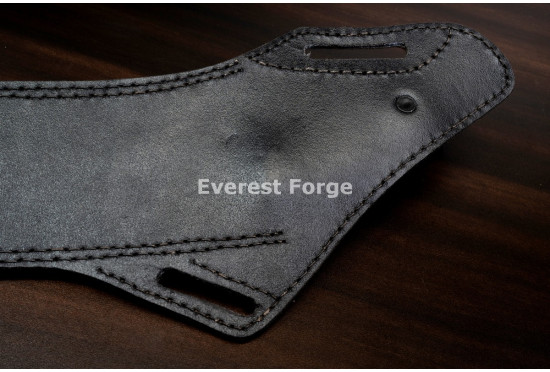
This is a big, plain, broad-bladed knife with no ornament on it anywhere, and the most useful thing about it is the sheath. The leather is cut with four belt slots rather than one, which means the same knife can ride vertically on your hip, horizontally across the small of your back, angled for a cross draw, or high and tight in a scout carry. Most large knives give you one position and expect you to live with it.
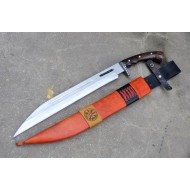
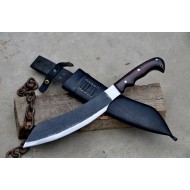
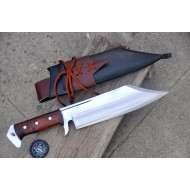
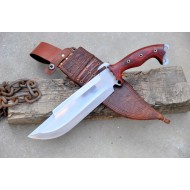
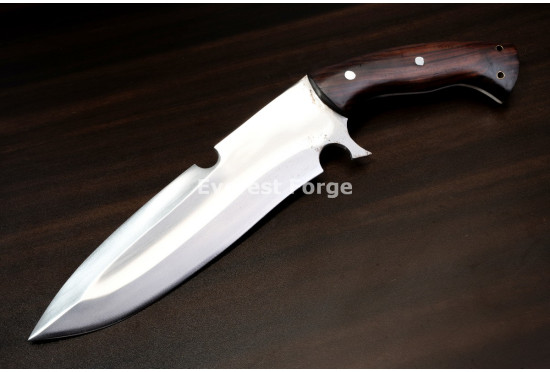
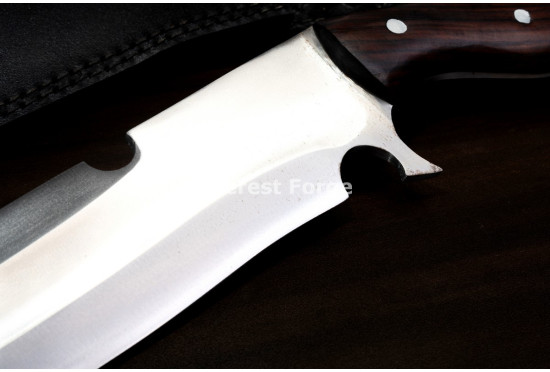
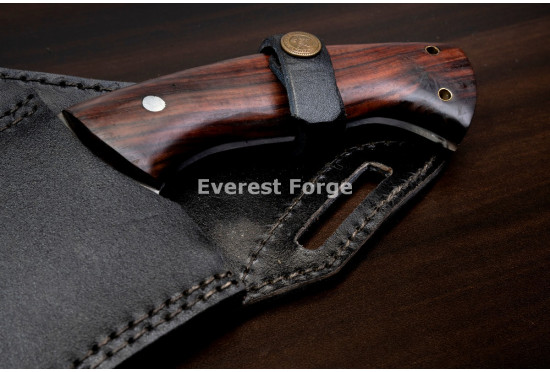
The blade is 10 inches, hand-forged from 5160 high-carbon steel, oil-quenched and tempered. It is unusually broad for its length, with a long shallow grind, a swedge along the upper edge toward the tip and a strong drop point. Where the blade meets the handle there is no guard: instead a pair of opposed notches is cut into the edge and the spine, forming a recess that stops the hand and lets you choke forward. The 6 inch grip is contoured rosewood pinned through a full tang, with brass-lined holes at the butt for a lanyard. The sheath is black leather, stitched throughout, with a studded strap over the handle.
An honest note. There is nothing decorative on this knife at all, and that is deliberate rather than a saving. No etching, no fuller, no carving, no brass beyond the lanyard liners. What you are paying for is steel, grinding, fit and a sheath that took real work. If you want a piece with visual presence for a wall or a cabinet, we make several and this is not one of them. The other thing worth saying plainly is that this is a heavy knife for its length — look at the specifications before you decide, because the width that makes it capable is also what makes it substantial in the hand.
Want This Built Your Way?
A different length, a narrower blade, a lighter grind, another grip material, a different carry arrangement, or your own drawing entirely. Our smiths in Kathmandu forge to specification and quote before any work begins.
Start a Custom BuildWhat Makes It Work
Standard Build and Specifications
Blade length, blade finish and grip material are selectable, so the figures above describe the standard build rather than every version. Because each piece is forged, ground and fitted by hand, weights and dimensions vary slightly between examples, and on a knife this substantial the variation is worth asking about if it matters to you — we will weigh your actual piece before dispatch on request.
Build Options
Is This the Right Knife for You?
Choose This One If
- You want one large knife that you can carry several different ways
- You want capability rather than looks — there is no ornament on this at all
- You want a point strong enough to pry and bore with
- You want a full tang you can see, with nothing hidden under the scales
- You are comfortable with a substantial knife and want the width that comes with it
Look Elsewhere If
- You want a light knife to carry all day — our bushcraft kukri is built for exactly that and weighs considerably less
- You want a chopper — at 10 inches this cuts well and chops poorly compared to a proper kukri
- You want a display piece — this is plain by design
- You want a fine slicing edge — the broad section is strong rather than keen
- You want a guard — there is not one, and if that matters we make guarded pieces
How to Order
Who This Knife Is For
- Campers and outdoorsmen who want one substantial knife for general work rather than a specialist
- Anyone who carries differently in different situations — on a belt one day, on a pack strap or across the back the next
- Buyers who want capability over decoration and would rather the money went into steel and leather
- People who use a knife point for boring, prying and levering, which most large knives are not built to survive
- Buyers who have owned a hidden-tang knife that came loose and do not intend to repeat it
What Is Included
- One hand-forged large belt knife, sharpened and ready to use
- Black leather four-slot sheath with studded retaining strap
- Everest Forge manufacturer warranty
- Care instructions
More From the Everest Forge Collection
Shipping, Returns and Care
Stock builds dispatch from our workshop within 2-3 business days. Custom and made-to-order builds take 4-6 weeks from confirmation, and we photograph the finished piece before it leaves us. We ship worldwide with DHL and FedEx, fully tracked, typically 7-14 business days in transit. Every blade carries the Everest Forge manufacturer warranty against defects in forging and construction.
Blade laws vary by country, state and province and it is the buyer's responsibility to check local restrictions before ordering. Note that horizontal and small-of-the-back carry are specifically restricted in some jurisdictions even where the knife itself is legal. We cannot advise on your jurisdiction and we cannot refund a blade seized in transit.
5160 is a high-carbon steel and it will rust if you let it. Wipe the blade dry after use, keep it lightly oiled, and do not store it in the sheath for long periods in a damp climate, because leather holds moisture against steel. The one place on this knife that needs more than a wipe along the flat is the pair of notches at the ricasso: they are tight internal curves that trap water and are easy to miss entirely. Run an oiled cloth corner or a cotton bud through both. The sheath will benefit from occasional leather conditioner, particularly if you are switching carry positions often and working the slots.
Forged by Hand, Not Assembled
Every blade we sell is forged, ground, heat-treated and fitted by our own smiths in Kathmandu. If you want something we do not list, we will make it.
Talk to Our SmithsFrequently Asked Questions
Why does the sheath have four belt slots?
So the knife can be worn four different ways without buying another sheath. Thread your belt through the two vertical slots and it hangs conventionally on your hip. Thread it through the horizontal pair and the knife lies flat across the small of your back or in front of the hip, which is far more comfortable when you are sitting, driving or wearing a pack waist belt. Angle it between the two and you get a cross draw, reachable with the opposite hand. Run it high and tight and you have a scout carry. The reason this matters on a large knife specifically is that a 16 inch package hanging vertically from a belt catches on everything and digs into your leg the moment you sit down, and that is why big knives end up left at home. Being able to move it is worth more than most people expect.
Why is there no guard?
Because the blade does the guard's job instead, and doing it that way costs nothing in bulk. Look at the base of the blade: there is a notch cut into the edge and another cut into the spine directly opposite it, forming a narrow waist between the sharpened edge and the handle. Your index finger sits in that recess, and the shoulder of steel ahead of it stops the hand travelling forward exactly as a guard would. What you gain over a crossguard is that nothing sticks out sideways, so the knife sheathes cleanly, sits flat against the body in horizontal carry, and does not catch when you draw it. What you lose is lateral protection: a guard shields the sides of your hand and this does not, which matters in a thrust and rarely matters in work. On a knife built to be carried and used rather than fought with, it is the better trade.
What does a broad blade give you?
Three things, and they are the reason this knife feels more capable than its 10 inches suggests. Width puts more steel behind the edge, so the blade resists twisting and lateral load in a way a slim blade does not — that is what lets you lever with it. Width means a taller grind, which lets the bevel run from a thick spine down to a thin edge over a longer distance, giving you a strong section and a keen edge at once. And width gives you knuckle clearance, so when you cut down onto a board or a stump your hand is not in the way. The cost is weight, which is real here, and a slight loss of finesse: a broad blade is clumsier than a narrow one for detail work, and there are jobs where you will wish you had something smaller.
What is the bevel along the top of the blade near the tip?
That is a swedge. It is a bevel ground into the spine side of the blade over the last few inches, thinning the section behind the point so the tip enters material more easily and looks less blunt. On this knife it is left unsharpened, which is an important distinction: an unsharpened swedge is a grinding feature and nothing more, where a sharpened one is a second edge and brings real legal consequences with it in a number of countries, states and provinces where the statutory test is whether a blade carries a second sharpened edge at all. Ours is not sharpened and we will not sharpen it, because on a knife of this size the legal exposure is not worth the marginal gain in penetration.
What steel is it?
5160 high-carbon spring steel, oil-quenched and tempered. It is the family of steel used for vehicle leaf springs, and it is chosen for toughness rather than for maximum hardness. That choice fits this knife better than most in our range, because a broad blade with a strong point invites exactly the kind of use — prying, levering, boring, batoning — that snaps a hard, brittle blade. Tough steel bends slightly and comes back where hard steel breaks, and an edge that rolls can be stoned straight again in the field. The cost is that it needs sharpening a little more often than a harder alloy, and that it is not stainless, so it will rust if you leave it wet.
Is it too heavy?
It is heavy, and whether that is a problem depends entirely on how you carry it. In the hand the weight reads as capability: the knife feels solid, cuts with authority and does not deflect. On a belt for eight hours it reads as weight. This is precisely why the four-slot sheath earns its place — moving a heavy knife from vertical hip carry to horizontal back carry transforms how it feels to wear, because the load spreads across your belt instead of hanging off one point. That said, if you already know you want something light, be honest with yourself now: our bushcraft kukri is a fraction of this and built for long carry. We would rather point you there than have you buy this and leave it in a drawer.
How does it compare to your kukris?
Different geometry for different work. A kukri is forward-curved with its mass carried out toward the belly, all arranged to deliver energy into wood on impact, and for chopping nothing here comes close to our bhojpure. This knife is straight-spined with the weight distributed more evenly and a point built to be used, so it cuts, slices, bores and pries better than a kukri does while chopping considerably worse. The practical split is simple. If your work involves reducing wood to smaller wood, take a kukri. If it involves cutting, piercing and general tasks where a point matters, take this. Plenty of people own both and reach for whichever the job asks for.
How does it compare to your seax?
Closer than either is to a kukri, but they are still built around different priorities. Our seax is 11 inches with a long straight edge and a broken-back point, and its whole argument is the straight edge: unbeatable on a board, easy to sharpen, excellent for carving and food work. This knife is shorter, broader, heavier, and has a belly and a stronger point. The seax is the better cutter, this is the better prier and the better all-rounder in rough conditions. The other real difference is carry: the seax comes in a single-position sheath and this one gives you four. If you want a historical piece take the seax, if you want a modern working tool take this.
Can I pry with it?
Within reason, and more than with most knives, which is one of the points of the design. The broad section resists twisting, the drop point has real steel behind it rather than tapering to a needle, and 5160 at a working temper bends before it breaks. So opening a crate, levering a stuck object, splitting a small round with a baton or working a stubborn joint are all fair use. What will still break it is the same thing that breaks every knife: leverage applied to the tip alone, particularly with a twist. The last inch of any blade is the weakest part of it no matter how well made. Keep the load back toward the middle of the blade where the steel is thick, and it will take a great deal.
How do I sharpen it?
Conventionally, and it is not difficult. The grind is a long shallow bevel with a gentle belly, so lay the bevel on a bench stone, hold the angle and work along the length, rolling the blade slightly as you follow the curve toward the point. There is no recurve to reach into and no convex edge to feel your way around, which makes this one of the more forgiving large knives to maintain. Two specifics. Work the section inside the notch at the ricasso with the corner of the stone or a small rod, or you will leave an unsharpened stub there. And do not sharpen the swedge along the spine — leaving it blunt is deliberate, for the legal reasons set out above.
How do I look after it?
Standard carbon steel care, with one place that catches people out. The opposed notches at the ricasso are tight internal curves, and a cloth drawn along the flat of the blade passes straight over them without touching the inside at all, so water sits in there unseen and that is where rust starts on this pattern. Run an oiled cloth corner or a cotton bud through both every time you clean it. Otherwise: wipe dry after use, oil lightly, do not store it sheathed for long periods in a damp climate. The sheath itself wants occasional conditioner, particularly if you are moving the belt between slots often, since working the leather repeatedly at the same points is what wears a sheath out.
Can I have it in a different size or shape?
Yes. We forge this profile shorter and longer, and the proportions hold well in both directions, though below about 7 inches the broad blade starts to look and handle oddly — at that size you want a narrower knife and we will say so. We can also change the character considerably without changing the shape: a narrower blade or a higher, thinner grind turns this from a heavy general-purpose knife into a much better slicer, and that is worth discussing if the weight is your only reservation. Grip material and contour, finish, sheath colour and carry arrangement can all be specified together. Tell us how you actually intend to use it rather than just naming dimensions, and we will tell you what we would build.
| Specification | |
| Blade: | 10 inches. Hand forged from 5160 carbon steel. Broad drop point with an unsharpened swedge toward the tip |
| Total Length: | 16 inches |
| Handle: | 6 inches, full tang, contoured rosewood, pinned, brass-lined lanyard holes. No guard - opposed notches at the ricasso form the hand stop |
| Weight: | Approx. 770 g blade, approx. 1020 g total |
| Note: | As each piece is forged, ground and fitted by hand, slight variation in weight, dimensions and finish may occur. Oil inside the ricasso notches - a cloth drawn along the flat never reaches them. |