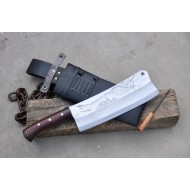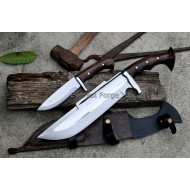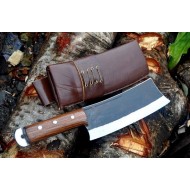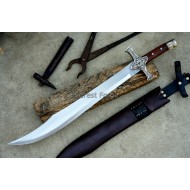


- Model: Forged Knives
- Product Code: HUNTING00905
- Location: Kathmandu,Nepal
Available Options
What Is a Hooked Butt Camp Knife?
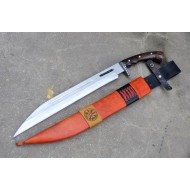
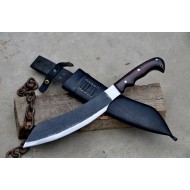
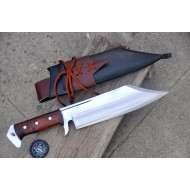
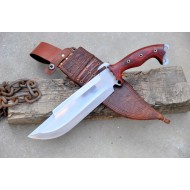
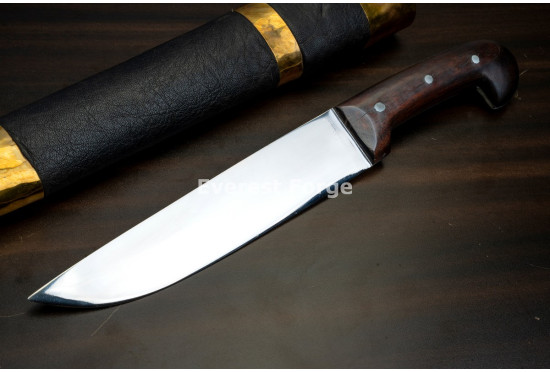
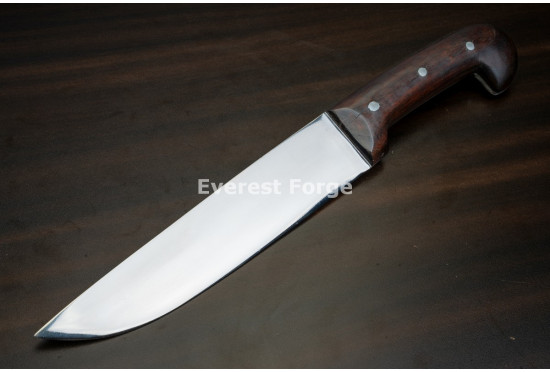
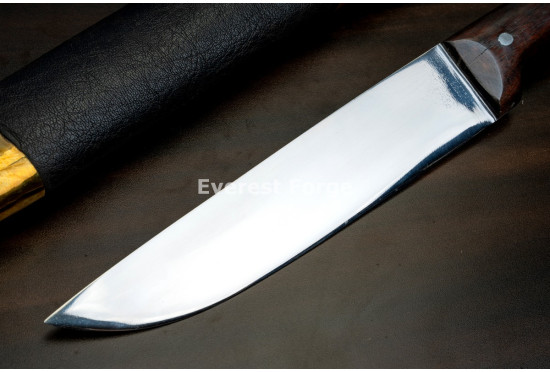
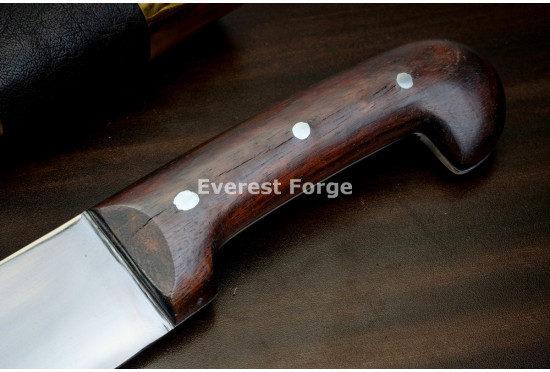
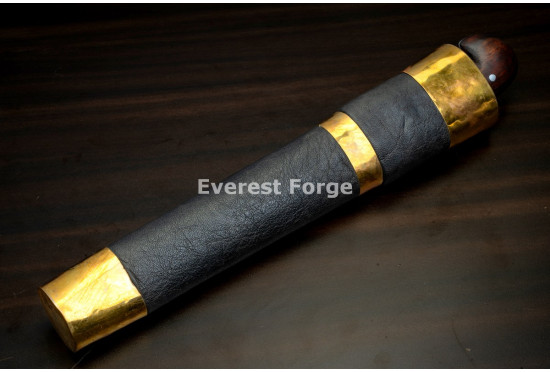
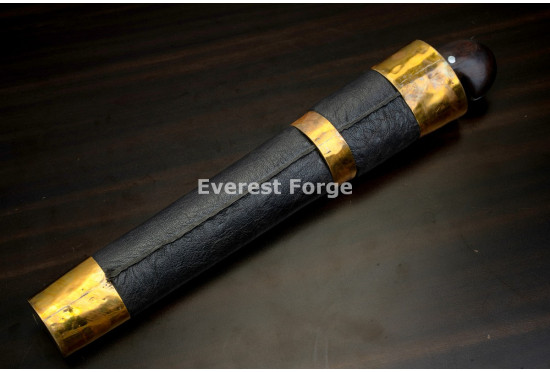
This is a large working knife with no guard, and the shape of the butt is the reason it does not need one. The handle finishes in a pronounced downward hook that catches the heel of your hand, which is what stops the knife travelling backwards out of your grip at the end of a hard swing. It carries a 9.5 inch broad single-edged blade with a smooth drop to the point, a full tang with rosewood scales pinned through it, and a 16 inch overall length. Hand-forged in Nepal from 5160 high-carbon spring steel, in a black leather scabbard over a rigid core, bound with three hammered metal bands and a heavy chape.
The arrangement is the traditional Himalayan one and it is worth understanding rather than assuming it is a shortcut. A guard exists to stop your hand sliding forward onto the blade when a point stops suddenly. A chopping knife faces the opposite problem, and solves it at the other end of the handle. Everything below explains that trade, and says plainly what you should not do with a knife built this way.
An honest note. Two things. First, there is no guard, and that is a deliberate design rather than an omission, but it means you should not thrust hard with this knife: the butt hook secures your hand against pulling backwards, not against driving forwards, and if the point stops dead against bone or a knot there is nothing between your fingers and the edge. It is a chopper and a slicer, not a stabbing tool. Second, the blade ships with a mirror polish, which is the least practical finish we make for a knife that is going to be used. A season of real work will patina and scratch it. The satin and dark forge finishes cost exactly the same and are what we would choose for a working build.
Please check your local law before ordering. At 9.5 inches this blade is above the everyday carry allowance in a good many jurisdictions even though it is single-edged and guardless, and rules for carrying a working knife in the field are frequently different from rules for carrying one in town. Import rules differ again from carry rules. We ship worldwide but we cannot advise on your jurisdiction. If length is the obstacle, a 7 or 8 inch build costs no more and is a more practical size for most camp work anyway.
Building It to Actually Use?
Say so and we will put a satin or forge finish on it, size the blade to the work you have in mind, and cut the scabbard for the way you carry. It costs no more and you will end up with a better knife for the job.
Specify a Working Build →Why This Knife Is Built the Way It Is
Full Specifications
Blade length, blade finish and handle material are selectable on this listing. The figures above describe the standard build as photographed; what you receive will match the options you choose at checkout. Small variations in weight, dimension and finish are normal in hand-forged work.
Build It Your Way
What This Knife Does Well, and What It Does Not
What It Is Good At
- Chopping. Broad blade, forward mass and a secure butt is exactly the combination for it
- Camp work generally: splitting kindling, clearing growth, preparing food, cutting cord
- Choking up on the blade for finer work, which a guard would make awkward
- Field sharpening. Carbon steel takes an edge back on a pocket stone at the end of a long day
- Being carried safely. A rigid banded scabbard holds a heavy knife where a soft sheath will not
What It Is Not Good At
- Thrusting. There is no guard, and a point that stops dead has nothing between it and your fingers
- Staying pretty. A mirror polish on carbon steel will patina and scratch in a season of real use
- Neglect. Carbon steel punishes being put away wet, and so does a leather scabbard
- Discreet carry. At 16 inches overall it is above the ordinary allowance in many places
- Fine detail work. It is a big knife; a small one is the better companion for that
How to Order a Custom Knife
Want a Camp Knife With a Point You Can Drive?
Our spear point camp knife has a guard and a symmetrical point, which makes it the better choice if you need to thrust as well as chop. Different tool, same bench.
See the Camp Knives →Who This Knife Is For
- Campers and bushcraft users who want one large knife that will chop, split and slice competently
- Buyers who understand guardless knives and want the grip freedom they give
- Anyone drawn to Himalayan working patterns without wanting a kukri's curve
- People who will maintain carbon steel and would rather have the edge than the convenience
- Collectors of traditional scabbard work, since a banded rigid scabbard is uncommon outside Nepal
It is not for you if you need to thrust with it, in which case a guarded knife is the honest answer, or if you want something you never have to think about, in which case a stainless production knife will suit you better.
What Is Included
- The hand-forged camp knife, sharpened and ready to use
- A black leather scabbard over a rigid core, with metal bands and a chape
- A certificate of authenticity from the workshop
- Care instructions for high-carbon steel
- Everest Forge manufacturer warranty against forging and material defects
Other Blades From the Everest Forge Workshop
Shipping, Returns and Care
Dispatch. Stock pieces leave the workshop within 2-3 business days. Custom builds take 4-6 weeks depending on the queue, and we will give you the honest date rather than an optimistic one.
Shipping. Tracked worldwide by DHL or FedEx, typically 7-14 business days in transit from Kathmandu. Customs paperwork is completed accurately and in full. Please check your own country's import rules before ordering, because a parcel seized at your border cannot be recovered.
Returns and warranty. Covered by the Everest Forge manufacturer warranty against defects in forging and materials. Custom builds made to your own specification cannot be returned for a change of mind, which is why we confirm everything in writing first.
Care. Wipe the blade dry after every use and keep a light film of oil on it; high-carbon steel will spot within a day of being put away damp. Pay attention to the seam where the tang meets the scales along the spine, which is an enclosed line a cloth drawn across the flat never reaches. Oil the timber once or twice a year. The scabbard wants a leather dressing at the same interval, kept off the metal bands, and it should be stored empty: leather holds damp against steel and a rigid-core scabbard dries slowly. If the fittings dull, a metal polish will bring them back, but keep it off the leather.
Questions Answered
Why does it have no guard?
Because on a knife built for chopping, a guard solves the wrong problem. A guard exists to stop your hand sliding forward onto the edge when a thrust lands and the point stops suddenly. A chopping knife almost never does that; what it does instead is get swung, and the risk at the end of a swing is the handle travelling backwards out of a tiring or sweaty hand. That is a problem at the other end of the grip entirely, and it is what the hooked butt solves. Removing the guard then buys you three things: nothing catches on the mouth of the scabbard as you draw, nothing sits under your palm when you choke up onto the blade for finer work, and the knife is simpler with one fewer component to fit and work loose. It is the arrangement most traditional Himalayan working knives use, kukris included, and it is a considered design rather than a saving.
Is a guardless knife safe?
For what it is built to do, yes. For thrusting, no, and we would rather say that clearly than let you find out. If you drive the point hard into something that stops it dead, a knot in seasoned wood, bone, or frozen ground, all of that force arrives back along the handle and there is nothing between your hand and the edge. That is the one thing this pattern will not forgive. Everything else it does perfectly safely, and the hooked butt makes it more secure in a chopping swing than most guarded knives are. Treat it as a chopper and a slicer and you will have no trouble. If your work genuinely needs a point you can lean on, buy a knife with a guard; we make those too, and we would rather sell you the right one.
What does the hooked butt actually do?
It gives the heel of your hand something solid to run into. On a straight handle, the only thing keeping the knife in your grip during a hard swing is friction, and friction fails exactly when you need it most: when the handle is wet, when your hands are cold, or when you have been working for an hour and your grip has softened. A butt that curves downward turns that from a friction problem into a mechanical one, because your hand cannot travel backwards past the hook without your fingers opening completely. It is the same principle as the flared butt on an axe haft and it is there for the same reason. The secondary benefit is indexing: you can feel where the hook is without looking, so you always know how the blade is oriented, which matters on a knife with no guard to tell you.
Are the scabbard fittings solid brass?
The standard build is described to us as brass-finish rather than solid brass, and we would rather tell you that than let the photographs imply otherwise. Brass-finished fittings are a base metal with a brass-coloured surface, and they look very close to the real thing when new. The practical differences show up over time: solid brass develops a patina all the way through and can be polished back indefinitely, while a finish is a surface layer that will eventually wear at the high points and show what is underneath, particularly on the band edges and the chape tip where a scabbard rubs against a belt. Neither is dishonest; they are different price points. If you want solid brass bands and a solid brass chape, we will build them at a modest extra cost, so say so at checkout and we will quote. If you are ordering the standard build, treat the fittings gently with polish and expect them to want more care than the steel does.
Why is the scabbard built on a rigid core?
Because a knife this heavy will not stay put in a soft one. A flat leather sheath holds a light blade by friction between two stitched panels, and that is fine up to a point; at 580 grams with a broad spine, the same construction sags, wears through at the mouth and eventually lets the blade shift. The traditional Nepali answer is a two-piece rigid core, usually timber, covered in leather, which holds its shape whatever the weight and grips the blade along its whole length rather than pinching it at the edges. The metal bands are not decoration either: they clamp the two halves of the core together at the points of greatest stress, at the throat where drawing wears it, in the middle where a belt bends it, and at the tip where the point bears. It is heavier than a flat sheath, and the 350 gram difference between knife and scabbard on this piece is almost all core and fittings. That weight is the price of a scabbard that will still be holding the knife properly in twenty years.
Is the tang full length, and how can I tell?
Yes, and unusually you can verify it yourself from the photographs. The steel line running along the spine of the handle between the two rosewood scales is the tang, and it continues right through to the butt, where you can see it again at the end of the hook. Follow it: it does not narrow and it does not disappear under the timber at any point. The scales are pinned through it with three pins. On a chopping knife this matters more than on most, because every impact travels back along the tang into the handle, and a partial tang glued into a slotted handle, which is how inexpensive knives of this size are usually made, has nothing holding it when that load repeats a few thousand times.
How does it compare with a kukri?
They are close relatives and the difference is the curve. A kukri's forward-angled blade puts the point of impact ahead of your hand, which multiplies chopping force considerably and is why it works so well on green wood. It also makes the knife specialised: the curve that helps it chop makes it awkward for anything you would use a straight edge for. This knife keeps the broad blade, the weight and the guardless Himalayan hilt, but runs the edge straight with a drop to the point. It chops less hard than a kukri of the same weight and does everything else more easily, which for a lot of camp work is the better trade. If you already own a kukri and want something to complement it, this is a sensible companion. If you want maximum chopping from one blade, buy the kukri.
Should I get the mirror polish or a working finish?
If the knife is going to be used, take the satin or the dark forge finish. Both cost the same. A mirror polish is bare steel taken through progressively finer abrasives until it stops scattering light, so there is nothing between the steel and the air, and on carbon steel every fingerprint and every wipe leaves a mark. After a season of camp use the polished blade will look like a used knife, which is honest but is not what the photographs promised. A satin finish hides handling almost entirely, a forge finish hides it completely, and neither affects cutting in any way. The polish is the right choice for a display piece or a gift and the wrong one for a pack.
Is a knife this size legal where I live?
We cannot answer that for you. At 9.5 inches this blade is above the everyday carry allowance in a good many places even though it is single-edged and has no guard, and rules for carrying a working knife in the field are frequently quite different from rules for carrying one in a town or a vehicle. Import rules differ again from carry rules. Check all of it for your own address before ordering, and if length is the obstacle, a 7 or 8 inch build costs no more and is a more practical camp size anyway.
What steel is it, and how is it heat treated?
5160 high-carbon spring steel, the same stock our smiths use for kukris and swords, forged down from leaf spring in the Nepali tradition. It is oil-quenched and then tempered back, giving a blade that holds a working edge but stays tough rather than brittle. On a chopping knife toughness matters more than outright hardness, because a blade that gets swung into things will meet a knot or a stone sooner or later, and a properly tempered edge rolls and can be steeled back where a hard, brittle one chips. It is not stainless and it will rust if you leave it wet.
Can I baton with it?
Yes, within reason, and the full tang is what makes that a fair answer rather than a hopeful one. Batoning means driving the blade through a piece of wood by striking the exposed spine with a second piece, and the loads it puts through a knife are exactly the loads that find a weak handle joint. Here the tang runs the full length and the scales are pinned through it, so there is no glued joint to fail. What to watch is the point: keep the tip out of the split and strike over the thickest part of the spine, because a drop point is strong but it is still the thinnest part of the blade. And do not baton a mirror-polished blade if you care how it looks afterwards.
Will my knife look exactly like the photographs?
Close, but not identical, and that is the nature of forged work. The profile is drawn out by eye against a pattern, the grind is done by hand, the butt hook is shaped individually so its curve varies slightly, and rosewood differs board to board in colour and figure. The scabbard varies more than most, because the core is fitted to the individual blade and the bands are hammered to shape around it. What does not vary is the specification: length, steel, construction, heat treatment and sharpness are held to the same standard on every piece. Our kukri machete page explains in more detail what can and cannot differ between two blades from the same bench.
| Specification | |
| Blade: | 9.5 inches. Hand forged from 5160 carbon steel. Faceted grind with flat planes meeting at a central ridge, recurved belly, acute point |
| Total Length: | 15.5 inches |
| Handle: | 6.5 inches, no guard, full tang exposed along the spine and at the butt with rosewood scales pinned through, hooked butt for retention |
| Weight: | 580 grams the knife, 930 grams with the scabbard |
| Note: | As each piece is forged, ground and fitted by hand, slight variation in weight, dimensions and finish may occur. Wipe after handling, not just after use - fingerprints etch a polished surface over time. |