- Model: Machete
- Product Code: MINIELI0012
- Location: Kathmandu,Nepal
Available Options
A Hand-Forged Machete Inspired by The Book of Eli, With a Drilled Blade and Full Tang
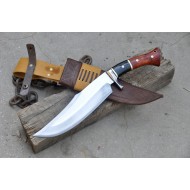
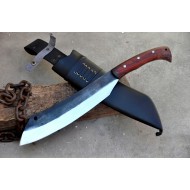
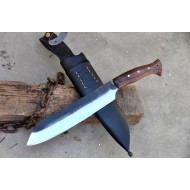
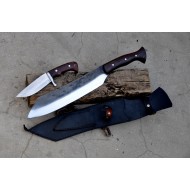
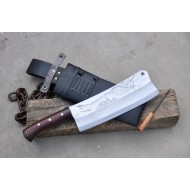
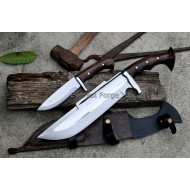
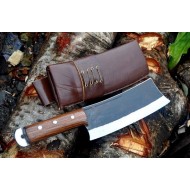
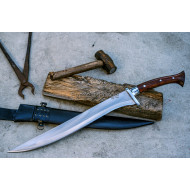
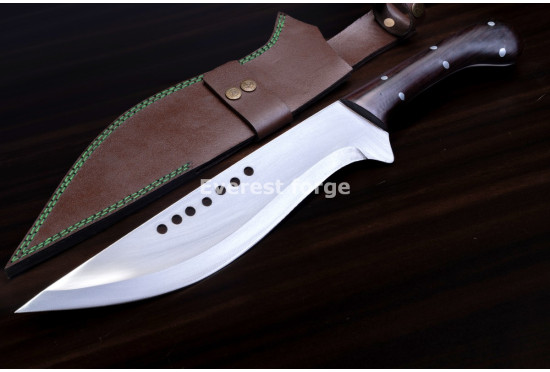
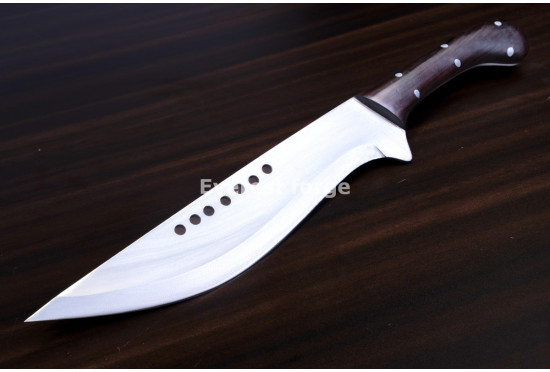
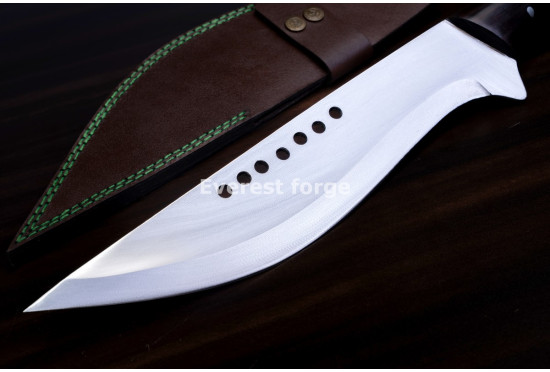
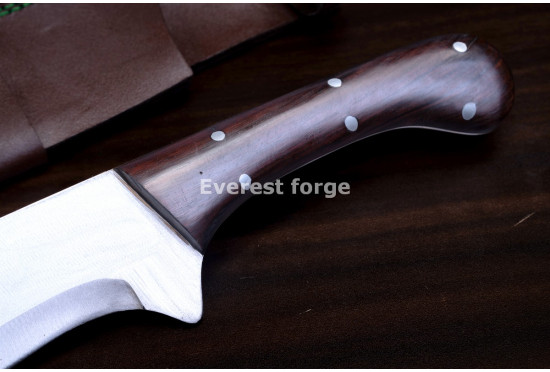
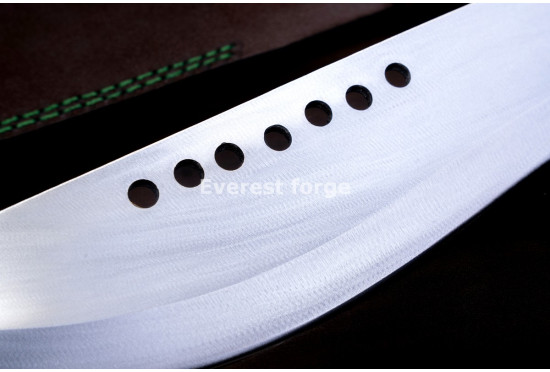
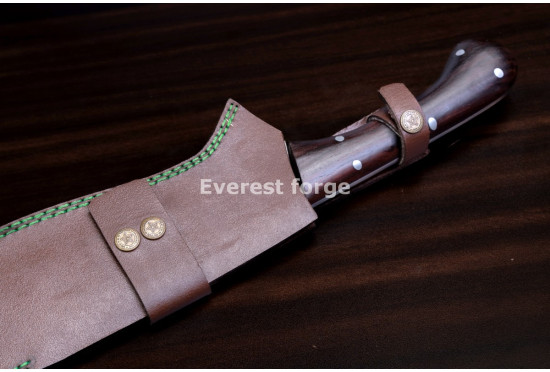
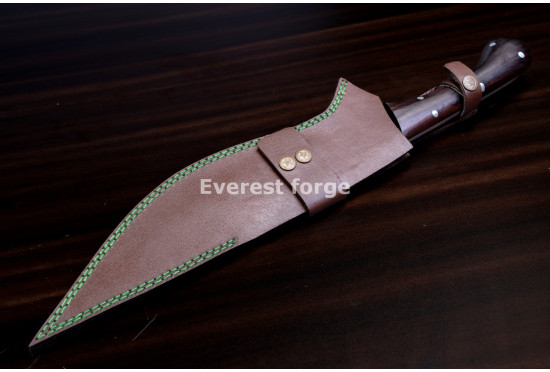
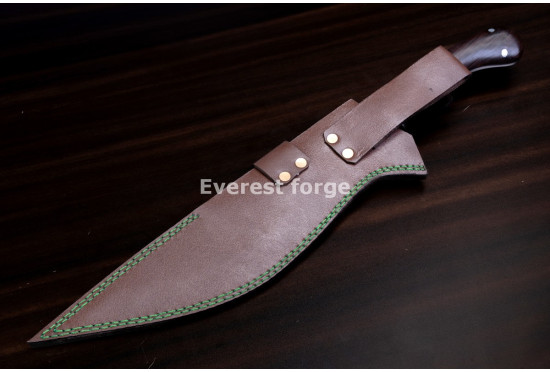
This is a 12 inch hand-forged machete: a short heavy chopping blade with a forward curve and a deep belly, pierced with six graduated holes running along the upper blade and stepped at the ricasso into an angular shoulder. The grip is contoured rosewood slabs pinned through the tang in five places with a black spacer at the shoulder and a rounded flare at the butt. Overall length is 18.5 inches and it weighs approximately 810 grams, which makes it the densest blade we forge for its length. It is made from 5160 high-carbon steel in Tokha-3, Kathmandu, and ships in a flat brown leather sheath saddle-stitched in green with brass press studs. The design takes its cue from the post-apocalyptic blade carried in the film The Book of Eli, forged as our own original piece rather than as a copy.
An honest note. This is an independent piece made by Everest Forge. It is not an official or licensed product, and we are not affiliated with, endorsed by or connected to the makers or rights holders of The Book of Eli. The film is named here only to describe where the look comes from. Two things about the blade itself. It is heavy — 810 grams over twelve inches makes it the densest blade we forge for its length, and that is the point of it rather than a side effect. And the holes are styling: they remove perhaps two or three per cent of the weight, which you will not feel, and we explain why properly below rather than pretending otherwise.
Have This Machete Forged Your Way
Blade length, spine thickness, the hole pattern and the grip are all decided at the forge before your knife is made. Send a sketch or a description and our smiths will quote it.
Start a Custom Forge Order →Why This Machete Is Built the Way It Is
Specifications
Build Options
Is This the Right Blade for You?
Buy This If You Want
- A short chopper with real mass, for working close in and in tight country
- A grip you can hold for an hour of cutting without a hot spot
- Full tang construction with five pins, which is what a blade this heavy needs
- A distinctive blade that will be recognised across a campsite
- A forged carbon-steel tool rather than a stamped stainless one
Look Elsewhere If You Want
- Lightening holes that actually lighten the blade — ask for a thinner spine instead
- Reach; at 12 inches this works close and a long machete clears far more ground per swing
- A traditional Nepali kukri, which this is not — see the answer below on the cho
- Something light to carry all day, since this is the densest blade we make for its length
- A stainless blade needing no care, since 5160 is carbon steel and will rust if left wet
Tell Us What You Are Cutting
Blade length, spine thickness and grind should follow the work rather than a catalogue. Describe your ground and our smiths will tell you what to order.
Talk to the Forge →How to Order
Who This Machete Is For
- Campers and bushcrafters who want chopping power without a long blade to swing
- Smallholders working in tight ground where a full-length machete keeps catching
- Anyone who already owns a long machete and wants the close-in tool to go with it
- Collectors of modern forged blades who want something that does not look like everything else
What Is Included
- One hand-forged machete, sharpened and ready to work
- Fitted flat brown leather sheath with green stitching and brass press studs
- Certificate of hand-forging from the workshop
- Everest Forge manufacturer warranty against defects in forging and heat treatment
Explore the Collection
Shipping, Returns and Care
Stock pieces are dispatched within two to three business days. Custom builds take four to six weeks at the forge before they ship. Everything travels tracked with DHL or FedEx and typically arrives in seven to fourteen business days. Every piece carries the Everest Forge manufacturer warranty against defects in forging and heat treatment.
Large fixed blades are restricted in some countries and in some states and provinces within them. It is your responsibility to check that this machete may lawfully be imported and possessed where you live before ordering, because a parcel seized by customs cannot be returned to us and cannot be refunded. Ask us before you buy if you are unsure and we will tell you what we know about your destination.
5160 is a high-carbon steel and it will rust if left wet or stored damp. Wipe the blade dry after use and keep a light film of oil on it, and pay particular attention to the inside of the drilled holes, which hold moisture and are the easiest place on this knife to miss. A cotton bud or a twist of cloth does it. Do not store the machete in the sheath for long periods. The rosewood scales take an occasional coat of oil.
Frequently Asked Questions
Why is a short blade this heavy?
Because it is a different way of solving the same problem. A chopper needs energy at the point of impact, and there are two routes to it: length, which gives you tip speed and lets a lighter blade arrive fast, or mass, which lets a shorter blade arrive slower and still hit hard. Long-and-light is more efficient per swing and clears more ground, which is why a proper machete is eighteen inches or more and thin. Short-and-heavy wins where you cannot take a full swing — in undergrowth, close to your own body, kneeling, working at a stump, or anywhere a long blade would catch on something behind you. At eight hundred and ten grams over twelve inches this is the densest blade we forge for its length, and that is deliberate. It is the tool you reach for when there is no room for the other one.
Do the holes weaken it?
Not meaningfully, given where they are, but the principle is worth understanding. Any hole in a loaded piece of steel is a stress concentration — force flowing through the material has to divert around it and bunches up at the edges of the opening, which is why aircraft windows are rounded and not square. On a blade, the loads that matter run along the spine under impact and across the section under bending. The holes here sit in the upper blade, away from the edge and away from the spine, in the part of the blade doing least structural work, and they are round, which is the shape that concentrates stress least. So this is a sound arrangement. Where we would refuse is holes cut close to the tang shoulder, close to the edge, or with sharp corners, all of which put an opening exactly where the steel is working hardest. If you send us a design with holes in those places, we will tell you and suggest moving them.
Is this a kukri?
No, and we are going to be precise about why, because the shape invites the question. The blade has the forward curve and the deep belly people associate with a kukri, but it does not have a cho: the notch filed into the edge just ahead of the handle that appears on every genuine Nepali kukri, catches fluid away from the grip and stops a crack running back out of the edge into the tang. We say on every one of our kukri pages that a blade with no cho did not come from a Nepali kukri tradition, and we are not going to make an exception for our own product. This is a modern machete made by Nepali smiths, which is a different thing from a Nepali kukri, and both are worth having. If you want the traditional article, our bhojpure and sirupate pages are where to look and both carry a hand-cut cho.
Do the holes make the blade lighter?
Barely, and it is worth doing the arithmetic rather than taking anyone's word for it. Six holes of this diameter through steel of this thickness remove somewhere around fifteen to twenty-five grams. The blade weighs eight hundred and ten. That is two or three per cent, which is smaller than the difference you would find between two hand-forged blades of the same pattern made on the same day, and it is nowhere near enough to feel. Genuine weight reduction on a chopper comes from two places: a thinner spine, which removes metal along the entire length, and a wider bevel, which removes it from the whole face of the blade. Either of those will take a hundred grams off without difficulty and we will forge you either. Holes are a design feature. They look purposeful, which is why they are popular, and there is nothing wrong with buying a knife because you like how it looks.
Why a contoured grip rather than a traditional one?
Comfort over time, at a small cost in retention. A traditional Nepali grip is waisted with a raised ring and a flared butt, and it is superb at one thing: stopping the hand travelling off the back of the blade under a hard swing. What it is not is comfortable for an hour, because those same rings and flares press into specific points of the palm and by the end of an afternoon you know exactly where each one is. A contoured slab grip like this one spreads the load across the whole palm with a swell where the hand closes and a gentle flare rather than a hard one. You give up some of that positive stop, which is why the flare at the butt is still there, and you gain a knife you can use all day. Neither approach is wrong. If you are chopping hard for short bursts, take the traditional grip; if you are working steadily, take this one.
What steel is it, and how is it heat treated?
5160 high-carbon spring steel, brought to temperature in the forge, quenched in oil and tempered back so the edge is hard while the body stays springy. It is the leaf-spring steel Nepali forges have worked for generations and it is a good match for a chopper: tough enough to take repeated impact, and soft enough at our temper that the edge rolls rather than chipping when it finds a stone in the grass. A roll is straightened with a file or a steel in a minute; a chip is a repair. It is not stainless, deliberately, because the stainless grades that genuinely resist rust give up the toughness this tool depends on.
Is it full tang?
Yes. The tang is the full width and shape of the grip with rosewood scales pinned through it in five places, and you can see the line of steel between the scales around the outline of the handle. On a blade of this mass that is the only construction we would fit. A hidden tang, where a narrow spike runs into a solid handle and is secured at the butt, is perfectly adequate on a light knife but works loose at the shoulder under the repeated shock of chopping, and it is the standard failure point on inexpensive heavy blades. Five pins is more than strictly necessary, which is the right side to err on.
Can I baton with it?
Yes. The spine is thick, flat and unsharpened, the tang is full width with five pins, and the blade is built for impact, which is everything batoning asks for. Strike the spine over the belly rather than out near the tip, keep the blade square in the cut so it does not twist, and use a wooden baton rather than a rock. One thing specific to this blade: do not strike over the drilled section. There is no real danger in it, but there is no reason to put repeated hammer blows directly above a row of holes when the rest of the spine is right there.
How sharp does it arrive?
Sharp and ready to work, with a convex working edge put on by hand at the forge. We do not send choppers out with a fine polished edge because it is the wrong edge for the job and will be gone within an hour of real cutting. A slightly coarser edge bites better into green wood and survives contact with grit and soil far longer. If you would prefer it shipped blunt — for display, for a gift, or because of the rules where you live — say so in the order comments and we will send it unsharpened at no extra cost.
How do I sharpen and clean it?
A mill file for the edge, which is the right tool for a chopper: brace the blade, run the file along the bevel in one direction until you feel a burr along the full length, then turn it over and take the burr off with lighter strokes. Two or three minutes restores a working edge and you do not want a razor finish anyway. The one job specific to this knife is the holes. They collect sap, dust and water, and a cloth wiped across the blade passes straight over them, which makes them the place rust will start. Push a twist of cloth or a cotton bud through each one when you oil the blade. It takes thirty seconds and it is the difference between this blade looking the same in five years and not.
How is this different from your Bush Machete?
They are opposite solutions. The Bush Machete is eighteen inches of thin blade at five hundred and ninety grams, built for reach and speed in green growth, with brass fittings and a harness sheath. This is twelve inches of thick blade at eight hundred and ten grams, built for mass in close quarters, with a modern contoured grip and a flat belt sheath. The long one clears far more ground per swing and is the better tool for cane, brambles and undergrowth. The short one works where you cannot swing and hits harder when you do. If you are buying one, buy the long machete for clearing and this for camp. If you are buying both, they genuinely do not overlap, which is unusual for two blades in the same category.
Where is this made, and by whom?
In our own workshop in Tokha-3 on the northern edge of Kathmandu, Nepal, by around ten smiths, most from families that have forged blades for generations. Everest Forge has operated since 2010, and we forge, grind, heat treat, fit the grips and cut the leather in the same building. This is a modern design rather than a traditional Nepali one, and we would rather say so than let the address imply otherwise. What the address does mean is that it was forged by people who make chopping blades for a living in a country where chopping blades are used every day, which is not the same as a factory pressing a shape out of bar stock.
| Specification | |
| Blade: | 12 inches. Hand forged from 5160 carbon steel |
| Total Length: | 18.5 inches |
| Handle: | 6.5 inches. Full tang with contoured rosewood scales pinned through in five places |
| Weight: | approx 810g machete, 1060g with sheath |
| Note: | Some variation in weight, dimensions and finish may occur as each piece is hand forged. Keep the blade lightly oiled and clear the drilled holes when oiling |