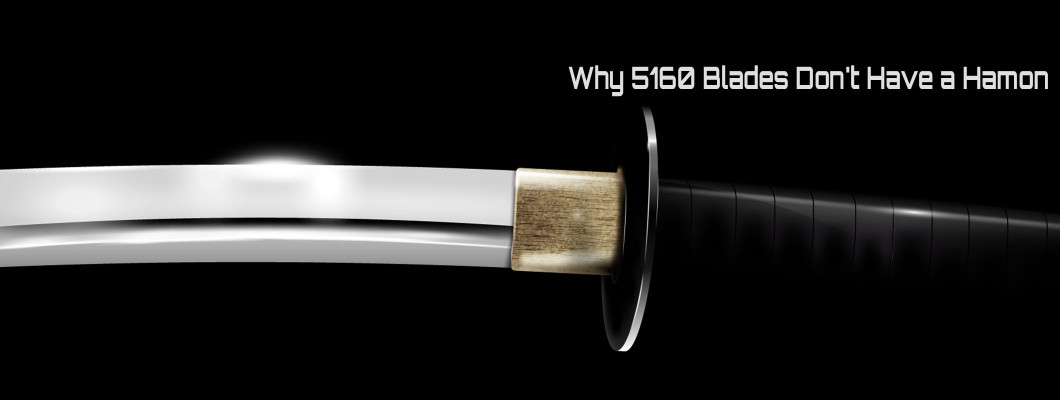
Why 5160 Blades Don't Have a Hamon
Because 5160 hardens too easily. A hamon only appears when part of a blade fails to harden — the clay on the spine slows its cooling, the spine stays soft, and you see a line where hard meets soft. 5160 contains chromium and manganese, both of which make steel harden more readily and more deeply, and so the spine hardens anyway even under clay. Nothing stays soft, so there is no boundary, so there is no hamon. That is the whole answer. What follows is why we chose a steel that behaves this way, what you can get on 5160 if you want a line, and why we think it is the right trade for a blade that will actually be used.
What a Hamon Actually Is
A hamon is not a decoration and it is not a temper line, though it is often called one. It is the visible boundary between two different crystal structures inside the same piece of steel.
It is made during the quench. Before the blade is heated, a clay slurry is painted on — thick along the spine, thin or absent along the edge. When the blade goes into the water or oil, the bare edge is in direct contact with the liquid and cools fast enough to become hard martensite. The clay-covered spine is insulated, cools more slowly, and stays softer.
The wavy, cloudy line you can see is where those two structures meet. Move the blade in the light and it changes, because you are looking into the metal rather than at its surface.
The full process is covered in our guide to heat treatment and tempering.
The Property That Decides It: Hardenability
Here is the part that answers the question, and it is not about carbon content.
Hardenability means how readily a steel hardens, and how deep into the metal that hardening reaches. It is not the same as hardness. A steel can reach a very high hardness and still be shallow-hardening, and that combination is exactly what a hamon needs.
Shallow-hardening steels — traditional Japanese tamahagane, and modern equivalents like W1, W2 and 1095 — only harden where the cooling is genuinely fast. Slow that cooling down even a little and they do not transform. Put clay on the spine of a W2 blade and the spine stays soft, and you get a crisp, active hamon.
Deep-hardening steels harden readily and all the way through. Alloying elements such as chromium, manganese and molybdenum raise hardenability, which is what these elements are for.
5160 has chromium in it, and manganese. The 5 at the front of the name means it is a chromium steel. Both elements raise hardenability, so it hardens fully in oil where a plain carbon steel would need water, and it hardens through the whole cross-section of the blade rather than just at the surface.
So the clay does not work. You can paint it on, quench the blade, and the spine will harden underneath it.
This is not a theoretical objection. Professional bladesmiths have tested it and published the results on the trade forums: clay-coated 5160 blades, fully normalised, quenched in fast oil and etched, come out with faint smudging and no line worth following. One maker reported running more than fifty thermal cycles to try to drop the hardenability far enough for clay to bite, and still got nothing. The consistent conclusion from people who make blades for a living is that clay does very little on this steel.
The trick only works on steel that needs speed to harden. 5160 does not need it.
You Can Get a Line on 5160 — Just Not With Clay
Worth being precise here, because the honest answer is not simply "no".
Clay works by slowing the cooling of the spine. On 5160 that fails, because the steel hardens even when cooled slowly. But there is a second route to a differentially hardened blade, and it works on 5160: instead of controlling how the blade cools, you control how it heats.
If only the edge is brought above critical temperature, only the edge can transform when the blade is quenched. The spine was never hot enough to harden, so it stays soft regardless of how deeply the steel would otherwise harden. Smiths do this by heating just the edge portion in the forge, or by bringing the whole blade up to temperature and then playing a torch along the edge to lift it back above critical just before the quench — which has the side benefit of an extra thermal cycle and some stress relief.
The result is a real structural boundary and a visible line. What it is not is a hamon in the Japanese sense. There is no clay-drawn shape, and the fine activity that collectors look for in a proper nioi — the cloudiness, the wisps, the features that shift in raking light — comes from a shallow-hardening steel behaving in ways 5160 will not. You get a quench line. You do not get the thing the word describes.
So if someone shows you a 5160 blade with a line on it, they are not necessarily faking anything. They may have differentially heated it. The useful question is which method was used, and what the line actually is.
Why We Use a Steel That Behaves This Way
This is a deliberate choice, so it is worth stating what we are choosing and what we are giving up.
A differentially hardened blade has a hard edge and a soft back. That is a genuinely clever solution, and in medieval Japan it was the right one — the steel available was inconsistent, and giving the blade a hard edge and a resilient spine got the best out of it.
But it also means the blade has a boundary inside it, between two materials with different properties. Boundaries are where cracks like to start. And a soft spine bends: put enough lateral stress through a differentially hardened blade and it takes a permanent set rather than springing back.
A through-hardened 5160 blade tempered to a spring temper has no boundary. It flexes along its whole length and returns straight. That is the behaviour you want in a blade that will be struck — a battle ready sword, a stage combat blade, a kukri, a machete, an axe. It is the same property that makes 5160 the steel used in vehicle leaf springs, which spend their lives absorbing repeated impact without cracking.
So the trade is this: we could switch to a shallow-hardening steel and produce a genuine hamon. We would be giving up that toughness to do it. For the blades we make, that is a bad exchange. A line on the surface is worth less than a blade that bends rather than breaking.
The reasoning behind the whole standard is set out on our battle ready page, and the case for the steel itself in our guide to why we forge in 5160.
And We Do Not Fake One
It is easy to put a hamon-like line on a blade that does not have one. Acid etching, wire brushing, sandblasting through a mask — all of them produce a pale line along the blade that photographs convincingly.
We do not do it, on any blade, and we would rather explain why there is no hamon than paint one on.
If you are looking at a blade elsewhere and want to know which you are seeing, the tells are consistent:
- A real hamon has depth. Grainy, cloudy, with activity that shifts as you tilt the blade in the light.
- It is irregular, because the transformation it records was irregular. Perfectly even is a warning sign.
- An etched line is flat. It sits on the surface, looks the same from every angle, and often runs at a suspiciously constant width down the whole blade.
- Ask directly. "Is this differentially hardened, or is the hamon applied?" An honest seller answers in one sentence. There is nothing wrong with an etched finish if it is described as one — the problem is when it is sold as heat treatment.
If You Want a Real Hamon
Then you want a shallow-hardening steel, and you should buy from someone who works in one. W2, W1, 1095 and traditional tamahagane all clay-temper properly, and a well-made differentially hardened blade is a beautiful thing.
Know what comes with it. Shallow-hardening steels are less forgiving in the quench, more blades are lost making them, and the finished blade has a soft spine that can take a set. For a blade that will be displayed, cut soft targets, or admired for the craft in it, none of that matters much. For a blade that will be hit, it does.
If you have a specific requirement, talk to us before assuming either way — through custom forge we will tell you honestly what a given steel and heat treatment will and will not give you, rather than promising a result the material cannot produce.
Ask Us What the Steel Can Actually Do
Every blade we make is forged from 5160 high-carbon spring steel, oil quenched, through-hardened and tempered by hand in Tokha-3, Kathmandu. No hamon, and no etched imitation of one. Tell us what the blade has to do and we will tell you straight what the steel will give you.
Frequently Asked Questions
Why doesn't 5160 steel produce a hamon?
Because it hardens too readily. A hamon only appears when part of the blade fails to harden, which is what the clay on the spine is meant to cause. 5160 contains chromium, which raises hardenability, so the steel forms martensite readily and deeply and the spine hardens even under clay. With nothing left soft there is no boundary, and with no boundary there is no hamon.
Can carbon steel have a hamon?
Yes — plain carbon steels are the best steels for it. W1, W2 and 1095 are shallow-hardening, meaning they only harden where cooling is genuinely fast, so clay on the spine keeps it soft and produces a crisp line. The property that matters is hardenability rather than carbon content, which is why an alloy steel like 5160 does not work for this while a simpler carbon steel does.
Can you get any kind of line on 5160?
Yes, but not with clay. Clay works by slowing the spine's cooling, which fails on 5160 because it hardens even when cooled slowly. The route that does work is differential heating rather than differential cooling: bring only the edge above critical temperature, either by heating just that portion or by torching the edge back up before the quench, and the spine cannot harden because it was never hot enough. That gives a genuine structural boundary and a visible quench line — but not the fine activity of a true hamon, which comes from shallow-hardening steel.
Is a blade without a hamon lower quality?
No. A hamon tells you a blade was differentially hardened, not that it was well made. A through-hardened blade tempered to a spring temper has no internal boundary between two structures, flexes along its whole length and returns straight, which is the behaviour you want in a blade that will be struck. Differential hardening gives a hard edge on a soft back, and that soft back can take a permanent bend.
What is hardenability?
How readily a steel hardens and how deep into the metal that hardening reaches. It is not the same as hardness — a steel can reach very high hardness and still be shallow-hardening. Alloying elements such as chromium, manganese and molybdenum raise hardenability, which is why 5160, a chromium steel, hardens fully in oil and all the way through the blade.
How do I tell a real hamon from an etched one?
A real hamon has depth and texture — grainy, cloudy, with activity that shifts as you tilt the blade in the light — and it is irregular, because the transformation it records was irregular. An etched line is flat, sits on the surface, looks the same from every angle and often runs at a suspiciously constant width. Ask the seller directly whether the blade is differentially hardened or the hamon is applied.
Would you make a blade with a real hamon?
It would mean a different steel, since 5160 cannot produce one. Shallow-hardening steels such as W1, W2 or 1095 clay-temper properly, but they are less forgiving in the quench and the finished blade has a soft spine that can take a permanent set. If you have a specific requirement, ask through custom forge and we will tell you honestly what a given steel and treatment will and will not give you.