A Saber Is a Curved, Single-Edged Sword Built for the Cut, and Every Type Follows From That
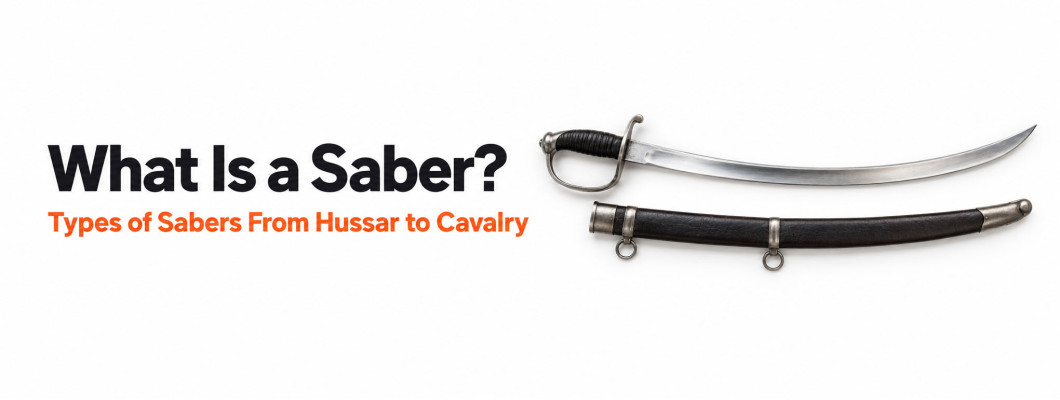
A saber (British spelling: sabre) is a single-edged sword with a curved blade, a guard that protects the hand, and a balance set for cutting rather than thrusting. It began as the sword of steppe horsemen, became the standard cavalry weapon of every European army from the seventeenth century to the First World War, and still exists today as the naval cutlass, the officer's dress sword and the fencing sabre. This guide defines the type, explains what the curve does, and sets out the main kinds of saber, from the Polish hussar's szabla to the British 1796 light cavalry pattern, the American 1860, the Cossack shashka and the Eastern kilij and shamshir, in one comparison table.
For the story of how the sabre spread from the steppe to the cavalry regiments of Europe, read our sabre sword history, which this post builds on. If you are trying to work out whether a blade is a sabre at all, sword vs saber covers that boundary.
Saber or Sabre: Which Spelling Is Right
Both. "Sabre" is the British and Commonwealth spelling and the one used in most historical sources, fencing bodies and museum catalogues. "Saber" is the American spelling, used by the US Army for its cavalry patterns and by most American collectors. The word itself reached English through the French sabre, from the German Säbel, which in turn came from the Hungarian szablya, a trail that neatly follows the weapon's own route into Western Europe. This post uses "saber" in its title because that is how most people search, and "sabre" in the body because that is how the blade is written about in the typological literature. They are the same sword.
What Makes a Sword a Sabre
Typologically, a sabre needs three things. Take any one away and you are looking at a different sword.
A curved blade. The curve can be slight (the British 1821 patterns, the American 1860) or dramatic (the Persian shamshir), but it is there, and it does a specific job. On a straight blade the edge meets the target at one point and stops. On a curved blade the edge is drawn through the target as the arm swings, so a single stroke slices as well as chops. For a rider passing a target at a canter, with no time to set up a thrust, that drawing cut is the whole reason the sabre exists.
A single edge. The cutting edge runs along the convex side of the curve. The back, or spine, is thick for stiffness and is often left blunt, though many sabres carry a sharpened false edge on the last quarter of the back for a back-cut or a thrust. On Ottoman and Hungarian blades that false-edged section widens into a yelman, a flare near the point that adds mass exactly where the cut lands.
A guard built for one hand. Sabres are one-handed swords, used from the saddle with the other hand on the reins. The hilt therefore protects the hand on its own: a cross-guard with a knuckle-bow, a stirrup hilt, a D-guard, or a full basket or bowl on later naval and heavy cavalry patterns. The grip is usually canted slightly forward to line the edge up with the forearm, and on Polish and Hungarian hilts a thumb-ring on the inside of the guard locks the hand in for the cut.
Two things a sabre does not need: it does not need to be light (the American M1840 weighs well over a kilogram and was nicknamed the "Old Wristbreaker"), and it does not need to be short (most cavalry sabres carry a blade of 80 to 90 cm). Length and weight vary with the job; curve, single edge and a guarded one-handed hilt do not.
Where the Sabre Came From
The curved single-edged sword is a steppe invention. Straight double-edged swords ruled the ancient Mediterranean and early medieval Europe because they suited infantry and could both cut and thrust. The sabre appeared among the Turkic and Mongol horse peoples of Central Asia and spread west with them: Avar and Khazar graves of the eighth and ninth centuries hold the earliest recognisable sabres, slightly curved, single-edged, with a short cross-guard and a grip canted toward the edge. The Magyars carried the type into the Carpathian basin, which is why Hungary became the sabre's European home.
From the steppe the design went in two directions. Eastward and southward it became the Ottoman kilij, the Persian shamshir, the Indian talwar and the Arab saif, each adapting the curve to its own fencing tradition. Westward it entered Poland and Hungary in the fifteenth and sixteenth centuries through constant war with the Ottomans, and from there it was copied by the Austrians, then the Prussians, the French and finally the British, who in 1796 produced the cavalry sabre that defined the Napoleonic Wars. The history of the sabre sword follows that journey in detail; what follows here is the typology.
Types of Sabers Compared
The table groups the main sabre types by region and period. Blade lengths are typical ranges for historical examples, not fixed values; a hand-forged reproduction can be built to any length within the type's historical envelope.
| Type | Region and period | Blade and curve | Hilt | What sets it apart |
|---|---|---|---|---|
| Kilij | Ottoman Turkey, 15th to 19th c. | 70 to 80 cm, moderate curve, pronounced yelman | Cross-guard with down-turned quillons, pistol-grip pommel | The flared, false-edged yelman that loads the cut; parent of most European hussar sabres |
| Shamshir | Persia, 16th to 19th c. | 75 to 90 cm, deep radial curve, no yelman, tapers to a fine point | Simple cross-guard, grip bent sharply toward the edge | The most curved of all sabres; a pure drawing-cut weapon, almost useless for the thrust |
| Talwar | India, Mughal period onward | 70 to 80 cm, moderate curve, often fullered | Disc pommel, short quillons, often a knuckle-bow; all-steel Indo-Muslim hilt | The disc pommel and the small grip that forces a locked-wrist cut |
| Szabla (Polish hussar sabre) | Poland-Lithuania, 16th to 18th c. | 80 to 85 cm, moderate curve, often a yelman | Closed hilt with knuckle-bow and thumb-ring; karabela form has an eagle-head pommel and open cross | The thumb-ring; the first European sabre built for a trained cavalry fencing system |
| Hungarian hussar sabre | Hungary and Austria, 17th to 18th c. | 80 to 85 cm, strong curve widening toward the point | Stirrup or knuckle-bow hilt, often a thumb-ring | The pattern every other European army copied; the direct ancestor of the British 1796 |
| British 1796 Light Cavalry | Britain, 1796 to 1821 | About 83 cm, pronounced curve, blade widens toward the tip | Iron stirrup hilt, leather grip | Le Marchant's design after the Austrian 1768; the most feared cutting sabre of the Napoleonic Wars |
| French AN XI / 1822 light cavalry | France, 1802 onward | 85 to 90 cm, gentle curve | Three-bar brass guard | The three-bar guard that became the standard European and American cavalry hilt |
| US M1840 heavy cavalry | United States, 1840 to 1860s | About 90 cm, slight curve, heavy | Three-bar brass guard, leather and wire grip | The "Old Wristbreaker": a French AN XI copy, carried into the Civil War |
| US M1860 light cavalry | United States, Civil War to 1913 | About 85 cm, slight curve, narrower and lighter than the 1840 | Three-bar brass guard | The classic American cavalry saber; the type most people picture |
| Naval cutlass | European navies, 17th to 20th c. | 60 to 75 cm, slight to moderate curve, broad | Figure-of-eight guard (British 1804), bowl guard (1845), cup guard (US M1860) | Short and heavy for fighting between decks and in rigging; a sabre cut down to the ship |
| Shashka | Caucasus, Cossacks, Russian army, 18th to 20th c. | 75 to 85 cm, slight curve | No guard at all; hooked pommel, carried edge-up in the scabbard | The only sabre type with no hand protection; drawn and cut in one motion |
| Briquet (infantry sabre) | France and allies, 1790s to 1830s | About 60 cm, slight curve | Cast brass single-piece hilt with knuckle-bow | The short sidearm issued to infantry and artillery; a sabre for men on foot |
| Mameluke sword | Western officers, 1800s to today | 75 to 80 cm, moderate curve | Cross-hilt with ivory or bone grip, no knuckle-bow | An Ottoman-style sabre adopted as an officer's dress sword; still worn by US Marine Corps officers |
| Fencing sabre | Italy and Hungary, 1880s to today | About 88 cm, straight or nearly so, flexible | Full knuckle-guard cup | A sporting descendant that keeps the cutting rules and loses the curve |
A note on the words. "Scimitar" does not appear in the table because it is not a type; it is a Western umbrella word for any Eastern curved sword, covering the kilij, shamshir, talwar and saif together. We will publish a dedicated identification guide to those four; until it is live, the sabre history post has a section on the Eastern influences.
Eastern Sabres and Western Sabres: The Real Difference
Collectors tend to split sabres into Eastern and Western, and the split is useful if you know what it actually marks. It is not the curve. Some Western sabres (the 1796 light cavalry) are more curved than some Eastern ones (many talwars). The difference is in the hilt and in how the sword was meant to be held.
Eastern sabres, the kilij, shamshir, talwar and saif, keep a short cross-guard and little or no knuckle protection, because their fencing systems rely on the blade and on movement rather than on a guard. The hand is protected by not being there when the other blade arrives. The grips are small, and the talwar's disc pommel and the shamshir's sharply bent grip both force the wrist to lock, so the cut is delivered from the shoulder and elbow with a fixed wrist angle. Many of the finest Eastern blades were made of wootz, the crucible steel of Persia and India, with its visible watered pattern.
Western sabres grew a knuckle-bow, then bars, then a full bowl, because European cavalry fought in formation, sword against sword, where a parry was expected and the hand was the first thing to be hit. The grips are longer, often with a thumb-ring or a canted pommel to line the edge up, and the blade is usually plainer, with one or two fullers and a straight or slightly curved spine. European sabres from the eighteenth century onward were made of homogeneous steel, not pattern-welded.
An honest note. Everest Forge forges every sabre from mono-steel 5160 spring steel. We do not make wootz, pattern-welded or folded steel, so a hand-forged shamshir or kilij from this forge will not show the watered pattern of a Persian or Ottoman original. What it will have is a blade that is tougher and more consistent under heat treatment than any historical steel, which for a sword built to be cut with is the better trade.
Light Cavalry, Heavy Cavalry and the Cut-Versus-Thrust Argument
From the 1790s to 1914 European armies argued about whether a cavalry sword should cut or thrust, and the argument shaped the sabre more than any single battle. Light cavalry, the hussars and light dragoons, were raiders and skirmishers who fought at speed against men who were often fleeing; they wanted a curved cutting sword, and the British 1796 Light Cavalry sabre, designed by John Gaspard Le Marchant after the Austrian pattern, was the perfect expression of it: a broad blade that widened toward the point so the cut landed heavy. French surgeons after the Peninsular War complained about the wounds it made.
Heavy cavalry, the dragoons and cuirassiers who charged formed infantry and other cavalry, wanted the point. Their swords were straighter and stiffer; the British 1796 Heavy Cavalry sword is barely curved at all, and strictly it is a backsword rather than a sabre. Through the nineteenth century the thrust slowly won the theoretical argument, and the British 1908 pattern, a straight thrusting sword with a pistol grip and a bowl guard, is often called the last cavalry sword and the best. It arrived just in time for machine guns. The practical lesson for anyone choosing a sabre today is that the curved light-cavalry type is the one that cuts, and the straight heavy types are for the thrust; if you want one sword to do both, a moderately curved blade with a sharpened false edge, the Hungarian or the 1796 type, is the historical compromise.
The Sabre in America
The United States took its sabres from France. The M1840 heavy cavalry saber was a copy of the French AN XI, heavy enough to earn its nickname, and the M1860 light cavalry saber lightened it for the Civil War. Both were made in huge numbers by Ames and others and both were carried on both sides; our guide to the swords of the American Civil War covers the patterns and who carried them. The M1860 remained the issue sword until the M1913 "Patton" sabre replaced it with a straight thrusting blade, which, like the British 1908, saw almost no use. The Mameluke sword worn by Marine Corps officers is the one American sabre still in service, a dress survival of an Ottoman design adopted in 1825.
How a Sabre Is Used
A sabre is cut with, and the cut is a draw. The edge is placed on the target with the arm already moving, and the curve pulls the edge through as the stroke continues, so the blade slices rather than wedges. Cavalry manuals taught a small number of cuts, numbered by direction, and a moulinet, a circular recovery that keeps the blade moving between cuts without stopping the arm. Parries are taken on the forte, the thick third of the blade near the hilt, with the guard doing the rest.
The thrust exists, especially on the straighter patterns and on blades with a sharpened false edge, but it is secondary: a deeply curved shamshir cannot thrust usefully at all, and a 1796 light cavalry sabre thrusts badly. If a sword's primary attack is the thrust, it is not really a sabre, whatever its curve.
Choosing a Hand-Forged Sabre Today
Everest Forge forges sabres on demand, from mono-steel 5160 spring steel with a full tang, in the curved sword collection. Nothing is held in stock; every blade is forged after the order is placed. The sabre types we build most often are these.
- Hungarian sabre. The hussar pattern: a strongly curved blade widening toward the point, a stirrup hilt and the balance of the sword that taught Europe to cut. Our hand-forged Hungarian sabre is the one to choose if you want the historical root of every later cavalry sabre.
- British cavalry sabre. Built on the 1796 light cavalry pattern with its iron stirrup hilt and heavy cutting tip. The British sabre sword is the Napoleonic cutter.
- D-guard sabre. A full D-shaped knuckle-guard over a moderately curved blade, the form of the naval cutlass and the later nineteenth-century cavalry patterns. The D-guard sabre gives the most hand protection of the three.
- Custom sabre. Any type in the table above, or your own combination of curve, length, guard and grip. Start with the custom sabre page or, for a longer blade, the 30-inch custom sabre; blade length, finish and handle are all selectable at order time.
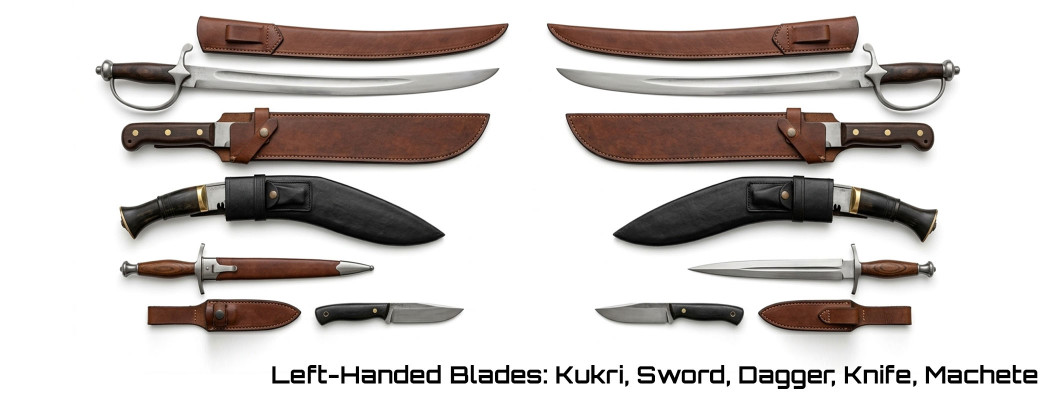
If you want to see the combination before you commit, the blade configurator lets you set type, length, finish and handle in one screen and shows the build. Any sabre can be ordered left-handed by writing "Left Handed" in the order note, and any sabre can be ordered to stage-combat specification, blunt edge and rounded tip, the same way. Catalogue builds dispatch in 2 to 3 business days; custom builds take 4 to 6 weeks at the forge; shipping is DHL or FedEx, tracked, 7 to 14 business days worldwide.
Two practical points when choosing. First, decide between cut and display before you decide on a type: a deeply curved shamshir is beautiful and almost purely a cutter, while a lightly curved 1860-type sabre is the better all-rounder and the easier one to learn with. Second, match the guard to the use: if you plan to fence or do stage work, take the D-guard or a knuckle-bow; if the sword is for the wall or for cutting practice alone, the open Eastern hilts are the more authentic choice.
Related Guides
Commission the Sabre Type You Want, Forged to Your Specification
Kilij, shamshir, hussar, 1796, 1860, cutlass or shashka: tell us the type, the curve, the length and the guard. The forge quotes it, builds it in 4 to 6 weeks from 5160 spring steel, and ships it tracked worldwide.
Start a Custom Forge RequestFrequently Asked Questions
What is a saber?
A saber (sabre) is a one-handed sword with a curved, single-edged blade and a guard that protects the hand, balanced for cutting rather than thrusting. It originated among the horse peoples of the Eurasian steppe and became the standard cavalry sword of Europe and the Middle East.
Is it saber or sabre?
Both are correct. "Sabre" is the British spelling used in most historical and fencing sources; "saber" is the American spelling used for the US cavalry patterns. They describe the same sword.
What is the difference between a saber and a scimitar?
A sabre is a defined sword type. "Scimitar" is a Western catch-all word for Eastern curved swords such as the kilij, shamshir, talwar and saif, all of which are sabres in the typological sense. Every scimitar is a sabre; not every sabre is called a scimitar.
What is the difference between a saber and a cutlass?
A cutlass is a short, broad sabre built for naval use, with a blade of roughly 60 to 75 cm and a large guard, so it could be used between decks and in rigging. It is a sabre type, not a separate family.
Why are sabers curved?
The curve lets the edge draw through the target as the arm swings, so one stroke slices as well as chops. For a rider passing a target at speed, with no time to set up a thrust, that drawing cut is far more effective than a straight chop.
What is a yelman?
The yelman is a widening of the blade near the point, usually with a sharpened false edge on the back, found on the Ottoman kilij and many hussar sabres. It adds mass where the cut lands and allows a back-cut.
Which saber type is best for cutting practice?
A moderately curved sabre with a sharpened false edge, such as the Hungarian or British 1796 light cavalry type, cuts hard and still thrusts. A deeply curved shamshir cuts beautifully but cannot thrust; a lightly curved 1860 type is the easier all-rounder to learn with.
Does Everest Forge make sabers from Damascus or wootz steel?
No. Every Everest Forge sabre is forged from mono-steel 5160 spring steel. Historical Persian and Ottoman blades were often wootz crucible steel with a watered pattern; our blades will not show that pattern, but 5160 is tougher and more consistent under heat treatment.
Can I order a saber left-handed or for stage combat?
Yes. Write "Left Handed" in the order note for a left-handed build, or ask for stage-combat specification (blunt edge, rounded tip) the same way. Either applies to any sabre in the catalogue or a custom build.
How long does a hand-forged saber take to arrive?
Catalogue sabres dispatch in 2 to 3 business days; custom sabres take 4 to 6 weeks at the forge. Shipping is DHL or FedEx, tracked, 7 to 14 business days worldwide.