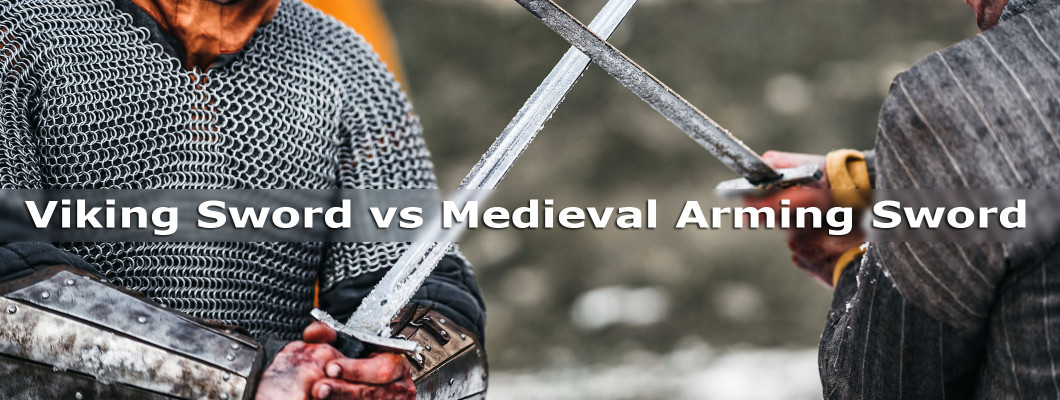
Viking Sword vs Medieval Arming Sword – What Really Changed?
At first glance, Viking swords and later medieval arming swords look very similar. Both are one-handed, double-edged weapons designed for real combat. But when you look closer, they reflect two very different fighting systems, shaped by changes in armor, battlefield tactics, and forging techniques over time.
The Viking sword belongs to an earlier warrior culture built around shields, mobility, and powerful cutting strikes. The medieval arming sword, which developed later, shows a clear shift toward versatility—especially the ability to thrust effectively against better-protected opponents.
Side-by-Side Comparison
| Feature | Viking Sword (c. 800–1050 AD) | Medieval Arming Sword (c. 1000–1500 AD) |
|---|---|---|
| Purpose | Built primarily for cutting and chopping in close combat | Designed for both cutting and controlled thrusting |
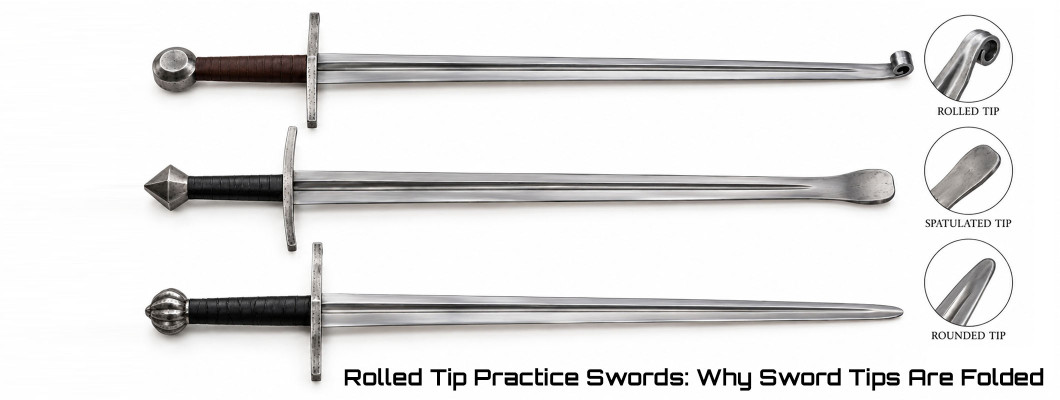
| Blade Profile | Wide blade with parallel edges and a rounded or spatulate tip | More tapered blade with a defined, acute point |
| Fuller | Long, broad fuller running most of the blade length | Fuller varies; often shorter or combined with stronger central ridge |
| Grip & Handling | Short grip, strictly one-handed, used alongside a shield | Still one-handed, but allows more refined control and point work |
| Crossguard | Small and simple, as shield provided main protection | Longer and more pronounced for hand protection and weapon control |
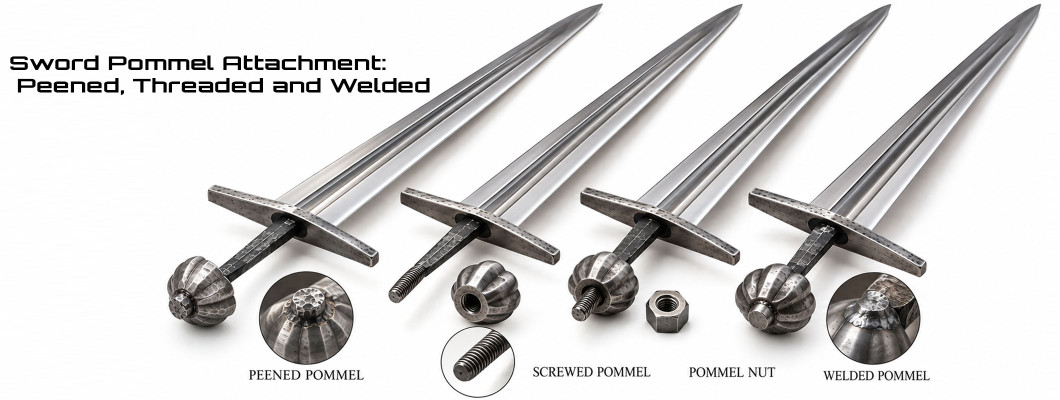
| Pommel Design | Commonly multi-lobed or Brazil-nut shaped for balance | More standardized forms like wheel or scent-stopper pommels |
| Construction | Often pattern-welded cores with hardened edges (not universal) | Improved steel quality with more consistent forging methods |
| Combat Style | Aggressive cutting, used with shield in tight formations | More flexible techniques, including thrusting and defensive play |
| Armor Context | Against lightly armored or mail-wearing opponents | Adapted to heavier mail and early plate armor |
| Weight | Typically around 900g – 1300g | Similar range, usually 800g – 1300g |
Understanding the Evolution
The difference between these swords is not about one being better than the other—it’s about adaptation. Viking swords were extremely effective for their time, delivering powerful cuts in a shield-based fighting system where speed and impact mattered most.
As warfare evolved, so did armor. Chainmail became more common, and later, reinforced armor began to appear. This forced sword design to evolve as well. The medieval arming sword reflects this shift by improving point control and penetration while still retaining strong cutting ability.
In reality, there is overlap between the two. Early medieval swords often look very similar to late Viking swords. The transition was gradual, not sudden. What changed most was not just the sword—but the way it was used.
Final Insight
If the Viking sword represents raw cutting power and battlefield aggression, the medieval arming sword represents refinement—precision, versatility, and adaptation to a changing world of armored combat.
Frequently Asked Questions
What is the main difference between a Viking sword and a medieval arming sword?
The main difference lies in their purpose. Viking swords were primarily designed for powerful cutting and were used alongside shields, while medieval arming swords evolved to handle both cutting and thrusting, especially as armor became more advanced.
Were Viking swords only used for cutting?
Viking swords were mainly optimized for cutting, but they were not limited to it. They could still thrust when needed, although their blade shape—with a more rounded tip—was less effective for penetrating armor compared to later swords.
Did Viking swords have a sharp point?
Most Viking swords had a rounded or slightly tapered tip rather than a sharp, acute point. This design focused more on slashing efficiency rather than precise thrusting.
Are medieval arming swords heavier than Viking swords?
No, both types of swords are surprisingly similar in weight. Most Viking swords and arming swords fall within the range of 800 grams to 1300 grams, making them fast and balanced weapons rather than heavy ones.
Why do medieval swords have longer crossguards?
Longer crossguards provided better hand protection and allowed for more advanced techniques, such as controlling or deflecting an opponent’s blade. This became more important as shield use declined and combat techniques evolved.
Were all Viking swords pattern welded?
No, while pattern welding was common in earlier Viking blades, not all swords were made this way. As steel production improved, simpler but effective construction methods became more widespread.
Can Viking swords and arming swords both be used one-handed?
Yes, both are primarily one-handed swords. Viking swords were almost always used with a shield, while arming swords could be used with or without one, depending on the combat style.
Which sword is better for real use?
Neither is universally better—it depends on the context. Viking swords excel in cutting and close combat, while arming swords offer more versatility, especially against armored opponents.