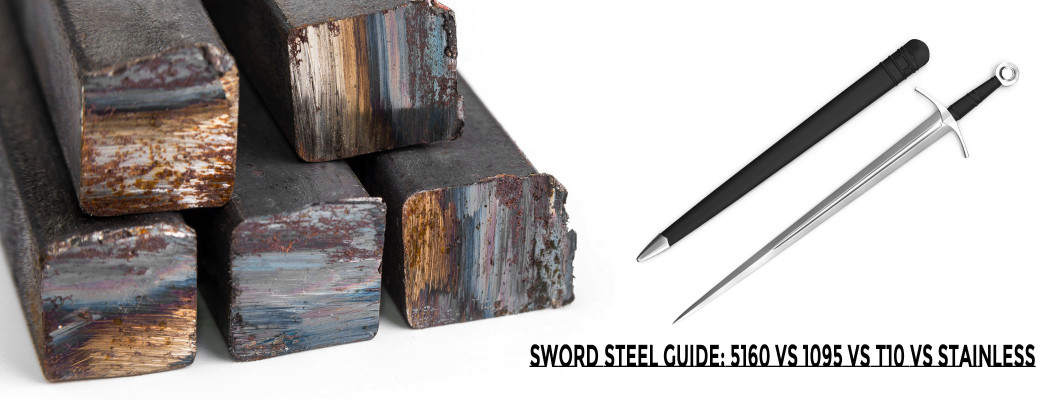
Sword Steel Guide: 5160 vs 1095 vs 1060 vs T10 vs Stainless
There is no best steel for a sword. There is only the right steel for what the sword has to do. A blade built to cut tatami and a blade built to be struck by another blade want opposite things from their steel, and a blade built to hang on a wall wants neither. This guide explains what each of the common sword steels actually does, why the numbers in their names mean something, and why heat treatment matters more than the steel you started with.
The Trade That Decides Everything: Hardness Against Toughness
Every argument about sword steel comes back to one trade-off, and once you understand it the rest of this guide is detail.
Hardness is a steel's resistance to being deformed. Harder steel takes a finer edge, holds it longer, and resists denting. Toughness is its resistance to fracturing — the ability to absorb energy and bend rather than break.
These pull against each other. Push the hardness up and the steel becomes more brittle. Draw it back and the steel becomes tougher but the edge dulls faster and rolls more easily. No steel gives you both at the maximum, and any seller who claims otherwise is selling.
What makes this decisive for swords rather than knives is failure mode — what happens when a blade exceeds its limit. A hard blade fails suddenly and completely: it chips, or it cracks, and the crack runs. A tough blade fails gradually: it bends and takes a permanent set. On a kitchen knife, at eight inches, in your hand, a chip is an annoyance. On a sword, at thirty inches, swung, near other people, a crack is a serious event.
That is why sword steel and knife steel are chosen differently. A knife can afford to sit hard. A sword that will be struck cannot.
What the Numbers Actually Mean
The names are not marketing. Most of them come from the AISI-SAE numbering system, and once you can read it you can tell a great deal about a steel from four digits.
The first two digits say what family it belongs to. 10xx is plain carbon steel — iron and carbon with nothing significant added. 51xx has chromium in it. 92xx is a silicon-manganese steel. The last two digits give the carbon content in hundredths of a percent.
So 1060 is a plain carbon steel with about 0.60 percent carbon. 1095 is a plain carbon steel with about 0.95 percent. 5160 is a chromium steel with about 0.60 percent carbon. Once you know that, you already know that 1095 will take a harder, finer edge than 1060, and that 5160 has something in it the plain carbon steels do not.
Carbon is what allows steel to harden at all. More carbon means a higher achievable hardness and better edge retention — and, past a point, more brittleness. The alloying elements adjust the rest: chromium adds hardenability and some corrosion resistance, silicon and manganese add resilience, tungsten adds wear resistance.
T10 and EN45 sit outside the AISI numbering — T10 is a Chinese tool steel designation and EN45 a British standard for a spring steel — but the same logic applies.
The Steels, One by One
1060 — the balanced middle
A plain carbon steel at about 0.60 percent carbon. It sits in the middle of the trade: harder and better at holding an edge than the low-carbon steels, tougher and more forgiving than 1095. It is straightforward to heat-treat, which matters because a steel that is easy to get right in a workshop produces more consistently good blades than one that is theoretically better and frequently botched.
Very common in production katana and in mid-range swords generally. A good, honest choice, and if someone tells you 1060 is a cheap steel they are confusing the steel with the blades it often appears in.
1075 — a step up in edge
About 0.75 percent carbon. Slightly harder and better at edge retention than 1060, slightly less forgiving. A sensible middle ground and a steel we use on some designs where a finer edge matters more than maximum resilience.
1095 — the edge holder
About 0.95 percent carbon, and the highest-carbon steel in common sword use. It takes a very fine edge and holds it well, and it is the reason 1095 dominates in knives.
The trade is real, though. At sword length 1095 is less forgiving than the spring steels, and it depends heavily on the heat treatment being right. Well heat-treated 1095 is an excellent cutting sword. Badly heat-treated 1095 is brittle, and because 1095 is a name buyers recognise it turns up on a lot of blades whose heat treatment nobody has thought about.
Best for: cutting swords, knives, blades where edge retention is the priority and the blade will not be struck against other steel.
5160 — the spring steel
About 0.60 percent carbon with chromium added. This is a genuine spring steel, and its industrial home is vehicle leaf springs — components that flex under load hundreds of thousands of times without cracking.
That is exactly the property a sword wants. 5160 takes and holds a working edge perfectly well, and its outstanding characteristic is that it absorbs shock and returns to straight. When it is finally overloaded it bends rather than shattering, which is the failure mode you want in a long blade near people.
It is what we forge in, and the reason is not cost — it is that a hand-forged sword that will actually be used should fail safely if it fails at all. Its limitation is honest: 1095 and T10 will hold a finer edge for longer. If your priority is pure cutting performance on a target, they are better steels for the job.
Best for: swords intended for real use, stage combat blades, kukris, machetes, spears, anything that takes impact. The full case for it is in our guide to why 5160 spring steel suits hand-forged blades.
9260 and EN45 — the silicon spring steels
Silicon-manganese spring steels at around 0.60 percent carbon. They are famous for extreme flexibility — 9260 blades are the ones in videos bending through ninety degrees and springing back — and they are genuinely tough.
The trade-off is that all that resilience comes with slightly softer edge behaviour than a high-carbon steel. Good for blades where flex and survivability are the point. We use EN45 on some designs for the same reason.
T10 — the tool steel
A Chinese high-carbon tool steel at around 1.0 percent carbon with tungsten added. The tungsten gives it real wear resistance, so it holds an edge extremely well, and it responds beautifully to clay-tempering, which is why it appears on higher-end katana with a genuine hamon.
It is a fine steel and better than 5160 at edge retention. It is also less forgiving, harder to heat-treat well, and more prone to chipping if the treatment is off.
Stainless — not for swords
Stainless steels such as 420 and 440 contain more than about 10.5 percent chromium, which is what gives them their corrosion resistance. In a kitchen or a pocket knife that is a real advantage and stainless is a sensible choice.
At sword length it is the wrong material, and this is the one point in this guide where there is no nuance. See the next section.
Damascus — a process, not a steel
Worth clearing up because it is constantly sold as though it were a steel. Modern Damascus, properly called pattern-welded steel, is made by forge-welding layers of two or more different steels together and manipulating them so the boundary between them shows as a pattern when etched.
The pattern is real craft and it is beautiful. But the performance of a Damascus blade comes from the steels used in the billet and the heat treatment given to it, not from the layering. Damascus made from good steels and properly treated is excellent. Damascus made from unknown steels is a pattern with a blade attached. Always ask what is in it.
The Steels Compared
| Steel | Carbon | Strength | Trade-off | Best for |
|---|---|---|---|---|
| 1060 | ~0.60% | Balanced, forgiving to treat | Edge retention below 1095 | General purpose swords |
| 1075 | ~0.75% | Finer edge than 1060 | Slightly less forgiving | Working blades, knives |
| 1095 | ~0.95% | Excellent edge retention | Brittle if treated badly | Cutting swords, knives |
| 5160 | ~0.60% + Cr | Outstanding toughness, bends not breaks | Edge dulls sooner than 1095 | Impact use, stage combat, kukris |
| 9260 / EN45 | ~0.60% + Si-Mn | Extreme flexibility | Softer edge behaviour | Flex-critical blades |
| T10 | ~1.0% + W | Superb wear resistance, takes a hamon | Demanding to heat-treat | High-end cutting katana |
| Stainless | Varies, 10.5%+ Cr | Corrosion resistance | Fails catastrophically at length | Kitchen and pocket knives only |
Why Stainless Fails at Sword Length
This deserves its own section because it is the most consequential mistake a buyer can make.
The chromium content that makes stainless resist rust also changes how the steel behaves structurally. Stainless sword blades cannot be heat-treated to the combination of hardness and toughness a long blade needs, and the failure is not gradual. A stainless sword does not bend and warn you. It snaps, often at the tang or partway down the blade, and the broken section keeps the momentum it had.
For a wall hanger that will never be swung, none of this matters, and that is precisely what most stainless swords are made for. The problem is that they are frequently sold with language that does not make that clear.
Never buy stainless for cutting, for training, for reenactment, or for stage combat. If a listing says stainless, says "surgical steel", says "440 steel" without further detail, or does not name the steel at all, treat it as decorative regardless of what else the description claims. What "battle ready" should actually mean is set out on our battle ready standard.
Heat Treatment Matters More Than the Steel
Here is the part that undercuts half of what gets argued about online. A well heat-treated 1060 blade will outperform a badly heat-treated 1095 blade every time. The steel sets the ceiling. The heat treatment determines how close to that ceiling the finished blade gets.
Heat treatment is three stages. The steel is brought to critical temperature, at which its internal structure changes. It is quenched — cooled fast enough to lock in a hard structure. Then it is tempered: reheated to a lower temperature to draw some of that hardness back out and restore toughness.
That third stage is where corners get cut, because tempering takes time and time costs money. An untempered blade is glass. A properly tempered one is a tool.
Hardness is measured on the Rockwell C scale. Most swords land somewhere between the low fifties and the high fifties HRC, with kitchen and pocket knives sitting higher and blades intended for percussive contact sitting deliberately lower. Where a given blade sits is a decision the maker makes, and a maker who cannot tell you what hardness they temper to has not made the decision deliberately.
The practical consequence for buyers: ask about the heat treatment, not just the steel. The steel is on the listing. The heat treatment is the thing that separates two blades made from the same bar.
Which Steel for Which Job
- A sword for cutting practice. 1095, T10, or a well-treated 1060. Edge retention is the priority and the blade is meeting soft targets, not other steel.
- A sword for stage combat. A spring steel, tempered deliberately softer than a cutter so it absorbs percussive contact and takes a set rather than chipping. Never stainless. Covered in full on our stage combat standard.
- A sword for reenactment or HEMA sparring. Spring steel again, to your organisation's equipment specification. Their published spec governs.
- A kukri, machete or axe. 5160 or another spring steel, without hesitation. These are impact tools and toughness beats everything else. A chipped chopper in the field is a real problem.
- A kitchen knife. High carbon for the edge, or stainless if you would rather not maintain it. This is the one place stainless makes genuine sense.
- A display piece that will never be swung. Anything, honestly. Buy for the look and know what you have bought.
What to Ask Before You Buy
- What steel is it, specifically? A number — 1060, 1095, 5160, T10. "High carbon steel" with no further detail is not an answer.
- What hardness is it tempered to? A maker who knows will tell you a figure or a range.
- Was it quenched and tempered, and in what? Oil, water, or clay-tempered.
- If it is Damascus, what steels are in the billet? The pattern tells you nothing about performance.
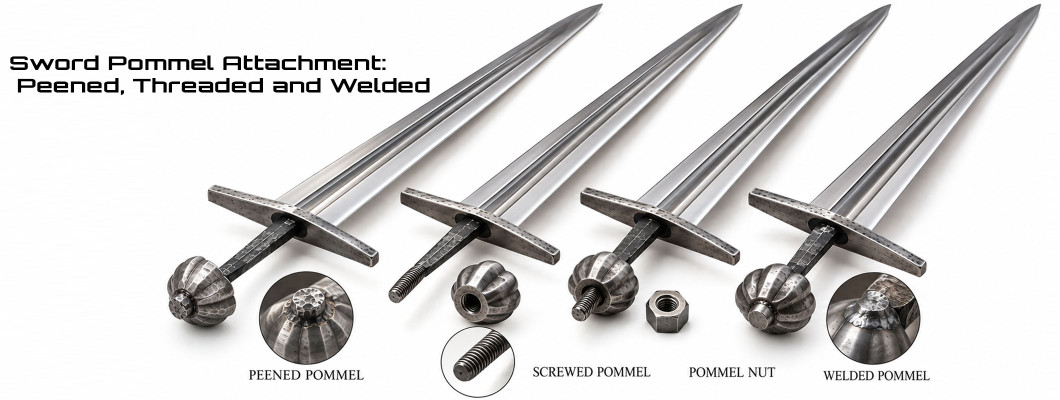
- Is the tang full length, and is the pommel peened or threaded? The best steel in the world does not help if the handle comes off. Covered in why stage combat swords fail.
5160 Spring Steel, Hammered by Hand
Every Everest Forge blade is forged from 5160 high-carbon spring steel, quenched and tempered by hand, and built full tang. Swords, kukris, machetes, spears, daggers and knives — battle ready as standard, with stage combat and custom builds available on request.
Browse Hand-Forged Swords →Frequently Asked Questions
What is the best steel for a sword?
There is no single best steel — it depends on what the sword has to do. For blades that take impact, including stage combat and reenactment, a spring steel such as 5160 is the right answer because it bends rather than shattering. For cutting performance on soft targets, 1095 or T10 hold a finer edge for longer. For anything that will be swung at all, stainless is the wrong choice.
Is 5160 better than 1095 for a sword?
For a sword that takes impact, yes. 5160 is a spring steel that absorbs shock and returns to straight, and when finally overloaded it bends rather than cracking. For pure cutting performance, 1095 is better — its higher carbon content holds a finer edge for longer. The honest answer is that they are optimised for different jobs, and the right one depends on whether your blade will be struck.
What do the numbers in sword steel names mean?
Most come from the AISI-SAE system. The first two digits identify the family: 10xx is plain carbon steel, 51xx contains chromium, 92xx is a silicon-manganese steel. The last two digits give the carbon content in hundredths of a percent. So 1095 is plain carbon steel with about 0.95 percent carbon, and 5160 is a chromium steel with about 0.60 percent. T10 and EN45 sit outside this system but follow the same logic.
Are stainless steel swords any good?
Only as display pieces. The chromium that gives stainless its corrosion resistance also prevents it being heat-treated to the combination of hardness and toughness a long blade needs, and it fails suddenly rather than bending as a warning. Stainless makes real sense in kitchen and pocket knives. At sword length it should never be used for cutting, training, reenactment or stage combat.
Is Damascus steel stronger than regular steel?
Not inherently. Modern Damascus, properly called pattern-welded steel, is a process rather than a steel — layers of two or more steels forge-welded together so the boundary shows as a pattern when etched. Performance comes from which steels are in the billet and how the blade was heat-treated, not from the layering. Damascus from good steels, properly treated, is excellent. Always ask what is in it.
Does heat treatment matter more than the steel?
Yes, in practice. The steel sets the ceiling on what a blade can be; the heat treatment determines how close to that ceiling it gets. A well heat-treated 1060 blade will outperform a badly heat-treated 1095 blade every time. The stage most often skipped is tempering, because it takes time, and an untempered blade is brittle regardless of what it was made from.
What hardness should a sword be?
Most swords sit somewhere between the low and high fifties on the Rockwell C scale, with the exact figure a deliberate choice by the maker. Kitchen and pocket knives generally run harder, since edge retention matters more than impact resistance. Blades built for percussive contact, such as stage combat and reenactment blades, are deliberately drawn back softer so they bend rather than chip.
Why is spring steel used for swords?
Because a sword needs to survive being struck. Spring steels such as 5160, 9260 and EN45 are engineered to flex under repeated load and return to shape — 5160 is used in vehicle leaf springs for exactly that reason. In a blade this translates into absorbing shock rather than resisting it, and failing by bending rather than cracking. That failure mode is what makes a long blade safe to use around people.