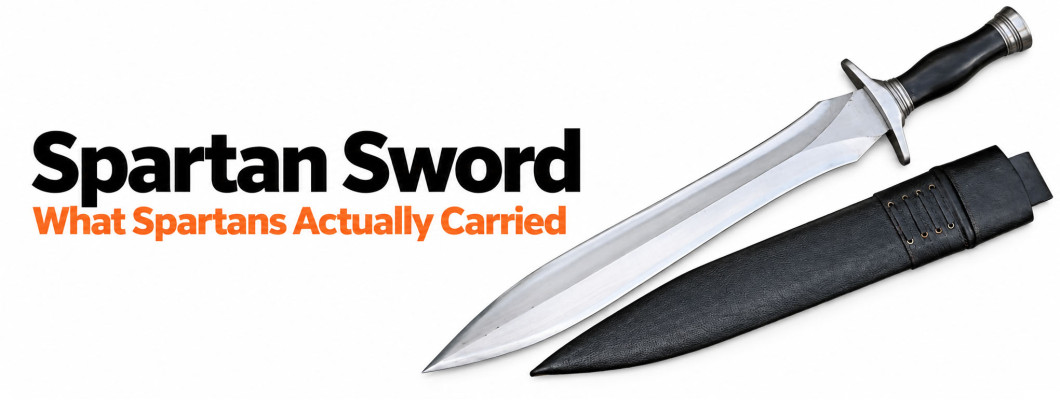
A Spartan's Sword Was Short, and It Was His Second Weapon: The Spear Came First
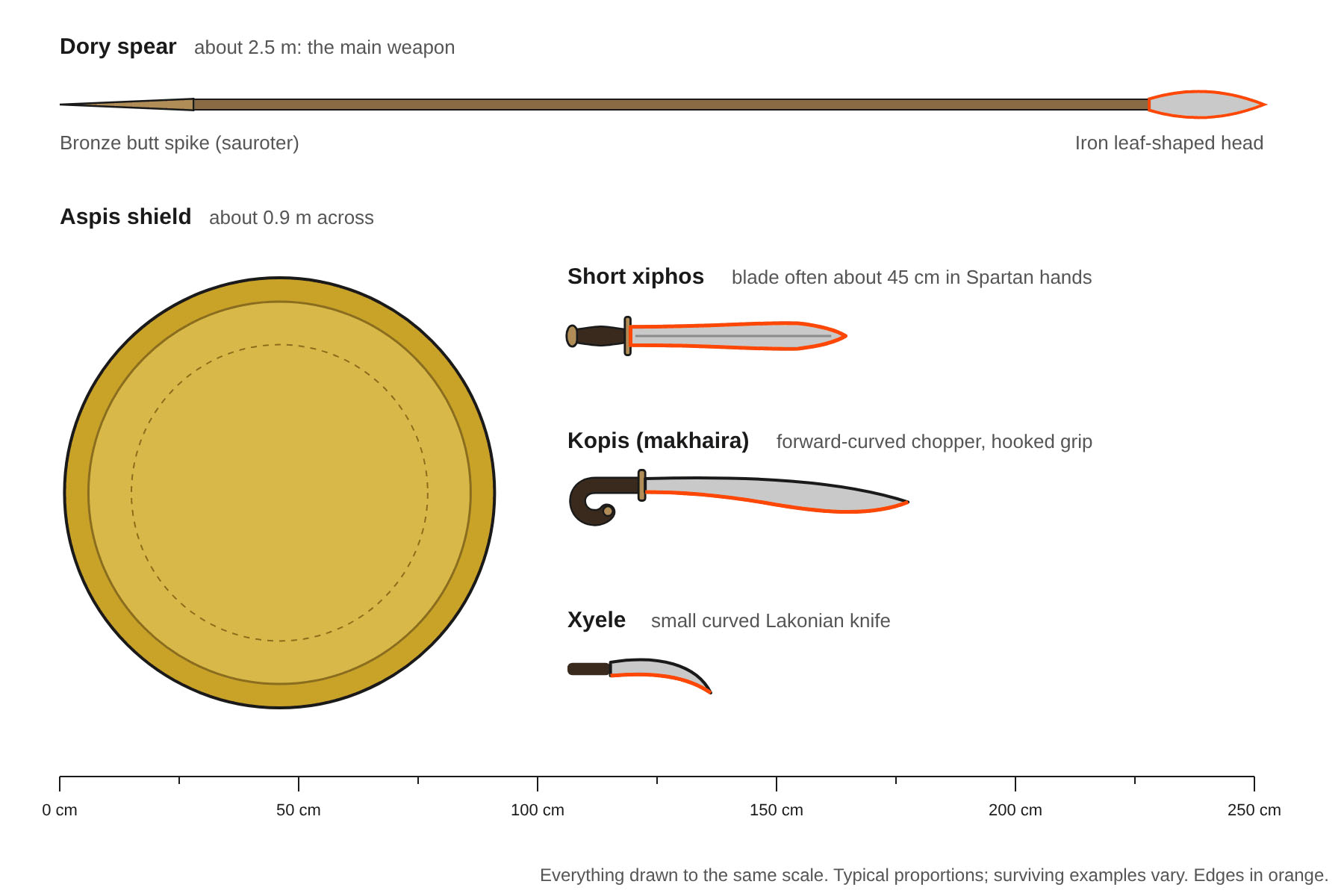
A Spartan hoplite of the fifth century BC fought first with the dory, a spear about 2.5 m long, and the aspis, a large round shield. His sword was the backup, drawn when the spear broke or the fight closed in. That sword was usually a xiphos, a straight, double-edged, leaf-shaped blade, and Spartans were known for carrying it shorter than other Greeks did. Some Greek soldiers also carried the kopis, or makhaira, a forward-curved chopping sword, and Spartans also carried a small curved knife called the xyele. The film 300 made the Spartans famous again, but its look owes more to the graphic novel than to Thermopylae. This guide explains what Spartans actually carried, why their swords were short, where the kopis fits, what the film changed, and how to specify a historically honest Spartan sword.
Our Spartan swords are historical and film-inspired pieces, not official 300 merchandise. Everest Forge is not affiliated with Warner Bros., Legendary Pictures or the makers of 300, and the film is named here only to compare it with history.
Commission a Historically Honest Spartan Sword
A short leaf-bladed xiphos sized to Spartan proportions, a kopis with a bird-head hilt, or a full hoplite set with spearhead and butt spike. Send photos or measurements; the forge quotes it, builds it in 4 to 6 weeks, and ships it tracked worldwide.
Start a Custom Forge RequestFor the xiphos itself, from its Bronze Age roots to its dimensions and hilt, start with our complete guide to the Greek xiphos sword. This post is about the Spartans and what they actually carried.
The Spartan's First Weapon Was the Spear
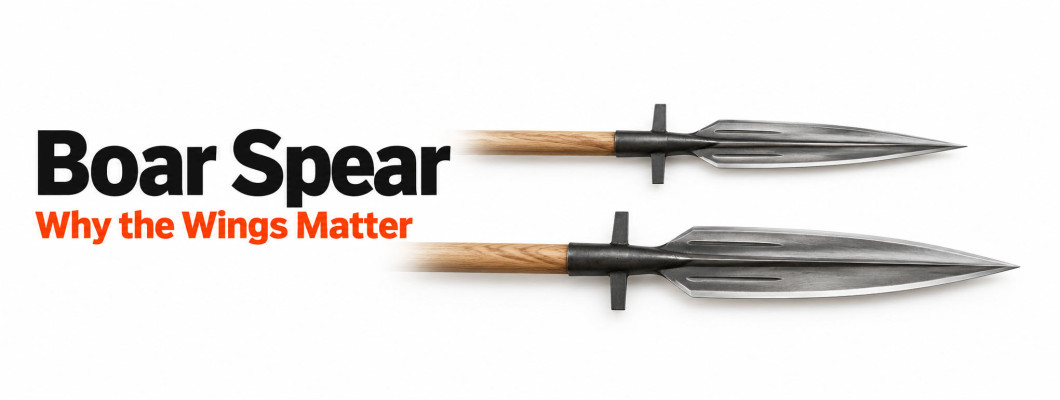
Spartans fought as hoplites in the phalanx, a tight block of men several ranks deep, shields overlapping, spears levelled over the shield rim. In that formation the spear did almost all the killing. The dory had a leaf-shaped iron head and a bronze butt spike, the sauroter, which could stand the spear upright, finish a fallen enemy or serve as a second point if the shaft snapped. The aspis, nearly a metre across and carried on the forearm, protected the man and half of his neighbour.
The sword came out when the spear broke or the lines crashed together so closely that there was no room to thrust with a long shaft. That is why the Spartan sword was built the way it was.
For the hoplite's armour, see the evolution of ancient Greek armour.
The Short Spartan Xiphos
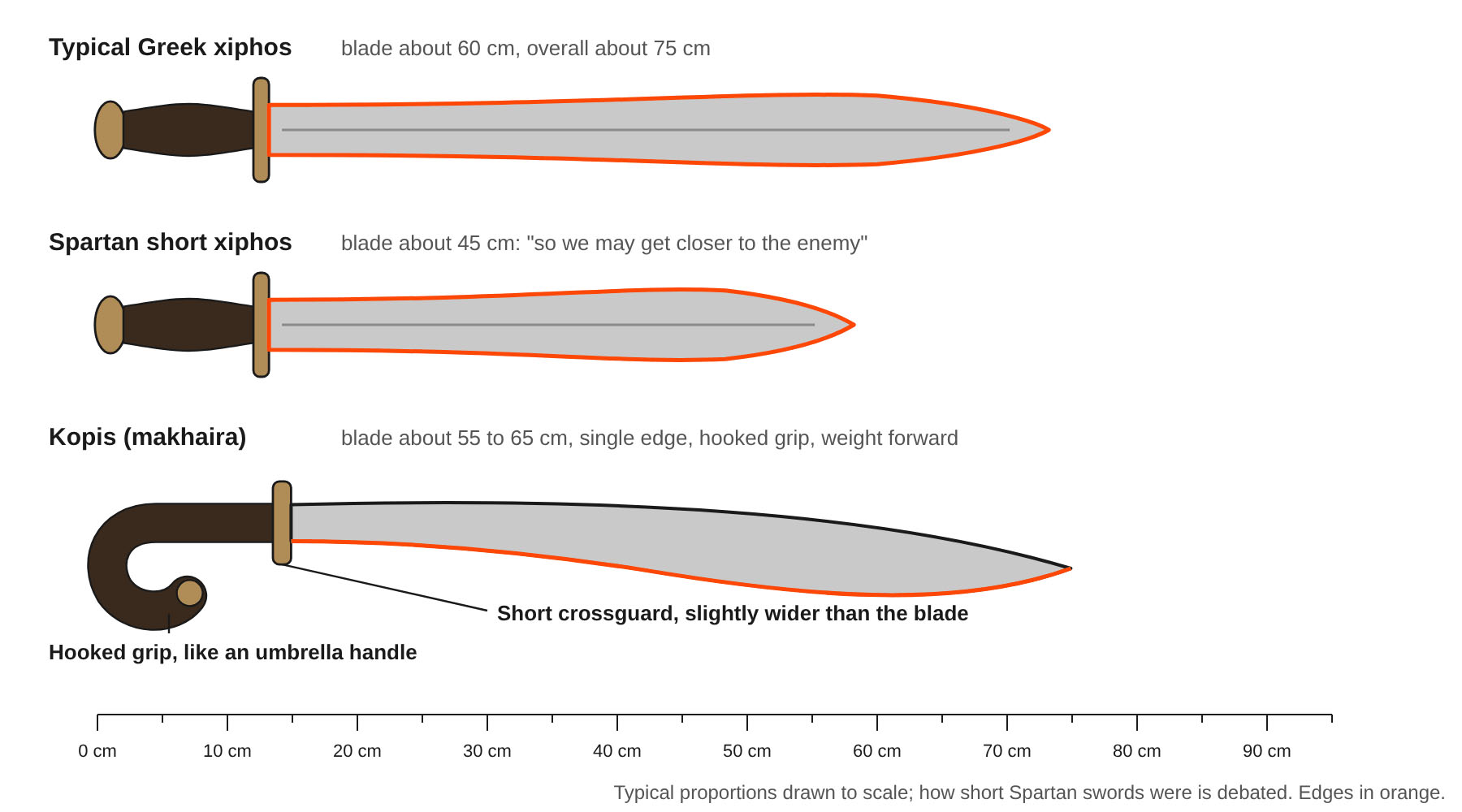
The xiphos was the Greek hoplite's standard sword: straight, double-edged, with a leaf-shaped blade that narrows below the hilt and widens toward the point before tapering again. The hilt has a short crossguard, a grip that swells in the middle and a cap or disc pommel. It was worn high under the left arm on a shoulder strap, so it could be drawn without catching on the shield.
Spartans were famous for carrying it short. Plutarch's collection of Spartan sayings has a Spartan answer a mocking question about short swords with "so we may get closer to the enemy". A typical Greek xiphos had a blade of around 60 cm. Spartan blades are usually given as shorter, around 45 cm, though how short is debated and surviving swords are rarely identified by city.
A short blade made sense for a Spartan. In the press of the phalanx, with shields locked and men chest to chest, a long sword cannot be swung and a short one can still stab under or around a shield. It was also a statement: the Spartans trained for the closest, hardest fighting and chose a sword that left no other kind.
Did Spartans Use the Kopis?
The kopis, which Greek writers often called the makhaira, is a single-edged sword that curves forward, with its weight toward the tip for strong downward cuts and the edge on the inside of the curve. Its grip is unmistakable: it hooks back toward the edge like an umbrella handle, often ending in a bird or animal head, and a short crossguard sits at the base of the blade. Greek vase paintings show hoplites with both the straight xiphos and the curved kopis, and Xenophon recommended the makhaira for cavalry, where a heavy cut from horseback mattered more than a thrust.
Nothing suggests the Spartans refused the kopis. But it is the short straight sword that Spartan sayings single out, and the kopis is best seen as a common Greek alternative rather than a specifically Spartan weapon. For the full story of the kopis, read the kopis sword: ancient Greek curved sword of power. Its often-confused Egyptian look-alike is covered in kopis vs khopesh.
The Xyele: Sparta's Curved Knife
Xenophon, who knew the Spartans well, mentions a short curved knife he calls the Lakonian xyele. He uses it to describe the weapon of another people, which tells us his readers knew it as a familiar Spartan blade. Little more is known about it. It seems to have been a small, curved, single-edged knife, a tool and a last-ditch weapon rather than a sword. It is a reminder that a Spartan's kit included more than the spear, shield and sword of the popular image.
The Lakonian Look: Red Cloaks, Lambdas and Long Hair
Some parts of the Spartan image are well founded and some are later. Ancient writers describe the Spartans' red cloaks and their long hair. Herodotus says the Spartans at Thermopylae were seen combing their hair before the battle, a custom before facing death. The famous lambda (Λ, for Lakedaimon) on Spartan shields is attested in sources from later in the fifth century, so it may not have been on the shields at Thermopylae in 480 BC.
The 300 Film vs History
The film 300 (2006), directed by Zack Snyder from Frank Miller's graphic novel, retells the Battle of Thermopylae as a stylised legend, and it says so in its look. The main differences from history:
- Armour. The film's Spartans fight bare-chested in cloaks and helmets. Real hoplites wore bronze helmets and greaves and usually a cuirass of bronze or layered linen. Their armour was what made the phalanx work.
- Fighting style. The film shows leaping, individual duels. Real Spartans won through the discipline of the phalanx, shields locked and spears forward.
- The three hundred. The 300 were Spartan citizens, but they fought alongside several thousand other Greeks, including Thespians and Thebans, most of whom were sent away before the final day.
- The swords. The film's blades are stylised designs for the screen, not copies of any excavated Greek sword. A historically honest Spartan sword is the short xiphos or the kopis.
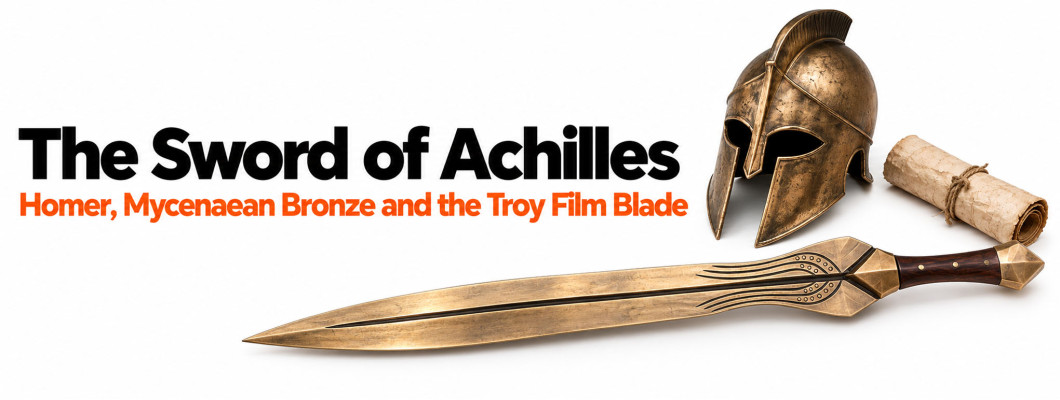
The film is still the reason many people first ask about Spartan swords. For other famous screen blades, see iconic movie swords, and for Homer's heroes, the sword of Achilles.
How to Specify a Historically Honest Spartan Sword
- Blade. Straight, double-edged and leaf-shaped, narrow below the hilt and widest about two-thirds of the way to the point, around 40 to 50 cm long.
- Hilt. A short bar crossguard, a grip that swells in the middle, and a cap or disc pommel. No knuckle-bow, no long quillons.
- Weight. Light and quick, well under a kilogram for a short blade, because it is a close-quarters sidearm.
- Scabbard. Worn high on a shoulder strap under the left arm, not on a waist belt.
- Or a kopis. If you prefer the cut, a forward-curved single-edged blade with a hooked or bird-head grip.
Our Spartan Swords
Every sword below is forged on demand in our Kathmandu workshop from mono-steel 5160 spring steel. Nothing is held in stock; every blade is forged after the order is placed.
- The Spartan sword: a forward-weighted, kopis-style warrior blade.
- The Custom Spartan blade: a curved Spartan-inspired short sword with a long grip.
- The Greek Spartan sword: a curved battle blade in the kopis tradition.
An honest note on these swords. All three of our "Spartan" swords are curved, kopis-inspired blades. That is a real Greek type, but it is not the short straight xiphos that Spartan sayings describe. For the straight leaf blade, including a short xiphos close to Spartan proportions, see our xiphos swords collection. For a sword built exactly to the specification above, use the custom forge.
To set the blade length, finish and handle yourself, start from Build Your Blade. Any sword can be ordered left-handed by writing "Left Handed" in the order note. For reenactment or stage use, ask the same way for a blunt edge and rounded tip. Catalogue builds dispatch in 2 to 3 business days; custom builds take 4 to 6 weeks at the forge; shipping is DHL or FedEx, tracked, 7 to 14 business days worldwide.
An honest note on the steel. Everest Forge forges mono-steel 5160 only. We do not make Damascus, pattern-welded, folded or laminated steel. Classical Greek swords were forged from iron and early steel, and our blades are plain, hardened spring steel.
Related Guides
Forge the Sword a Spartan Would Recognise
A short leaf-bladed xiphos with a bar guard and disc pommel, a kopis with a bird-head grip, or a matching dory head and sauroter for a full hoplite kit. Tell us the build; the forge quotes it, makes it in 4 to 6 weeks, and ships it tracked worldwide.
Start a Custom Forge RequestFrequently Asked Questions
What sword did the Spartans use?
Mainly the xiphos, a straight, double-edged, leaf-shaped sword, which Spartans were known for carrying shorter than other Greeks. Some Greek soldiers also used the curved kopis. The sword was a backup to the dory spear and aspis shield.
Why were Spartan swords so short?
Because they were for the press of the phalanx, where there was no room to swing a long blade. A Spartan saying recorded by Plutarch answers a jibe about their short swords: "so we may get closer to the enemy".
How long was a Spartan sword?
A Spartan xiphos blade is usually estimated at about 45 cm, shorter than the roughly 60 cm of a typical Greek xiphos. Exact lengths are debated, because surviving swords are rarely linked to a particular city.
Did Spartans use the kopis?
The kopis was a common Greek sword and Spartans may well have used it, but Spartan sources single out the short straight sword. The kopis is better seen as a Greek alternative than a Spartan speciality.
What was the main Spartan weapon?
The dory, a spear about 2.5 m long with an iron head and a bronze butt spike, used with the large round aspis shield in the phalanx. The sword was secondary.
What is a xyele?
A small curved Lakonian knife mentioned by Xenophon. Little is known about it beyond that it was a familiar Spartan blade, more knife than sword.
Are the swords in 300 historically accurate?
No. The film's swords and armour are stylised for the screen, following Frank Miller's graphic novel. A historically accurate Spartan sword is a short leaf-bladed xiphos or a kopis.
Did Spartans really have the lambda on their shields?
Yes, but the evidence for it comes from later in the fifth century BC, so it may not have been used at Thermopylae in 480 BC.
Is the Everest Forge Spartan sword a xiphos?
No. Our Spartan swords are curved, kopis-inspired blades. For the straight leaf-bladed xiphos, see our xiphos swords collection, or commission a Spartan-proportioned xiphos through the custom forge.
How long does a hand-forged Spartan sword take to arrive?
Catalogue builds dispatch in 2 to 3 business days and ship by DHL or FedEx, tracked, in 7 to 14 business days. Custom builds take 4 to 6 weeks at the forge before shipping.