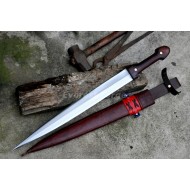
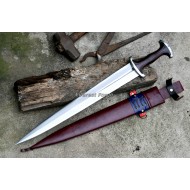
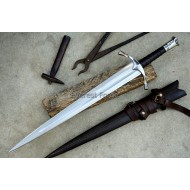
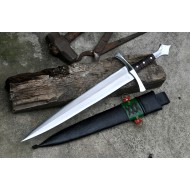
- Model: Movie Sword
- Product Code: FORKSWORD
- Location: Kathmandu,Nepal
Available Options
Inverted Spear of Heaven, Hand-Forged Unofficial Replica
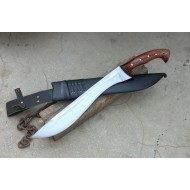
This is an unofficial, independently forged tribute to the Inverted Spear of Heaven carried by Toji Fushiguro in Jujutsu Kaisen, made from 5160 high-carbon spring steel in our workshop in Tokha-3, Kathmandu. We are not affiliated with or endorsed by the rights holders, and the page below describes the sword we actually make rather than the one on screen. The blade is broad and single-edged with stepped shoulders and a squared, angled tip, and it carries a long open slot cut clean through the flat near the spine, with a narrow prong running forward above it so the front of the blade forks in two. The hilt is a plain flat steel cross-bar, a 12 inch grip wrapped in close-laid leather cord, and a brass bell pommel. It comes with a brown leather sheath cut to this outline and a long shoulder strap. Nothing is held in stock: it is forged after your order arrives, so the proportions, the slot, the grip and the finish are all yours to set at no extra cost.
The proportions are the first unusual thing. Twelve inches of hilt on a thirty inch sword is two fifths of the whole object, where most swords give the hilt about a fifth. That is not a styling accident — it is what makes 1,690 grams manageable. Two hands spread apart on a long grip have far more control over a heavy blade than two hands crowded together, and the mass behind the guard pulls the balance back toward you.
The second unusual thing is the slot, and it is the reason most people will want this sword. A blade that forks is memorable in a way a plain one is not. What it is not is functional, and the questions below say so plainly rather than inventing a mechanism for it.
An honest note. Three things. The slot and prong are decoration — they do not trap a blade, improve the cut or do anything a solid blade would not do better, and any seller telling you otherwise is making it up. Second, and more useful: the prong is a cantilever, a narrow bar anchored at one end and free at the other, and a cantilever carries all its load at the root. It is right for handling and display; it is not a prying tool. We will thicken the root or shorten the slot at no extra cost if you want it stronger, and it changes the look a little and the durability a lot. Third, at 1,690 grams this is the heaviest sword per inch we make, roughly 30 to 55 per cent above a conventional sword of this length, and the squared tip means it does not thrust at all. And to say it plainly rather than in small print: this is not an official or licensed product, it is our own interpretation forged by hand, and the proportions are ours rather than measured from anything.
Why It Is Built This Way
Full Specifications
Figures are taken from the sword shown and describe the standard build. Hand-forged work varies a little from piece to piece, so read these as close rather than exact. If a dimension matters, tell us before we start and we will build to it and measure the finished sword for you.
Build It Your Way
None of this costs extra, because none of it is made before you ask for it. Work down these six and put what you want in the order note.
How strong do you want the prong?
It is the one decision on this sword that actually matters. As built, the prong is right for a piece that gets hung on a wall and picked up now and then. A thickened root, or a slot stopped an inch or two shorter, makes the front of the blade markedly stronger and barely alters the silhouette at normal viewing distance. Neither costs anything. Tell us how the sword is going to live and we will build to that rather than to the photograph.
Talk to the Forge →What It Does Well, and What It Does Not
What it does well
- An outline nobody will mistake for anything else. A forked blade with an open slot is about as distinctive as a silhouette gets.
- The cutting blade is solid and broad from cross-bar to tip. The clever part is above it, not in the part that works.
- Genuinely two-handed, with a 12 inch grip that gives both hands room and real leverage over a heavy blade.
- Balances closer to the hand than the shape suggests, because the slot takes steel out of the middle and the long hilt puts it back behind the guard.
- A sheath actually cut to this outline, which on a forked blade with stepped shoulders is the only way it can be done.
- Everything configurable at no extra cost, including a thicker prong root for anyone who intends to handle it hard.
What it does not do
- The slot and prong do nothing functional. They do not trap blades or improve the cut, and we will not pretend they do.
- The prong is a cantilever and the root is where it would yield. It is fine for handling and display and it is not a prying tool.
- It is heavy — about 56 grams per inch of overall length, the heaviest in our sword range, and 30 to 55 per cent above a conventional sword of this length.
- The squared tip is not a point. This sword does not thrust.
- It is unofficial and unlicensed, and it is our interpretation rather than a measured reproduction. We say so on the page rather than in small print.
- It is not stainless. 5160 rusts if left wet and wants an occasional wipe of oil.
How to Order
Who It Is For
- Collectors who want one piece on the wall with an outline nobody else has, and would rather be told what the clever part does and does not do.
- Fans of the series who want a hand-forged tribute in real spring steel rather than a cast display piece, and who understand it is unofficial.
- Anyone who likes a genuinely two-handed short sword rather than a one-hander with a long pommel.
- Stage combat and theatrical armourers, who can order this rebated and round-tipped at no extra cost.
- Buyers with limited space, for whom 30 inches carries real presence without needing a wall to itself.
- Anyone who would rather hear that a slot is decorative than be sold a mechanism that does not exist.
What Is Included
- The sword, hand-forged in Tokha-3, Kathmandu, Nepal.
- A brown leather sheath cut to this outline, contrast stitched, with riveted retaining straps.
- A long leather shoulder strap.
- A protective coat of oil on the blade for transit, wiped off before handling.
- Care instructions, and the Everest Forge manufacturer warranty against defects in materials and workmanship.
Bring us your own design
Blades like this one start as a drawing. If you have a shape in mind, send it — a sketch, a render, a description — and we will tell you honestly which parts of it will survive being made in steel, which parts will need thickening to hold together, and what it will cost. We would rather build your idea properly than sell you an approximation of somebody else's.
Start a Custom Forge Request →Related Blades and Reading
Shipping, Returns and Care
Dispatch and transit. Standard builds leave the workshop in 2 to 3 business days. Genuinely custom work — a thickened prong, different proportions, a different grip material or finish — runs 4 to 6 weeks depending on the queue. We ship by DHL or FedEx with tracking, typically 7 to 14 business days from Kathmandu, sheathed and braced with the strap packed separately so nothing bears on the blade.
Duties, import and edge law. Import duty and local taxes are the buyer's responsibility and vary by country. Swords are regulated differently in different places and are treated more strictly than knives almost everywhere. Please check what applies where you live before ordering. If an unsharpened build would make the difference, we will supply one at no extra cost, and on a sword bought for its outline an unsharpened build loses you very little.
Trademarks and attribution. Inverted Spear of Heaven, Toji Fushiguro and Jujutsu Kaisen are the property of their respective rights holders. Everest Forge is an independent workshop and is not affiliated with, authorised by or endorsed by them. This piece is an unofficial tribute made by hand in Nepal, and it is sold as our own work.
Returns and warranty. Because every sword is forged after the order, a custom build cannot be restocked, so please make sure the specification is right before you confirm. Anything damaged in transit, or showing a defect in materials or workmanship, is covered by the Everest Forge manufacturer warranty and we will repair or replace it. Photograph the packaging as well as the sword if something has gone wrong on the way.
Care. 5160 is a high-carbon steel and it is not stainless. Wipe the transit oil off before handling and put a light film back on before the sword goes away. Fingerprints are acidic and will etch a polished blade if left for weeks. The slot is the part that needs attention: its inside faces and the two internal corners at either end are surfaces a cloth drawn along the flat cannot reach at all, and enclosed spaces hold damp. Use a narrow strip of cloth drawn through the slot, or a brush with oil on it. Do not store the sword in the sheath for long periods, since leather holds moisture against steel.
Questions About This Sword
Is this an official or licensed product?
No. This is an unofficial, independently forged tribute piece. Everest Forge is not affiliated with, authorised by, sponsored by or endorsed by the creators, publishers or rights holders of Jujutsu Kaisen, and no claim of any such connection is made or implied. All series names, character names and weapon names belong to their respective owners and are used here only to describe what the design takes its inspiration from.
What you are buying is a sword we forged: a broad single-edged blade with stepped shoulders and a squared angled tip, a long open slot cut through the flat with a forward prong above it, a plain steel cross-bar, a 12 inch leather-cord grip and a brass bell pommel. It is made in Kathmandu from 5160 spring steel by the same smiths who make everything else here, and it is described on this page as the object it is rather than as merchandise.
What are the slot and the prong for?
Visually, they are the whole design — a blade that forks is memorable in a way a plain one is not, and this is the part every photograph is of. Functionally, we are not going to invent a purpose for them. A slot of this size does not trap a blade, does not make the sword cut better, and does not do anything a solid blade would not do more reliably.
What the slot genuinely does is remove a great deal of steel from the middle of the blade, which takes weight out of the front end. On a sword this heavy that is not nothing. But it is a side effect of the shape rather than the reason for it, and the reason for it is that it looks extraordinary.
Does the slot weaken the blade?
It changes where the blade is strong, and the honest answer has two halves. The main blade below the slot is a continuous bar of steel from the guard to the tip, and it is broad. That part is fine, and it is what you would actually cut with.
The prong above the slot is the part to understand. It is a cantilever — a narrow bar of steel anchored at one end and unsupported at the other — and a cantilever concentrates all its load at the root. Hit something hard with the prong, or lever sideways against it, and the place that yields is where it meets the body of the blade, not the tip. It is thick enough for handling and display and it is not a prying tool. If you want it stronger, we can thicken the root or shorten the slot, which changes the look a little and the durability a lot. That is the honest trade and it is yours to make.
How heavy is it?
1,690 grams, which over 30 inches of total length works out at about 56 grams per inch — the heaviest per inch of anything in our sword range. A 30 inch sword of conventional proportions would run somewhere near 1,100 to 1,300 grams, so this is roughly 30 to 55 per cent above that.
Two things carry it. The blade is broad and cut from thick stock, and the hilt is enormous by proportion at 12 inches with a brass pommel on the end. What that produces is a sword that is genuinely two-handed and that balances much closer to the hand than the silhouette suggests. It is not a quick sword, and it is not trying to be.
Why is the grip so long?
Because the design wants it that way, and because it is what makes the weight manageable. Twelve inches is enough for both hands with room between them, and hands spread apart on a long grip give you far more control over a heavy blade than hands together on a short one — the further apart they are, the more leverage you have over where the tip goes.
It also moves mass behind the guard, which pulls the balance back toward you. On a sword that weighs 1,690 grams that matters more than almost anything else in the build. A shorter grip would look more conventional and handle considerably worse.
What size is it, and can I change it?
The standard build carries an 18 inch blade and a 12 inch hilt, 30 inches overall. That is a default rather than a fixed specification — every blade we make is forged after the order, so the dimensions are yours to set.
The proportion is the interesting variable here rather than the total length. Keeping the 12 inch grip and lengthening the blade makes a much more aggressive object; shortening the grip toward a conventional proportion makes it look more like a normal sword and handle worse for the weight. Tell us what you are after and we will tell you what we would build.
What are the grip and furniture made of?
Leather cord wrapped in close rings over the grip, a plain flat steel cross-bar at the blade, a steel collar, and a brass bell pommel. The wrap gives a positive grip along the whole 12 inches, which matters when your hands move along it.
Grip material and colour are both selectable at no extra cost — rosewood, horn, micarta and plain leather are all available, and we will match the sheath to whatever you choose. The furniture can be left bright, given a satin finish, or blackened.
Does it arrive sharp?
Yes, the main edge sharpened along its full length and ready to use, unless you tell us otherwise. The squared tip is finished but is not a point and will not thrust.
The inside faces of the slot and the prong are left unsharpened on the standard build. They do no cutting work, they are extremely awkward to sharpen properly, and a sharpened edge inside an enclosed slot is a snagging hazard. Unsharpened builds are free for display or an awkward import, and so is a stage combat build — rebated edge, rounded tip.
What steel is it, and how is it heat treated?
5160 high-carbon spring steel, which we use across the whole range. The blade is forged to shape, quenched, and then tempered back by hand as a separate operation afterwards. Those two steps are distinct and the second matters more here than on almost anything we make.
The reason is the slot. Cutting a long opening through a blade leaves internal corners at each end of it, and corners concentrate stress. A properly tempered blade absorbs that; an untempered one finds the corner and cracks from it. 5160 is not stainless, rusts if left damp, and takes and keeps an edge far better than any stainless we could sensibly forge. We do not make pattern-welded or laminated blades at all, by choice.
Where does it balance?
Closer to the hand than the silhouette suggests, for two reasons that work together: the slot removes steel from the middle of the blade, and the 12 inch hilt with a brass pommel puts a lot of mass behind the guard.
We do not publish a single point-of-balance figure, because hand-forged work varies and a number two inches out is worse than none. Ask before dispatch and we will measure the actual sword we are sending you, from the cross-bar, and send you the figure. Our sword guide explains what the measurement means and why it is worth asking any seller for.
What comes with it?
A brown leather sheath cut to this outline, stitched in contrasting thread, with riveted retaining straps and a long shoulder strap. It is built to the blade rather than to a pattern, which on a shape like this is not optional — nothing generic will take a forked blade with stepped shoulders.
Colour, stitching and carry arrangement are yours to specify. A wall mount cut to this silhouette is a custom forge item and we will quote it, and on a sword with an outline this distinctive a fitted mount is worth considering.
How long does it take, and how is it shipped?
Nothing is held in stock. Every blade is forged after the order arrives, which is why the dimensions, the proportions, the grip material and the furniture finish are all free to change — there is no standard version already made. Standard builds dispatch in 2 to 3 business days; genuinely custom work runs 4 to 6 weeks depending on the queue.
It ships sheathed and braced in a rigid carton with the strap packed separately so nothing bears on the blade, by DHL or FedEx with tracking, typically 7 to 14 business days from Kathmandu. Import duty and local taxes are the buyer's responsibility and vary by country.
| Specification | |
| Blade: | 18 inches. Hand forged from 5160 carbon steel |
| Total Length: | 30 inches |
| Handle: | 12 inches. Full tang, leather cord wrapped grip, steel cross-bar, brass pommel |
| Weight: | 1690 grams the sword, 2140 grams with the sheath |
| Note: | Handmade variation in weight, dimensions and finish may occur. Keep blade lightly oiled when not in use. |