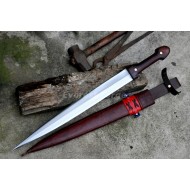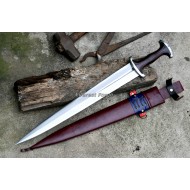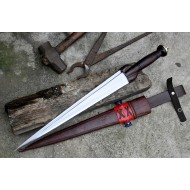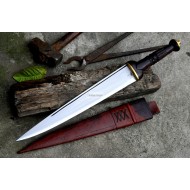


- Model: Dagger
- Product Code: DISDAGGER12
- Location: Kathmandu,Nepal
Available Options
A Hand-Forged Quillon Dagger With a Disc Pommel and Bone Grip
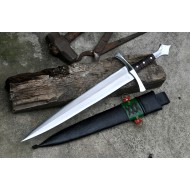
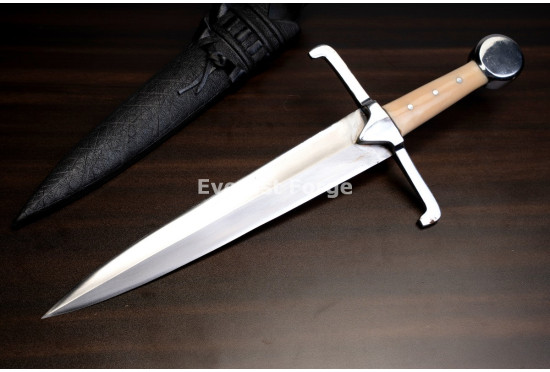
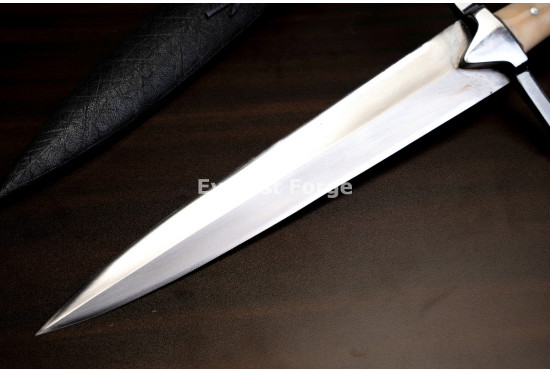
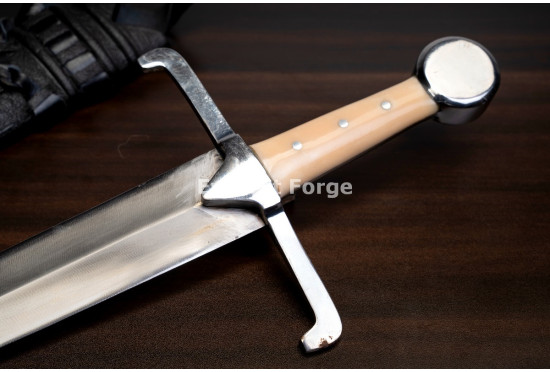
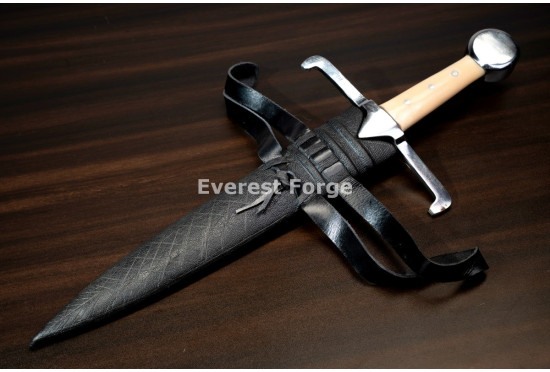
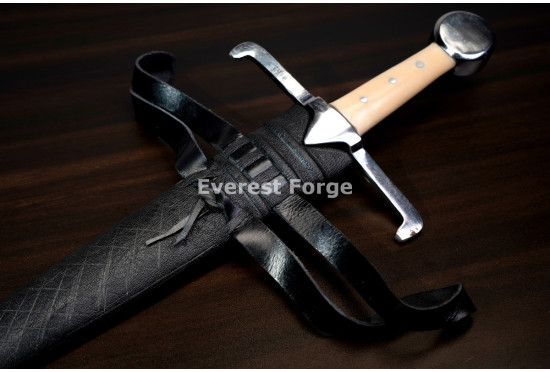
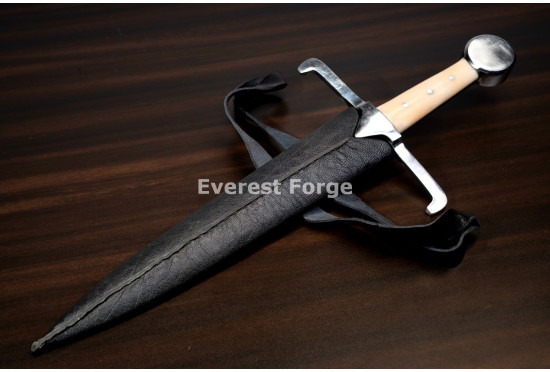
This is a 12 inch hand-forged quillon dagger in the late medieval manner: a broad double-edged blade tapering in one long line to an acute point, meeting the hilt at a shaped ecusson — the shield-shaped block where the guard sits against the blade. The cross is straight steel with terminals turned down toward the point, the grip is bone pinned through the tang, and the pommel is a large flat steel disc. Overall length is 18 inches and it weighs approximately 700 grams. Forged from 5160 high-carbon steel in Tokha-3, Kathmandu, and supplied in a black leather scabbard with a laced throat and long hanging straps.
An honest note. Two things worth saying. This is a dagger built in the medieval manner rather than a copy of a documented find: the disc pommel, the ecusson, the turned quillons and the bone grip are all correct period vocabulary, and the proportions are right, but it is our own arrangement of those elements and not a reconstruction of a particular piece. If you want a specific museum object, send us the reference and our smiths will forge to it. Second, the grip is bone and the page should say which. We use camel and water buffalo bone, both of which are ordinary agricultural by-products and both of which cross borders without a permit. We do not work in ivory or in bone from any protected species, and we would rather state that plainly than let a customer wonder.
Have This Dagger Forged Your Way
Blade length, pommel form, quillon shape and grip material are all decided at the forge. Send a museum reference and our smiths will quote a reconstruction.
Start a Custom Forge Order →Why This Dagger Is Built the Way It Is
Specifications
Build Options
Is This the Right Dagger for You?
Buy This If You Want
- Correct late medieval hilt vocabulary rather than a generic cross and knob
- A disc pommel, which is the form most associated with the period and rarely done properly
- A bone grip with the species stated, not left vague
- An ecusson at the shoulder, which almost nobody bothers to shape
- A base for a documented reconstruction, with the reference supplied
Look Elsewhere If You Want
- A copy of a specific museum piece out of the box — that is a custom order and we will quote it
- An armour-piercing thruster, which is the narrow medial-ridged section rather than this broad one
- A utility or camp knife, since a double-edged dagger is the wrong tool for cutting anything
- A stainless blade needing no care, since 5160 is carbon steel and will rust if left wet
- A sparring or HEMA trainer, which needs rolled edges and a rebated point from the first heat
Sword and Dagger, Built as a Pair
Same cross, same pommel, same grip, both scabbards cut from one hide. It is how they were worn and almost nobody offers it. Ask us to quote the pair.
Talk to the Forge →How to Order
Who This Dagger Is For
- Collectors of medieval arms who want the fittings right rather than approximated
- Re-enactors and living history groups covering the fourteenth and fifteenth centuries
- Film, stage and photography armourers needing a hilt that reads correctly in close-up
- Anyone who owns an arming sword and wants a companion dagger dressed to match
What Is Included
- One hand-forged quillon dagger, sharpened and ready
- Fitted black leather scabbard with laced throat and hanging straps
- Certificate of hand-forging from the workshop
- Everest Forge manufacturer warranty against defects in forging and heat treatment
Explore the Collection
Shipping, Returns and Care
Every piece is prepared at the forge in seven to ten days, and shipping adds a further seven to ten days. Orders to the USA and Canada travel with FedEx; everywhere else ships on a DDP service, which means duties and taxes are settled before the parcel moves so there is nothing to pay on delivery. Every piece carries the Everest Forge manufacturer warranty against defects in forging and heat treatment.
Double-edged blades are restricted in some countries and in some states and provinces within them, and the rules for a double-edged dagger are often stricter than for a single-edged knife of the same length. It is your responsibility to check that this piece may lawfully be imported and possessed where you live before ordering, because a parcel seized by customs cannot be returned to us and cannot be refunded. The bone used here is camel or water buffalo, both unrestricted, so it raises no separate import question. Ask us before you buy if you are unsure.
5160 is a high-carbon steel and it will rust if left wet or stored damp. Wipe the blade dry, keep a light film of oil on it, and pay attention to the angles of the ecusson where it meets the blade, which is the one place on this hilt a cloth will not reach. Do not store the dagger in the scabbard for long periods. Bone needs less attention than wood but dislikes extremes: keep it out of direct sun and away from radiators, and give it an occasional wipe of mineral oil if you live somewhere very dry.
Frequently Asked Questions
What is the shaped block between the guard and the blade?
It is called an ecusson, from the French for a small shield, and it is one of the details that separates a properly built medieval dagger from a generic one. It is the shaped block sitting between the cross and the blade, usually shield-shaped or lozenge-shaped, and it does two jobs. It spreads load off the tang shoulder, which is the single most stressed point on any dagger and the place a blade will break if it is going to. And it closes the gap where a straight cross meets a blade that is wider than the tang, which would otherwise leave an awkward step collecting dirt and moisture. Surviving daggers of this period carry them constantly and modern reproductions frequently leave them out, because shaping one is fiddly work that adds nothing to a photograph seen at thumbnail size. If you are looking at daggers anywhere, the ecusson is a good quick test of how much attention the maker was paying.
What does a disc pommel do?
It stops the hand coming off the back of the grip, and it does so better than almost any other form. A broad flat disc presents a large surface against the heel of the palm, so under a hard thrust or a pull the hand meets a wide obstruction rather than a small knob. That matters particularly on a dagger, because a great deal of medieval dagger work was done point-down in a reverse grip, driving downward, where the whole weight of the blow is trying to pull the weapon out of your hand in the direction the pommel is protecting. The disc also balances the blade, moving the point of balance back toward the hand and making a forward-heavy dagger feel quicker than it is. It is the form most closely associated with the fourteenth and fifteenth centuries and it is the one that reads as medieval instantly, which is why it is on this piece rather than a wheel or a fishtail.
What kind of bone is the grip?
Camel or water buffalo, depending on the batch, and we state it rather than leaving "bone" to do the work. Both are ordinary agricultural by-products, both are unrestricted, and both cross international borders without permits or paperwork. We do not use ivory, and we do not use bone from any species listed under CITES or any other protection regime — not as a policy position we are announcing so much as a practical one, because a customer whose parcel is stopped at a border has a problem that quickly becomes ours. Bone is a genuinely good grip material: harder than most woods, cool in the hand, it takes a fine polish, and unlike wood it does not swell or shrink much with humidity. What it dislikes is heat and direct sunlight over years, which will dry and eventually craze it, so keep the piece out of a sunny window and away from a radiator.
Is this a copy of a particular dagger?
No, and we would rather say so than let the word medieval imply otherwise. What this is: a dagger built from correct period vocabulary. The disc pommel, the ecusson, the straight cross with turned terminals, the bone grip and the broad tapering blade are all things you find on surviving fourteenth and fifteenth century daggers, and the proportions here are right for the type. What it is not is a reconstruction of a documented object, because the particular combination is our arrangement rather than one taken from a specific find. That distinction matters to collectors and not at all to most buyers, which is exactly why it should be stated rather than fudged. If you want a documented piece, send us photographs, measurements or a museum catalogue entry and our smiths will forge to it. That is a custom order and it is the work they most enjoy.
Why are the quillons turned toward the blade?
To hold rather than deflect. A perfectly straight cross stops an opposing blade at the guard but gives it somewhere to go: an edge sliding down the length of your blade reaches the cross and can run off the end of it toward your hand. Terminals that turn down toward the point make each arm into a shallow hook, so the blade is caught in the angle and stays there. On a dagger this matters more than on a sword, because dagger work happens at a distance where you are binding and controlling constantly rather than fighting at reach. There is a second effect worth knowing: turned quillons also protect the back of the hand better when the dagger is held point-down, which was a very common medieval grip. Straight terminals are the more common survival across the period and we build those too, so this is a preference rather than a correction.
How does it compare to your other quillon daggers?
We build three and they separate on section and fittings. This one has a 12 inch broad blade, a straight cross with turned terminals, an ecusson and a large flat disc pommel on a bone grip. Our Ring Pommel dagger is 13 inches with a narrow blade and a raised medial ridge — the stiffer armour-piercing section — a straight cross with squared terminals and a polished steel ring at the end of the tang. Our Broad Blade dagger is 14 inches, broad and flat like this one but with quillons curving forward and a small domed pommel button. If you want the thrusting section, take the ring pommel. If you want the most recognisably medieval hilt of the three, take this one, because the disc pommel is the form that dates a piece to the eye faster than anything else on it.
Broad blade or narrow — which should I choose?
Ask what you want the dagger to do, or to look like it does. A narrow blade with a raised medial ridge down the centre is stiff, and it is built almost purely to thrust: into the gaps of a harness, through a visor, into a joint where a cut would achieve nothing. Cutting is barely a consideration on one. A broad flat blade like this one keeps far more sharpened edge along its length and enough width behind it to actually slice, while still tapering to a point that will drive home. It is the general sidearm rather than the specialist. Against a man in plate the narrow form wins and it is not close. As an object, and as a dagger for someone not expecting to meet armour, the broad blade does more and looks like more. Both are historical and both are on the site.
What steel is it, and how is it heat treated?
5160 high-carbon spring steel, brought to temperature in the forge, quenched in oil and tempered back so the edges are hard while the body of the blade stays springy. On a broad flat blade the temper matters in a specific way: there is no medial ridge adding stiffness, so the steel itself has to provide the spring, and a blade tempered too hard would take a set or crack rather than flexing and returning. It is not stainless, deliberately, because the stainless grades that genuinely resist rust give up toughness, and on a wide thin section toughness is what keeps the blade straight.
Is it full tang?
The tang runs the full length of the hilt with the disc pommel fitted over the end, which is through-tang construction rather than the slab-and-rivet full tang used on a working knife. That is correct for this pattern: a cross, an ecusson, a fitted grip and a pommel all need a narrower tang so the fittings can be assembled onto it, and the cross and pommel then clamp the grip between them so the whole hilt works in compression. Done properly it is not weaker. The bone grip is additionally pinned through the tang, which you can see as the pins along the grip, so the assembly is held two ways rather than one.
How sharp does it arrive?
Sharp and ready, with both edges put on a stone by hand at the forge. If you would prefer it shipped unsharpened — for display, for a gift, for a re-enactment group where a live edge is not permitted, or because of the rules where you live — say so in the order comments and we will do it at no extra cost and rebate the point as well. What we cannot do is turn a sharp into a safe training weapon afterwards, because a proper trainer needs thicker rolled edges and a flared blunt tip designed in from the first heat.
How was a dagger like this carried?
On the same belt as the sword, usually pushed round toward the back or the right hip so it sat behind the sword and could be reached across the body with either hand. The scabbard here hangs on long straps rather than sitting in a fixed frog, which is the arrangement that allows that: the dagger needs to swing out of the way when you sit or ride and to be pulled round to hand when you want it. In the fifteenth century the dagger was worn constantly by men who would never draw a sword in their lives, as a tool, an eating knife and a mark of status, which is why so many survive and why the fittings on them run from plain iron to silver-mounted. Tell us how you want the straps set and we will make them up to suit rather than sending a standard rig.
Where is this made, and by whom?
In our own workshop in Tokha-3 on the northern edge of Kathmandu, Nepal, by around ten smiths, most from families that have forged blades for generations. Everest Forge has operated since 2010, and we forge, grind, heat treat, cut and fit the bone, and make the scabbards in the same building. A European dagger made in Nepal deserves the same word we give our bowie, our seax and our kopis: this is not our own tradition and we do not pretend it is. It is worked from the record, which is why this page tells you plainly which parts of the piece follow it and which are our own arrangement.
| Specification | |
| Blade: | 12 inches. Hand forged from 5160 carbon steel |
| Total Length: | 18 inches |
| Handle: | 6 inches (4 inch grip). Bone pinned through the tang, straight steel cross with turned terminals over a shaped ecusson, large flat steel disc pommel |
| Weight: | approx 700g dagger, 810g with scabbard |
| Note: | Some variation in weight, dimensions and finish may occur as each piece is hand forged. Keep the blade lightly oiled when not in use |