Menu
Your Cart

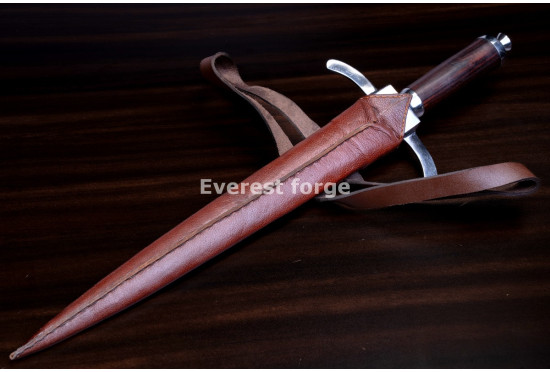
Hand-Forged Quillon Dagger, Broad Blade

Hand-Forged Quillon Dagger, Broad Blade
$214.99
Ex Tax: $214.99
  • Model: Hand forged Dagger
  • Product Code: DAGGWEBOR0014
  • Location: Kathmandu,Nepal

Available Options

A Hand-Forged Medieval Quillon Dagger With a Broad Blade and Curved Quillons

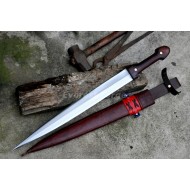
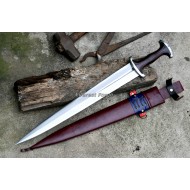
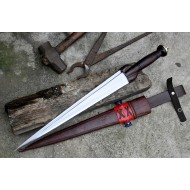
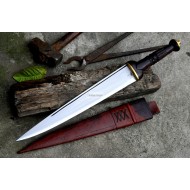
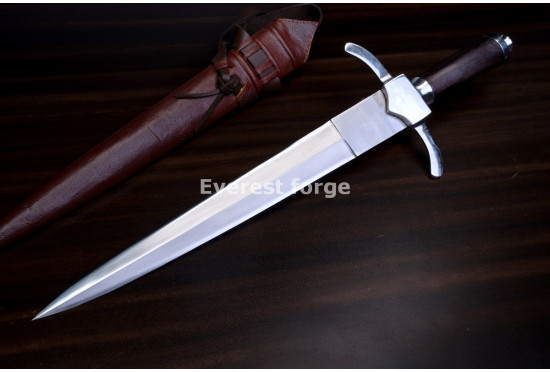
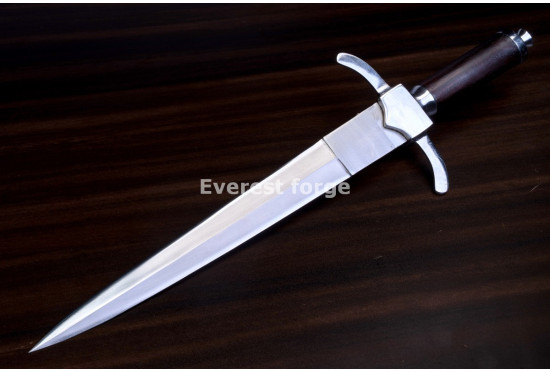
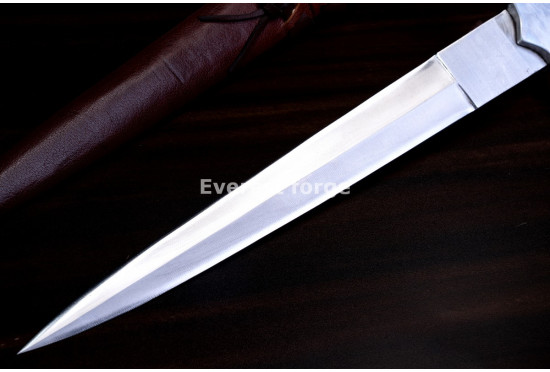
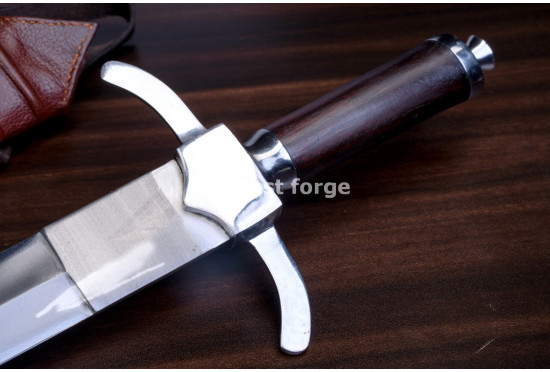
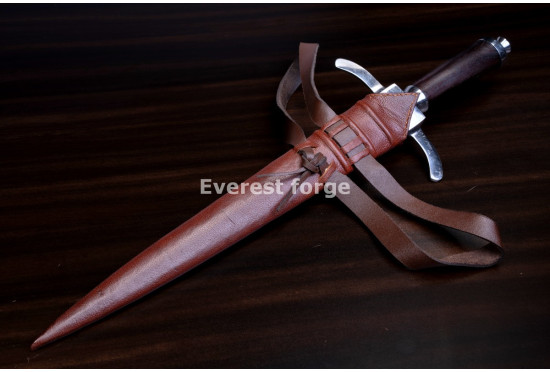
This is a 14 inch hand-forged quillon dagger with a broad flat blade: a wide triangular profile tapering evenly from a heavy squared ricasso block to an acute point, rather than the narrow stiff section most medieval daggers carry. The hilt has forward-curved steel quillons sweeping toward the blade, a shaped rosewood grip between fitted steel collars, and a small domed pommel button. Overall length is 21 inches and it weighs approximately 750 grams. Forged from 5160 high-carbon steel in Tokha-3, Kathmandu, and supplied in a brown leather scabbard on a laced belt rig.

An honest note. This dagger sits at the large end of the medieval range. Surviving quillon daggers run roughly ten to sixteen inches of blade with most nearer the lower end, so fourteen inches is inside the record but toward the top of it, and a broad blade at that length is a substantial object to wear. It is also a modern build rather than a reconstruction: the grip is a shaped rosewood section between fitted collars where period examples used a shaped one-piece grip over a narrow tang, and the pommel is a plain domed button rather than a wheel, scent-stopper or fishtail. Nothing here is wrong; it is simply a dagger in the medieval manner rather than a copy of a particular find. If you want the period arrangement, our smiths will build it and it is the first option below.

Made to your specification

Have This Dagger Forged Your Way

Blade length, blade section, quillon form, pommel and scabbard are all decided at the forge. Send a description or a photograph of a museum piece and our smiths will quote it.

Start a Custom Forge Order →

Why This Dagger Is Built the Way It Is

Broad Rather Than NarrowMost medieval daggers are built as thrusters, narrow and stiff. This one is wide and flat through its whole length, which gives it real cutting edge as well as a point that will drive.
Quillons That Curve ForwardThe arms of the cross sweep toward the blade rather than sitting straight. That shape catches and holds a blade sliding down toward your hand instead of letting it run off the end.
A Ricasso You Can GripThe heavy squared block above the cross is left unsharpened so you can put a thumb or finger over the guard and steer the point rather than working from the grip alone.

Specifications

Blade Length14 inches
Handle Length7 inches, of which 4 inches is grip
Overall Length21 inches
Blade Steel5160 high-carbon spring steel, oil-quenched and tempered
Blade ProfileBroad triangular, double-edged, tapering evenly to an acute point
SectionFlat rather than medial-ridged, with a heavy squared ricasso at the shoulder
GuardSteel quillons curving forward toward the blade
GripShaped rosewood between fitted steel collars
PommelSmall domed steel button
Standard BuildSatin blade, rosewood grip — size, finish and grip material are selectable above
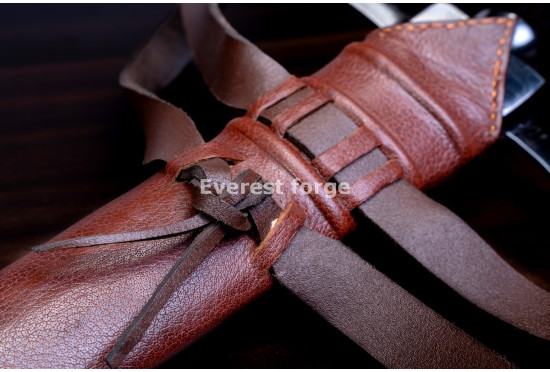
ScabbardBrown leather on a laced belt rig
WeightApproximately 750 grams for the dagger, 900 grams with the scabbard
OriginHand-forged in Tokha-3, Kathmandu, Nepal

Build Options

Period HiltA shaped one-piece grip over a narrow tang with a wheel, scent-stopper or fishtail pommel, which is how the surviving examples are built. This is the change that makes it a reconstruction.
Blade SectionThe broad flat blade shown, or a narrow section with a raised medial ridge, which is the stiffer thrusting form and what most medieval daggers carry.
Blade LengthTen to twelve inches for a dagger closer to the common surviving size and far easier to wear, or the fourteen shown for presence.
Quillon FormThe forward-curved quillons shown, a straight cross with squared terminals, or quillons turned back toward the hand.
Grip MaterialRosewood as standard. Water buffalo horn, bone, cord under leather, or a plain leather wrap, all cut and fitted in the same workshop.
Matching SwordThe same quillon profile, pommel and grip treatment on an arming sword or longsword, so the pair reads as a set. This is how they were worn.

Is This the Right Dagger for You?

Buy This If You Want

  • A medieval dagger that cuts as well as thrusts, rather than a pure thruster
  • The broad flat blade, which is the less common and more striking of the two sections
  • Forward-curved quillons that will hold a blade rather than shed it
  • A ricasso you can grip above the cross for point control
  • A large piece with real presence on a belt or a wall

Look Elsewhere If You Want

  • A stiff armour-piercing thruster — that is the narrow medial-ridged section, and we build two of those
  • An accurate museum reconstruction out of the box, since the hilt here is a modern build
  • Something discreet to wear; at 21 inches overall this is a visible sidearm
  • A utility or camp knife, since a double-edged dagger is the wrong tool for cutting rope, food or wood
  • A sparring or HEMA trainer, which needs rolled edges and a rebated point from the first heat
Fifteen years at the anvil

Sword and Dagger, Built as a Pair

Matching a dagger to a sword — same quillons, same pommel, same grip, both scabbards from one hide — is straightforward for us and almost nobody offers it. Ask us to quote the pair.

Talk to the Forge →

How to Order

Choose your blade length, finish and grip material from the options above the description.
Note your blade section, quillon form and pommel in the order comments.
We confirm the build by email and start forging. Preparation takes seven to ten days.
Your dagger ships tracked and arrives a further seven to ten days later.

Who This Dagger Is For

  • Collectors of medieval arms who already own a narrow thrusting dagger and want the other section
  • Re-enactors and living history groups covering the fourteenth and fifteenth centuries
  • Film, stage and photography armourers needing a blade that reads clean and broad on camera
  • Anyone who owns an arming sword and wants a companion dagger dressed to match it

What Is Included

  • One hand-forged quillon dagger, sharpened and ready
  • Fitted brown leather scabbard on a laced belt rig
  • Certificate of hand-forging from the workshop
  • Everest Forge manufacturer warranty against defects in forging and heat treatment

Explore the Collection

Shipping, Returns and Care

Every piece is prepared at the forge in seven to ten days, and shipping adds a further seven to ten days. Orders to the USA and Canada travel with FedEx; everywhere else ships on a DDP service, which means duties and taxes are settled before the parcel moves so there is nothing to pay on delivery. Every piece carries the Everest Forge manufacturer warranty against defects in forging and heat treatment.

Double-edged blades are restricted in some countries and in some states and provinces within them, and the rules for a double-edged dagger are often stricter than for a single-edged knife of the same length. It is your responsibility to check that this piece may lawfully be imported and possessed where you live before ordering, because a parcel seized by customs cannot be returned to us and cannot be refunded. Ask us before you buy if you are unsure and we will tell you what we know about your destination.

5160 is a high-carbon steel and it will rust if left wet or stored damp. Wipe the blade dry, keep a light film of oil on it, and pay attention to the angles where the ricasso meets the quillons, which is the one place on this hilt a cloth will not reach. Do not store the dagger in the scabbard for long periods, because leather holds moisture against steel. The rosewood grip takes an occasional coat of oil.

Frequently Asked Questions

Why is this blade broad when most medieval daggers are narrow?

Because it is built to do a different job, and both were made. The dagger most people picture from this period is narrow and stiff with a raised ridge down the centre, and it is built almost purely to thrust: into the gaps of a harness, through a visor, into a joint. Cutting is barely a consideration. A broad flat blade like this one keeps far more sharpened edge along its length and enough width to actually slice, while still tapering to a point that will drive. It is a cut-and-thrust dagger rather than a pure thruster. The trade is stiffness: a wide flat section will flex sooner under heavy point pressure than a narrow ridged one, which is exactly why the armour-piercing forms went narrow. So the question to ask yourself is what the piece is for. Against a man in plate, narrow wins and it is not close. As a general sidearm, and as an object, the broad blade does more and looks like more.

What do the curved quillons do?

They hold rather than deflect. A straight cross stops a blade at the guard but gives it somewhere to go: an opposing edge sliding down your blade meets the cross and can run off the end of it toward your hand or past it. Quillons that curve forward toward the blade turn the cross into a shallow hook on each side, so a blade coming down the length is caught in the angle and held there instead of continuing. That matters on a dagger far more than on a sword, because dagger work happens at a distance where you are binding and controlling constantly rather than at reach. The forward curve also protects the back of the hand slightly better when the dagger is held point-down in a reverse grip, which is how a great deal of medieval dagger work was actually done. Straight quillons are the more common survival and we build those too.

How does this compare to your other quillon dagger?

They are the two sections of the same family and we build them as a deliberate pair. Our Quillon Dagger, Ring Pommel has a 13 inch blade with a raised medial ridge, a narrow stiff section, a straight cross with squared terminals and a polished steel ring at the end of the tang, weighing 660 grams. This one has a 14 inch blade, a broad flat section, forward-curved quillons and a small domed pommel button, weighing 750 grams. That extra 90 grams on a blade only an inch longer is the width doing it, and it is the honest way to see the difference: one is a thruster, one cuts as well. If you own neither and want the more historically typical dagger, take the ring pommel. If you own that one already, this is the one that adds something rather than repeating it.

What is the ricasso block for?

Gripping. The heavy squared section immediately above the cross is left unsharpened, which lets you lay a thumb or a finger over the guard and onto the blade itself. That shortens your effective grip and gives you far finer control of where the point goes, which is what you want on a weapon used at very close range. It also gives you somewhere safe to hold the dagger when it is being used as a tool rather than a weapon, and somewhere to rest a hand when passing it to someone. On this dagger the block is squared rather than rounded so it sits flat in the fingers. If you see a dagger of this type with the edges ground all the way back to the cross, the maker has copied a silhouette without understanding how the thing is held.

What kind of medieval dagger is it?

A quillon dagger, which is the type built like a sword in miniature: a straight or curved cross between blade and grip, a pommel at the end of the tang, and a symmetrical double-edged blade. The name comes from the quillons, the two arms of the cross. It is the dagger a knight wore alongside his sword, and it is usually the plainest of the medieval forms because it borrows its design language from the sword rather than developing one of its own. The others are told apart by their hilts rather than their blades: a rondel has flat discs at guard and pommel, a bollock has two rounded lobes and no cross at all, a baselard has a capital-I hilt with a bar top and bottom, and a cinquedea has a blade five fingers wide at the base. Misericorde is not a shape but a role, meaning any narrow stiff dagger used to finish an armoured man, and it gets used as a type name by sellers when it is not one.

Is the hilt authentic?

No, and we would rather set it out than let the word medieval imply otherwise. Two things differ from the surviving examples. The grip is a shaped rosewood section held between fitted steel collars, where period daggers of this type generally used a one-piece shaped grip of wood, horn or bone over a narrower tang, sometimes wrapped. And the pommel is a small plain domed button, where the record gives you wheels, scent-stoppers, fishtails and faceted forms, all of which are heavier and do more to balance the blade. What we have built is sound and comfortable; it is simply modern. The period arrangement is the first build option above and it changes the look of the piece considerably, particularly the pommel, which is the single fitting that most dates a dagger to the eye.

Is fourteen inches too long for a dagger?

It is at the top of the range rather than outside it. Surviving quillon daggers run roughly ten to sixteen inches of blade, and the bulk of them sit in the lower half of that. Past about sixteen to eighteen inches a piece stops being a dagger in any useful sense and becomes a short sword, and it should be built as one with a longer grip to match. Fourteen inches with a broad blade is a substantial thing to wear on a belt: it will foul when you sit, and it hangs low. If you want the piece to be worn rather than displayed, order ten to twelve inches, which is closer to typical and considerably more practical. If it is going on a wall or into a kit where presence matters, fourteen looks the part.

What steel is it, and how is it heat treated?

5160 high-carbon spring steel, brought to temperature in the forge, quenched in oil and tempered back so the edges are hard while the body of the blade stays springy. On a broad flat blade the tempering matters in a particular way: there is no medial ridge adding stiffness, so the steel itself has to provide the spring, and a blade tempered too hard would take a set or crack rather than flexing and returning. It is not stainless, deliberately: stainless grades that genuinely resist rust give up toughness, and on a wide thin section toughness is what keeps the blade straight.

Is it full tang?

The tang runs the full length of the hilt with the pommel fitted over it at the end, which is through-tang construction rather than the slab-and-rivet full tang used on a working knife. That is the correct build for this pattern: a cross, a fitted grip and a pommel all need a narrow tang for the hilt to look and handle as it should, and the cross and pommel clamp the grip between them so the whole assembly works in compression. It is not weaker when it is done properly. If you would prefer a visible full tang with riveted scales, that is a different hilt design and we would build the dagger around it from the start rather than adapting this one.

How sharp does it arrive?

Sharp and ready, with both edges put on a stone by hand at the forge and the ricasso left properly blunt. If you would prefer it shipped unsharpened — for display, for a gift, for a group where a live edge is not permitted, or because of the rules where you live — say so in the order comments and we will do it at no extra cost, and rebate the point as well if you need it. What we cannot do is convert a sharp into a safe training weapon afterwards: a proper trainer needs thicker rolled edges and a flared blunt tip designed in from the first heat.

Can you match it to a sword?

Yes, and it is the order we most enjoy taking. The same cross profile, the same pommel form, the same material and treatment of grip, and both scabbards cut from the same hide, so the two pieces read as one set instead of two purchases. Historically that is how they were worn — the dagger was the sword's companion, hung on the same belt and often dressed to match it. Tell us which sword you have or want, or send a photograph of one you already own, and we will quote the pair together or quote the dagger dressed to match it.

Where is this made, and by whom?

In our own workshop in Tokha-3 on the northern edge of Kathmandu, Nepal, by around ten smiths, most from families that have forged blades for generations. Everest Forge has operated since 2010, and we forge, grind, heat treat, fit the hilts and cut the leather in the same building. A European dagger made in Nepal deserves the same word we give our bowie and our seax: this is not our own tradition and we do not pretend it is. It is worked from the record, which is why this page tells you plainly which parts of the piece follow it and which do not.

Specification
Blade: 14 inches. Hand forged from 5160 carbon steel
Total Length: 21 inches
Handle: 7 inches (4 inch grip). Shaped rosewood between fitted steel collars, domed pommel button
Weight: approx 750g dagger, 900g with scabbard
Note: Some variation in weight, dimensions and finish may occur as each piece is hand forged. Keep the blade lightly oiled when not in use

Write a review

Note: HTML is not translated!
Bad Good
Captcha