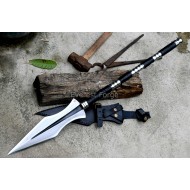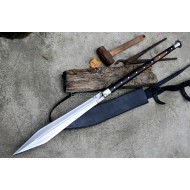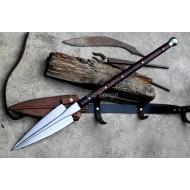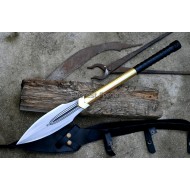


- Model: SPEAR
- Product Code: SPEAR53
- Location: Kathmandu, Nepal
Available Options
A Hand-Forged Winged Spear, 47 Inches Overall
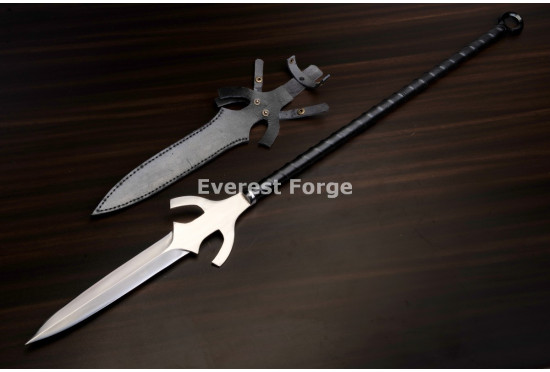
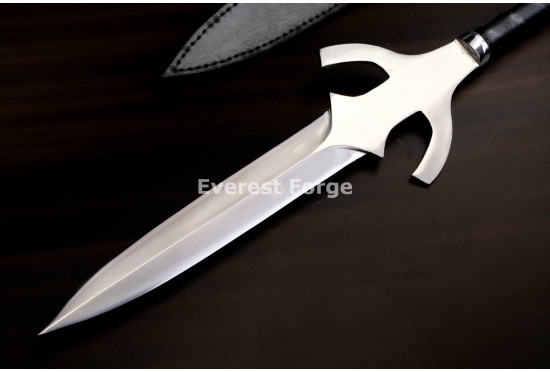
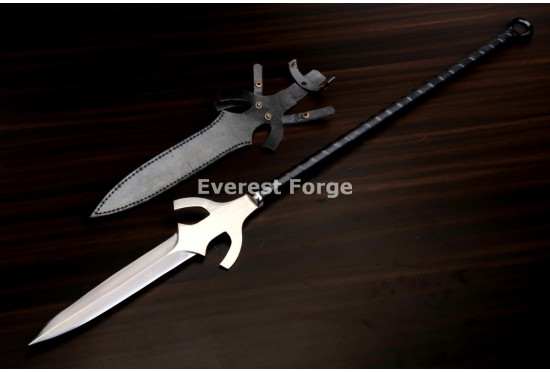
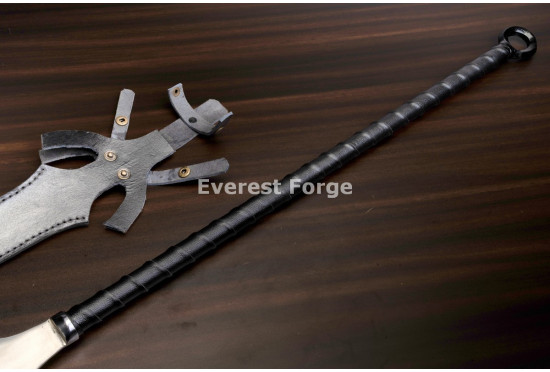
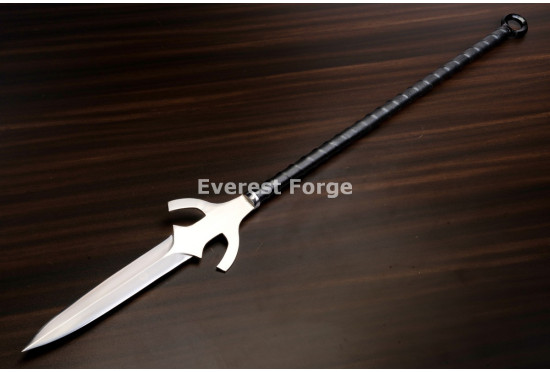
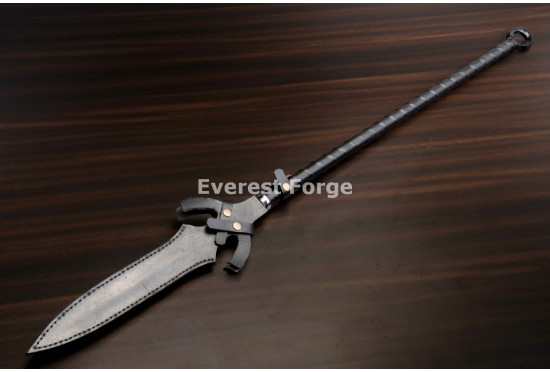
This is a hand-forged winged spear with a 17-inch double-edged head and a 30-inch wrapped haft, 47 inches overall, forged from 5160 high-carbon spring steel in our workshop in Tokha-3, Kathmandu. It comes with a stitched black leather sheath for the head. Like everything we make, it is not held in stock: it is forged after your order arrives, which is why the reach, the finish, the haft material and the edge are all yours to set at no extra cost.
The head is the reason people stop on this page. It is a broad, double-edged blade that carries its width well back before running out in a long straight taper to the point, and at the base the plate widens into a pair of forward-swept flanges either side of a crescent notch. That silhouette quotes the winged spear of northern Europe, the weapon the German sources call a Flugellanze, and something of the broad hunting-spear profile with it. It is a modern design wearing historical clothes, and the page below is careful about which parts are which.
At 47 inches this is a short spear rather than a polearm. That is a deliberate class of weapon, not a compromise — it is the length of hunting spears, boar spears and the shortened half-pike, made to be used at close quarters, often in one hand. If you want true polearm reach we will forge the same head onto a longer haft; see the build options below.
An honest note. Three things a knowledgeable buyer will notice, so we would rather say them first. The flanges at the base of the blade are decorative: they are forged in the plane of the edges and sweep forward, where the lugs on a genuine winged spear stand out at right angles to the blade and exist to stop over-penetration and bind an opponent's shaft. We will forge true perpendicular lugs at no extra cost if you want the working version. Second, at 1,560 grams this is heavy for a 47-inch spear — a timber-hafted weapon of the same reach runs nearer a kilogram — and the extra mass is in the haft, not the head. Third, this is not a reproduction of any documented spear from any period. It is an original design, and we would rather sell it as one than invent a lineage for it.
Why It Is Built This Way
Full Specifications
Weights and dimensions are taken from the piece photographed. Hand-forged work varies a little from one blade to the next, and the figures above should be read as close rather than exact. If a dimension is critical to what you are doing, tell us before we start and we will build to it and measure the finished piece for you.
Build It Your Way
Nothing here costs extra, because nothing is built before you ask for it. Work down these six and put whatever you want in the order note.
Want a spear we have not built yet?
A Viking-age winged spear from a documented find, a boar spear with a proper crossbar, a te-yari, a qiang with a counterweighted butt spike, or something out of your own head on paper. We work from your drawing or your reference photographs, quote before we start, and forge it from the same 5160 as everything else here.
Start a Custom Forge Request →What It Does Well, and What It Does Not
What it does well
- Reach with control. 47 inches is enough to keep distance without the weapon owning the room, and short enough to use one-handed if you want the other hand free.
- A thrusting point that is genuinely built for it, with section kept behind the tip rather than ground away for looks.
- A haft that will not split, take a set, or care about humidity, which is the usual failure mode on a timber-shafted spear.
- A striking silhouette that photographs well and hangs well, with the flange work as the thing people ask about.
- Complete configurability at no extra cost, because nothing is built until you order it.
- Honest materials throughout: mono-steel 5160, real leather, no plating standing in for solid metal.
What it does not do
- It is not a polearm. If you want six or seven feet of reach, this is the wrong length and you should order a longer haft rather than be disappointed.
- It is heavy for its length. 1,560 grams over 47 inches is roughly half again what a timber-hafted spear of this reach weighs, and you will feel that in a long session.
- It is not a documented historical reproduction. Anyone wanting a period-correct Viking or Migration-period spear should ask for one specifically.
- The flanges are decorative. They are not the working lugs of a true winged spear, and we will not tell you otherwise.
- It cannot be thrown, and should not be. The balance is wrong and the joint will not thank you.
- It is not stainless. 5160 rusts if you leave it wet, and it needs a wipe of oil now and then.
How to Order
Who It Is For
- Collectors who want a sculpted, striking spear on the wall and would rather know exactly which parts of it are historical and which are not.
- Fantasy and film-inspired collectors after a piece with real presence that is nonetheless forged from proper steel by people who make weapons for a living.
- Stage combat and theatrical armourers, who can order this same design rebated and round-tipped at no extra cost.
- Reenactors and living-history people — with the caveat that you should order the working-lug version, and probably a timber haft, to bring it into period.
- Buyers who want a short spear specifically, for the reach class rather than the look, and are tired of finding only seven-foot pikes and eight-inch spearheads.
- Anyone who wants a spear built to their own reach, weight and finish, which is most of the people who end up on this page.
What Is Included
- The winged spear, hand-forged in Tokha-3, Kathmandu, Nepal.
- A stitched black leather head sheath with buckled retaining straps.
- A light protective coat of oil on the blade for transit, which should be wiped off before handling.
- Care instructions covering oiling, storage and what to do about surface rust.
- Everest Forge manufacturer warranty against defects in materials and workmanship.
Tell us the reach and we will build to it
The single most useful thing you can tell us about a spear is how long you want it. Haft length changes the weight, the balance, the shipping class and what the weapon is actually good for. Send us the length, or just tell us what it is for, and we will come back with what we would build and what it costs.
Talk to the Forge →Other Blades and Reading From the Forge
Shipping, Returns and Care
Dispatch and transit. Standard builds leave the workshop in 2 to 3 business days. Genuinely custom work — a different haft length, a different material, working lugs — runs 4 to 6 weeks depending on the queue. We ship by DHL or FedEx with tracking, typically 7 to 14 business days from Kathmandu. A 47-inch item travels in a rigid tube or a timber-cornered carton with the head sheathed and lashed and the haft padded along its length. Longer hafts ship as oversize freight, which we quote before you order rather than after.
Duties, import and edge law. Import duty and local taxes are the buyer's responsibility and vary by country. Edged weapons, and long ones in particular, are regulated differently in different places, and a spear is treated more strictly than a knife almost everywhere. Please check what applies where you live before ordering. If an unsharpened build would make the difference, we will supply one at no extra cost — just ask.
Returns and warranty. Because every piece is forged after the order, we cannot restock a custom build, so please make sure the specification is right before you confirm. Anything that arrives damaged in transit, or that shows a defect in materials or workmanship, is covered by the Everest Forge manufacturer warranty and we will repair or replace it. Photograph the packaging as well as the piece if something has gone wrong on the way.
Care. 5160 is a high-carbon steel and it is not stainless. Wipe the transit oil off before you handle the blade, and put a light film of oil back on before it goes away. Fingerprints are acidic and will etch a polished blade if they are left on it for weeks, so wipe the head down after handling. Store it dry and out of a sealed leather sheath for long periods, since leather holds moisture against steel. Light surface rust comes off with oil and fine steel wool; do not use anything abrasive on a polished finish. The wrap can be wiped with a barely damp cloth and left to dry.
Questions About the Winged Spear
Is this a spear or a polearm?
It is a spear, and at 47 inches overall it sits in the short-spear class rather than the polearm class. A polearm in the proper sense means a head mounted on a long shaft, five to eight feet, meant to be used in formation with both hands and a lot of ground between you and the other man. This piece has 30 inches of haft. That puts it with hunting spears, boar spears and the shortened half-pike, weapons carried and used at conversational distance, often with one hand.
We list it under spears and polearms because that is how buyers search, but we would rather tell you the reach up front than have a seven-foot weapon arrive in your imagination and a 47-inch one arrive in the post. If you want true polearm reach, we forge the same head on a longer haft. Ask in the order note.
What are the flanges at the base of the blade, and are they functional?
They are decorative, and it is worth being exact about why. On a genuine winged spear, the medieval Flugellanze, the wings are lugs set at the socket and standing out at right angles to the plane of the blade. That geometry is the whole point: they stop the head driving in further than you want, and they give you something to bind an opponent's shaft against. The boar spear does the same job with a crossbar, for the blunt reason that a boar will otherwise walk up the shaft to reach you.
On this piece the flanges are forged as part of the blade plate, lying in the same plane as the edges and sweeping forward rather than out. They quote the winged form beautifully and they do not do its job. If you want working lugs set perpendicular to the blade, we will forge them at no extra cost. Put it in the order note.
Why does it weigh 1,560 grams?
Because the mass is in the haft, not the head. A 47-inch spear with an ash or hickory shaft comes in nearer a kilogram, and much of that is the head. This one runs about half as heavy again, and the extra is distributed along the length of the grip rather than out at the point.
That is a real trade and we would rather you knew which side of it you are getting. What you gain is a weapon that will not split, will not take a set, and does not care about damp. What you pay is fatigue: 1,560 grams held out at arm's length gets heavy faster than 1,000 does, and the piece is slower to start and slower to stop. If low mass matters more to you than an unbreakable haft, say so and we will build it differently.
Where does it balance?
Further back than you might expect from the photographs. The head is broad and looks like it should dominate, but 30 inches of dense haft behind it pulls the balance well down toward the middle of the weapon. In practice that means it handles more like a heavy staff with a point than like a top-heavy chopper: quick to bring back on line, less authority behind a committed thrust.
We do not publish a single balance figure for this model because hand-forged pieces vary and a number that is wrong by two inches is worse than no number. If it matters to your use, ask us before dispatch and we will measure the actual piece we are sending you, from the collar, and send you the figure. Our sword balance guide explains what the measurement means and why it is worth asking about.
Can I order it with a wooden haft?
Yes, and at no extra cost. A straight-grained ash or hickory haft will bring the weight down substantially, will flex slightly under load in the way a traditional spear is supposed to, and will feel warmer in the hand in cold weather. It is the historically correct choice for almost any spear you could name.
It is also the one that can break. A timber haft can split along the grain if it is levered hard or struck across, and it moves with humidity. Neither is likely in normal handling or display, and neither happens to steel. Tell us which you want in the order note and we will build to it.
Can I order a longer haft?
Yes. The head is the fixed part of this design; the haft length is yours to set. Buyers ask for three broad things. Around 47 inches, as built, for a one-handed short spear or a piece that fits a wall without dominating the room. Around 60 to 66 inches for a hunting or boar spear that still fits through a doorway. Around 72 to 84 inches for genuine polearm reach.
Two practical notes. Longer hafts add weight along the whole length, so a 7-foot version of this spear in steel is a serious lift; that is the length where we will usually steer you to timber. And anything over about 60 inches ships as an oversize freight item, which changes the cost and the transit time. We will quote both before you commit.
What steel is the head forged from, and is it hardened?
5160 high-carbon spring steel, the same stock we use across the range. It is forged to shape, quenched, and then tempered back by hand as a separate operation. That second step is what takes the brittleness out; a blade that has only been quenched is hard and will chip or crack, and tempering trades a little hardness for the toughness that keeps a long thrusting point in one piece.
5160 is not stainless and is not meant to be. It rusts if you leave it wet, and it takes and holds an edge better than any stainless we could sensibly forge. We do not make pattern-welded or Damascus blades at all, by choice, so nothing in this range is laminated or folded.
Does it arrive sharp?
Yes, unless you ask us not to. The standard build ships with both edges and the point sharpened and ready to use. On a spear that mostly means the point, since the edges on a head of this shape do relatively little cutting work.
Two alternatives are available at no extra charge. An unsharpened build leaves the edges blunt from the grinder, which some buyers prefer for display or for shipping into jurisdictions with awkward rules. A stage-combat build gives you a deliberately rebated edge and a rounded tip, balanced for the work. Add the note "Stage combat build — rebated edge, rounded tip" to your order and we will build it that way.
What does the sheath cover?
The head only. It is a stitched black leather cover shaped to the blade, with buckled retaining straps that close over the flanges and hold it on. It exists so that the sharpest and most fragile part of the weapon is protected in transit, in storage and while the piece is being carried or moved, and so that you are not handling a bare 17-inch point every time you take it off the wall.
It is not a carry rig and it is not designed to be worn on a belt. If you want a full-length haft cover, a shoulder sling, or a wall mount cut to this profile, those are custom forge items and we will quote them.
Is this a reproduction of a specific historical spear?
No, and we will not pretend otherwise. The head borrows the silhouette of the northern European winged spear and something of the broad hunting-spear profile, but the combination here — integral forward-swept flanges, a haft of this construction, a forged ring at the butt — matches no documented type from any period or region we can point at. It is a modern design that reads as historical, which is a perfectly good thing to be as long as nobody calls it something it is not.
If you want a documented type, we forge those too, and we would rather build you the right thing. A Viking-age winged spear, a Migration-period lancehead, a Japanese te-yari, a Chinese qiang with a proper butt spike: name it and we will work from the surviving examples rather than from a catalogue photograph.
Can it be thrown?
No. Do not throw this. It is not balanced for flight, the haft is not designed to survive impact with the ground, and a 1,560-gram weapon landing badly will bend, mark or damage the collar joint where head meets haft.
Throwing spears are a different weapon built to different rules: lighter, balanced well forward, with a head made to be sacrificial and a shaft made to be cheap. If that is what you want, ask for a javelin build on the custom forge page and we will design it for the purpose instead of adapting something that is wrong for it.
How long does it take to forge, and how do you ship a 47-inch package?
Nothing is held in stock. Every blade we sell is forged after the order arrives, which is why the customisation costs nothing extra — we have not already made the standard version. Standard builds dispatch in 2 to 3 business days; anything genuinely custom runs 4 to 6 weeks depending on the queue and what you have asked for.
The spear ships in a rigid tube or a braced timber-cornered carton, head sheathed and lashed, haft padded along its length. It goes by DHL or FedEx with tracking, typically 7 to 14 business days from Kathmandu. Long items occasionally attract a surcharge at the destination; if that applies to your address we will tell you before we take the order rather than after.
| Specification | |
| Blade: | 17 inches. Hand forged from 5160 carbon steel |
| Total Length: | 47 inches |
| Handle: | 30 inches. Wrapped haft with steel collar and forged butt ring |
| Weight: | 1560 grams the spear, 1790 grams with the sheath |
| Note: | Handmade variation in weight, dimensions and finish may occur. Keep blade lightly oiled when not in use. |