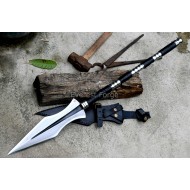
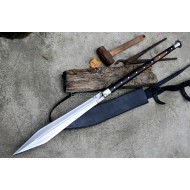
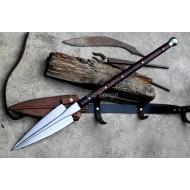
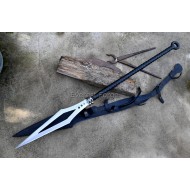
- Model: VIKING SPEAR
- Product Code: SPEAR54
- Location: Kathmandu, Nepal
Available Options
A Hand-Forged Leaf-Blade Spear With a Raised Midrib
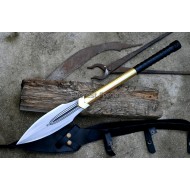
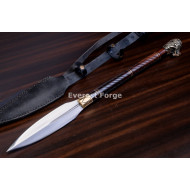
This is a hand-forged short spear with a broad 13 inch double-edged head on a 25.5 inch haft, 38.5 inches overall and 1,380 grams. The head is forged from 5160 high-carbon spring steel in our workshop in Tokha-3, Kathmandu, and the piece comes with a shaped leather sheath cut to the blade outline and a long leather carry belt. Nothing is held in stock: it is forged after your order arrives, which is why the reach, the haft material, the finish and the edge are all yours to set at no extra cost.
The head is what people stop for. It is leaf-shaped in general outline, swelling to its widest point forward of centre and running out in a long taper to the tip, with deep concave sweeps either side of the base that give it a waisted, winged silhouette. Down the centre-line of both faces runs a raised ridge, and that ridge is the most functional thing on the piece: width without depth folds, and a midrib puts depth exactly where a broad head needs it most.
At 38.5 inches this is a short spear rather than a polearm, which makes it one of the few pieces at this scale that will actually hang on an ordinary wall and be handled in an ordinary room. If you want real polearm reach, we forge the same head onto a longer haft — see the build options below.
An honest note. Four things a knowledgeable buyer will notice, so we will say them first. The forms at the base of the head are not barbs. A barb faces backwards and exists to stop the head being withdrawn; these sweep outward, in the plane of the blade, and cannot catch anything — they are a decorative treatment, and we will forge genuine rearward barbs at no extra cost if you want them. Second, at 1,380 grams this is heavy for a 38.5 inch spear, where a comparable timber-shafted weapon runs closer to 800 grams — and because the haft is rosewood rather than anything dense, that mass is in the HEAD. Expect a distinctly head-forward spear. Third, rosewood is a cabinet timber rather than a traditional shaft timber: ash and hickory are what shafts have always been, because they are springy and shrug off shock where rosewood is stiffer and more brittle. We will build the haft in ash or hickory at no extra cost. Fourth, this is not a reproduction of any documented spear. Broad leaf-shaped heads are genuinely ancient; the concave waisting is a modern design decision, and we would rather sell it as one than invent a lineage.
Why It Is Built This Way
Full Specifications
Figures are taken from the piece shown. Hand-forged work varies a little from one to the next, so read these as close rather than exact. If a dimension matters to what you are doing, tell us before we start and we will build to it and measure the finished piece for you.
Build It Your Way
None of this costs extra, because none of it is made before you ask for it. Work down these six and put what you want in the order note.
Want a spear we have not built yet?
A genuinely barbed head, a Greek doru with a bronze-style sauroter, a boar spear with a proper crossbar, a winged lancehead from a documented find, or something out of your own head on paper. We work from your drawing or your reference photographs, quote before we start, and forge it from the same 5160 as everything else here.
Start a Custom Forge Request →What It Does Well, and What It Does Not
What it does well
- A head with real presence. Thirteen inches of broad double-edged blade is a great deal of visible steel, and the ridge and the waisting catch light from across a room.
- The midrib is genuine engineering rather than decoration, and it is what allows a head this wide to still be a serious point.
- Compact enough to be practical. At 38.5 inches this hangs on an ordinary wall and can be handled indoors, which a seven-foot polearm cannot.
- A shaped sheath cut to the blade's outline with a carry belt, rather than a bag with a strap on it.
- A rosewood haft, turned and carved, with a steel collar, a brass band and a fitted butt cap rather than a dowel pushed into a socket.
- Complete configurability at no extra cost, because nothing is built until you order it.
What it does not do
- The shapes at the base of the head are not barbs. They sweep outward rather than back and cannot catch or hold anything. Order the true barbed head if that is what you want.
- It is heavy for its length and the mass is at the front. 1,380 grams over 38.5 inches is roughly half again what a timber-shafted spear of this reach weighs, and nearly all of it is head.
- Rosewood is not a traditional shaft timber. It is stiffer and more brittle than ash or hickory, which is what shafts have always been. Ask for ash and it costs nothing.
- It is a short spear, not a polearm. If you want six or seven feet of reach, order a longer haft rather than be disappointed by the box.
- It cannot be thrown, and should not be. The balance is wrong for it and the joint will not thank you.
- It is not stainless. 5160 rusts if left wet and needs an occasional wipe of oil.
How to Order
Who It Is For
- Collectors who want a dramatic head on the wall and would rather be told which parts of it are historical and which are design.
- Fantasy and film-inspired buyers after a piece with genuine presence that is nonetheless forged from proper steel by people who make weapons for a living.
- Buyers with limited space, for whom 38.5 inches is the practical argument over a polearm-length piece.
- Stage combat and theatrical armourers, who can order this design rebated and round-tipped at no extra cost.
- Reenactors and living-history people — with the caveat that you should order true barbs, an ash or hickory shaft and probably a butt spike to bring it into period.
- Anyone who wants a spear built to their own reach, weight and finish, which is most of the people who reach this page.
What Is Included
- The spear, hand-forged in Tokha-3, Kathmandu, Nepal.
- A shaped leather head sheath, stitched in contrasting thread, with a riveted retaining strap.
- A long leather carry and hanging belt with fittings.
- A protective coat of oil on the blade for transit, wiped off before handling.
- Care instructions, and the Everest Forge manufacturer warranty against defects in materials and workmanship.
Tell us the reach and we will build to it
The most useful thing you can tell us about a spear is how long you want it, because haft length sets the weight, the balance, the shipping class and what the weapon is actually good for. Send us the length, or just tell us what it is for, and we will come back with what we would build and what it costs.
Talk to the Forge →Other Blades and Reading From the Forge
Shipping, Returns and Care
Dispatch and transit. Standard builds leave the workshop in 2 to 3 business days. Genuinely custom work — a different haft length or material, true barbs, a butt spike — runs 4 to 6 weeks depending on the queue. We ship by DHL or FedEx with tracking, typically 7 to 14 business days from Kathmandu. A 38.5 inch item travels in a rigid tube or timber-cornered carton with the head sheathed and lashed and the haft padded along its length. Longer hafts ship as oversize freight, quoted before you order rather than after.
Duties, import and edge law. Import duty and local taxes are the buyer's responsibility and vary by country. Edged weapons, and long ones in particular, are regulated differently in different places, and a spear is treated more strictly than a knife almost everywhere. Please check what applies where you live before ordering. If an unsharpened build would make the difference, we will supply one at no extra cost.
Returns and warranty. Because every piece is forged after the order, a custom build cannot be restocked, so please make sure the specification is right before you confirm. Anything damaged in transit, or showing a defect in materials or workmanship, is covered by the Everest Forge manufacturer warranty and we will repair or replace it. Photograph the packaging as well as the piece if something has gone wrong on the way.
Care. 5160 is a high-carbon steel and it is not stainless. Wipe the transit oil off before you handle the blade and put a light film back on before it goes away. Fingerprints are acidic and will etch a polished blade if left on it for weeks. Pay particular attention to the valleys either side of the midrib and the inside of the concave sweeps at the base: those are surfaces a cloth drawn along the flat never properly touches, and that is exactly where moisture sits. Store the head out of the leather sheath for long periods, since leather holds damp against steel. Light surface rust comes off with oil and fine steel wool; nothing abrasive on a polished finish. The rosewood haft wants very little: wipe it down, and a rub of furniture or boiled linseed oil once or twice a year keeps it from drying out.
Questions About the Leaf-Blade Spear
What exactly is this, and is it a historical type?
A short spear with a broad double-edged head, 13 inches of blade on a 25.5 inch haft, 38.5 inches overall. The head is leaf-shaped in outline, swelling to its widest point forward of centre and running out in a long taper, with a raised ridge down the centre-line of both faces and a deep concave sweep either side of the base.
It is not a reproduction of any documented type. Broad leaf-shaped heads are real and ancient — Bronze Age Europe, Greece and the Migration period all used them — but those outlines are smoothly convex. The concave waisting here is a modern design decision. An original spear in a historical idiom, which is a fine thing to be as long as nobody sells it as something older.
What is the raised ridge down the middle of the blade for?
Stiffness, and it is the most functional thing on the head. A broad flat spearhead has plenty of width and very little depth, and depth is what resists bending. Drive a wide flat head into something solid off-square and it wants to fold across itself. A midrib adds material on the centre-line, where it buys the most depth for the least weight, turning a flat plate into something closer to a shallow beam.
It is also why a broad head can afford to be broad. Narrow heads do not need the help, their width being small enough that the section holds up alone. This is a different argument from the one our pierced kukri page makes about where bending stress sits across a blade's width — that is about taking material out of the middle of the width, this is about adding depth at the centre-line. Perpendicular problems, opposite solutions.
Are the shapes at the base of the blade barbs?
No, and it is worth knowing what a real barb is for. A barb faces rearward and its job is to stop the head coming back out. Harpoons use them so the animal cannot shake the head loose, and some boar spears carry them for the same reason. The Frankish angon was barbed so that once it struck a shield it could not be pulled free, and the enemy had to drop the shield or fight with a spear shaft dragging on it.
The forms at the base of this head sweep outward rather than back, in the plane of the blade. They cannot catch or hold anything. They are decorative, they look superb, and they are not doing a barb's work. If you want a genuinely barbed head with rearward points, we will forge one at no extra cost.
Why does it weigh 1,380 grams?
Because the head is heavy, not because the haft is. A 38.5 inch spear with a timber shaft runs around 700 to 900 grams. This one is half again that, and the haft is rosewood — dense for a timber, but a shaft of this length accounts for only a few hundred grams. Do the subtraction and most of the mass is in those 13 inches of broad, ridged steel at the front.
So this is a head-forward spear and it will feel like one. Real authority in a thrust, and it holds a line once moving. The costs are the ones mass out front always brings: slower to start, slower to stop, heavier at arm's length. If you want it livelier, a lighter head profile and a butt spike instead of the cap both help, and we will do either.
What is the haft made of?
Rosewood as standard, turned and carved, with a steel collar and a brass band where it meets the head and a fitted steel cap at the butt. Rosewood is dense, hard, dimensionally stable and about as handsome as timber gets, which is why it is the default across most of our range.
It is worth saying what it is not. Rosewood is a cabinet timber. Shafts, tool handles and axe hafts have traditionally been ash or hickory, and not for cost: those timbers are springy and tough and absorb shock, where rosewood is stiffer and comparatively brittle and would rather crack than bend. For display and handling this makes no practical difference. For a piece you mean to work hard, ask for ash or hickory — free, lighter, and the historically correct shaft.
What does the butt cap do?
More than most buyers expect. The obvious job is protecting the end of the haft, which otherwise splits or mushrooms the first time you set the spear down hard. The second is balance: mass at the back pulls the balance point rearward, away from the head, which is what makes a spear quick to bring back on line after a thrust.
The third job is the interesting one. On a Greek doru the butt was a bronze spike, the sauroter, and it was a working end of the weapon — a second point if the head broke off, a way to plant the spear butt-down in the ground, and something to finish with when the fighting got close. Ours is a cap rather than a spike, which is the sensible choice for a piece that will mostly be handled and displayed. If you want a proper spike we will forge one.
Broad head or long head — which should I choose?
They are different weapons and the answer depends on what you want it to do. A broad head like this one carries its width forward, makes a wide wound channel, and cuts on a draw as well as thrusting. The costs are real: more resistance going in, slower to withdraw, and more mass ahead of your hands.
A long narrow head does the opposite: it concentrates force behind a small point, penetrates far better against anything resistant, comes back out cleanly and feels lighter at the front. We build both. Tell us what the spear is for rather than what it should look like and we will say which one we would make you.
Does it arrive sharp?
Yes, unless you ask us not to. Both edges and the point ship sharpened and ready to use. On a head of this shape the point does most of the work, but the edges on a broad head are genuinely useful and are finished properly rather than left as ground bevels.
Two alternatives at no extra charge. An unsharpened build leaves the edges blunt, which suits display or an awkward import. A stage combat build gives you a rebated edge and a rounded tip, balanced for the work — add the wording "Stage combat build — rebated edge, rounded tip" to your order note.
What does the sheath cover, and what is the belt for?
The head only. Shaped leather cut to the outline of the blade, stitched in contrasting thread, with a riveted retaining strap closing over the base. It protects the sharpest and most fragile part of the spear in transit and storage, and means you are not handling a bare 13 inch edge every time you take it off the wall.
The belt is a carry and hanging strap rather than a scabbard rig. A spear is not a sword and there is no comfortable way to wear one at the hip. Use it to carry the sheathed head or to hang the piece. A wall mount cut to this blade's profile, or a shoulder rig, are custom forge items and we will quote them.
Can I order a longer haft?
Yes. The head is the fixed part of this design and the haft length is yours to set. As built, 25.5 inches of haft gives a compact 38.5 inch weapon that fits an ordinary wall and handles indoors. Longer hafts take it toward hunting-spear and then polearm reach.
Two practical notes. Extra haft adds weight along the whole length, and on a spear already carrying its mass at the front a long rosewood shaft gets unwieldy, so that is the point where we will usually steer you toward ash. And anything much over 60 inches ships as an oversize freight item, which changes both cost and transit time. We quote both before you commit.
Can it be thrown?
No. Do not throw this. It is not balanced for flight, the haft is not built to survive impact with the ground, and a 1,380 gram weapon landing badly will bend or mark the collar joint where head meets haft.
Throwing spears are a different weapon built to different rules — lighter, with a head meant to be sacrificial and a shaft meant to be cheap. If that is what you want, ask for a javelin build through the custom forge page and we will design it for the purpose rather than adapt something wrong for it.
How long does it take, and how do you ship a 38.5 inch item?
Nothing is held in stock. Every piece is forged after the order arrives, which is why the haft length, the haft material, the finish and the edge specification cost nothing extra to change — there is no standard version already made. Standard builds dispatch in 2 to 3 business days; genuinely custom work runs 4 to 6 weeks depending on the queue.
The spear ships in a rigid tube or a braced timber-cornered carton, head sheathed and lashed, haft padded along its length, by DHL or FedEx with tracking, typically 7 to 14 business days from Kathmandu. Long items occasionally attract a surcharge at the destination; if that applies to your address we will tell you before we take the order rather than after.
| Specification | |
| Blade: | 12 inches Long Blade, Made of 5160 carbon steel |
| Total Length: | 36 inches long in total |
| Handle: | 24 inches Long Full tang Handle made from Rosewood |
| Weight: | 1200 Grams (Approx.) |
| Note: | Slight variations in weight, dimensions, or finish may occur due to the handmade nature of the item. |