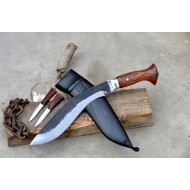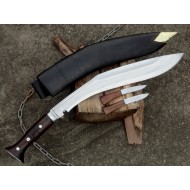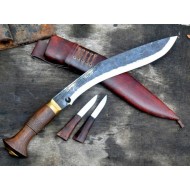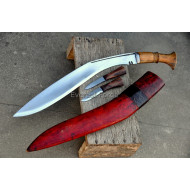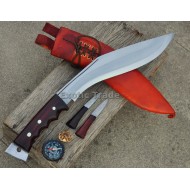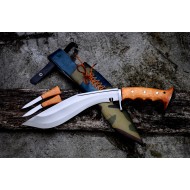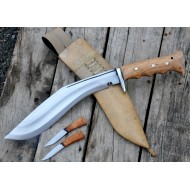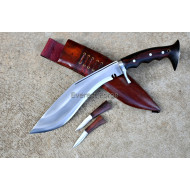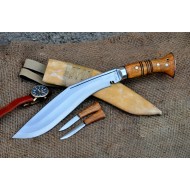
- Model: Modern kukri
- Product Code: EAGLEDAGON0015
- Location: Kathmandu, Nepal
Available Options
A Hand-Forged Fantasy Kukri With a Sawback Dragon Spine and Panawal Hilt
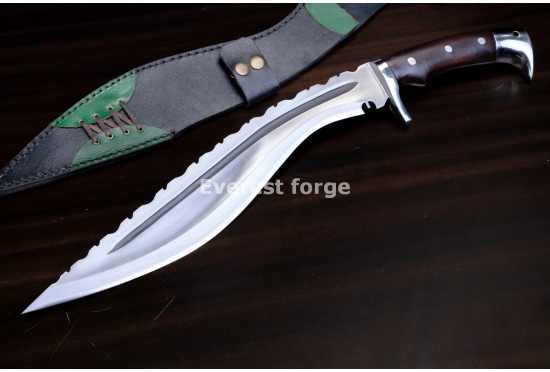
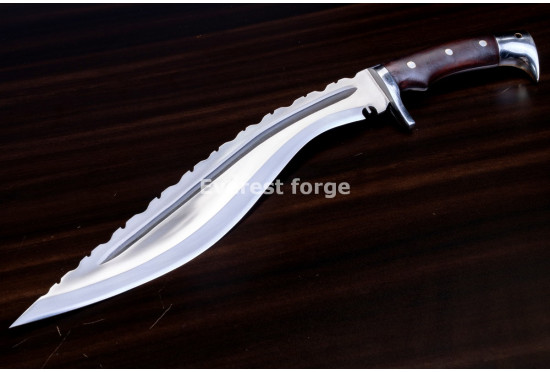
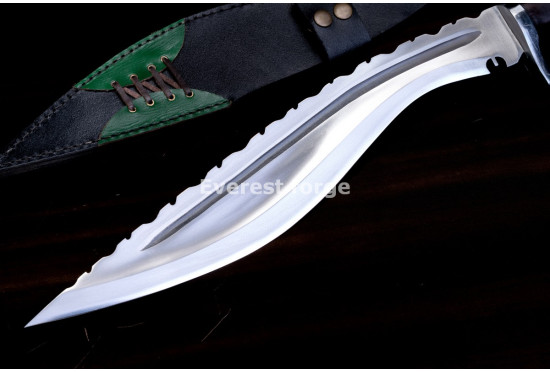
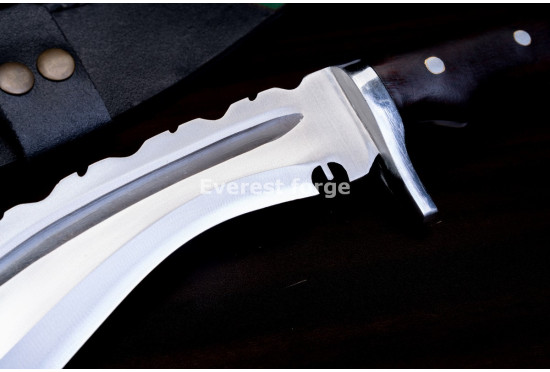
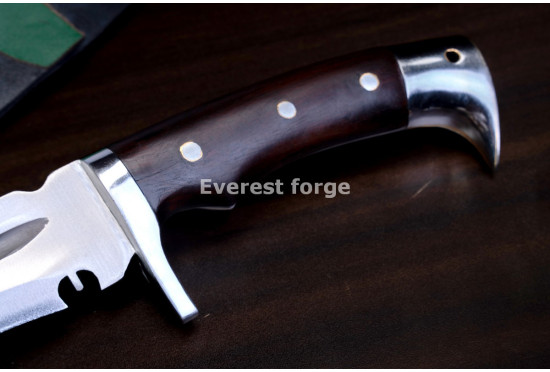
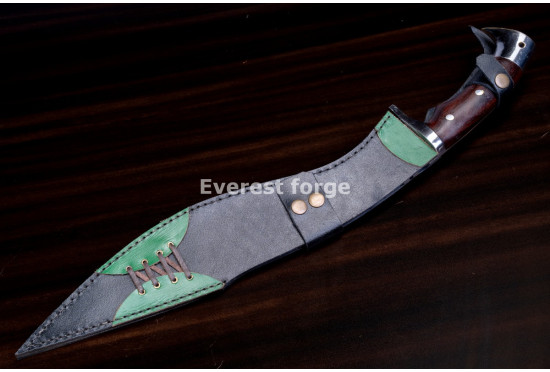
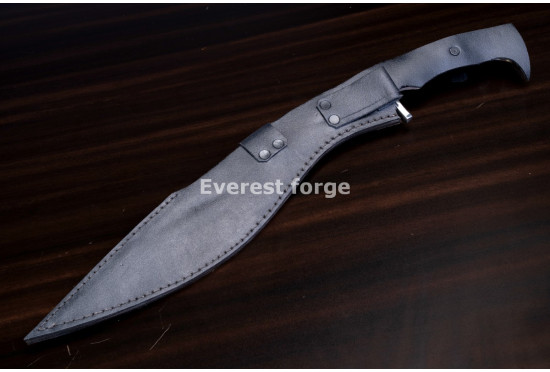
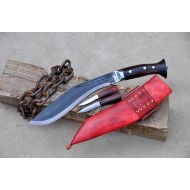
This is a 15 inch hand-forged fantasy kukri with a sawback spine: a continuous run of deep scalloped teeth cut along the whole length of the back, from the bolster out to the drawn point. Beneath the styling it is a properly built kukri — forward-curved with the edge on the inner curve, a long chirra ground down the blade, and the cho notch filed at the base of the edge. The hilt is panawal, with rosewood scales riveted through a full-width tang, capped in polished steel with a beaked pommel. Overall length is 21 inches and the kukri weighs approximately 740 grams. Forged from 5160 high-carbon steel in Tokha-3, Kathmandu, and supplied in a black leather scabbard with green applique panels.
An honest note. The sawback is styling, not a saw. We will explain why in full below, but the short version is that saw teeth need what woodworkers call set — alternate teeth bent slightly left and right so the cut they make is wider than the blade behind them. Teeth cut into the spine of a thick kukri have no set at all, so the blade binds in its own kerf after a few strokes. It will rasp, notch, tear through rope and strip bark, and it looks superb. It will not cut through a branch the way a folding saw will. Anyone selling you a sawback blade as a serious wood-cutting tool is either not being straight with you or has never tried it.
Have This Kukri Forged Your Way
Tooth pattern, blade length, pommel form and scabbard dress are all decided at the forge. Send a sketch or a description and our smiths will quote it.
Start a Custom Forge Order →Why This Kukri Is Built the Way It Is
Specifications
Build Options
Is This the Right Kukri for You?
Buy This If You Want
- A striking fantasy blade that is genuinely forged rather than cast or stamped
- Kukri geometry and a panawal hilt underneath the styling, so it handles properly
- A spine that will rasp, notch, strip bark and tear rope
- A piece for display, collection, cosplay or photography that would survive real use
- Hand-filed teeth rather than a machine-cut serration pattern
Look Elsewhere If You Want
- A blade that will actually saw through wood — read the answer below, then buy a folding saw
- To baton with it; there is no flat spine to strike and the teeth will destroy your baton
- A traditional Nepali kukri, since the sawback and the pommel are modern styling
- A stainless blade needing no care, since 5160 is carbon steel and will rust if left wet
- Something simple to sharpen, because a toothed spine takes longer to clean and maintain
Design It and We Will Forge It
Fantasy blades are where our smiths get to invent rather than reproduce. Send a drawing, a screenshot or a description and we will tell you honestly what will work and what will only look good.
Talk to the Forge →How to Order
Who This Kukri Is For
- Collectors of fantasy blades who want forged steel rather than a stainless wall-hanger
- Cosplay, prop and photography work where the piece has to read dramatically in a single frame
- Gamers and readers after a real-world version of something they have seen rendered
- Kukri owners who already have a working blade and want one that is purely for pleasure
What Is Included
- One hand-forged fantasy kukri, sharpened and ready
- Fitted black leather scabbard with green applique panels
- Certificate of hand-forging from the workshop
- Everest Forge manufacturer warranty against defects in forging and heat treatment
Explore the Collection
Shipping, Returns and Care
Stock pieces are dispatched within two to three business days. Custom builds take four to six weeks at the forge before they ship. Everything travels tracked with DHL or FedEx and typically arrives in seven to fourteen business days. Every piece carries the Everest Forge manufacturer warranty against defects in forging and heat treatment.
Large fixed blades are restricted in some countries and in some states and provinces within them, and a toothed or serrated spine attracts additional restrictions in a few. It is your responsibility to check that this kukri may lawfully be imported and possessed where you live before ordering, because a parcel seized by customs cannot be returned to us and cannot be refunded. Ask us before you buy if you are unsure and we will tell you what we know about your destination.
5160 is a high-carbon steel and it will rust if left wet or stored damp. A sawback needs more attention than a plain spine, because the valleys between the teeth hold moisture and are easy to miss with a cloth. Dry it properly, work oil into the teeth with a brush rather than wiping across them, and check the spine when you check the edge. Do not store the kukri in the scabbard for long periods. The rosewood scales take an occasional coat of oil.
Frequently Asked Questions
Does the sawback actually saw?
Not properly, and we would rather say so on the product page than let you find out in a wood pile. A working saw depends on set: alternate teeth are bent slightly left and right so the slot they cut, the kerf, ends up wider than the blade following behind. Without set the blade jams in its own cut almost immediately, and you cannot put set into teeth filed along the spine of a kukri because the spine is thick, hardened and structural. There is a second problem: sawing wants a long straight stroke, and a kukri spine is curved, so the teeth do not track. What a sawback does do is rasp. It will tear through rope, webbing and plastic, strip bark, rough out a notch, score a surface and cut fibrous material where a smooth spine would slide. Those are real uses. Cutting a branch is not one of them. If you want teeth that genuinely saw, ask us and we will forge you a thinner blade with proper set filed in — it will look nothing like this knife, and it will work.
Why do so many knives have sawbacks then?
Because they look purposeful, and because the idea has a long tail. Sawback edges were fitted to European military bayonets from the nineteenth century, issued mainly to pioneer and engineer troops who genuinely needed to cut timber and clear obstacles rather than to ordinary infantry. During the First World War they became notorious: Allied propaganda held that soldiers captured carrying them were dealt with harshly, and the pattern was largely withdrawn from front-line issue as the war went on. How much of that reputation was real and how much was propaganda is still argued over. What is not argued over is that the tool was always a compromise, which is why modern military and outdoor kit uses a separate folding saw. The sawback survives today mostly because it reads as serious in a photograph, which is the honest reason it is on this blade too — this is a fantasy piece and the spine is part of the design.
Is it still a real kukri underneath?
Yes, and that distinction is worth drawing carefully. The things that make a kukri a kukri are all present and all correct: the forward curve with the edge on the inner side, the forward-biased balance, the cho filed at the base of the edge, the chirra, and a panawal hilt with a full-width tang. Steel and heat treatment are identical to our working kukris. What is not traditional is the sawback spine, which no Nepali pattern carries, and the beaked pommel, which is a modern fitting. So it is a genuine forged kukri wearing a modern design, rather than a kukri-shaped object. We draw the line this way on every fantasy piece we make: the construction is never the part we take liberties with, because a decorative blade with a weak hilt is worthless and a well-built one is a knife you can hand down.
Can I baton with it?
No, and this is the one real functional cost of the sawback. Batoning means striking the spine of the blade with a piece of wood to drive it through a log, and it needs a flat spine to strike. A toothed spine gives you nothing to hit squarely, it chews the baton apart in a few blows, and it concentrates the impact on individual tooth tips rather than spreading it along the blade. The panawal hilt on this knife would take batoning without complaint; the spine will not. If you want a kukri you can baton, our Panawal Hilt kukri has the same hilt construction with a plain spine and is built for exactly that. This one is for cutting, display and the pleasure of owning it.
What is the notch near the handle?
The cho, also called the kaudi, filed by hand into the edge just ahead of the bolster. It arrests cracks running back out of the edge into the tang and keeps sap and fluid off the grip, and in Nepal it carries symbolic readings as well, variously a trident, a cow's hoof or a mark of the divine depending on who you ask. We cut one on every kukri we make including the fantasy pieces, because it is the mark of the tradition the blade comes from. A kukri with no cho at all, or with a perfectly identical stamped cho across every example in a listing, did not come from a Nepali forge.
What steel is it, and how is the edge hardened?
5160 high-carbon spring steel, the same alloy family as the vehicle leaf springs Nepali kamis have forged kukris from for generations. The edge is hardened differentially rather than the blade being through-hardened, so the cutting edge is hard while the spine stays soft and springy. On this blade the differential treatment matters more than usual, because a toothed spine is full of small notches and every notch is a place a crack could start — a hard brittle spine would be the wrong choice here even before you consider the chopping. It is not stainless, deliberately.
How do I sharpen and clean the teeth?
The edge sharpens exactly like any other kukri, on a stone. The teeth are a different job. They do not need sharpening in the usual sense, because they work by tearing rather than slicing, but they do collect debris, and the valleys between them are where rust starts on a carbon-steel blade because a cloth simply skates over the top. Use a stiff brush along the spine rather than a rag across it, dry properly after any wet work, and push oil down into the gaps. If a tooth ever chips, a small round or triangular file will restore it in a minute; the shape is not precise and nothing depends on the teeth being identical.
What is the pommel meant to be?
It is a beaked cap: a polished steel form curving over the end of the tang and hooking downward. Whether you read it as a bird's head, a claw or simply a hook is up to you, and we would rather describe what is there than tell you what to see in it. Functionally it does the job any kukri butt cap does, which is to stop the hand travelling off the back of the grip under a hard swing, and the hook gives it more purchase against the heel of the palm than a plain flare would. If you want an unambiguous sculpted animal head — eagle, dragon, wolf, anything you can describe — that is cast and finished as a custom order and our smiths enjoy those.
Is it strong enough to actually use?
The hilt is, without qualification: panawal construction with a full-width tang and riveted scales is the strongest kukri hilt made and it is what we would fit to a working blade. The blade is a genuine forged kukri and will chop. The caveat is the spine, in two ways. You cannot baton it, as above. And a row of deep notches along the back removes material and creates stress points, so a sawback blade is inherently a little less robust than a plain-spined one of identical dimensions. In practice this only matters if you are asking the knife to survive real abuse. For chopping, cutting and camp work it is fine. For the hardest possible use, order the plain spine.
How sharp does it arrive?
Sharp and ready, with the edge put on a stone by hand at the forge. The teeth arrive as filed and need nothing. If you would prefer the whole piece shipped blunt — for display, for a convention, for a gift, or because of the rules where you live — say so in the order comments and we will send it unsharpened at no extra cost. That is a common request on fantasy pieces and it costs nothing.
Can you make it from a design I send?
Yes, and fantasy work is where our smiths most enjoy themselves, because they are inventing rather than reproducing. Send a drawing, a screenshot, a render or just a description. What we will do in return is tell you honestly which parts of it will work and which will only look good — thin spikes snap, deep cutouts near the tang are a bad idea, and blades that are all silhouette and no cross-section handle terribly. Nearly every fantasy design can be built so that it both looks right and is a real knife, but it usually needs one or two changes, and we would rather have that conversation before forging than after.
Who makes these?
Our own kami, in our own workshop in Tokha-3 on the northern edge of Kathmandu. Kami is the Nepali word for smith, and most of ours came from families that have forged blades for generations. Everest Forge has operated since 2010. Fantasy blades sit oddly alongside traditional work and we are comfortable with that: the same hands forge both, the construction standard does not drop, and a smith who has made ten thousand working kukris brings something to a fantasy design that a factory pressing them out of stainless bar does not.
| Specification | |
| Blade: | 15 inches. Hand forged from 5160 carbon steel |
| Total Length: | 21 inches |
| Handle: | 6 inches. Panawal construction, full width tang with rosewood scales riveted through, steel bolster and beaked pommel cap |
| Weight: | approx 740g kukri, 950g with scabbard |
| Note: | Some variation in weight, dimensions and finish may occur as each piece is hand forged. Keep the blade lightly oiled and work oil into the sawback teeth with a brush |