

- Model: EDC Knives
- Product Code: EDCHOPPER6
- Location: Kathmandu,Nepal
Available Options
An EDC Chopper for the Pack
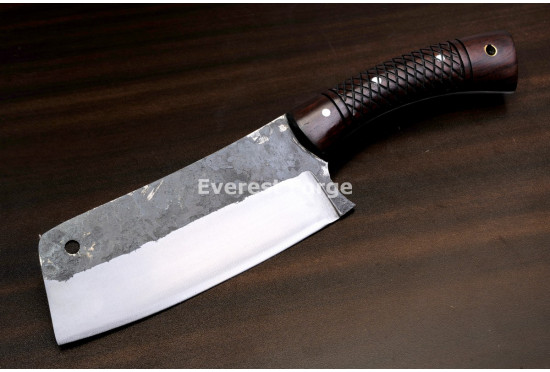
Most people carrying a blade outdoors end up carrying two: something small for the fiddly work and something large for the wood. This is built to be the second one without being the size of the second one. The whole package is 12.5 inches, which fits a pack lid or a belt without argument, and 620 grams of that is blade — short, tall and thick, with the mass sitting forward where it does the cutting.
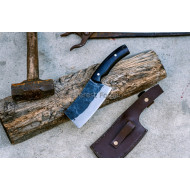
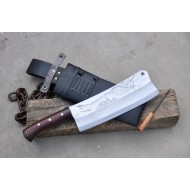
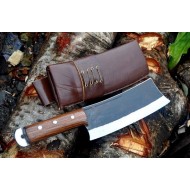
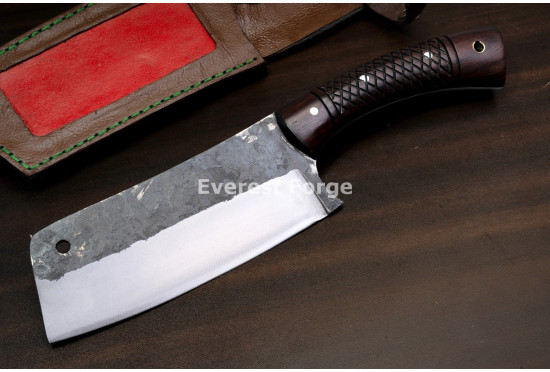
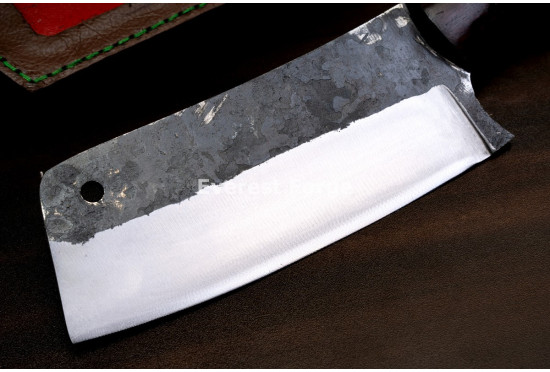
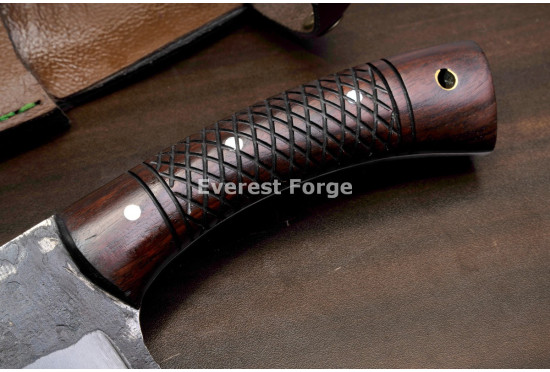
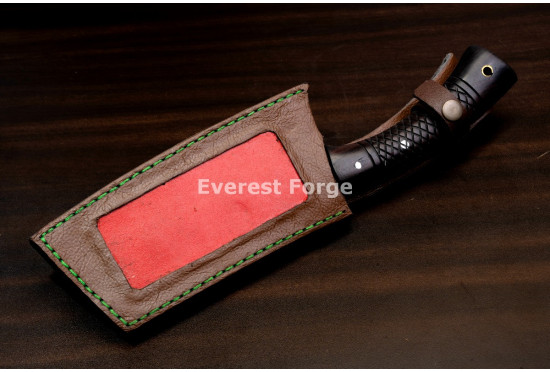
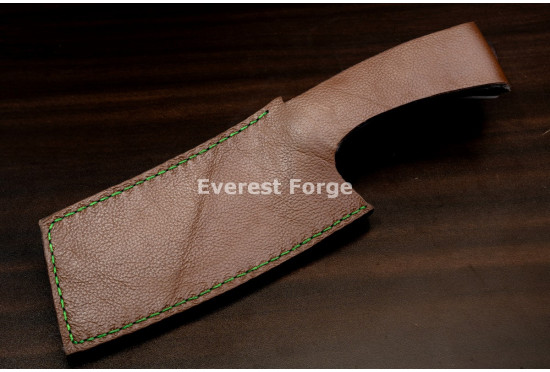
The blade is 6.6 inches, hand-forged from 5160 high-carbon steel, oil-quenched and tempered, in a cleaver profile with a straight edge and a squared-off nose. The upper part of the blade is left as it came off the anvil, hammer marks and forge scale intact, with the bevel ground bright below it, so the two finishes meet in a hard line down the flat. There is a hole through the blade near the spine for hanging or a lanyard. The 6 inch grip is contoured rosewood, pinned through with three rivets, with a diamond-carved section under the palm and a brass-lined hole at the butt. It ships in a brown leather slip sheath, stitched in green, with a snap strap over the handle.
An honest note. Two things. The forge finish on the upper blade is a look and a labour saving, not a coating — scale is not rust-proof, and this blade needs oiling like every other carbon steel piece we make. Anyone selling forge scale as protection is overstating it. Second, the sheath is a slip cover rather than a full welted sheath: it protects the edge, it keeps the blade off your kit, and the snap holds the handle, but it is not built for the blade to be thrown loose in a pack for a week. If you want a heavier sheath with a welt and a firm belt loop, we will make one.
Want This Built Your Way?
A longer blade, a polished finish, another grip material, a heavier welted sheath, or your own drawing entirely. Our smiths in Kathmandu forge to specification and quote before any work begins.
Start a Custom BuildWhat Makes It Work Outdoors
Standard Build and Specifications
Blade length, blade finish and grip material are selectable, so the figures above describe the standard build rather than every version. Because each piece is forged, ground and fitted by hand, weights and dimensions vary slightly between examples, and the forge finish varies more than most — hammer marks are never twice the same.
Build Options
Is This the Right Blade for You?
Choose This One If
- You want chopping ability in something that actually fits a pack
- You baton — a flat cleaver spine is the best striking surface of any blade shape
- You want one blade for firewood, camp cooking and game prep
- You prefer a finish that hides use rather than showing it
- You have found full-size choppers get left at home because of their size
Look Elsewhere If
- You want reach — 6.6 inches cannot clear brush or take a limb the way a kukri can
- You want a point — a cleaver has none, so no drilling, boring or fine tip work
- You want a light blade — this is dense for its size and it is meant to be
- You want a heavy-duty sheath as supplied — ask for the welted version
- You want a slicer — the grind favours impact over fine cutting
How to Order
Who This Chopper Is For
- Bushcrafters who want a batoning and splitting tool that does not dominate the pack
- Hunters — a cleaver profile is the right shape for jointing and for going through bone
- Campers cooking over fire who want one blade for kindling and for the food
- Overlanders and vehicle campers where space matters more than reach
- Anyone whose full-size chopper stays at home because it is too much to carry
What Is Included
- One hand-forged EDC chopper, sharpened and ready to use
- Brown leather slip sheath with snap strap
- Everest Forge manufacturer warranty
- Care instructions
More From the Everest Forge Collection
Shipping, Returns and Care
Stock builds dispatch from our workshop within 2-3 business days. Custom and made-to-order builds take 4-6 weeks from confirmation, and we photograph the finished piece before it leaves us. We ship worldwide with DHL and FedEx, fully tracked, typically 7-14 business days in transit. Every blade carries the Everest Forge manufacturer warranty against defects in forging and construction.
Blade laws vary by country, state and province and it is the buyer's responsibility to check local restrictions before ordering. Carrying a fixed blade day to day is restricted in many jurisdictions regardless of blade length. We cannot advise on your jurisdiction and we cannot refund a blade seized in transit.
5160 is a high-carbon steel and it will rust if you let it, and the forge finish does not change that — scale is not a protective coating. Wipe the blade dry after use, keep it lightly oiled, and pay attention to the hole through the blade and to the cut lines of the grip carving, both of which a cloth drawn across the flat will skip. If you use this on food, and most owners will, clean it promptly and dry it properly: carbon steel is safe for food but it reacts with acid, so onions, tomatoes and citrus will darken the bevel within minutes. That patina is harmless and many people encourage it, but it is not reversible without abrasive work.
Forged by Hand, Not Assembled
Every blade we sell is forged, ground, heat-treated and fitted by our own smiths in Kathmandu. If you want something we do not list, we will make it.
Talk to Our SmithsFrequently Asked Questions
Why a cleaver profile for camp work?
Because almost everything a cleaver is good at is something you do at a camp. The straight edge meets a flat surface along its whole length, so cutting on a board, a stump or a flat rock gives you contact everywhere rather than at one point — that is food prep, jointing and controlled splitting all improved at once. The tall blade puts your knuckles clear of whatever you are cutting into. The flat spine is the best batoning surface any blade shape offers. And the mass sits forward and low, so the tool does the chopping rather than your arm. What you give up is a point, and that is a genuine loss: there is no drilling, no boring and no fine tip work with this. Most people who carry one pair it with a small knife, which between them weighs less than one full-size chopper.
Is 620 grams heavy for a 6.6 inch blade?
It is dense, and that is the design rather than an accident. It is worth heading off a comparison that looks alarming and is not meaningful: we publish grams per inch of blade across our range, and by that measure this comes out near 94, well above any kukri we make. But grams per inch assumes a long blade that tapers, and a cleaver is short, tall and thick along its whole length — the number is measuring the wrong thing. What matters here is that 620 grams is concentrated into a small area ahead of your hand, which is exactly why a 6.6 inch blade can chop like something much longer. Compare it against our full-size choppers on total weight instead: this is 850 grams all in, against 1,070 to 1,400 for the big kukris, in a package roughly two-thirds the length.
Why is the handle nearly as long as the blade?
For leverage and for options. A 6 inch grip behind a 6.6 inch blade is an unusual ratio — most knives run far more blade than handle — and it exists because a short heavy blade needs somewhere to put your hand to make use of the mass. Hold it at the back and you get the longest lever, which means the most force at the edge for a given swing, and that is how you use it on wood. Slide your hand forward against the ricasso and the tool shortens dramatically in your hand, the mass comes under your palm and you get control instead of power — which is how you use it on food or on anything needing accuracy. One tool, two working lengths. It is also why the whole package still fits in 12.5 inches despite chopping like something bigger.
What is the rough finish on the blade?
Forge finish: the surface as it came off the anvil, with the hammer marks and the dark scale left in place rather than ground away. The bevel below it is ground bright, so the two meet in a hard line down the flat and you can see exactly where the smith stopped shaping and started sharpening. Three honest points about it. It is not a coating and it is not rust protection — scale is iron oxide and this blade needs oiling exactly like a polished one. It does hide working marks, which a mirror finish emphasises, so a forge-finished blade looks better after a year of use than a polished one does. And it varies: hammer marks are never twice the same, so yours will not match the photographs. If you would rather have a clean blade, we will grind and polish it throughout.
Can I baton with it?
Yes, and this is one of the things it is genuinely best at. Batoning means striking the spine with a wooden billet to drive the blade through wood, and most knives are compromised for it: a curved or tapering spine gives the billet somewhere to slip off, and a thin blade wedges rather than splits. A cleaver spine is straight, square and thick along its entire length, which gives you a large flat target that will not deflect a strike, and the wide blade acts as a wedge as it goes. Strike over the middle of the blade rather than out near the nose, use a wooden billet and never a steel hammer, and keep the rounds sensible — a 6.6 inch blade limits how big a piece you can work through, which is the real constraint rather than blade strength.
What is the hole through the blade?
Hanging and lanyard. Drilled through near the spine where the steel does the least work, it takes a cord, a carabiner or a hook, which matters more on a compact blade than on a large one: this is a tool designed to live on the outside of a pack, on a hook by a fire, or looped to a belt rather than sheathed on a hip. A cord through it also gives you a retention loop when you are working over water or on a slope. There is a small structural cost to any hole in a blade, and it is worth being straight about that — but it sits high near the spine, well away from the edge, in a blade that is thick through its whole section, so on this piece the effect is not measurable in use.
How does it compare to your kukris?
It does one of the two things a kukri does, in a third of the package. A kukri chops by combining mass with reach and an arc, so it clears brush, takes limbs and covers ground. This chops by concentrating mass in a short blade, so it splits, joints and processes what is already in front of you. The practical split is about what your day looks like. If you are clearing a trail or felling anything, a kukri wins and it is not close. If you are at a camp reducing wood to fire-size, preparing food and jointing game, this does the work in something you will actually carry. Plenty of people own both. Nobody carries both at once.
What steel is it?
5160 high-carbon spring steel, oil-quenched and tempered. It is the family of steel used for vehicle leaf springs, which is where the Nepali practice of forging blades from springs comes from, and it is chosen for toughness rather than for maximum hardness. On a chopper that is the right call twice over. A blade that takes repeated impact needs to deform slightly rather than shatter, and 5160 at a working temper rolls at the edge where a harder steel would chip. And a rolled edge can be brought back with a stone in the field, where a chipped one needs a workshop. The trade-off is that it wants sharpening a little more often than a harder alloy. It is not stainless and it will rust if neglected.
Is the sheath enough for pack carry?
For most use, and we would rather be honest about the limit. What you get is a slip sheath: a folded leather cover, stitched, with a snap strap over the handle. It protects the edge, keeps the blade off the rest of your kit, and holds securely enough for belt carry or for the blade to sit in a pack lid. What it is not is a welted sheath with a rigid mouth. If this blade is going to be loose in a pack for days with heavy gear shifting against it, or worn on a belt through brush where it might catch, a heavier sheath is the sensible choice and we will build one with a welt and a firm belt loop. Say so at the point of order and we will quote it with the chopper.
How do I sharpen it?
Easily, which is one of the quiet advantages of the shape. A straight edge with no belly and no recurve means you can lay the bevel flat on a bench stone and work along the length without rolling the blade to follow a curve, so the angle stays consistent even if you are not practised. That makes this one of the more forgiving blades in our range to maintain, and a pocket diamond stone is enough to keep it going in the field. Two specifics. Work the square nose separately with the corner of the stone or you will round it off, and it is the part of the edge that does the scraping. And keep the stone off the forge-finished upper blade, which is not an edge and will only dull your abrasive.
Is it safe to use on food?
Yes, with one thing to expect. Carbon steel is food-safe and has been the standard kitchen material for most of history — stainless is the recent arrival. What carbon steel does is react with acid, so cutting onions, tomatoes, citrus or anything fermented will darken the bevel within minutes, and over time the blade develops a grey-blue patina. That patina is harmless, it is not rust, and many owners deliberately encourage it because a patinated blade resists true rusting better than a bright one. What you must do is clean and dry it promptly rather than leaving it wet or with food residue on it, and never put it in a dishwasher, which will damage both the steel and the rosewood grip. If you want a blade that stays bright, this is not the steel for it.
Can I have it in a different size?
Yes, though it is worth thinking about what you would lose. The whole argument for this piece is that it chops properly at 12.5 inches overall, which is the length that makes it carryable when a full-size chopper is not. Go much longer and you have a small kukri without the reach advantage a kukri would give you at that size, so we would generally steer you to one of those instead and say why. Shorter is more interesting: a 5 inch version keeps the profile and becomes a genuinely pocketable camp tool, though it loses chopping authority quickly since the mass goes with the size. Grip material, finish, grind and sheath can all be specified alongside. Tell us what you actually do with a blade and we will say what we would build.
| Specification | |
| Blade: | 6.6 inches. Hand forged from 5160 carbon steel. Cleaver profile - straight edge, square nose, flat spine |
| Total Length: | 12.5 inches |
| Handle: | 6 inches, contoured rosewood with diamond-carved palm section, three pins, brass-lined lanyard hole |
| Weight: | Approx. 620 g blade, approx. 850 g total |
| Note: | The forge finish is not rust protection. Oil this blade like any carbon steel piece. Acidic food will darken the bevel within minutes - that patina is harmless and not reversible. |