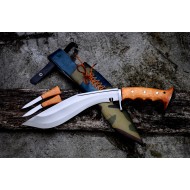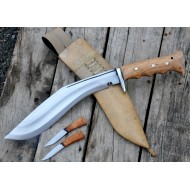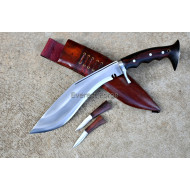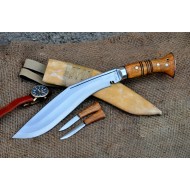
- Model: Signature Kukri/Khukuri
- Product Code: SingnatureBlade052
- Location: Kathmandu, Nepal
Available Options
Hand-Forged Bushcraft Kukri Knife — Rosewood Handle and Belt Sheath
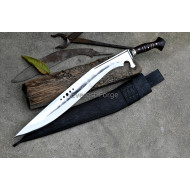
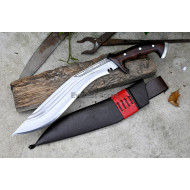
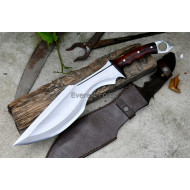
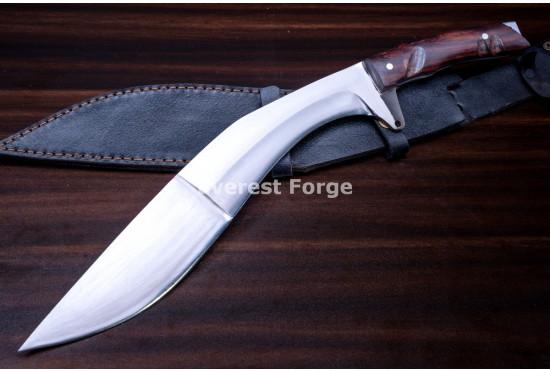
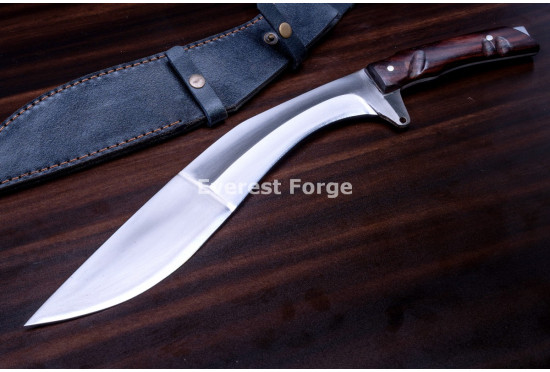
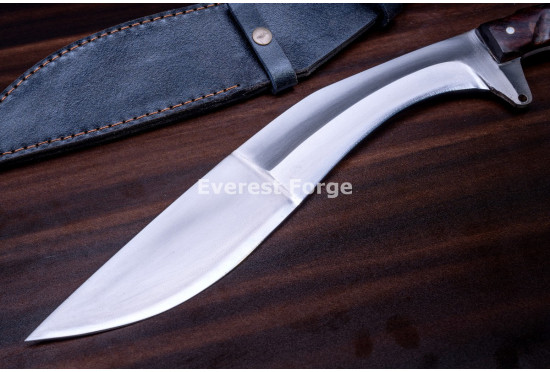
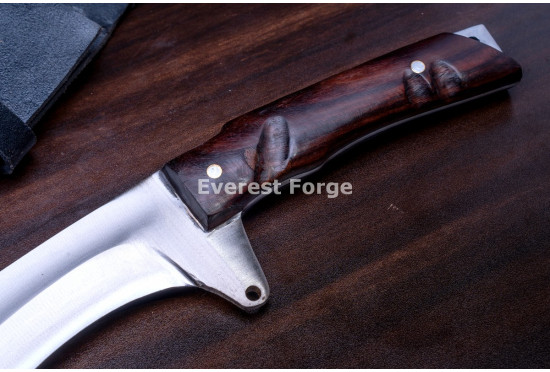
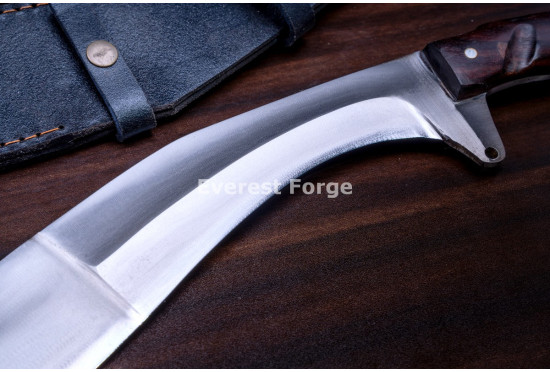
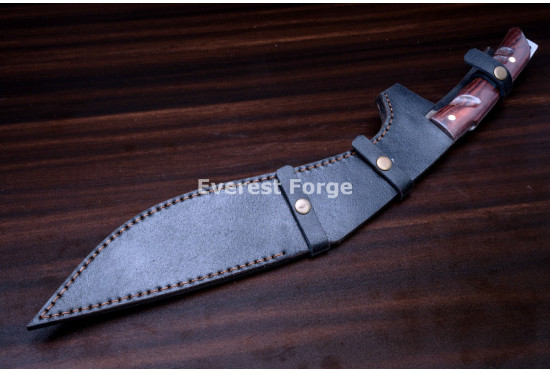
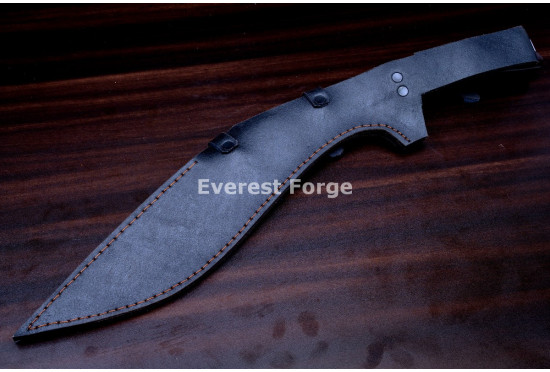
This is a hand-forged, fully functional bushcraft kukri — the forward-curved Nepali blade built for outdoor work, forged at our workshop in Kathmandu from 5160 high-carbon spring steel, oil-tempered, full tang, and sharpened to a true edge. The blade is polished, undecorated and carries the traditional cho notch at its root. Where it departs from a village kukri is the furniture: contoured rosewood slabs pinned to the tang in a modern working profile, and a flat black leather belt sheath with contrast stitching rather than a traditional scabbard. Every kukri is made to order in your chosen size, finish, and engraving.
The standard blade is 15 inches on a 7-inch handle, for an overall length around 22 inches at about 1.09 kg. That makes it the most practical kukri we build in this size range — long enough to chop with real authority, short enough to carry on a belt and swing in tight cover. The oil-tempered 5160 steel and full tang make it a working tool rather than a display piece.
An honest note. This is a modern bushcraft build, not a traditional Nepali kukri, and the difference is in the fittings rather than the blade. A village kukri has a bulbous ringed grip with a flared butt, and rides in a dap — a wooden-cored scabbard with pockets for the karda and chakmak. This one has a contoured slab handle shaped for a modern grip and a flat leather belt sheath, both chosen because they suit the way people actually carry and use a knife outdoors. The blade itself is genuine: forward-curved, deep-bellied, cho at the root, forged from leaf-spring steel. If you want the traditional handle and dap, we build those too.
Bespoke Service
Forge a Kukri to Your Own Design
Want a traditional handle and dap scabbard, a service-size blade, a different wood, or the karda and chakmak set? Our Custom Forge service builds to your spec, by hand in Kathmandu.
Request a Custom Forge →What Makes It a Bushcraft Kukri
The kukri is one of the oldest and most effective chopping tools in the world, and it has been doing outdoor work in Nepal for centuries — clearing brush, cutting firewood, butchering, building. What this version changes is the interface between the blade and the person using it. The handle is a pair of contoured rosewood slabs pinned through the tang, shaped to fill the hand and stay put when wet, rather than the ringed and flared traditional profile that assumes a particular grip and a particular set of habits. The sheath is flat black leather with a belt loop, so it rides properly on a modern belt or pack strap instead of hanging from a waist sash. Everything forward of the bolster is a real kukri; everything behind it is built for how you will actually use it.
Specifications
Customize Your Kukri
Every kukri is forged to order. Set your options before you add to cart:
Hand-Forged, Not a Souvenir Kukri
This Kukri
- Hand-forged 5160 high-carbon spring steel
- Oil-tempered, hard edge and flexible spine
- Full tang with scales pinned through it
- Cho cut properly at the blade root
- Sharpened, balanced, forged in Nepal by Nepali smiths
A Souvenir Kukri
- Unhardened mild steel or stainless
- No real heat treatment, edge rolls on first use
- Stick tang glued into a hollow handle
- Cho stamped on as decoration, or missing entirely
- Blunt, made for a shelf
How It Is Made
Who It Is For
- Bushcraft and camp users who want a chopper that carries properly on a belt
- Anyone who finds a traditional ringed kukri grip uncomfortable in the hand
- Buyers who want the most usable size in our kukri range rather than the biggest
- Outdoor workers clearing brush, cutting firewood or building shelter
- Gift buyers personalizing a blade with a name or engraving
- Not for traditional Gurkha or Nepali collecting — order a traditional handle and dap instead
What Is Included
- One hand-forged bushcraft kukri, built to your chosen spec
- Flat black leather belt sheath with contrast stitching
- Contoured rosewood handle pinned through a full tang, with steel bolster
- Any personalization or engraving you ordered
- A polished, sharpened blade with a traditional cho
- Everest Forge manufacturer warranty
Explore More Hand-Forged Blades
Shipping, Returns & Care
Shipping
In-stock specs dispatch within 2 to 3 business days; fully custom builds take roughly 4 to 6 weeks to forge before dispatch. We ship worldwide by DHL or FedEx in 7 to 14 business days, tracked. Import and blade laws vary by country, so please check your local rules before ordering.
Returns & Warranty
Every blade is backed by the Everest Forge warranty against forging and material defects. If something is wrong with your order, we will repair, replace, or refund it. Personalized and custom-engraved blades are made to order, so please confirm your spec carefully before purchase.
Care
Wipe the blade clean and dry after use and keep a light film of oil on it — 5160 is carbon steel and it will rust if neglected, and sap from green wood is acidic enough to mark a blade overnight. A polished finish shows corrosion sooner than a satin one, so it wants oiling more diligently. Give the rosewood an occasional wipe with oil, and do not store the kukri inside its sheath for long periods.
From The Forge
Build a Kukri That Is Yours Alone
Beyond the options here, our Custom Forge service will build a fully traditional kukri with a ringed grip and a dap scabbard, a service-size blade, a different wood, or the full karda and chakmak set. Roughly 4 to 6 weeks from order.
Start a Custom Forge →Frequently Asked Questions
What makes this a bushcraft kukri rather than a traditional one?
The fittings, not the blade. A traditional Nepali kukri has a bulbous grip with a raised ring around the middle and a flared butt, and it rides in a dap — a scabbard built around a wooden core, usually with pockets for the karda and chakmak. This one has a pair of contoured rosewood slabs pinned through the tang, shaped to fill the hand in the way a modern outdoor knife does, and a flat black leather belt sheath with a loop. Both changes are about carrying and using the knife the way people do now rather than the way it was done in a Nepali village. The blade itself is unchanged: forward-curved, deep-bellied, cho at the root, forged from leaf-spring steel by Nepali smiths.
Are there different kukri patterns, and which one is this?
Yes, and Nepal names them mostly by district or by feature. The best known are the sirupate, a slender leaf-shaped blade named after the siru grass leaf, quick in the hand and favoured in eastern Nepal; the bhojpure, from Bhojpur district, broad and heavy through the belly and built to chop; the ang khola, meaning roughly "body hollowed", with a very thick spine and a hollow ground into the flat; the chirra, which is any kukri with fullers ground into it; and the dhankuta and chainpure, which are known more for their finish and decorative work than their profile. There are also handle terms that get used as pattern names — panawal for a riveted full-tang slab handle, budhume for a bulbous one. This blade is a broad-bellied working profile in the bhojpure tradition rather than a slender sirupate, with a modern slab handle rather than a traditional grip.
How do you sharpen a kukri?
Differently from a straight knife, and this is where most people go wrong. A kukri edge changes angle along its length, so you cannot run it flat along a bench stone the way you would a chef's knife — you would only touch the belly and leave the rest untouched. Work in sections instead, moving a small stone or a rod along the edge and following the curve, keeping the angle constant relative to the edge rather than to the blade. Nepali users do exactly this with the chakmak, the blunt steel that comes in a traditional dap, which trues and realigns the edge without removing metal. For actual sharpening, a small ceramic or diamond rod suits the curve far better than a flat stone. The area near the cho and back toward the bolster is traditionally left unsharpened, so do not try to bring an edge onto it. Finish by stropping on leather, and touch the edge up often rather than letting it get properly dull.
How does a kukri compare with an axe or a machete for camp work?
It sits between them, which is exactly why it is worth carrying. A machete is light and long and excellent on soft green growth, but it bounces off anything substantial. An axe concentrates enormous force on a small edge and beats everything for splitting and felling, but it is heavy, single-purpose and clumsy for anything delicate. A kukri gives you a good share of the axe's chopping power because the forward bend puts mass out where the edge lands, while still being a knife you can carve, cut cord and prepare food with. On limbs up to wrist thickness it is quicker than an axe because you are not swinging as far. On a standing tree or a big round of firewood, take the axe. The honest summary is that a kukri is the best single tool to carry if you can only carry one, and the second-best tool for almost every individual job.
How does this differ from your other kukris?
This is the smallest and most practical of the three. It has a 15-inch blade on a 7-inch contoured slab handle with a flat belt sheath, no decoration and no companion blades. The tiger-etched kukri is larger at 16.5 inches with a traditional rosewood grip, an etched tiger on the blade, and a karda in the scabbard. The fullered fantasy kukri is larger still at 17 inches, with a single chirra fuller, a nine-inch two-hand grip and a swept steel guard. Buy this one if you want a kukri to use outdoors and carry on a belt; buy the tiger kukri if you want something closer to a traditional Nepali knife; buy the fullered one if you want a two-handed chopper.
Does it come with a karda and chakmak?
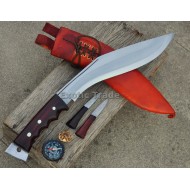
Not as standard. A traditional kukri dap carries two small blades in a pocket — the karda, a utility knife for the fine work a big chopper cannot do, and the chakmak, a blunt burnisher for truing the edge. This kukri ships with a flat modern belt sheath instead, which has no companion pockets. Both blades are available through the companion blades option, and if you order them we will supply a dap-style sheath to carry them in.
Is this a real, functional kukri?
Yes. It is hand-forged from 5160 high-carbon spring steel, oil-tempered, sharpened, and built on a full tang with the rosewood scales pinned straight through it. It will chop green wood, clear brush and take the abuse a working blade is meant to take. Do not use it on stone, metal, nails hidden in old timber, or seasoned hardwood knots, and check the pins and the edge after heavy use.
What steel is it, and is it oil-tempered?
The blade is forged from 5160 high-carbon spring steel, the same alloy used in heavy-duty truck leaf springs, prized for toughness and edge retention. It is oil-tempered for a hard cutting edge backed by a flexible, shock-absorbent spine. Nepali smiths have forged kukris from vehicle leaf spring for generations, long before anyone in Nepal was quoting an alloy number — it became the traditional material because it was available and because a chopping blade needs to absorb shock without chipping far more than it needs extreme hardness.
Is it full tang?
Yes, full tang with the rosewood scales pinned straight through it — the construction Nepali smiths call panawal. The handle is mechanically fastened to the steel rather than held by adhesive. The traditional alternative is a narrow stick tang set into a solid handle and peened at the butt, which is lighter but is the part that fails first on a hard-used knife. For a blade you intend to actually work with outdoors, full tang is the right call.
What is the sheath like?
A flat black leather belt sheath with contrast stitching and a belt loop, cut and stitched by hand to fit the blade you order. It is deliberately not a traditional dap — no wooden core, no companion pockets, no frog — because a flat sheath rides better on a modern belt or pack strap and is easier to draw from standing. A traditional dap is available as a custom option if you want the authentic carry, and it is the right choice if you are ordering the karda and chakmak. Whichever you choose, store the kukri out of the sheath rather than in it for the long term: leather is tanned with acids and holds damp.
Can I order a traditional handle, a smaller blade, or a dap?
Yes to all three. A service-size blade nearer eleven inches with a traditional ringed grip and a dap scabbard gives you something close to a real Nepali kukri, and it is a genuinely more comfortable knife to carry all day. Handle material, blade finish and companion blades are all adjustable too. Tell us the job you want the knife to do rather than only the dimensions, and we will say honestly what suits it.
Do you ship worldwide, and how long does it take?
Yes. We ship worldwide from Nepal by DHL or FedEx in 7 to 14 business days with tracking. In-stock specs dispatch within 2 to 3 business days; fully custom builds take roughly 4 to 6 weeks to forge first. Import and blade laws vary by country, so please check your local rules before ordering.
| Specification | |
| Blade: | 15 inches. Hand forged from 5160 carbon steel |
| Total Length: | 22 inches long in total. |
| Handle: | 7 inches. Full tang panawal construction, contoured rosewood slabs pinned through the tang, with steel bolster |
| Weight: | Approx 1090 grams total (blade approx 810 grams) |
| Note: | As every piece is forged by hand, slight variation in weight, dimensions and finish may occur. Rosewood grain varies between pieces. Supplied without karda or chakmak; both available to order. Keep the blade lightly oiled when not in use. |