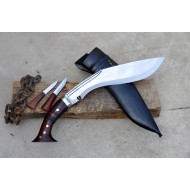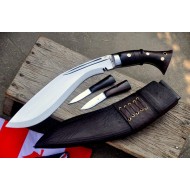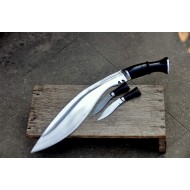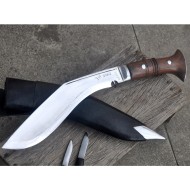
- Model: Hybrid Kukri
- Product Code: HybridKukri13
- Location: Kathmandu, Nepal
Available Options
Hand-Forged Chainpure Kukri Knife — Ek Chirra Blade with Inlaid Bone Handle
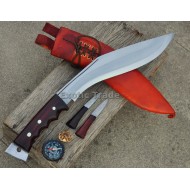
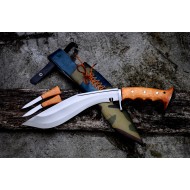
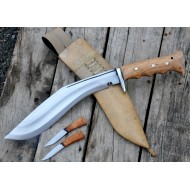
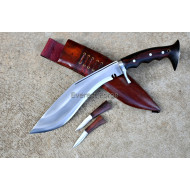
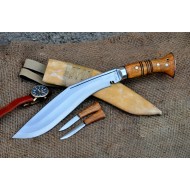
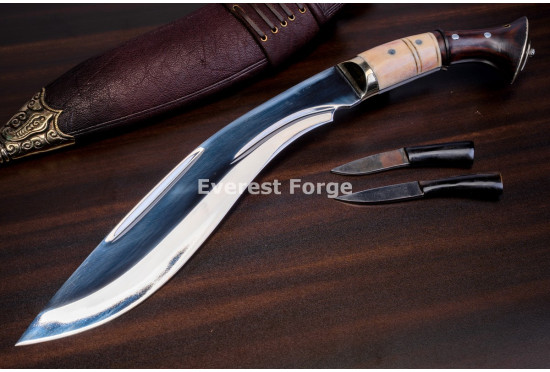
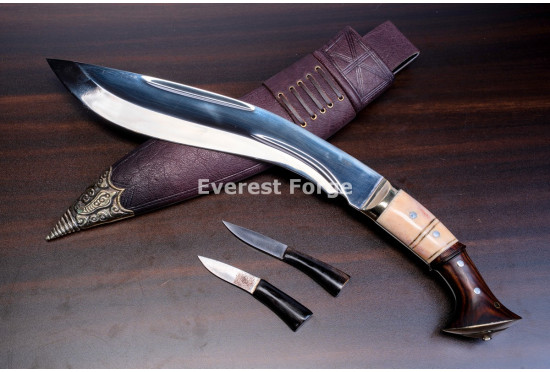
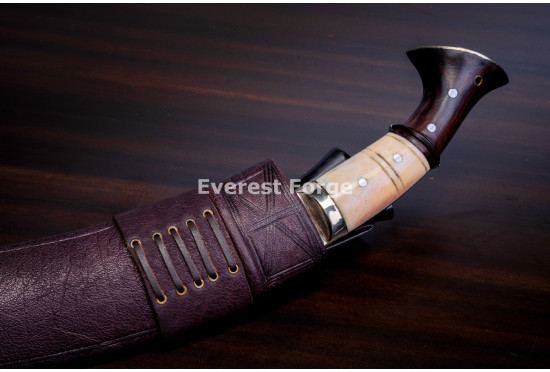
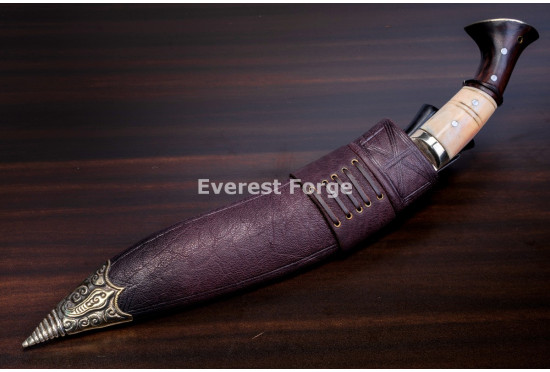
This is a hand-forged, fully functional Chainpure kukri — the finely finished pattern of eastern Nepal, forged at our workshop in Kathmandu from 5160 high-carbon spring steel, oil-tempered, full tang, and sharpened to a true edge. A single fuller runs along the blade, what Nepali smiths call ek chirra, and the cho is cut at the root as tradition requires. The handle is jointed bone and rosewood, ringed and set with inlaid dots, finished with white metal fittings. It ships as a complete traditional set: a leather dap with a cast brass chape, and both companion blades, the karda and the chakmak.
The standard blade is 13 inches on a 6-inch handle, for an overall length around 19 inches at about 1.11 kg. That is a carrying size rather than a display size — short enough to wear on a belt, substantial enough to work with. Where a Bhojpure is built for chopping weight, a Chainpure is built for the quality of its finish, and this one follows that.
An honest note. Chainpure kukris are known in Nepal for their finish and decorative work rather than for being the toughest pattern, and that is the tradition this one follows — the inlaid handle, the white metal fittings and the cast chape are as much the point as the blade. It is a real working knife underneath and will do everything a kukri should, but if you want the hardest-hitting blade we make, the Bhojpure carries more weight through the belly and is the better chopper. Bone and rosewood are natural materials, so colour, grain and the exact placement of the inlay vary from piece to piece — that is the material and the hand, not a defect.
Bespoke Service
Forge a Kukri to Your Own Design
Want a service size, a Bhojpure or sirupate profile, a different fuller count, or brass fittings instead of white metal? Our Custom Forge service builds to your spec, by hand in Kathmandu.
Request a Custom Forge →What Makes This a Chainpure
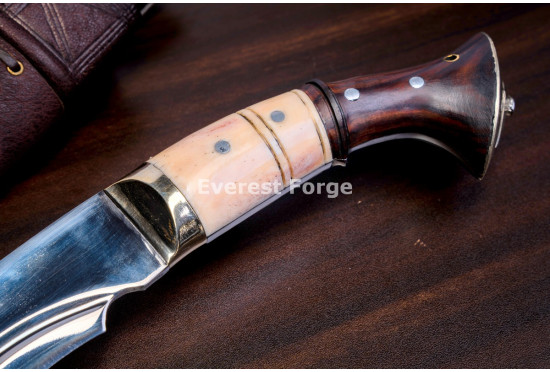
Chainpur is a town in Sankhuwasabha district in the eastern hills of Nepal, and the kukris that carry its name are the ones made to be looked at as well as used. Where the Bhojpure pattern from further west is defined by the mass in its belly, the Chainpure is defined by the quality of its finish: cleaner lines through the blade, more careful work in the handle, and fittings that get real attention rather than being purely functional. This one carries the marks of that tradition — a jointed bone and rosewood grip with cut rings and inlaid dots, white metal ferrule and butt cap rather than plain brass, and a cast chape on the dap with traditional Nepali scrollwork. The blade itself is an ek chirra, single-fullered, with the cho cut properly at the root.
Specifications
Customize Your Kukri
Every kukri is forged to order. Set your options before you add to cart:
Hand-Forged, Not a Souvenir Kukri
This Kukri
- Hand-forged 5160 high-carbon spring steel
- Oil-tempered, hard edge and flexible spine
- Full tang, traditional Nepali construction
- Cho cut properly, fuller ground rather than stamped
- Complete with karda and chakmak in a proper dap
A Souvenir Kukri
- Unhardened mild steel or stainless
- No real heat treatment, edge rolls on first use
- Stick tang glued into a hollow handle
- Groove stamped in cold, cho decorative or missing
- Companion blades blunt, or absent entirely
How It Is Made
Who It Is For
- Collectors who want a decorated traditional kukri rather than a plain working one
- Buyers drawn to the Chainpure pattern specifically, or building a collection by district
- Anyone who wants a complete set — kukri, karda, chakmak and dap — at a carrying size
- Gift buyers, because the inlaid handle and cast chape make it a presentation piece
- Outdoor users who want something they can wear on a belt rather than a large chopper
- Not for the heaviest chopping — our Bhojpure carries more mass through the belly
What Is Included
- One hand-forged Chainpure kukri, built to your chosen spec
- Karda companion knife and chakmak burnisher, both with matching handles
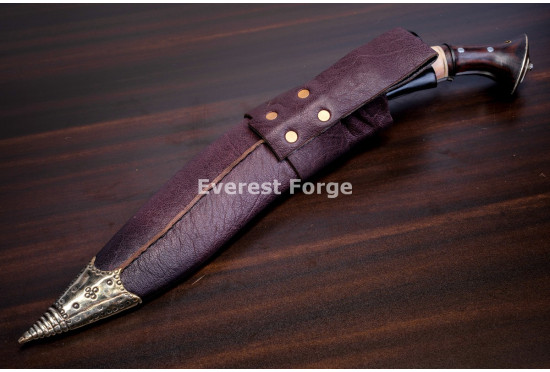
- Traditional leather dap with cast brass chape and pockets for both companion blades
- Jointed bone and rosewood handle with inlaid dots and white metal fittings
- An ek chirra blade with a traditional cho
- Everest Forge manufacturer warranty
Explore More Hand-Forged Blades
Shipping, Returns & Care
Shipping
In-stock specs dispatch within 2 to 3 business days; fully custom builds take roughly 4 to 6 weeks to forge before dispatch. We ship worldwide by DHL or FedEx in 7 to 14 business days, tracked. Import and blade laws vary by country, so please check your local rules before ordering.
Returns & Warranty
Every blade is backed by the Everest Forge warranty against forging and material defects. If something is wrong with your order, we will repair, replace, or refund it. Personalized and custom-engraved blades are made to order, so please confirm your spec carefully before purchase.
Care
Wipe the blade clean and dry after use and keep a light film of oil on it — 5160 is carbon steel and sap from green wood is acidic enough to mark it overnight. Pay attention to the fuller, which holds moisture more readily than a flat surface. The bone and rosewood handle wants a wipe with a drop of mineral or neatsfoot oil every few months, kept away from radiators and direct sun so neither material dries and cracks. The white metal fittings dull with handling and can be brought back with a soft cloth; keep polish away from the inlay and the leather. Do not store the kukri inside its dap for long periods.
From The Forge
Build a Kukri That Is Yours Alone
Beyond the options here, our Custom Forge service will build a Bhojpure or sirupate profile, a dui chirra or tin chirra blade, a service size, or a kukri matched to an antique you send us photographs of. Roughly 4 to 6 weeks from order.
Start a Custom Forge →Frequently Asked Questions
What is a Chainpure kukri?
Chainpure is the kukri pattern named after Chainpur, a town in Sankhuwasabha district in the eastern hills of Nepal. What distinguishes it is not a fighting characteristic but the standard of finish: Chainpur built a reputation for careful work, so the blades from there tend to have cleaner lines, more attention in the handle, and fittings that are decorated rather than merely functional. Inlaid handles, ringed grips and cast or worked metal fittings are all part of that tradition. It is a kukri made to be a good-looking object as well as a working one, which is a different intention from a pattern like the Bhojpure, where the point is the mass in the belly.
What is the difference between a dress kukri and a working kukri?
In Nepal a kukri is a household tool first, and most of them look like it — plain wooden handles, no inlay, a scabbard that does its job and nothing more. But kukris have always also been carried as status objects, given as gifts, presented on occasions and worn where they would be seen, and those get made differently: better finish, decorated handles, worked metal fittings, sometimes engraving on the blade. That is the dress kukri. The distinction is not about quality of steel or heat treatment, and a dress kukri is not a display piece in the sense of being non-functional — a good one is a working blade that happens to be finely made. It is about where the maker's time went. This Chainpure sits on the decorated side; our Bhojpure and bushcraft patterns sit on the plain working side, and both are honest ways to make a kukri.
What is white metal, and how does it differ from brass?
White metal is the term used across Nepali and Indian metalwork for the silver-coloured alloys used in fittings — generally a nickel-based alloy such as nickel silver, sometimes called German silver, which contains no actual silver. It is used because it takes fine detail well, resists tarnish better than brass, and gives a cool silver tone against the warm colours of bone, horn and rosewood. Brass is the yellow alternative and is more common on plainer kukris. On this knife you get both: white metal for the ferrule and butt cap at the hilt, and a cast brass chape at the tip of the dap. The two-tone effect is deliberate. Practically, white metal dulls with handling like any metal and comes back with a soft cloth, and it wants no oil at all — that is only for the blade.
How does this differ from your Bhojpure kukri?
Different districts, different intentions. The Bhojpure is the broad, heavy-bellied chopping pattern from Bhojpur, built as an angkhola with a thick hollowed spine and two fullers, fitted in brass with a bone and horn handle. This Chainpure is the finely finished pattern from Chainpur: a single fuller rather than two, an inlaid bone and rosewood handle with white metal fittings, and a shorter 13-inch blade. Both ship as complete traditional sets with karda, chakmak and a decorated dap, and both are forged from the same steel by the same smiths. Buy the Bhojpure if you want the harder-hitting blade; buy this one if you want the better-dressed one.
What does ek chirra mean, and how does one fuller differ from two?
Chirra is the Nepali word for a fuller ground into a kukri blade, and smiths count them: ek chirra is one, dui chirra two, tin chirra three. This blade is an ek chirra. The practical difference between one and two is weight and stiffness. Each fuller removes metal from the flat of the blade, so more fullers means a lighter blade for the same outline — but each one also takes a little stiffness out, and there is a point where you have removed more than the blade can spare. A single fuller is the common choice on a well-balanced working blade: enough weight saved to matter, nothing given up. Two or three appear on heavier builds where there is more steel to spare, or where the maker wants the visual effect. Both are traditional and neither is better.
What are the inlaid dots in the handle?
They are decorative inlay set into the bone sections of the grip — small pins or dots of contrasting material let into drilled holes and finished flush with the surface. It is a traditional Nepali handle decoration and it is one of the details that marks a kukri as coming from the more finely finished end of the tradition, which is exactly what the Chainpure name implies. Because each dot is placed and finished by hand, their spacing and colour vary slightly between pieces. They are set flush, so they do not affect grip and they will not catch on anything.
Is this a real, functional kukri?
Yes, and it is worth saying because decorated kukris are often assumed to be display pieces. It is hand-forged from 5160 high-carbon spring steel, oil-tempered, sharpened, and built on a full tang. The decoration is in the fittings and the handle, not in the blade — the blade is the same steel, the same heat treatment and the same edge as our plainest working kukri. It will chop green wood and clear brush. Do not use it on stone, metal, nails hidden in old timber, or seasoned hardwood knots.
What steel is it, and is it oil-tempered?
The blade is forged from 5160 high-carbon spring steel, the same alloy used in heavy-duty truck leaf springs, prized for toughness and edge retention. It is oil-tempered for a hard cutting edge backed by a flexible, shock-absorbent spine. Nepali smiths have forged kukris from vehicle leaf spring for generations, long before anyone in Nepal was quoting an alloy number — it became the traditional material because it was available and because a chopping blade needs to absorb shock without chipping far more than it needs extreme hardness.
How is the handle built, and is it full tang?
Full tang, with sections of bone and rosewood jointed together over it, turned and shaped as one piece, with rings cut into the profile and the inlay set into the bone. A white metal ferrule closes the front where the handle meets the blade and a white metal cap finishes the butt. The rings are not purely decorative — they give the hand something to register against, which matters on a kukri because the forward bend puts a twisting load on the grip with every strike. Because bone and rosewood are natural materials, no two handles are identical in colour or grain.
Does it come with the karda and chakmak?
Yes, both, carried in pockets on the back of the dap. The karda is the small sharpened utility knife for the fine work a big blade cannot do; the chakmak is the blunt burnisher used to true and realign the edge in the field without removing metal. A traditional kukri is not considered complete without them, and they are included here with handles matched to the kukri rather than as an afterthought.
Does it arrive sharpened, and can I order a different pattern?
It arrives sharpened to a working edge along the belly, finished by hand, and the karda is sharpened too; the chakmak is blunt by design. The area near the cho is traditionally left unsharpened, which is normal. Choose the display-blunt option if you need it unsharpened for display or import rules, at no extra charge. As for patterns — yes, we build the Bhojpure for chopping weight, the sirupate for a slender quicker blade, and fuller counts from none through tin chirra. Tell us what you want the knife to do and we will say honestly which pattern suits it.
Do you ship worldwide, and how long does it take?
Yes. We ship worldwide from Nepal by DHL or FedEx in 7 to 14 business days with tracking. In-stock specs dispatch within 2 to 3 business days; fully custom builds take roughly 4 to 6 weeks to forge first. Import and blade laws vary by country, so please check your local rules before ordering.
| Specification | |
| Total Length: | 19 inches |
| B Length: | 13 inches Long Blade Hand forged from 5160 carbon steel |
| H Length: | 6 inches. Full tang, jointed bone and rosewood with ringed profile and inlaid dots, white metal ferrule and butt cap |
| Weight: | Approx 1110 grams total (blade approx 800 grams) |
| Note: | As every piece is forged by hand, slight variation in weight, dimensions and finish may occur. Bone and rosewood are natural materials, so colour, grain and the exact placement of the inlay differ in every handle. Supplied complete with karda and chakmak in a traditional dap. Keep the blade lightly oiled when not in use. |