Menu
Your Cart

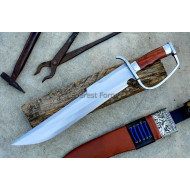
Hand-Forged Bowie Knife, Coffin Handle

Hand-Forged Bowie Knife, Coffin Handle
$184.99
Ex Tax: $184.99
  • Model: Bowie knives
  • Product Code: COFFINBOWIE0014
  • Location: Kathmandu,Nepal

Available Options

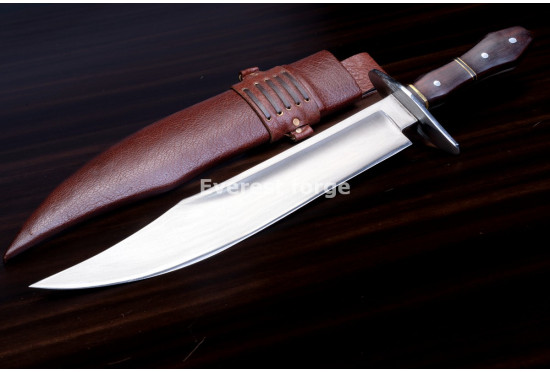
A Hand-Forged Coffin Handle Bowie Knife With a True Clip Point

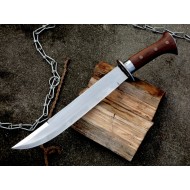
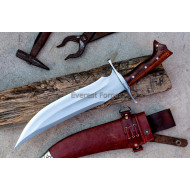
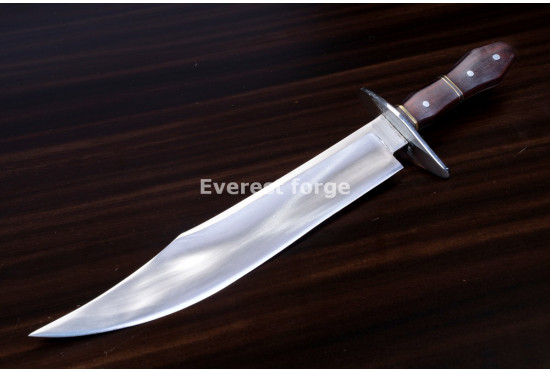
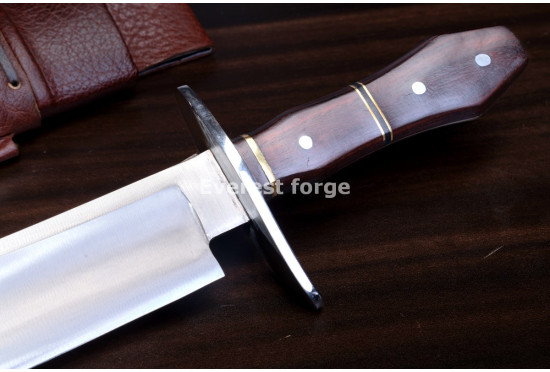
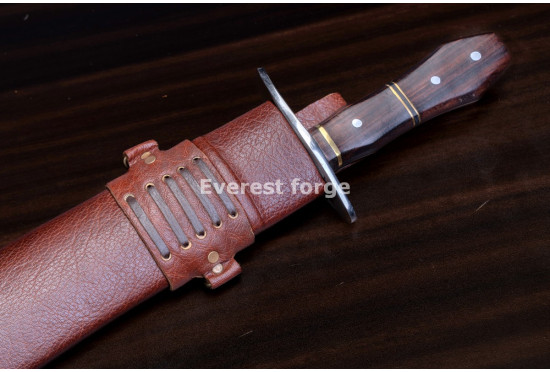
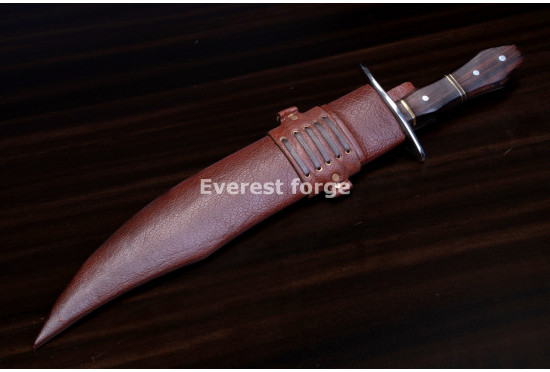
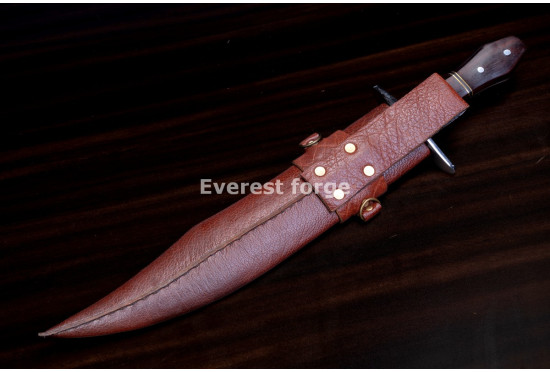
This is a 14 inch hand-forged bowie knife built to the classic American pattern: a straight-backed blade clipped back in a long concave sweep so the point drops onto the centre line, with a false edge along the clip and a deep belly running to the tip. The grip is a coffin handle — flat-sided rosewood slabs, angular and tapering, pinned through the tang with a brass spacer at the guard. Overall length is 20 inches and the knife weighs approximately 600 grams, which is light for its size and correct for the pattern. Forged from 5160 high-carbon steel in Tokha-3, Kathmandu, and supplied in a brown leather sheath with a laced belt panel.

An honest note. Two things about the size. Fourteen inches is at the large end of the bowie tradition. Most knives made and carried in the pattern's own period ran nine to twelve inches; the very large bowies exist, but they are the exception, and much of what people picture as a huge bowie comes from later theatre and film rather than from the 1830s. Second, we do not claim this is a replica of any particular historical knife, because no knife is definitively verified as the one Jim Bowie carried and every so-called authentic pattern is a reconstruction. What this is, honestly stated: a correctly proportioned coffin-handled clip-point bowie built the way the pattern is built, at a size that reads well and handles well, rather than a documented copy of something in a museum.

Made to your specification

Have This Bowie Forged Your Way

Blade length, clip depth, false edge, guard form and grip material are all decided at the forge before your knife is made. Send a sketch or a description and our smiths will quote it.

Start a Custom Forge Order →

Why This Knife Is Built the Way It Is

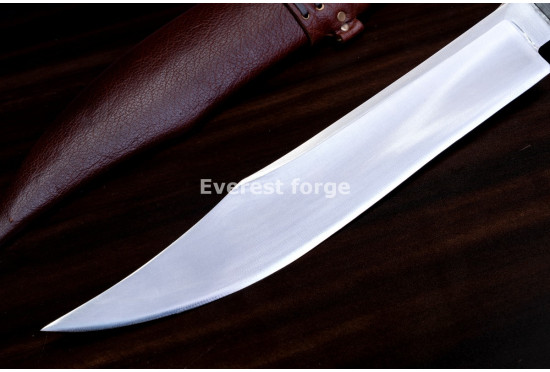
The Clip Is Ground, Not SuggestedThe spine is genuinely cut away in a long concave sweep with a false edge along it. Plenty of knives sold as bowies simply curve to a point and call it a clip; this one has the geometry the name refers to.
A Coffin Handle You Can Read BlindFlat faces and hard angles rather than a rounded grip. Your hand knows which way the edge is pointing without looking, which is the whole reason the shape existed.
Light for Fourteen InchesAt 600 grams this is a knife you can actually move. A bowie was a fighting and general-purpose knife, not a chopper, and the pattern falls apart when it is made too heavy to use quickly.

Specifications

Blade Length14 inches
Handle Length6 inches
Overall Length20 inches
Blade Steel5160 high-carbon spring steel, oil-quenched and tempered
Blade ProfileStraight back with a long concave clip to a centre-line point, deep belly to the tip
ClipFalse edge ground along the clip, unsharpened as standard
GripCoffin handle — flat-sided angular rosewood slabs, pinned through the tang
FittingsDark steel guard with a brass spacer at the front of the grip
Standard BuildSatin blade, rosewood slabs — size, finish and grip material are selectable above
SheathBrown leather with laced belt panel and brass eyelets
WeightApproximately 600 grams for the knife, 830 grams with the sheath
OriginHand-forged in Tokha-3, Kathmandu, Nepal

Build Options

Blade LengthNine to twelve inches for a knife closer to the historical norm and far easier to wear, or the fourteen shown for presence. The hilt stays the same and the sheath is cut to the blade.
Sharpened False EdgeThe clip can be left as a false edge or ground sharp. Read the legal answer below before choosing, because a sharpened clip makes the knife double-edged in some jurisdictions.
Grip MaterialRosewood as standard. Water buffalo horn, stag, stacked leather washers or micarta are all cut and fitted in the same workshop.
Guard FormThe shaped steel guard shown, a straight rectangular cross, or an S-guard with one quillon turned forward and one back, which is the period form on many surviving bowies.
Blade FinishSatin as standard. Mirror polish, dark forge finish or a stonewashed working finish, none of which change the geometry.
Engraving and EscutcheonA brass or silver plate let into the grip for a name or initials, which is the traditional way a bowie was personalised.

Is This the Right Knife for You?

Buy This If You Want

  • An actual clip-point bowie rather than a large knife the seller has called one
  • The coffin grip, which is the shape most associated with the pattern's own period
  • A knife light enough at 600 grams to handle quickly rather than swing
  • A forged carbon-steel blade you can sharpen with a stone anywhere
  • A collector piece that also happens to work

Look Elsewhere If You Want

  • A chopper for firewood or standing timber — this is not built for it and a kukri is
  • A skinning or field-dressing knife, where fourteen inches gets in the way of every part of the job
  • A documented replica of a specific historical bowie, which nobody can honestly sell you
  • A stainless blade needing no care, since 5160 is carbon steel and will rust if left wet
  • Something discreet to carry; at 20 inches overall this is a visible knife
Fifteen years at the anvil

Your Name Let Into the Grip

A brass or silver escutcheon plate inlet into the coffin handle is how these knives were personalised in their own period, and we still cut them by hand. Tell us what it should say.

Talk to the Forge →

How to Order

Choose your blade length, finish and grip material from the options above the description.
Note whether you want the false edge sharpened, and any engraving, in the order comments.
We confirm the build by email and start forging. Custom work takes four to six weeks.
Your knife ships tracked by DHL or FedEx and arrives in seven to fourteen business days.

Who This Knife Is For

  • Collectors of American frontier arms who want the pattern built correctly rather than approximated
  • Re-enactors and living history groups covering the 1830s to the Civil War period
  • Film, stage and photography armourers who need a blade that reads instantly as a bowie
  • Anyone giving a serious gift, particularly with a name let into the grip

What Is Included

  • One hand-forged bowie knife, sharpened and ready to use
  • Fitted brown leather sheath with laced belt panel
  • Certificate of hand-forging from the workshop
  • Everest Forge manufacturer warranty against defects in forging and heat treatment

Explore the Collection

Bowie Knife, Crossguard HiltA heavier sabre-profile camp knife →
Hunting Knife, Bolstered Full TangA 9 inch field knife →
Bush Machete, Brass-Fitted HiltFor clearing green growth →
Kukri Knife, Panawal HiltThe right tool for seasoned wood →

Shipping, Returns and Care

Stock pieces are dispatched within two to three business days. Custom builds take four to six weeks at the forge before they ship. Everything travels tracked with DHL or FedEx and typically arrives in seven to fourteen business days. Every knife carries the Everest Forge manufacturer warranty against defects in forging and heat treatment.

Large fixed blades are restricted in some countries and in some states and provinces within them, and a bowie is named specifically in the statutes of several. It is your responsibility to check that this knife may lawfully be imported and possessed where you live before ordering, because a parcel seized by customs cannot be returned to us and cannot be refunded. If you are asking us to sharpen the false edge, check that too, because it can change how the knife is classified. Ask us before you buy and we will tell you what we know about your destination.

5160 is a high-carbon steel and it will rust if it is left wet or stored damp. Wipe the blade dry, keep a light film of oil on it, and do not leave the knife in the sheath for long periods, because leather holds moisture against steel. The rosewood slabs take an occasional coat of oil and the brass will dull to a warm tone, which any metal polish reverses if you would rather it stayed bright.

Frequently Asked Questions

What is a coffin handle, and why that shape?

It is a grip with flat faces and hard angled corners, wider through the middle and tapering toward both ends, so that seen from the side it has the outline of a coffin lid. It appears on a great many American knives of the 1830s to the 1850s and it is the shape most closely associated with the bowie in its own period. The reason it works is orientation. A round or oval grip tells your hand nothing about where the edge is pointing, so you have to look, or index off the guard. Flat faces and corners tell you instantly and in the dark, and they stop the knife rotating in a wet or gloved hand far better than a smooth grip does. It is also simply easier to make well from slab stock than a carefully sculpted round grip, which mattered on a frontier. The trade is comfort over long cutting sessions: hard corners press into the palm in a way a rounded grip does not.

What does the clip actually do?

Three things, and they all point the same way. Cutting the spine away in a concave sweep removes metal from the section forward of the balance point, which makes the tip lighter and the knife quicker to change direction. It brings the point down from the line of the spine toward the centre of the blade, which is where you want it for thrusting, because a point on the centre line drives straight rather than levering. And it thins the tip, so it penetrates rather than pushing material aside. The false edge ground along the clip is part of that thinning; sharpened, it also allows a cut on the back stroke. What you give up is tip strength, which is why a clip point is a poor choice for prying and why heavy-duty knives use a drop point instead. It is the geometry of a fighting and general-purpose knife, which is exactly what a bowie was.

Should I have the false edge sharpened?

Answer the legal question first, because it is not a small one. In several countries, states and provinces, a knife with two sharpened edges is classified differently from one with a single edge, and daggers or double-edged knives face restrictions that a single-edged knife of identical size does not. Sharpening the clip on a bowie can move it into that category. So check your local rules before you tick the box, and if you are importing, check the rules of the country the parcel passes through as well. If it is lawful where you are, a sharpened clip gives you a genuine back-cut and a slightly better thrust. If you are unsure or it is going on a wall, leave it as a false edge, which is how we ship it as standard and how many period bowies were made anyway.

Is this a replica of Jim Bowie's knife?

No, and neither is anything else sold as one. The knife enters the record with the Sandbar Fight near Natchez in September 1827, where Jim Bowie used a large knife to considerable effect in a duel that turned into a general brawl, and the story spread fast enough that men across the American South were asking cutlers for one like it within a few years. The design is often credited to his brother Rezin, and James Black of Washington, Arkansas is traditionally said to have made a refined version around 1830. Jim Bowie died at the Alamo in 1836. What does not exist is a knife anyone can prove was his. Several candidates are argued over, none is settled, and every so-called authentic bowie pattern on the market is therefore a reconstruction from period examples and descriptions rather than a copy of a documented original. We would rather tell you that than print the word replica.

Is fourteen inches too big for a bowie?

It is at the large end, and worth thinking about before you order. Knives made and carried in the pattern's own period commonly ran nine to twelve inches of blade. Large ones did exist and were made, but the enormous bowie in the popular imagination owes a good deal more to later theatre, dime novels and eventually film than to what men actually wore on a belt in Louisiana. Fourteen inches has real presence, photographs superbly and handles well because this knife is light for its length. But if you want the knife that is historically typical rather than historically possible, order ten or eleven inches. It will be easier to wear, easier to use, and closer to what a period buyer would have recognised as normal.

How is this different from your other bowie?

They are barely the same kind of knife despite sharing a name. Our Crossguard Hilt bowie has no clip at all: its spine curves downward through its whole length and the point drops below the line of the handle, which is sabre geometry, and it is a considerably heavier knife built around chopping and camp work with a full steel cross. This one is the historical article: straight back, true concave clip, point on the centre line, coffin grip, and light enough to move quickly. If you want a working chopper that happens to be called a bowie, take that one. If you want a bowie, take this one. The crossguard knife's page offers a true clipped spine as its first custom option, and this is that knife made as a standing product.

What steel is it, and how is it heat treated?

5160 high-carbon spring steel, brought to temperature in the forge, quenched in oil and tempered back so the edge is hard while the body of the blade stays springy. It is the traditional stock of our workshop and a good match for a long single-edged blade: tough enough not to snap, forgiving to sharpen on ordinary stones, and it takes a fine edge. It is not stainless, which is deliberate. Stainless grades that genuinely resist rust give up either edge retention or toughness, and on a fourteen inch blade with a thin clipped tip, toughness is what keeps the point on the knife.

Is it full tang?

Yes. The tang is the full width and shape of the coffin grip with rosewood slabs pinned through it, and you can see the tang as a line running between the slabs around the whole outline of the handle. That is the correct construction for this pattern and it is what a coffin handle is built around — the shape comes from slabbing a flat tang, which is one reason the style became common. Check any knife claiming a full tang the same way: look along the top and bottom of the grip for a continuous line of steel between the scales. A knife where the wood wraps all the way round is a hidden tang, whatever the listing says.

How sharp does it arrive?

Sharp and ready, with the main edge put on by hand at the forge. The false edge along the clip is left unsharpened as standard for the reasons in the legal answer above. If you would prefer the whole knife shipped blunt — for display, for a gift, or because of the rules where you live — say so in the order comments and we will send it unsharpened at no extra cost, and we can rebate the point at the same time.

Can you put a name plate in the grip?

Yes, and it is the historically correct way to personalise one of these. A small brass or silver escutcheon plate is inlet flush into one flat face of the coffin handle and engraved by hand with a name, initials or a date. Period bowies carry them often, and the coffin shape suits it because a flat face gives the plate somewhere to sit properly, which a rounded grip does not. Tell us the wording and the metal in the order comments. It adds a little to the lead time and it is the single change that turns this from a knife into a specific person's knife.

Can I use it for camp work?

For some of it. It will cut cord, prepare food, shape a stake and handle general camp tasks well, and the length gives you reach for things like splitting a fish or working at arm's length. What it is not is a chopper. A clipped tip is thin by design and the knife is light, so batoning it through logs or hitting seasoned wood is asking it to do a job the geometry rules out, and you risk the point. If you want one blade for camp that does everything including wood, a kukri is the honest answer and we make several. This knife is a bowie, and a bowie was carried for fighting, for utility and for status rather than for firewood.

Where is this made, and by whom?

In our own workshop in Tokha-3 on the northern edge of Kathmandu, Nepal, by around ten smiths, most from families that have forged blades for generations. Everest Forge has operated since 2010. We forge, grind, heat treat, cut and fit the grips and make the sheaths in the same building. An American pattern made in Nepal is worth a word of explanation: this is not our own tradition and we do not pretend it is, which is why this page tells you what is documented about the bowie and what is not. What our smiths bring to it is forging, and a bowie is a forged knife.

Specification
Blade: 14 inches. Hand forged from 5160 carbon steel
Total Length: 20 inches
Handle: 6 inches. Coffin handle, full tang with flat-sided rosewood slabs pinned through, brass spacer and steel guard
Weight: approx 600g knife, 830g with sheath
Note: Some variation in weight, dimensions and finish may occur as each piece is hand forged. Keep the blade lightly oiled when not in use

Write a review

Note: HTML is not translated!
Bad Good
Captcha