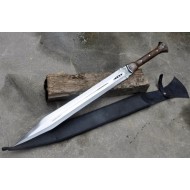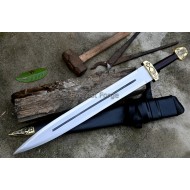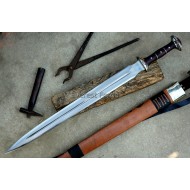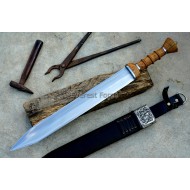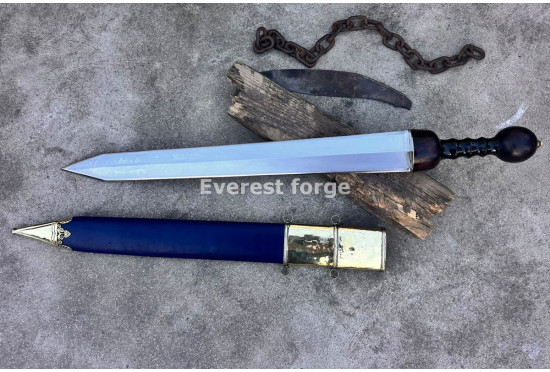
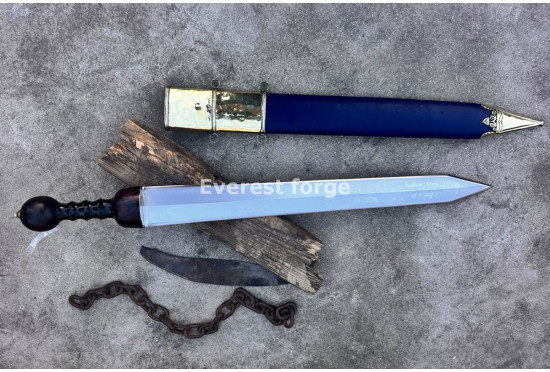
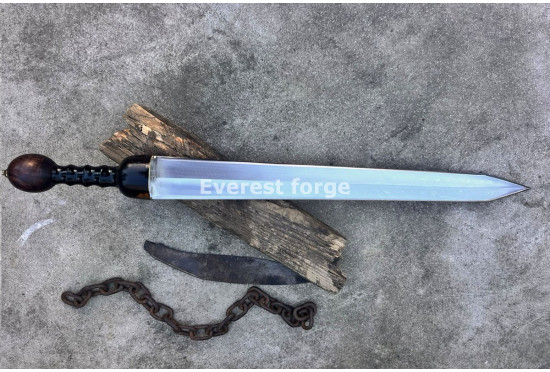


- Model: Roman Gladius Sword
- Product Code: GLADIUS0055
- Location: Kathmandu,Nepal
Available Options
What Is a Pompeii Gladius?
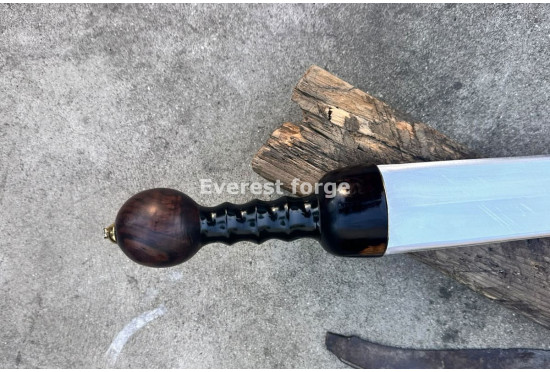
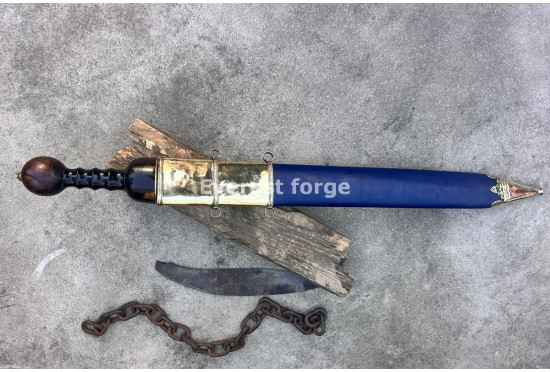
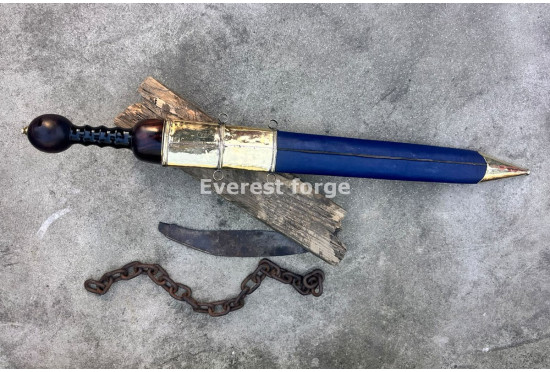
The Pompeii is the last and the most familiar of the four Roman gladius patterns: straight parallel edges running the length of the blade and a short, abrupt triangular point, with none of the waisting that marks the earlier types. It came into use around the middle of the first century AD and it is the sword that armed the legions through the period most people picture when they think of Rome. This one has a 24 inch blade, an 8 inch turned hardwood hilt in the Roman arrangement, and 32 inches overall. It is hand-forged in Kathmandu from 5160 high-carbon spring steel and comes in a blue scabbard with metal binding, suspension rings and a decorated chape.
The pattern is named for the town rather than by the Romans, who simply called it a gladius. Archaeologists name the types after the places the best surviving examples were found, and four Pompeii-pattern swords came out of the ruins at Pompeii itself, sealed there in 79 AD.
An honest note on the proportions. Surviving Pompeii blades measure roughly 42 to 50 centimetres, which is about 16.5 to 20 inches. At 24 inches this blade is longer than any documented Pompeii example, and closer to the length of the much earlier Hispaniensis pattern. So what you have is a Pompeii profile at a Hispaniensis length: a handsome sword and not a reproduction of a particular find. If you want the historical proportion we will build it at 18 or 20 inches at no extra cost, and it will handle considerably better for it.
An honest note on the weight. Roman gladii of every pattern weigh somewhere between about 700 and 1000 grams. This one is 1380 grams without the scabbard, which is well above that range , partly because it is longer than a Pompeii should be, but mostly because the blade carries more steel toward the point than a Roman one did. The practical consequence is that it is slower to recover and more tiring to hold in guard than the original was. For a display piece that does not matter. If you want it to handle like a gladius, ask for the historical weighting when you order: our smiths will take the distal taper down and it costs nothing extra.
Please check your local law before ordering. This is a 32 inch sword. Sword legislation is a separate body of law from knife legislation, and in many countries ownership is straightforward while carrying in public is not, or import requires paperwork a knife would never need. Rules for owning, carrying and importing are three separate questions with three different answers. Check all three for your own address before ordering.
Want It Built to the Documented Proportions?
An 18 or 20 inch blade with the distal taper taken down brings this into the range of the surviving finds, and it transforms how the sword feels in the hand. No extra cost.
Specify a Historical Build →Why This Gladius Is Built the Way It Is
Full Specifications
Blade length, blade finish, handle material and scabbard colour are selectable on this listing. The figures above describe the standard build as photographed; what you receive will match the options you choose at checkout. Small variations in weight, dimension and finish are normal in hand-forged work.
Build It Your Way
What This Gladius Does Well, and What It Does Not
What It Is Good At
- Display. The gladius silhouette is among the most recognisable in the world and this one is scaled up to suit a wall
- Thrusting, which is what the pattern was arranged around above everything else
- Costume and film work set anywhere in the Roman world
- Cutting. The gladius cut as well as it thrust, which the popular picture often forgets
- Being a starting point. Every Roman pattern is available and they differ more than people expect
What It Is Not Good At
- Being a documented reproduction. It is longer and heavier than any surviving Pompeii
- Handling like a gladius. At 1380 grams it is well above the 700 to 1000 gram range
- Sparring or drilling. It is sharp; order the blunt trainer build instead
- Reach. A short abrupt point is the trade the pattern makes for tip strength
- Low maintenance. Polished carbon steel marks if you look at it
How to Order a Custom Gladius
Pompeii, Fulham, Mainz, Hispaniensis
Two centuries of development, and the differences are real: the blade goes from long and waisted with a drawn-out point to short, straight and abrupt. We forge all four.
Commission Another Pattern →Who This Gladius Is For
- Display and collection buyers who want the most recognisable sword of the ancient world at a size that suits a wall
- Costume, film and reenactment buyers working anywhere in the Roman world
- Collectors building the Roman sequence, since the four patterns tell a story of two centuries of development
- Buyers who want the historical build, which is a free option and a genuinely different object
- Gift buyers, since a gladius with a coloured scabbard and ringed fittings presents extremely well
It is not for you if you need a documented reproduction for inspected reenactment, in which case order the 18 or 20 inch build with historical weighting, or if you fence, in which case order the blunt trainer.
What Is Included
- The hand-forged gladius, sharpened and ready for display
- A scabbard with metal binding plates, twin suspension rings and a decorated chape
- A certificate of authenticity from the workshop
- Care instructions for high-carbon steel
- Everest Forge manufacturer warranty against forging and material defects
Other Blades From the Everest Forge Workshop
Shipping, Returns and Care
Dispatch. Stock pieces leave the workshop within 2-3 business days. Custom builds take 4-6 weeks depending on the queue, and a scabbard with fitted binding plates sits at the longer end because the metalwork is made to the finished sword.
Shipping. Tracked worldwide by DHL or FedEx, typically 7-14 business days in transit from Kathmandu. This is declared as a sword rather than a knife and the paperwork is completed accordingly. Swords attract considerably more import scrutiny than knives; please check your own country's rules before ordering.
Returns and warranty. Covered by the Everest Forge manufacturer warranty against defects in forging and materials. Custom builds made to your own specification cannot be returned for a change of mind, which is why we confirm everything in writing first.
Care. Wipe the blade after every handling and keep a light film of oil on it; polished carbon steel takes a fingerprint mark within days. Pay attention to the joint where the blade meets the hilt, which is an enclosed line a cloth drawn along the flat never reaches, and to the inside faces of the scabbard binding plates. Oil the timber hilt once or twice a year. Store the sword out of the scabbard, because a close-fitting scabbard holds damp against steel and dries slowly.
Questions Answered
What makes this a Pompeii and not another gladius?
The blade profile, which is how all four Roman patterns are told apart. Run them in order and the development is clear. The Hispaniensis, in use from around 200 BC, is the longest of the four, with a pronounced waist in the middle of the blade and a long tapering point. The Mainz, from around 20 BC, keeps that waist but shortens the blade considerably. The Fulham, appearing around the Claudian invasion of Britain, loses the waist and runs straight edges into a triangular point. The Pompeii, from about 50 AD, is the simplest of all: parallel edges the whole length and a short abrupt point. This blade has parallel edges and a short point, so it is a Pompeii. The names are modern and come from where the best surviving examples were dug up, four of them from Pompeii itself, buried by Vesuvius in 79 AD.
Why is this one longer than a real Pompeii?
Because it is built as a display sword rather than a reproduction, and we would rather explain that than let you discover it. Surviving Pompeii blades measure roughly 42 to 50 centimetres, which is about 16.5 to 20 inches; this one is 24. That is not a small difference on a short sword, and it puts the blade closer to the length of the Hispaniensis, the earliest pattern, than to the Pompeii it otherwise resembles. There is a practical reason the Romans went short. The gladius was used in close formation behind a large shield, where a long blade is a liability and a short one can be worked in a space barely wider than a man's shoulders. Length was not an oversight they corrected; it was a constraint they designed around. If you want the historical proportion we build it at 18 or 20 inches at no extra cost, and it is a noticeably better object in the hand.
Why is it heavier than a Roman gladius?
Two reasons, and the second matters more than the first. Roman gladii of all four patterns weigh somewhere between about 700 and 1000 grams. This one is 1380 without the scabbard. Part of that is simply the extra length, but most of it is the distal taper: a historical blade thins steadily in thickness as well as width from the hilt toward the point, so the last third carries far less steel than the base. A blade with a gentler taper keeps more mass out at the far end of the lever, and that is where it is felt most, in how quickly the sword recovers after a thrust and in how long you can hold it in guard. Ask for the historical weighting when you order and our smiths take the taper down. It costs nothing extra and it is the single most worthwhile thing you can specify on this page.
Was the gladius a stabbing sword or a cutting sword?
Both, and the popular picture overcorrects. Roman military writers emphasise the thrust, and there is a well-known passage arguing that a thrust of two inches is usually fatal while a cut, however spectacular, is often survivable. That is genuine period advice and it reflects how the sword was used in formation. But the conclusion people draw from it, that the gladius was a pure stabbing weapon with a negligible edge, does not survive contact with the archaeology. Surviving blades are sharpened along their full length, they are broad enough to cut well, and Roman accounts of fighting in Greece describe wounds that can only have come from cuts. The honest position is that it was a short double-edged sword optimised for the thrust and entirely capable of the cut, and that in a shield wall the thrust was simply the move you had room for.
How is the hilt put together?
In four parts assembled on the tang, which is the standard Roman arrangement and quite unlike a medieval hilt. From the blade backwards: a guard block sits against the shoulders of the blade, then the grip, turned with finger grooves, then a large rounded pommel, all threaded onto the tang and secured at the end. The originals used wood, bone and ivory for these components, sometimes in combination, and the same four-part logic appears on nearly every surviving example regardless of which blade pattern it carries. The large pommel is not decoration: it counterweights a blade whose mass sits forward, and it gives the heel of the hand something solid to drive against, which is exactly what you want on a sword used primarily to thrust.
How was a gladius carried?
On a baldric over the shoulder, and on the right hip rather than the left. That surprises people, since a right-handed swordsman would normally wear a sword on the left. The reason is the shield: a legionary carrying a large scutum on the left arm cannot easily reach across his body to draw, and a short blade can be drawn from the right hip with the same hand that will use it, in one movement, without the point fouling anything. It is one of those details where the equipment only makes sense as a system. The scabbard suspension reflects it too: the twin rings on binding plates that this scabbard carries are the Roman arrangement, designed for a baldric rather than for hanging from a belt loop.
What steel is it, and how does it compare to Roman steel?
5160 high-carbon spring steel, forged down from leaf spring in the Nepali tradition, oil-quenched and then tempered back. It is a considerably better material than anything available in the first century and we would rather say so than imply otherwise. Roman smiths worked with bloomery iron of variable and unpredictable carbon content, and the better swords were made by combining strips of harder and softer material, sometimes pattern-welded, to get a blade that would hold an edge without shattering. They achieved remarkable results with difficult material. Modern spring steel is consistent, and it is selected specifically for its ability to flex repeatedly without taking a set, which is exactly what you want in a sword. So this blade is better than a Roman one in every measurable respect, and it is not made the way a Roman one was.
Can I use it for reenactment or sparring?
Not as it ships. It is sharpened on both edges and no reenactment group or fencing club will allow a sharp sword on a field or a drill floor, and rightly. Blunting it yourself is not the answer either: a training sword is a different build from the forge up, with edges left thick, a tip rolled or flared so it cannot pierce, and the blade tuned appropriately. Grinding the edge off a sharp sword leaves you with a rigid bar with a spike on the end, which is more dangerous rather than less. Tell us your group's standard and we will forge a trainer to it. Roman reenactment societies tend to have specific and well-documented requirements, so send us the spec rather than a description and we will build to the document.
How do I check the blade is properly tapered?
Lay it flat and sight along it edge-on from the hilt. Every sword narrows in width toward the point, which is obvious at a glance; a good one also thins in thickness, which you have to look for deliberately. That distal taper is what decides how a sword recovers and how it feels held out, and it matters more than total weight. On a gladius the blade is short enough that the taper is subtle, so look carefully at the last six inches in particular. Our twin fuller bollock dagger page sets the test out in full. It is worth applying to any sword you are considering from any maker, and on this piece it connects directly to the weight question above.
Is a sword legal where I live?
We cannot answer that for you and you should be wary of any seller who claims they can. Sword legislation is a genuinely separate body of law from knife legislation, and the answers surprise people: in a number of countries ownership at home is entirely unrestricted while carrying in public is a serious offence, and in others import requires paperwork that a knife of any size would never need. Rules for owning, carrying and importing are three separate questions and you should check all three for your own address before ordering. If import is the obstacle rather than ownership, tell us and we will advise on what we can and cannot send where.
Which Roman pattern should I buy?
Choose on the blade rather than on the name, because they are genuinely different swords. Take the Pompeii, this one, if you want the classic legionary silhouette, the simplest lines and the strongest point. Take the Fulham if you want the transitional form, straight-edged like the Pompeii but with a longer drawn-out point, and associated with the invasion of Britain. Take the Mainz if you want the waisted blade and the long point, which is the more elegant shape and the one most often illustrated in older books. Take the Hispaniensis if you want the earliest and longest, the sword Rome adopted from Spain and named after it. If you are portraying a specific period, the dates in the first question above will decide it for you.
Will my gladius look exactly like the photographs?
Close, but not identical. The blade is drawn out by eye against a pattern and ground by hand, so the exact width and the angle of the point vary slightly. The hilt components are turned individually and timber differs piece to piece in colour and figure, which on a four-part hilt shows in three places rather than one. The scabbard binding plates are formed and fitted to the individual sword, so their proportions shift a little. What does not vary is the specification: length, steel, construction, heat treatment and sharpness are held to the same standard on every piece.
| Specification | |
| Blade: | 24 inches. Hand forged from 5160 carbon steel |
| Total Length: | 32 inches |
| Handle: | 8 inches. Turned hardwood in the four-part Roman arrangement |
| Weight: | 1380 grams the sword, 1894 grams with the scabbard |
| Note: | Handmade variation in weight, dimensions and finish may occur. Keep blade lightly oiled when not in use. |