The kukri (Nepali: khukuri, pronounced khoo-koo-ree) is a forward-curved knife from Nepal, the standard-issue blade of the Gurkha soldier, and the national knife of Nepal. The word khukuri is the original Nepali spelling; kukri is the international variation popularised through British military use after the Anglo-Nepalese War of 1814–1816. Both spellings refer to the same blade and are correct and interchangeable. The kukri is also widely transliterated as khukri, kukuri, khookri, and kookri — all describe the same Nepali curved knife.
This page is the buyer's reference glossary for the kukri — every named part of the blade, every regional pattern, every construction term, and every cultural concept you will encounter when researching or owning a hand-forged Nepali kukri. Each term has a clear definition, a pronunciation guide where needed, and a link to the relevant Everest Forge category if you want to see the term in physical blade form.
Quick Answer: What Does Kukri (Khukuri) Mean?
Kukri (noun) — A forward-curved single-edged knife originating from Nepal, characterised by an inward-sloping blade with a pronounced weighted belly that concentrates cutting force toward the front of the blade. Used as a working tool, household knife, ceremonial object, and military service weapon. The kukri is the national knife of Nepal and the standard-issue service blade of Gurkha regiments in the British and Indian armies.
Etymology and spelling variants:
- Khukuri (खुकुरी) — the original Nepali spelling. Pronounced khoo-koo-ree.
- Kukri — the international/English-language variation, popularised through British military use after 1816.
- Khukri — common alternate Anglicised spelling.
- Hindi: कुकरी / खुकरी (kukri / khukri) — same meaning.
- Urdu: کھکری — same meaning.
- Other transliterations: kukuri, khookri, kookri, kookery, kukrii — all refer to the same Nepali curved knife.
For the full history of the blade and its 2,500-year design lineage from the ancient Greek kopis, see our origin of the kukri page.
Glossary Contents
Jump to any section:
- Blade Anatomy & Parts — Belly, cho, edge, fuller, ricasso, spine, tip
- Regional Blade Patterns — Bhojpure, Sirupate, Salyani, Baspate, Budhune, Angkhola, Chirra
- Construction & Tang Types — Panawal, Parowala, full tang, rat-tail tang
- Military & Ceremonial Types — Service No. 1, BSI 2008, Kothimora, dragon kukri
- Handle & Scabbard Parts — Pommel, bolster, Laha, scabbard, frog, throat, tip
- Companion Blades — Karda, chakmak
- Materials — 5160 steel, water-buffalo horn, micarta, G10, water-buffalo leather
- Cultural & Craft Terms — Kami, Bishwakarma, Dashain, Gurkha, kukri naach
Blade Anatomy & Parts
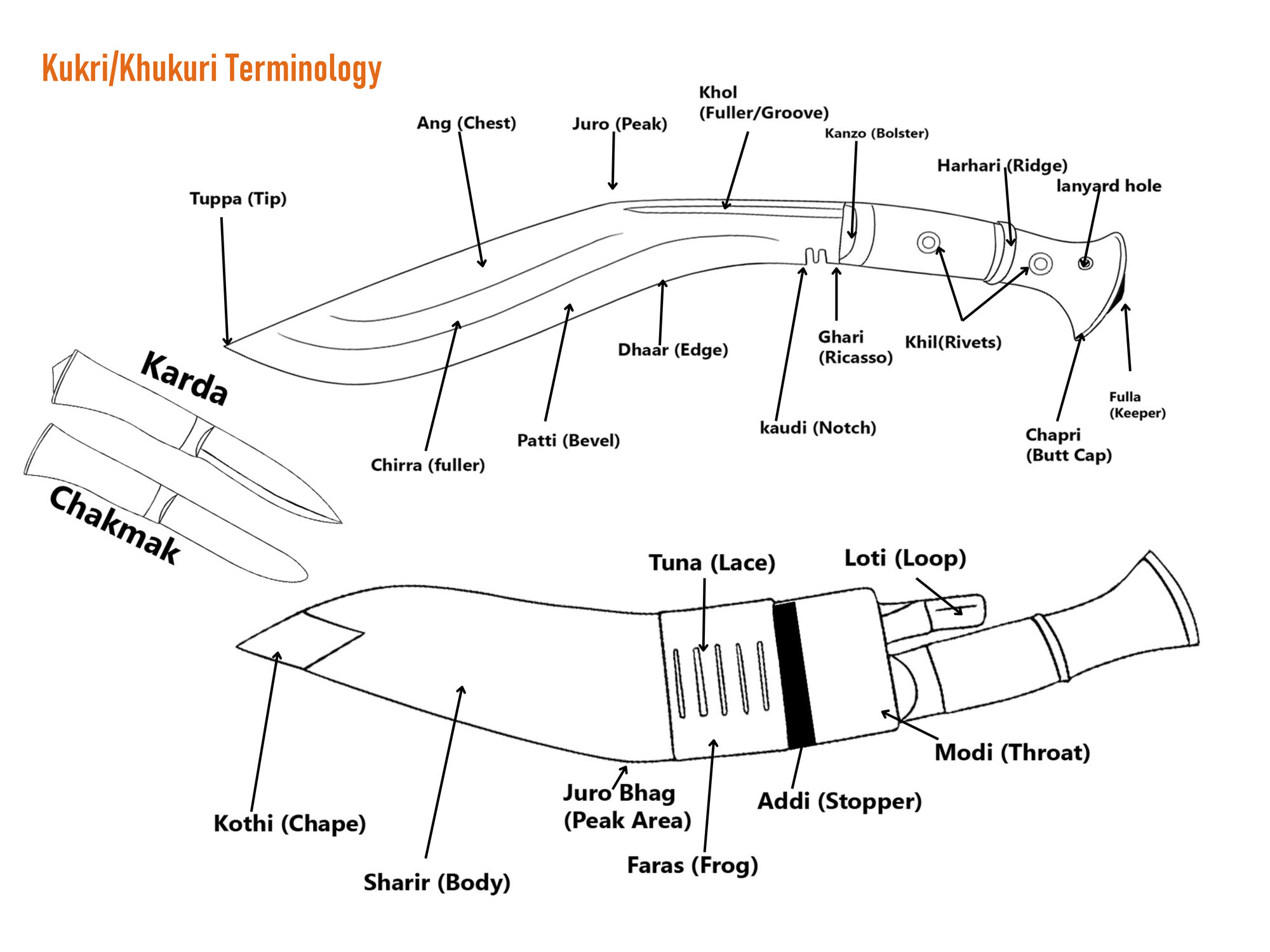
Annotated kukri anatomy — every named part of the blade, handle, and scabbard.
Belly (बेलि / पेट)
The belly is the widest, deepest section of the curved blade — typically located 2–4 inches forward of the handle. The belly carries the most mass and is where the cutting edge does most of its chopping work. The belly's forward weight is what gives the kukri its distinctive chopping efficiency: the cutting edge arrives at the target with momentum and speed at the same moment. The deeper the belly, the more chopping power; a slimmer belly favours slicing precision over chopping force.
Bevel
The bevel is the angled face that runs from the spine down to the cutting edge. Kukris are typically forged with a convex bevel (a slight curve from spine to edge) which improves cutting efficiency and edge durability under heavy impact. Some modern kukris use a flat bevel or a hollow grind for specific use cases.
Cho / Kaudi (चो / कौडी)
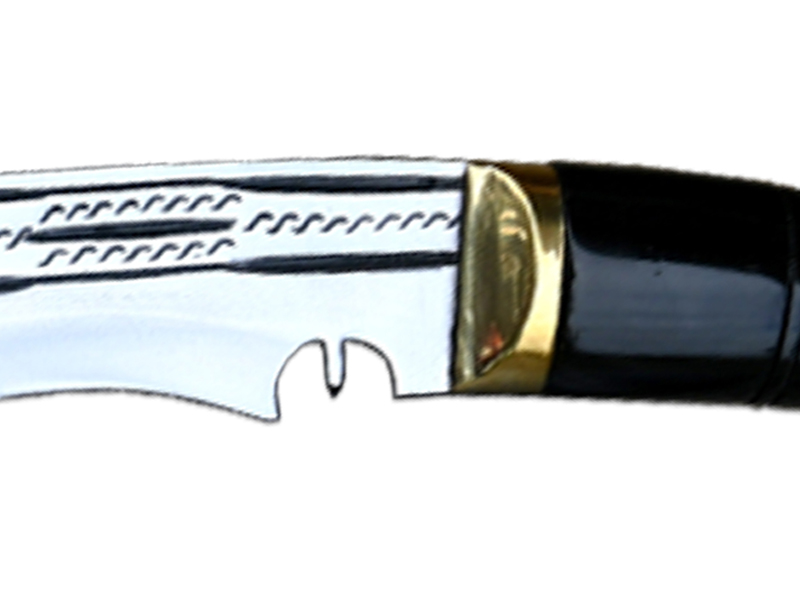
The cho (kaudi) — every authentic Nepali kukri carries one. Marker of authenticity.
The cho (also called kaudi, chouri, or notch) is the small distinctive notch hammered into the blade at the base of the cutting edge, just where it meets the handle. The cho is the single most identifiable feature of an authentic Nepali kukri — its presence is a marker of authenticity, and its absence usually indicates a reproduction by a maker who didn't know to include it.
The cho serves three layered purposes:
- Practical — As a stress-relief point that prevents cracks from propagating up the blade under heavy impact. The notch interrupts any crack that might otherwise travel from the edge toward the tang.
- Functional — To stop blood and fluids running back from the cutting edge onto the handle during use, keeping the grip dry.
- Spiritual — The shape symbolises a trishul (the trident of Shiva) or a cow's hoof, both sacred in Hindu tradition. This dedicates the blade to a protective religious purpose.
The cho appears on every regional pattern and every traditional Nepali kukri across all eras. For more detail, see our blog post on the cho / kaudi meaning and function.
Edge
The edge is the cutting surface of the blade — the sharpened side of the inward-curving line. On a water-tempered hand-forged kukri, only the edge is hardened during the temper process (while the spine stays softer for shock absorption). This differential tempering is what allows a kukri to chop into hard targets without snapping at the tang. Edge angles typically run 20–25° per side for working kukris and slightly steeper for ceremonial blades.
Fuller (खाँचो)
The fuller is a long groove hammered into one or both faces of the blade, running parallel to the spine. Fullers are sometimes incorrectly called "blood grooves" — they have nothing to do with blood. The actual purpose is to reduce blade weight without compromising structural rigidity, like the I-beam principle used in steel construction. A fullered kukri is lighter than a flat-spined kukri of the same dimensions while keeping the same chopping geometry. Kukris with multiple fullers (typically two or three) are called chirra. See our chirra fullered kukri collection.
Ricasso
The ricasso is the unsharpened section of the blade between the handle and the start of the cutting edge — sometimes only 5–10mm long on a kukri, but visually distinct from the rest of the blade. The ricasso allows the user to choke up onto the blade for fine control work without contacting the sharp edge. On some kukris, particularly working and military patterns, the ricasso also accommodates the cho notch.
Spine
The spine is the thick top edge of the blade running from handle to tip — the unsharpened side opposite the edge. The spine is the thickest section of the blade (typically 6–10mm on a working kukri) and is left softer during heat treatment to absorb impact. The spine also serves as the striking surface for batoning, where a wooden stick strikes the spine to drive the blade through wood. On chirra kukris, the spine carries the fullers.
Tang
The tang is the section of steel that extends from the blade into the handle — the structural backbone that joins blade to grip. Tang construction determines the strength of the entire kukri. See Construction & Tang Types below for the three principal tang patterns (rat-tail, semi-rat-tail, and full tang).
Tip / Point
The tip is the forward-most point of the blade. Kukri tips vary by pattern: some are sharply tapered for piercing and fine work (sirupate, military service patterns), others are more rounded for safety and durability under hard chopping (working and ceremonial patterns).
Regional Blade Patterns
The kukri is not a single design but a family of regional patterns, each evolved for the geography, work, and culture of its origin. Understanding the patterns is essential when buying — the wrong pattern for your intended use will leave you with a beautiful blade that doesn't perform.
Angkhola (आँखोला)
The Angkhola is a kukri pattern with a single fuller (groove) hammered along the spine of the blade. The fuller reduces overall weight while preserving structural rigidity. Angkhola is a working pattern — the lighter blade is easier to wield for sustained chopping. The name derives from the Nepali word for "groove" or "channel." Angkhola is essentially the single-fullered cousin of the more heavily-fullered chirra pattern. See our heavy-duty working kukri collection.
Baspate (बाँसपाते)
The Baspate is the general-purpose Nepali farmer's kukri — balanced, smooth-curved, and leaf-shaped after the bas (bamboo) leaf the name describes. The Baspate is the workhorse pattern of rural Nepal: not as broad as a Bhojpure, not as slender as a Sirupate, but versatile enough to handle daily chopping, slicing, and household work. See our traditional kukri collection.
Bhojpure (भोजपुरे)
The Bhojpure is the broad, heavy, deeply-curved kukri pattern originating from the Bhojpur region of eastern Nepal. The Bhojpure carries a pronounced belly that maximises chopping power and is the traditional pattern for working kukris, ceremonial kukris, and historically the basis of many military service patterns. If you imagine the "classic" Nepali kukri shape — broad-bellied, weighty, deeply curved — you are picturing a Bhojpure. See our heavy-duty working kukris and traditional kukris.
Budhune (बुधुने)
The Budhune is the short, compact, household-sized kukri of rural Nepal — typically 6–9 inches in blade length. The Budhune is the kitchen and small-task kukri: meat preparation, household carving, light food work, garden trimming. It is the pattern that introduces Nepali children to kukri use because of its manageable size. The international equivalent is the small EDC kukri. See our small EDC kukri collection.
Chirra / Chirrawala (चिर्रा)
The Chirra (also Chirrawala) is a kukri pattern with multiple fullers (typically two or three grooves) along the blade. The multiple fullers remove significant weight from the centre of the blade while preserving structural rigidity, producing a lighter blade with retained chopping geometry. Chirra kukris are favoured by users who do sustained heavy work and need to reduce blade fatigue without losing chopping power. See our Chirra fullered kukri collection.
Salyani (सल्यानी)
The Salyani is the deeply-curved, almost sickle-like kukri pattern unique to the Salyan region of western Nepal. The exaggerated curve gives the Salyani a sweeping cut profile ideal for vegetation work — clearing grass, slicing through stalks of millet and corn, harvesting fibrous crops. It is the most distinctive regional pattern by silhouette and is not commonly found outside specialist hand-forged makers. See our traditional regional kukri patterns.
Sirupate (सिरुपाते)
The Sirupate is the slender, long, lightweight kukri pattern from the eastern highlands of Nepal — named after the siru grass leaf the blade silhouette resembles. The Sirupate trades chopping mass for speed and precision; it is favoured by users who need swift control over forceful chopping. Historically associated with the eastern hill regions and martial-arts demonstration use. See our Sirupate kukri models or our traditional kukri collection.
Construction & Tang Types
Full Tang (पनावाल / Panawal)
A full tang kukri has a tang of steel that runs the entire length of the handle, with grip scales (wood, horn, micarta, or G10) riveted to either side. The full tang is the strongest possible construction — the handle cannot separate from the blade under impact because they are a single piece of steel from tip to butt. The Nepali term for full-tang construction is Panawal. Required for tactical, combat, survival, and heavy-duty bushcraft kukris where sustained impact load is expected. See our hybrid combat, utility & survival kukris.
Rat-Tail Tang (परोवाल / Parowala)
A rat-tail tang is a narrow steel rod that extends from the blade into a hollow handle and is sealed inside the handle with traditional Himalayan pine resin (Laha). The Nepali term is Parowala. Rat-tail construction is lightweight, well-balanced, and is the traditional method used on most authentic Nepali kukris for centuries. Ideal for ceremonial, decorative, household, and lighter working kukris. The construction tradeoff: lighter and more elegant in the hand, but not designed for prying or extreme impact loads. See our traditional kukri collection.
Semi-Rat-Tail Tang
A semi-rat-tail tang extends part-way through the handle (typically 60–80% of handle length) — a middle-ground construction offering more strength than rat-tail with less weight than full tang. Common on mid-tier working kukris and some modern hybrid designs. The semi-rat-tail bridges the gap between traditional and tactical construction.
Laha (लहा)
The Laha is traditional Himalayan pine resin used by Kami smiths for centuries to seal the rat-tail tang of a kukri inside its hollow handle. The resin is melted, poured into the handle around the tang, and allowed to harden — producing a bond that holds firm under repeated impact but can be reheated and re-fitted if a handle ever needs replacing. Laha is one of the small details that distinguishes a traditional Nepali kukri from a modern reproduction.
Military & Ceremonial Types
Service No. 1 (BSI 2008)
The Service No. 1 is the current British Gurkha service kukri — the standard-issue blade carried by serving Gurkha soldiers in the British Army. The specification was formalised by the British Ministry of Defence in 2008 under the standard BSI Service No. 1, 2008. The Service No. 1 specifies a 10.5-inch blade, 5160 high-carbon spring steel, water-tempered cutting edge, water-buffalo horn handle, hand-stitched leather scabbard with karda and chakmak. Everest Forge was one of the workshops contracted to supply blades to this specification. See our current-issue military kukri collection.
Kothimora (कोठीमोरा)
The Kothimora is a ceremonial kukri housed in a silver-mounted scabbard — descending directly from the Shah-era royal court tradition of presenting kukris as gifts of honour. The blade is typically a full-quality Bhojpure or service-pattern kukri; what distinguishes the Kothimora is the silver scabbard, often decorated with traditional Nepali motifs in repoussé or filigree work. Kothimora kukris are presented today at military retirements, regimental commissions, and major diplomatic occasions. See our Kothimora ceremonial kukri collection.
Dragon Kukri
The Dragon kukri is a presentation and ceremonial pattern engraved with dragon and floral motifs along the blade and scabbard. The dragon imagery draws from Tibetan Buddhist and Chinese influence in the broader Himalayan cultural sphere. Dragon kukris are commonly chosen for display, gifting, and collection purposes; the engraving work itself is part of the blade's value. See our etched and engraved kukri collection.
Historical Replica
A historical replica kukri is a hand-forged blade made to the specifications of a documented historical pattern — typically a kukri carried in a specific military campaign (WWI Western Front, WWII Burma, the Falklands), a known museum specimen, or a regional pattern from a specific period of Nepali history. Historical replicas are forged with period-accurate construction, materials, and finish — not modernised. See our historical replica kukri collection.
Handle & Scabbard Parts
Bolster
The bolster is a metal collar (typically brass or steel) at the junction of the blade and the handle. The bolster strengthens this critical junction, prevents the handle material from cracking where it meets the tang, and adds visual weight to the transition between blade and grip. Not all kukris have a bolster; some traditional patterns omit it entirely.
Butt Cap / Pommel
The butt cap (or pommel) is the metal cap at the rear end of the handle. The pommel serves three purposes: it caps and protects the handle material from impact, balances the blade against the forward weight of the belly, and provides a striking surface for some practical tasks (driving small wooden stakes, breaking glass in an emergency). Materials are typically brass or steel; ceremonial Kothimora kukris may have decorative silver butt caps.
Frog
The frog is the leather loop or fitting on the back of a kukri scabbard that attaches the scabbard to a belt or harness. Quality kukri scabbards have hand-stitched frogs reinforced with rivets. The frog is the part that wears fastest on a working kukri and is replaceable separately from the rest of the scabbard.
Handle
The handle (or grip) is the gripping section of the kukri. Traditional handles are made from water-buffalo horn or hardwood (typically rosewood or Indian sissoo); modern full-tang handles use micarta, G10, or polished hardwood scales riveted to the tang. Handle shape varies by pattern — most kukri handles have a slight waist that locks into the user's grip without conscious squeezing. See the construction types section above for tang variations within the handle.
Scabbard (दाप / Daap)
The scabbard (Nepali: daap) is the protective sheath that houses the kukri when not in use. A traditional Nepali kukri scabbard is built around a hollow wooden core, wrapped in hand-stitched water-buffalo leather, and fitted with two small pockets on the back to hold the karda and chakmak companion blades. Higher-end scabbards include brass throat-and-tip fittings; ceremonial Kothimora scabbards are mounted in worked silver.
Throat
The throat is the opening at the top of the scabbard where the blade enters and exits. The throat is often reinforced with a brass collar or leather binding because it experiences the most friction during drawing and re-sheathing.
Tip (of scabbard)
The tip of a kukri scabbard is the bottom end where the blade's point sits. The scabbard tip is reinforced because the blade's weight rests on it when carried point-down, and it is often capped with a brass or metal fitting for protection.
Companion Blades
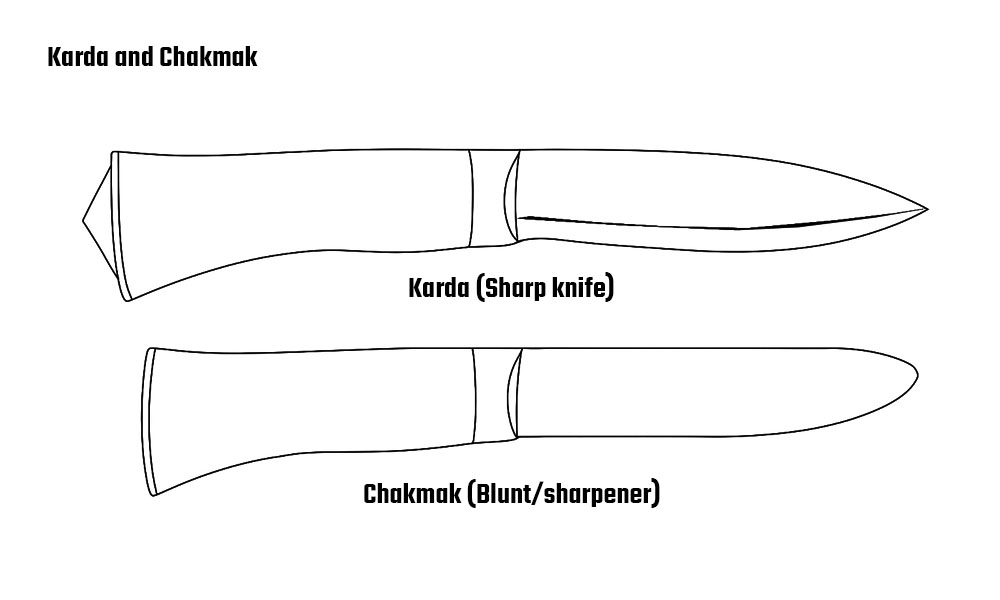
Karda (small utility knife) and chakmak (sharpening steel) — the two traditional companion blades carried in every authentic Nepali kukri scabbard.
Karda (कर्द)
The karda is a small utility knife (typically 3–5 inches in blade length) tucked into a pocket on the back of the kukri scabbard. The karda is forged from the same 5160 steel as the main kukri and is used for fine work the larger kukri is too clumsy for: skinning game, food preparation, carving notches, cutting cordage, opening packages. Think of the karda as the kukri's pocketknife — always present, always sharp, always to hand.
Chakmak (चक्मक)
The chakmak is a small hardened steel rod (typically 4–6 inches long) housed in a second pocket on the kukri scabbard. The chakmak has two functions: primarily, it is a sharpening steel used to maintain the kukri's edge between full sharpenings — touching up the edge in the field. Secondarily, the chakmak's hardened spine can be struck against flint or quartz to produce sparks for fire-starting, which is why traditional Nepali travellers and soldiers carried it as part of their basic survival kit. For sharpening technique, see our kukri maintenance guide. For more detail, see our blog post on karda and chakmak.
Materials
5160 High-Carbon Spring Steel
5160 is the alloy of choice for hand-forged Nepali kukris and the steel specified by the British Ministry of Defence for Gurkha service blades. Composition: roughly 0.6% carbon, 0.7% manganese, 0.8% chromium. 5160 was originally developed for vehicle leaf springs and brings the property a kukri needs more than anything else — shock absorption under repeated impact. It is a high-carbon steel (not stainless), which means it requires oiling to prevent rust but holds an edge through hard work without rolling or chipping. Some traditional Nepali smiths still forge from reclaimed leaf-spring stock, which is also typically 5160 or its close equivalent.
Water-Buffalo Horn
Black, dense water-buffalo horn is the traditional handle material for Nepali kukris. Horn is naturally water-resistant, takes a high polish, and develops a deep darker patina with age and skin oils. Water-buffalo horn is harvested from animals slaughtered for meat — not from live animals — making it a byproduct material rather than an extracted one. The classic handle material for Bhojpure and service-pattern kukris.
Indian Rosewood / Sissoo (शिशो)
Indian rosewood (also called sissoo or shisham) is the traditional hardwood used for kukri handles where horn is not available or desired. Sissoo is dense, durable, takes carving and polishing well, and ages with a warm reddish-brown tone. Used on traditional, decorative, and modern polished-rosewood handle patterns.
Micarta
Micarta is a composite material made from layers of fabric or paper bonded with phenolic resin under pressure and heat. Used on modern full-tang kukri handles for tactical, survival, and bushcraft patterns. Micarta is essentially indestructible, water-resistant, and provides excellent grip texture without slipperiness in wet conditions. Available in linen, canvas, and paper variants.
G10
G10 is a fibreglass-and-epoxy composite — denser, harder, and more impact-resistant than micarta. Used on combat, tactical, and heavy-duty survival kukri handles where maximum durability is required. G10 is fully waterproof, dimensionally stable across temperature ranges, and resistant to chemical exposure.
Water-Buffalo Leather
Water-buffalo leather is the traditional material for Nepali kukri scabbards. Thicker, stiffer, and more impact-resistant than cattle leather, water-buffalo leather is hand-stitched over a wooden scabbard core to produce the classic Nepali kukri sheath. Like water-buffalo horn, the leather is a byproduct of animals slaughtered for meat.
Cultural & Craft Terms
Kami (कामी)
The Kami are the hereditary blade-making and metal-working caste of Nepal. Kami smiths have forged kukris, agricultural tools, and ceremonial blades for centuries, with the craft passed from father to son across generations. The Kami caste sits within the broader Bishwakarma category of Nepali artisan castes who work with metal, wood, and leather. Authentic Nepali kukris have historically been made by Kami smiths, and our Kathmandu workshop continues that lineage with 10 Kami smiths currently working at the anvils. For more on the people behind the blades, see meet the master smith behind our blades.
Bishwakarma (बिश्वकर्मा)
Bishwakarma is the broader Hindu deity-named artisan caste category in Nepal, encompassing Kami (blade-making and metalwork), Damai (tailoring and music), and Sarki (leatherwork). The name derives from the Hindu deity Vishwakarma, the divine architect and craftsman. Many traditional Nepali blade-making families carry Bishwakarma as a surname, and the term is used to distinguish artisan-caste smiths from general iron-workers.
Gurkha
The Gurkha (sometimes Gorkha) is a Nepali soldier traditionally recruited from the hill regions of Nepal, serving in the British Army (Brigade of Gurkhas), the Indian Army (Gorkha Regiments), the Royal Brunei Armed Forces, and historically the Singapore Police Force. Gurkha recruitment began after the Anglo-Nepalese War of 1814–1816, when British forces were impressed by the courage and effectiveness of Nepali soldiers carrying the kukri. The kukri has been the standard-issue Gurkha service knife continuously from that date to the present. For the cultural weight of the kukri in Gurkha tradition, see our Honor of the Kukri page.
Dashain (दशैं)
Dashain is the largest Hindu festival in Nepal — a 15-day celebration in autumn honouring the goddess Durga. The kukri is central to Dashain: the blade is worshipped with prayer, tika, and floral offerings before being used in ritual animal sacrifices that symbolise the victory of good over evil. The Dashain blessing is the most important annual cultural use of the kukri in Nepal and is one of the reasons the blade is considered a sacred household object rather than merely a tool.
Tika / Tilak (टीका)
Tika is the red rice-and-yogurt mark applied to the forehead during Hindu and Nepali religious ceremonies. Kukris are blessed with tika during Dashain and other major rituals; the red mark appears on the blade itself when the kukri is worshipped on a household altar. The tika represents divine blessing and protection.
Trishul (त्रिशूल)
The trishul is the three-pronged spear or trident — the weapon of the Hindu deity Shiva. The cho notch on a kukri blade is interpreted in one tradition as a stylised trishul, dedicating the blade to Shiva's protective purpose. The trishul is one of the most widely-recognised Hindu sacred objects and appears throughout Nepali religious art and iconography.
Kukri Naach / Khukuri Dance (खुकुरी नाच)
Kukri Naach (kukri dance) is a traditional Nepali performance form featuring choreographed movements with a kukri or pair of kukris, performed at cultural festivals and military ceremonial occasions. The dance demonstrates traditional handling skill and is performed by Gurkha units during regimental celebrations and Nepali cultural festivals.
See a Kukri in 3D Detail
The interactive 3D model below lets you rotate and inspect a Damascus-pattern kukri from every angle — useful for visualising the terminology covered above (blade curvature, cho notch placement, handle profile, scabbard fit).
Interactive 3D model — Damascus-pattern kukri. Click and drag to rotate.
How to Identify an Authentic Hand-Forged Kukri
With the terminology in hand, the marks of authenticity become recognisable. A genuine hand-forged Nepali kukri shows specific signs:
- Has a cho. The cho notch near the base of the blade is the single most reliable marker of authenticity. Reproductions often omit it.
- Forged from 5160 (or traditional leaf-spring) high-carbon steel. Not stainless. The seller should be able to tell you what steel was used.
- Hammer marks and slight asymmetry. Real hand-forged blades show small variation; machine-stamped blades are eerily perfect.
- Differentially tempered edge. A faint temper line where the smith water-quenched only the cutting edge.
- Water-buffalo horn or hardwood handle, sealed with Laha resin (on rat-tail tang) or riveted (on full tang).
- Hand-stitched water-buffalo leather scabbard with karda and chakmak pockets.
- Forge attribution. A genuine kukri has a known forge behind it. If the seller cannot tell you who forged it, where, and from what steel, walk away.
Read about the standard every Everest Forge blade passes in our Everest Forge battle-ready standard page, and learn how every Everest Forge blade is made.
Continue Learning About the Kukri
- Kukri (Khukuri) Guide — Blade patterns, tang construction, military heritage, complete buyer's reference.
- Origin of the Kukri — The 2,500-year lineage from the Greek kopis to the modern khukuri.
- How a Kukri Is Forged — Inside the Kathmandu workshop, from 5160 spring steel to finished blade.
- Kukri Handling Guide — Safe drawing, working grips, and carry positions.
- Kukri Maintenance Guide — Sharpening, oiling, rust removal, storage.
- Honor of the Kukri — Cultural and Gurkha military tradition.
- Kukri FAQ — Quick answers to common buyer questions.
Frequently Asked Questions About Kukri Terminology
What does kukri (khukuri) mean?
Kukri (Nepali: khukuri, pronounced khoo-koo-ree) is a forward-curved single-edged knife originating from Nepal, characterised by an inward-sloping blade with a pronounced weighted belly. It is the national knife of Nepal and the standard-issue service blade of Gurkha regiments in the British and Indian armies. Khukuri is the original Nepali spelling; kukri is the international/English variation. Both refer to the same blade.
What is the notch on a kukri called and what is it for?
The notch is called the cho or kaudi. It is the small distinctive notch hammered into the blade at the base of the cutting edge, where the edge meets the handle. The cho serves three purposes: practically, as a stress-relief point that prevents cracks propagating up the blade under impact; functionally, to stop blood and fluids running back onto the handle; and spiritually, the shape symbolises a trident (the weapon of Shiva) or a cow's hoof, both sacred in Hindu tradition. Every authentic Nepali kukri has a cho — its absence usually indicates a reproduction.
What are the two small knives carried with a kukri?
The two small companion blades carried in pockets on a kukri scabbard are the karda and the chakmak. The karda is a small utility knife (3–5 inches blade) used for fine work the main kukri is too large for — skinning, food prep, carving. The chakmak is a small hardened steel rod (4–6 inches) used as a sharpening steel for maintaining the kukri's edge in the field; the chakmak's hardened spine can also be struck against flint to produce sparks for fire-starting.
What does khukuri mean in Hindi and Nepali?
In Nepali, khukuri (खुकुरी) means the forward-curved national knife of Nepal — a working tool, household blade, and military weapon. In Hindi, the word is rendered as कुकरी (kukri) or खुकरी (khukri) with the same meaning. The word has no direct English-language equivalent because the kukri is a culturally specific Nepali blade form; English speakers either use the transliterated word or call it a "Gurkha knife" after the soldiers most associated with it.
How do you pronounce kukri / khukuri?
Khukuri (the original Nepali spelling) is pronounced khoo-koo-ree — three syllables, with the stress on the first. The "kh" is a slightly aspirated "k" (like the "kh" in "Khan"). The English-language pronunciation of "kukri" is typically KOO-kree — two syllables, less aspirated, slightly anglicised. Both pronunciations are widely accepted in their respective contexts.
What are the different types of kukri?
The kukri is a family of regional patterns, each developed for specific work and geography. The principal traditional patterns are: Bhojpure (broad and heavy), Sirupate (slender and long), Salyani (deeply curved, sickle-like), Baspate (balanced general-purpose), Budhune (short household), Angkhola (single fuller), and Chirra (multiple fullers). Modern types include the Service No. 1 (current Gurkha military issue), the Kothimora (silver-scabbard ceremonial), and the Dragon kukri (engraved presentation pattern). See the regional patterns and ceremonial sections of this glossary for detailed descriptions.
What is a Bhojpure kukri?
A Bhojpure kukri is the broad, heavy, deeply-curved kukri pattern originating from the Bhojpur region of eastern Nepal. The Bhojpure has a pronounced belly that maximises chopping power and is the traditional pattern for working kukris, ceremonial kukris, and historically the basis of many military service patterns. If you picture the "classic" Nepali kukri shape — broad-bellied, weighty, deeply curved — you are picturing a Bhojpure. See our heavy-duty working kukris.
What is a Chirra kukri?
A Chirra (or Chirrawala) kukri is a kukri with multiple fullers (typically two or three grooves) along the blade. The fullers reduce blade weight without compromising structural rigidity, producing a lighter blade that retains chopping geometry. Chirra kukris are favoured by users who do sustained heavy work and need to reduce blade fatigue without losing chopping power. See our Chirra fullered kukri collection.
What is a Kothimora kukri?
A Kothimora is a ceremonial kukri housed in a silver-mounted scabbard, descending directly from the Shah-era royal court tradition of presenting kukris as gifts of honour. The blade is typically a full-quality Bhojpure or service-pattern kukri; what distinguishes the Kothimora is the silver scabbard, often decorated with traditional Nepali motifs. Kothimora kukris are presented today at military retirements, regimental commissions, and major diplomatic occasions. See our Kothimora ceremonial kukri collection.
What is a Sirupate kukri?
A Sirupate kukri is the slender, long, lightweight kukri pattern from the eastern highlands of Nepal — named after the siru grass leaf the blade silhouette resembles. The Sirupate trades chopping mass for speed and precision. Historically associated with the eastern hill regions and traditional martial-arts demonstration use.
What is the difference between Panawal and Parowala kukris?
Panawal and Parowala are the Nepali names for the two principal tang construction types. Panawal refers to a full-tang kukri, where the tang runs the full length of the handle with grip scales riveted to either side — the strongest construction, used for combat, survival, and heavy-duty work. Parowala refers to a rat-tail tang kukri, where a narrow steel rod extends into a hollow handle and is sealed with Laha (Himalayan pine resin) — the traditional construction, lighter and well-balanced, ideal for ceremonial and lighter working use.
What is Laha used for in kukri construction?
Laha is traditional Himalayan pine resin used by Kami smiths to seal the rat-tail tang of a kukri inside its hollow handle. The resin is melted, poured into the handle around the tang, and allowed to harden — producing a bond that holds firm under repeated impact but can be reheated and re-fitted if a handle ever needs replacing. Laha is one of the small details that distinguishes a traditional hand-forged Nepali kukri from a modern reproduction.
Who are the Kami in kukri making?
The Kami are the hereditary blade-making and metal-working caste of Nepal. Kami smiths have forged kukris, agricultural tools, and ceremonial blades for centuries, with the craft passed from father to son across generations. Authentic Nepali kukris have historically been made by Kami smiths. At Everest Forge, our Kathmandu workshop is staffed by 10 Kami smiths working in pairs at the anvils.
What is the spelling — kukri or khukuri?
Both spellings are correct and interchangeable. Khukuri (खुकुरी) is the original Nepali spelling. Kukri is the international/English-language variation popularised through British military use after 1816. You will also see khukri, kukuri, khookri, and other transliterated forms — all refer to the same Nepali curved knife. Most Nepali producers and the British Army use either spelling depending on context.
What is a fuller on a kukri blade?
A fuller is a long groove hammered into one or both faces of the kukri blade, running parallel to the spine. Fullers are sometimes incorrectly called "blood grooves" — they have nothing to do with blood. The actual purpose is to reduce blade weight without compromising structural rigidity, like the I-beam principle used in steel construction. A kukri with multiple fullers (typically two or three) is called a Chirra.
Now see the terminology in physical blades
Every term in this glossary corresponds to a blade pattern, construction type, or feature you can examine in person on one of our hand-forged kukris. From the broad-bellied Bhojpure to the silver-scabbard Kothimora, from the single-fuller Angkhola to the multi-fuller Chirra — see the terminology in steel.
Browse all hand-forged kukris → Historical replicas → Commission a custom kukri →