

- Model: Historical khukuri
- Product Code: CHIRRAWWII
- Location: Kathmandu, Nepal
Available Options
What Is a Chirra Khukuri?
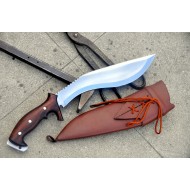
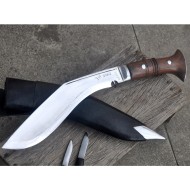
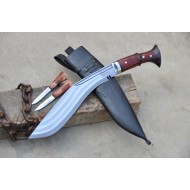
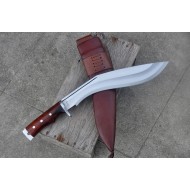
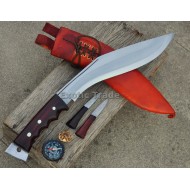
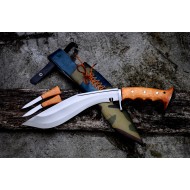
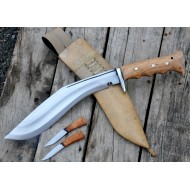
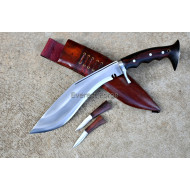
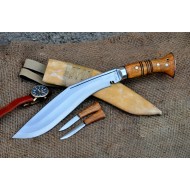
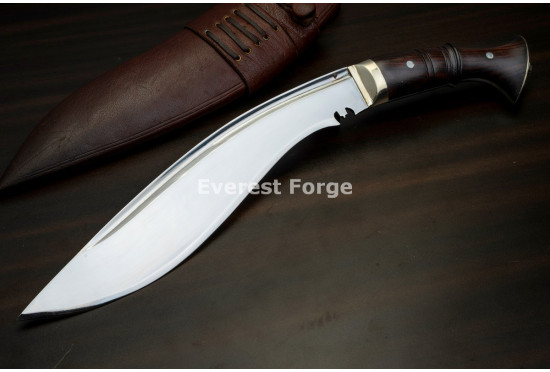
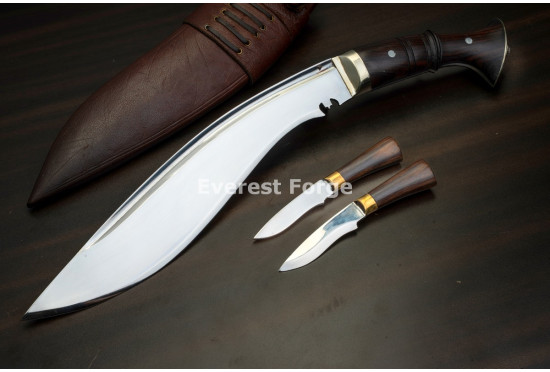
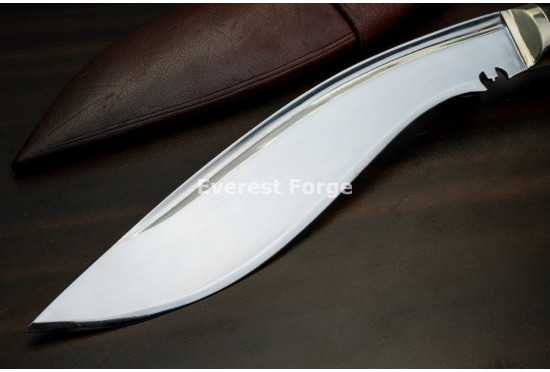
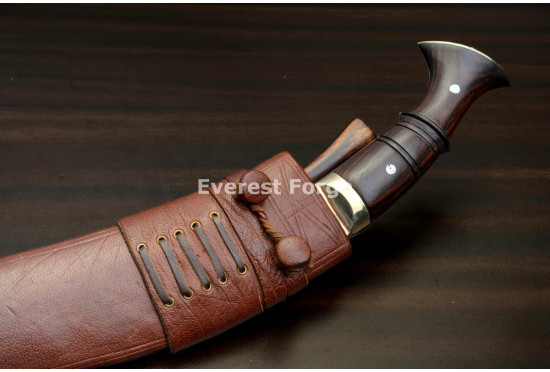
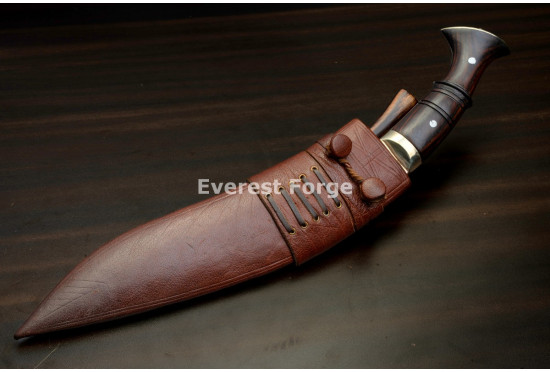
Chirra means fullered. It is the Nepali name for a khukuri whose blade carries grooves ground along its length, and it is one of the oldest ways of solving the khukuri's central problem: how to keep a broad chopping blade heavy enough to bite and light enough to swing all day. This one is a 13 inch chirra blade in the WWII-era proportions, with a brass bolster, a riveted full tang through a flared rosewood grip, and karda and chakmak in a brown leather scabbard. It is hand-forged in Kathmandu from 5160 high-carbon spring steel and runs to 19 inches overall, weighing 630 grams bare and 1040 grams with the scabbard.
The chirra is a smith's pattern rather than a soldier's one. Cutting fullers into a curved blade by hand is slow, unforgiving work: the grooves have to follow the sweep evenly on both faces or the blade looks wrong and balances worse. That is why chirra khukuris have always been made by the better kamis and why they cost more than a plain blade of the same size.
An honest note on the period. We describe this as a WWII-era pattern rather than a service replica, and the distinction is deliberate. The proportions are right for the period and the 13 inch blade sits squarely at the issue length. What is not issue is the construction: the official British Indian patterns closed a full rat-tail tang with a circular nut sunk into the butt, and used steel fittings throughout. This khukuri has a riveted full tang with visible pins and a brass bolster, which is traditional Nepali civilian work. It is the better construction in several respects and it is not what a quartermaster handed out. If you want an accurate service reproduction, we build those; see the question below and our historical replica collection.
Please check your local law before ordering. At 13 inches this blade is above the everyday carry allowance in most jurisdictions, and the khukuri's distinctive shape draws customs attention in some countries. Rules for owning one at home, carrying one in the field and importing one across a border are frequently three separate questions with three different answers. Check all three for your own address before ordering.
Want More Fullers, or None?
Our smiths cut single, dui chirra and tin chirra to order, and will build the same blade plain if you prefer. Each changes the weight and the feel. Tell us how you intend to use it and we will advise.
Specify Your Fullering →Why This Khukuri Is Built the Way It Is
Full Specifications
Blade length, blade finish, fullering and handle material are selectable on this listing. The figures above describe the standard build as photographed; what you receive will match the options you choose at checkout. Small variations in weight, dimension and finish are normal in hand-forged work.
Build It Your Way
What This Khukuri Does Well, and What It Does Not
What It Is Good At
- Sustained chopping. The fullering is why you can still swing it after an hour
- Camp and field work: clearing, splitting kindling, general heavy cutting
- Handling. At 630 grams for a 13 inch blade it is lively for its size, which is the whole point of the pattern
- Showing workmanship. Hand-cut fullers on a curved blade are the hardest grinding a kami does
- Being a complete set, with the karda for small jobs and the chakmak for edge maintenance
What It Is Not Good At
- Passing as issue kit. The riveted tang and brass bolster are civilian construction
- Fine work. It is far too large, which is exactly why the karda is in the scabbard
- Maximum chopping mass. A plain blade of the same size hits harder, and costs less
- Neglect. Carbon steel spots within a day of being put away damp, and fullers hold moisture
- Discreet carry. At 19 inches with a curved scabbard it is conspicuous
How to Order a Custom Khukuri
Looking for a Different Fullering?
Our chirra collection covers single, dui and tin chirra across several blade patterns, and the historical replica collection carries the documented service marks.
See the Full Khukuri Range →Who This Khukuri Is For
- Buyers who will actually use it, since the fullering exists to make a heavy blade usable for longer
- Collectors of Nepali forging, for whom hand-cut fullers on a curve are the mark of a good kami
- Campers and outdoors users wanting one blade that chops hard without punishing the forearm
- Anyone comparing chirra patterns, since we cut single, dui and tin to order on the same blade
- Buyers who want period proportions without needing a collector's construction checklist satisfied
It is not for you if you want a documented service reproduction, in which case order the replica build or browse the historical replica collection, or if you want maximum chopping mass, in which case a plain blade of the same size will hit harder for less money.
What Is Included
- The hand-forged chirra khukuri, sharpened and ready to use
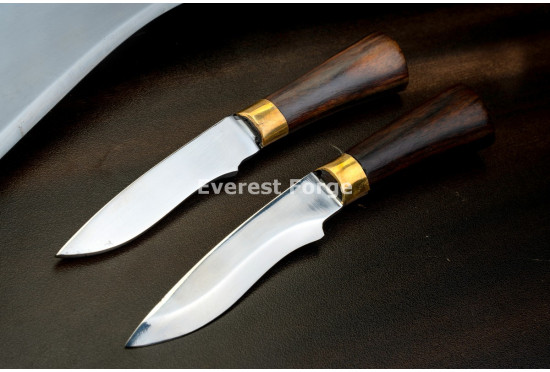
- A karda companion utility knife and a chakmak companion burnisher
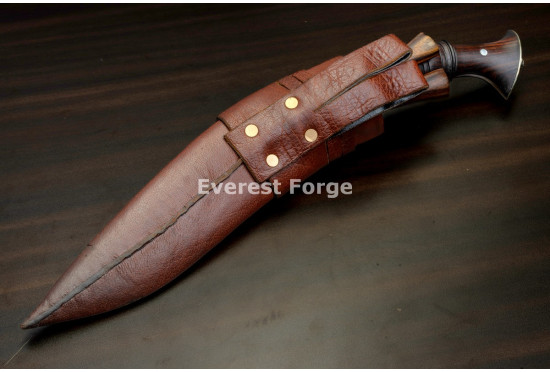
- A brown leather scabbard over a rigid core, with fitted pockets for both companions
- A certificate of authenticity, care instructions, and the Everest Forge manufacturer warranty
Other Blades From the Everest Forge Workshop
Shipping, Returns and Care
Dispatch. Stock pieces leave the workshop within 2-3 business days. Custom builds take 4-6 weeks depending on the queue, and dui or tin chirra sit at the longer end because each additional fuller is a further day of hand grinding.
Shipping. Tracked worldwide by DHL or FedEx, typically 7-14 business days in transit from Kathmandu. Customs paperwork is completed accurately and in full. The khukuri is a recognisable shape and attracts more import scrutiny than a plain knife; please check your own country's rules before ordering.
Returns and warranty. Covered by the Everest Forge manufacturer warranty against defects in forging and materials. Custom builds made to your own specification cannot be returned for a change of mind, which is why we confirm everything in writing first.
Care. Wipe the blade dry after every use and keep a light film of oil on it. The fullers need particular attention: a groove is exactly the shape that holds moisture and exactly the shape a cloth drawn across the flat skips over, so run a corner of cloth along each one rather than assuming a general wipe has reached it. There are three blades here rather than one, so check the companion pockets too. Oil the timber once or twice a year and feed the scabbard leather at the same interval, keeping conditioner off the brass. Store all three out of the scabbard, because leather holds damp against steel.
Questions Answered
What does chirra actually mean?
Chirra is the Nepali word for a fullered blade, and in practice it is used as a family name for khukuris cut with grooves along the length of the blade. The counting matters, because the terms are specific: a single groove near the spine is usually called angkhola, which translates roughly as body groove; two grooves are dui chirra; three are tin chirra. Beyond three is rare and mostly a display of skill. The distinction is not decorative. Each groove removes a further slice of weight from the blade and adds a further day of hand grinding, so the pattern you choose is a decision about how the knife will feel and what it will cost, not about how it looks. If you are comparing khukuris from any seller, counting the grooves tells you a good deal about what you are being offered.
Why multiple fullers instead of one deep groove?
Because taking the same weight out in several shallow cuts leaves a stronger blade than taking it out in one deep one. A fuller works by removing steel from the middle of the blade's thickness, where it contributes least to stiffness. But a single deep groove concentrates that removal in one line, thinning the blade dramatically at that point and creating what an engineer would call a stress riser, a place where a bend will naturally start. Spreading the same material loss across two or three shallower grooves keeps more thickness at any given point, distributes the transition across several gentler curves, and leaves ribs of full-thickness steel between them which stiffen the blade in the way corrugation stiffens a sheet. That is why the multi-fullered patterns have a reputation among kamis for resilience rather than merely for lightness. Our deep-fullered kukri page sets out the underlying structural argument if you want it in more detail.
Is this an actual WWII issue khukuri?
No, and we would rather say so here than let a collector tell you. This is built to the proportions of the period, which is why we call it a WWII-era pattern rather than a service replica. The 13 inch blade is right at the issue length and the plain riveted scabbard is far closer to military than a decorated one. What is not issue is the construction. The official patterns from 1903 onward closed a full rat-tail tang with a circular nut recessed into the butt, and used steel fittings throughout. This khukuri has a riveted full tang with visible pins and a brass bolster, both of which are traditional Nepali civilian work. Neither is a compromise; a riveted full tang is arguably the more robust arrangement. It simply is not what a quartermaster issued. Our WWI-era pattern khukuri page sets out the four diagnostics for telling issue from civilian, and they apply here too.
What is panawal construction?
Panawal is the Nepali term for a khukuri built with a full-width, full-length tang and the handle scales riveted through it, which is what this one has: you can see the pins in the grip and the steel of the tang along its edge. It is worth knowing because Nepali khukuris are made three quite different ways. The traditional village construction is a partial tang set into a drilled handle and fixed with laha, a resin adhesive, which is strong and completely invisible from outside. The official military patterns used a full rat-tail tang drawn up under a nut sunk into the butt. Panawal is the third way and the most robust of the three for hard use, because there is no adhesive to fail and no single threaded point carrying the load, just steel and rivets along the whole length. The trade is weight and the fact that the tang is exposed to weather along its edges, which is one more place to keep oiled.
Did fullered khukuris actually see military service?
Yes, though not as an issue pattern. The chirra was well established in Nepal long before the British standardised anything, and it gained wider military use in the interwar years, when soldiers who wanted a lighter blade than the issue one could have a fullered khukuri made at home. That is the honest position: a chirra khukuri of this period is far more likely to have been a private purchase or a family piece carried alongside issue kit than something drawn from stores. Given that a great many Gurkhas did carry khukuris from home throughout both wars, a fullered blade in the hands of a serving soldier is entirely plausible for the period. It just would not have had a broad arrow on it.
How does it compare with your other period khukuris?
Two pages, two different periods and two different builds. Our WWI-era pattern khukuri is the larger of the pair at 15 inches, with a single spine fuller, a decorated cast chape and older, longer proportions that sit closer to the nineteenth century heritage sizes. This one is 13 inches, which is the service length of the later period, with chirra fullering, panawal riveted construction and a plain riveted scabbard much nearer to military dress. Take the 15 inch if you want presence and the older silhouette; take this one if you want something closer to service proportions and a blade you will actually carry and swing. For documented service reproductions rather than period patterns, our historical replica collection is the right place.
What does the fullering do to the weight and the feel?
It takes weight off the blade without taking it off the belly, which is the only place a khukuri actually needs it. At 630 grams bare for a 13 inch blade, this sits in the middle of our khukuri range rather than at the heavy end, and the difference shows up in how long you can work with it rather than in how hard it hits. A plain blade of the same dimensions is noticeably heavier in the hand and will out-chop it on any single stroke; this one will still be swinging comfortably when the plain blade has tired your forearm. That is the trade, and which side of it you want depends entirely on whether you are clearing a path or splitting a log. If you are unsure, the plain build costs less and hits harder, and we would rather tell you that than sell you the more expensive option by default.
Does it come with the karda and chakmak?
Yes, both, in fitted pockets on the scabbard. The karda is the small sharpened utility knife for the jobs a 13 inch blade cannot manage, and the chakmak is a burnisher for truing the khukuri's edge between sharpenings and for striking sparks from flint. The chakmak is meant to be blunt and that is not a fault; our kukri with karda and chakmak page explains what both tools do and how to use the chakmak properly, and it is worth reading if you have not used a set before.
Is it a working knife or a display piece?
A working knife, and the fullering is the evidence. Nobody cuts grooves into a curved blade by hand for decoration alone; it takes days, it is the most unforgiving grinding a kami does, and the reason the pattern survives is that it makes a heavy blade usable for longer. This one will chop, split, clear and do everything a khukuri is for. The polished finish is the only thing on it built for looking at rather than using, and if the knife is going into a pack rather than onto a wall, the satin or dark forge finish costs the same and will look better after a season. What it will not do is fine work, which is what the karda is in the scabbard for.
Is a khukuri this size legal where I live?
We cannot answer that for you and you should be careful of any seller who claims they can. At 13 inches this blade is above the everyday carry allowance in most jurisdictions, and the khukuri's distinctive shape means it is sometimes named or recognised specifically where a plain knife of the same size would pass without comment. Rules for owning one at home, carrying one while working outdoors and importing one across a border are frequently three separate matters with three different answers. Check all three for your own address before ordering. If length is the obstacle, a 10 or 11 inch build costs no more.
What steel is it, and how is it heat treated?
5160 high-carbon spring steel, forged down from leaf spring in the Nepali tradition, which is the same stock and the same method our smiths use for khukuris that go to working households in Nepal. It is oil-quenched and then tempered back. On a chopping blade toughness matters more than outright hardness, because the edge will meet things it was not aiming at, and a blade that rolls and can be trued back is far more use than one that chips. It is not stainless: it will take a patina with use and it will rust if left wet.
Will my khukuri look exactly like the photographs?
Close, but not identical, and on a chirra rather less so than on a plain blade. The curve is drawn out by eye and hammered rather than cut from a template, so the sweep of the belly varies from piece to piece. The fullers are then ground by hand to follow that individual curve, which means their exact length, depth and where they run out toward the point are decided at the grinding wheel rather than set by a jig. Two chirra khukuris from the same bench on the same day will differ visibly. Rosewood varies board to board, and the scabbard core is shaped to the individual blade. What does not vary is the specification: length, steel, construction, heat treatment and sharpness are held to the same standard on every piece.
| Specification | |
| Blade: | 13 inches. Hand forged from 5160 carbon steel |
| Total Length: | 9 inches |
| Handle: | 6 inches. Rosewood with brass bolster and riveted full tang |
| Weight: | 630 grams the khukuri, 1040 grams with the scabbard |
| Note: | Handmade variation in weight, dimensions and finish may occur. Keep blade lightly oiled when not in use. |