Menu
Your Cart

Hand-Forged Recurve Knife, S-Guard Hilt

Hand-Forged Recurve Knife, S-Guard Hilt
$144.99
Ex Tax: $144.99
  • Model: Bowie Knife
  • Product Code: KUKRIBOWIE012
  • Location: Kathmandu,Nepal

Available Options

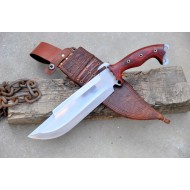
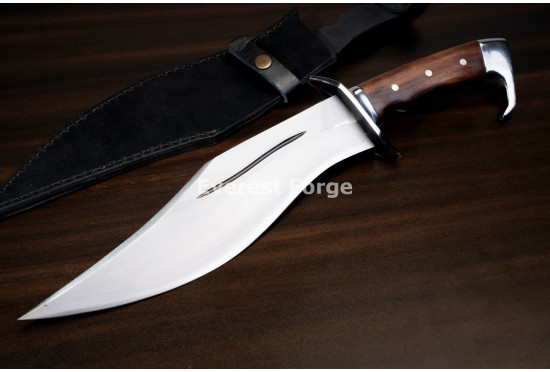
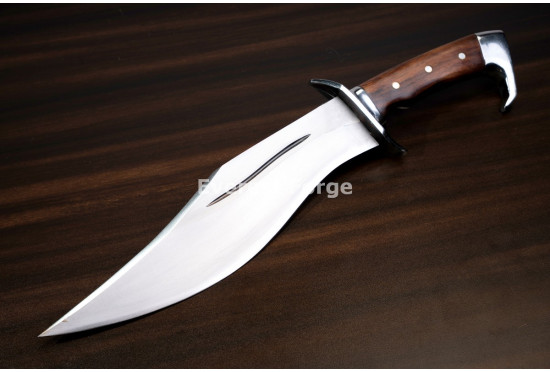
A Hand-Forged Recurve Knife With an S-Guard Hilt and Hooked Butt

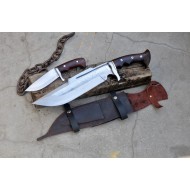
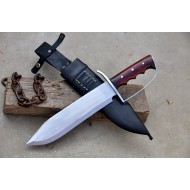
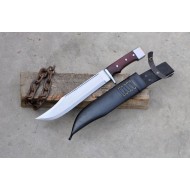
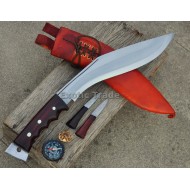
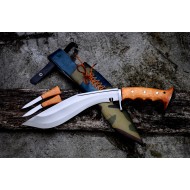
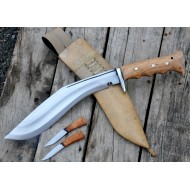
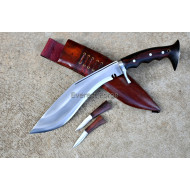
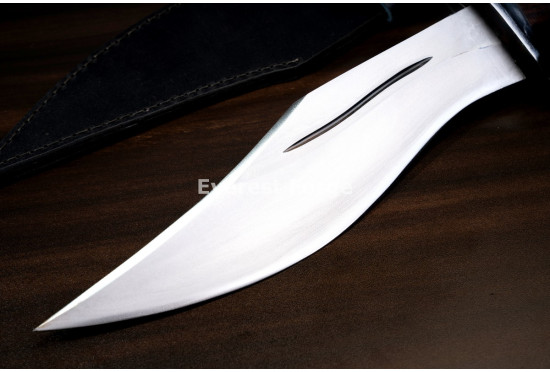
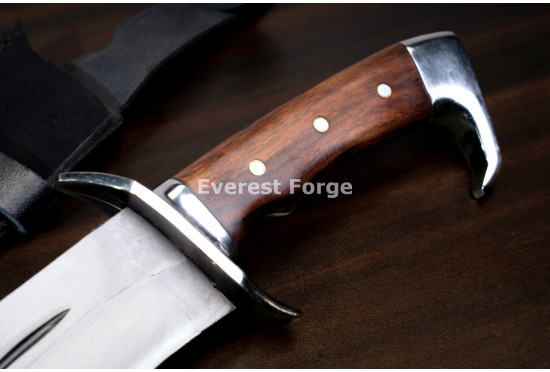
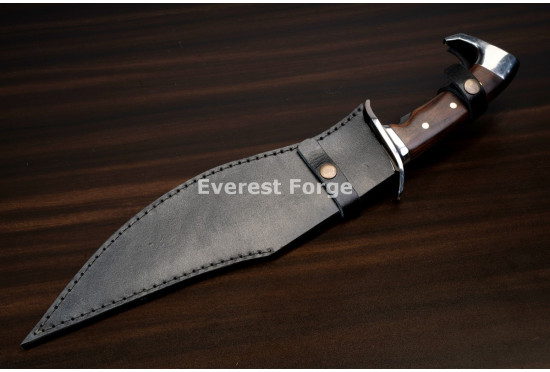
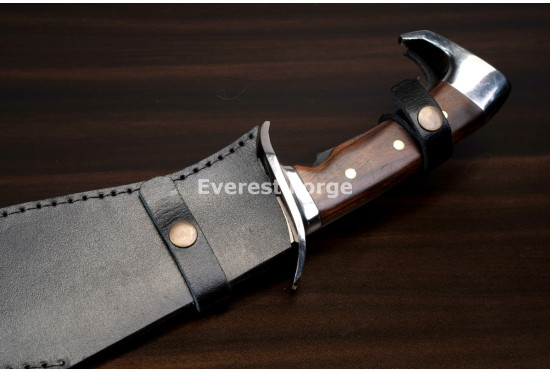
This is a 12 inch hand-forged recurve knife: the spine dips through the middle of the blade and rises again to an upswept point, while the edge sweeps down into a deep belly and back up to meet it, giving the long S-curve the type is named for. A short lens-shaped fuller sits high in the blade. The hilt is a polished steel S-guard with one quillon sweeping forward over the blade and one back over the hand, rosewood slabs pinned through a full tang, and a heavy hooked steel butt. Overall length is 18.5 inches and it weighs approximately 900 grams. Forged from 5160 high-carbon steel in Tokha-3, Kathmandu, and supplied in a stitched black leather sheath with a retaining strap.

An honest note. This gets described as a kukri-and-bowie hybrid, which is a fair way to talk about where the ideas came from and a bad way to name it, so we have not. It is not a kukri: there is no cho, the notch filed into the edge ahead of the bolster that every genuine Nepali kukri carries, and we say on eight other pages that a blade without one did not come from that tradition. It is not a bowie either: a bowie is defined by its clip point, where the spine is cut away to bring the tip down, and this spine recurves and rises instead. What it actually has is a recurve, which nothing else in our catalogue does, so that is what it is called. The answer below sets out honestly what a hybrid inherits from each side and what it gives up by being neither.

Made to your specification

Have This Knife Forged Your Way

Blade length, depth of recurve, guard form and spine thickness are all decided at the forge. Tell us what you are cutting and our smiths will tell you what to order.

Start a Custom Forge Order →

Why This Knife Is Built the Way It Is

A Recurve That Pulls InThe concave section behind the belly catches material and draws it toward the widest part of the blade rather than letting it slide off. On rope, hide and green stems that is a real difference.
Mass Where the Cut LandsAt 900 grams over twelve inches this is at the top of the weight range for a blade this size, and nearly all of it sits forward of your hand in the belly.
Steel at Both Ends of the GripA polished bolster at the front and a heavy hooked butt at the back, with the tang pinned through between them. The hook stops the hand travelling back on a hard swing.

Specifications

Blade Length12 inches
Handle Length6.5 inches, of which 4.5 inches is grip
Overall Length18.5 inches
Blade Steel5160 high-carbon spring steel, oil-quenched and tempered
Blade ProfileRecurve — spine dipping through the middle and rising to an upswept point, deep belly below
FullerShort lens-shaped fuller set high in the blade
GuardPolished steel S-guard, one quillon forward over the blade and one back over the hand
ConstructionFull tang with rosewood slabs pinned through
FittingsPolished steel bolster and heavy hooked steel butt
Standard BuildSatin blade, rosewood slabs — size, finish and scale material are selectable above
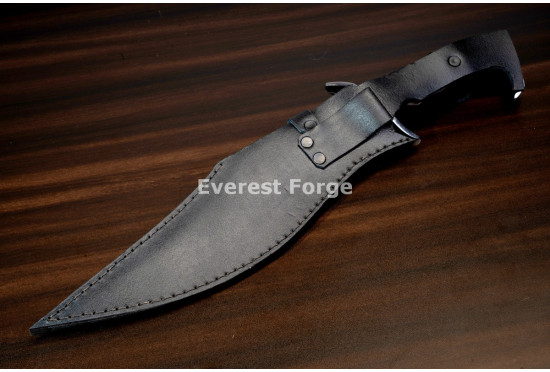
SheathStitched black leather with a retaining strap over the guard
WeightApproximately 900 grams for the knife, 1100 grams with the sheath
OriginHand-forged in Tokha-3, Kathmandu, Nepal

Build Options

Depth of RecurveDeeper for more of the pulling effect and a more dramatic outline, or shallower for a blade that is far easier to sharpen. Read the sharpening answer below before choosing.
Spine ThicknessWhat actually sets the weight. Tell us the work and our smiths will forge the spine heavier or lighter without changing anything you can see.
Blade LengthNine to fourteen inches. Shorter is far easier to wear and to control; longer exaggerates the recurve, which on this design is much of the appeal.
Guard FormThe S-guard shown, a straight cross, a single forward quillon, or no guard at all if you want the outline uninterrupted.
Scale MaterialRosewood as standard. Water buffalo horn, micarta or stacked leather washers, all cut and fitted in the same workshop.
Plain BladeThe short fuller left off entirely. It is decorative rather than structural at this size, and some buyers prefer the clean face.

Is This the Right Knife for You?

Buy This If You Want

  • A recurve, which nothing else in our catalogue has and which genuinely cuts differently
  • Serious forward mass in a blade short enough to work close in
  • A guard on both sides of the hand and a hooked butt to stop it travelling back
  • Full tang construction with steel at both ends of the grip
  • An outline that will be recognised across a room

Look Elsewhere If You Want

  • An easy knife to sharpen — a recurve needs a round file or rod and the answer below explains why
  • A kukri; there is no cho and we will not call it one
  • A bowie; there is no clip point and our coffin-handle bowie is the real pattern
  • Something light to carry all day, since this is at the top of the weight range for its size
  • A stainless blade needing no care, since 5160 is carbon steel and will rust if left wet
Fifteen years at the anvil

Tell Us What You Are Cutting

Recurve depth, spine thickness and blade length should follow the work rather than a catalogue. Describe your ground and our smiths will tell you what to order.

Talk to the Forge →

How to Order

Choose your blade length, finish and scale material from the options above the description.
Note your preferred recurve depth and spine thickness in the order comments.
We confirm the build by email and start forging. Preparation takes seven to ten days.
Your knife ships tracked and arrives a further seven to ten days later.

Who This Knife Is For

  • Hunters and campers who want one heavy blade that slices as well as it chops
  • Anyone cutting rope, webbing or fibrous material, which is where a recurve earns its keep
  • Collectors of large forged knives looking for a profile that is not another clip point
  • Buyers who already own a kukri or a bowie and want the shape that sits between them

What Is Included

  • One hand-forged recurve knife, sharpened and ready to work
  • Fitted stitched black leather sheath with retaining strap
  • Certificate of hand-forging from the workshop
  • Everest Forge manufacturer warranty against defects in forging and heat treatment

Explore the Collection

Shipping, Returns and Care

Every piece is prepared at the forge in seven to ten days, and shipping adds a further seven to ten days. Orders to the USA and Canada travel with FedEx; everywhere else ships on a DDP service, which means duties and taxes are settled before the parcel moves so there is nothing to pay on delivery. Every piece carries the Everest Forge manufacturer warranty against defects in forging and heat treatment.

Large fixed blades are restricted in some countries and in some states and provinces within them. It is your responsibility to check that this knife may lawfully be imported and possessed where you live before ordering, because a parcel seized by customs cannot be returned to us and cannot be refunded. Ask us before you buy if you are unsure and we will tell you what we know about your destination.

5160 is a high-carbon steel and it will rust if left wet or stored damp. Wipe the blade dry, keep a light film of oil on it, and pay attention to the fuller and to the inside of the recurve, which is the one part of the edge a cloth drawn along the blade will skip over. Do not store the knife in the sheath for long periods. The rosewood slabs take an occasional coat of oil.

Frequently Asked Questions

What does a recurve actually do?

It catches. A recurved edge is concave through the middle and convex through the belly, so material sliding along the blade is drawn inward toward the widest, fastest-moving part rather than skidding off the way it does on a straight or simply curved edge. On rope, webbing, hide, sinew, green stems and anything else fibrous that makes a real difference, because those are exactly the materials that slip away from a knife rather than staying put to be cut. The concave section also means the edge meets the target at a more acute angle for part of the stroke, which lets it start the cut with less force. What you are giving up is simplicity: a recurved edge is more work to make, considerably more work to sharpen, and slightly weaker through the narrow waist than a straight blade of the same stock. It is a specialist geometry that happens to look dramatic, which is why it turns up on both serious working knives and on things designed purely to be looked at.

How do I sharpen a recurve?

With something round, and this is the honest cost of the shape. A flat stone or a mill file cannot reach into the concave section: it bridges across the hollow and only touches the two high points either side, so after a few sharpenings the recurve flattens out and the blade loses the thing you bought it for. What you need is a round or half-round file, a sharpening rod, or the rounded edge of a stone, worked along the curve rather than across it. Do the concave section with the rod, the belly with a flat stone or file, and take the burr off both in one pass along the whole edge so the transitions stay smooth. It takes longer than sharpening a straight blade and there is no way around that. If sharpening in the field with whatever is to hand matters more to you than the cutting behaviour, order a shallower recurve or a plain belly, both of which are build options above, and we will tell you honestly that you will not miss much.

What does a hybrid actually inherit?

Worth answering properly, because hybrid is usually a word that means nothing. From the kukri side this takes the forward mass and the deep belly: weight ahead of the hand so the blade carries itself into the cut, and a long curved edge for slicing rather than a straight one for pushing. What it does not take is the kukri's defining features — the forward angle at the bolster, the cho, the traditional hilt — so it is not one. From the bowie side it takes the guard, the full-tang slab hilt with pinned scales, and an upswept point rather than a dropping one. What it does not take is the clip. And what it adds that neither parent has is the recurve itself. The honest accounting is that a hybrid trades depth for range: it chops less well than a proper kukri because the mass is not angled forward, and it thrusts less well than a bowie because the point sits high and the recurve puts the edge out of line. In exchange it slices better than either. Whether that is a good trade depends entirely on what you cut.

Is the fuller a blood groove?

No, and there is no such thing, which is worth saying plainly because the myth is one of the most persistent in the knife world. The story goes that a groove lets air into a wound to break suction so the blade can be withdrawn. Suction of that kind does not occur, blades are not held in by vacuum, and no maker in any period has ever documented cutting a groove for that reason. What a fuller genuinely does is remove metal from the middle of the blade face where it contributes least to stiffness, so a long fuller on a long blade saves useful weight while leaving raised areas either side that stiffen the section. That is the same principle as an I-beam. On this knife the fuller is short and lens-shaped and set high in the blade, so it is doing very little of that: at this size it is a decorative feature and a hand-ground one, and we would rather call it that than dress it up. If you want the face plain, that is a free change and it is a build option above.

Why is it not called a kukri?

Because there is no cho. The cho is the notch filed into the edge just ahead of the bolster on every genuine Nepali kukri: it arrests cracks running back out of the edge into the tang, it keeps sap and fluid off the grip, and it carries symbolic readings in Nepal. We state on eight kukri pages that a blade without a cho did not come from that tradition, and we are not going to make an exception for our own product just because the outline is suggestive. There is a second difference that matters more in the hand: a kukri bends forward at an angle near the bolster, which is what puts its mass out ahead of the wrist and makes it chop. This blade recurves smoothly instead, which is a different shape doing a different job. If you want the real thing, our bhojpure and sirupate pages are where to look and they both carry a hand-cut cho.

Why is it not called a bowie?

Because there is no clip point. A bowie is defined by the clip: the spine runs straight and is then cut away, straight or concave, so the point drops down onto the centre line of the blade, and it is that geometry the whole pattern is built around. Here the spine dips through the middle and then rises again, so the point finishes above the spine line rather than on the centre of the blade. That is an upswept point on a recurved back, which is close to the opposite. Our Coffin Handle bowie has the real thing and its page explains the geometry in detail; our Crossguard Hilt bowie carries the trade name and states in its own honest note that it is not a true bowie for exactly this reason. Three pages disagreeing about what a bowie is would make all three worthless, so this one does not use the word.

How does it compare to your other twelve inch blades?

By the shape of the last few inches, which is the only thing that really separates knives at this size. We now forge six geometries in the same class. This one recurves: spine dipping and rising to an upswept point, with a concave waist that pulls material in. Our Heavy Chopper has an upswept point with no recurve, so the longest simple belly of the group. Our Crossguard Hilt bowie has a drooping point falling below the handle line, which keeps mass forward for chopping. Our Camp Knife has a symmetrical spear point, the strongest tip of the six. Our Coffin Handle bowie has the true clip point. Our Book of Eli inspired machete has a forward curve. If you are choosing, ask what the last three inches will be doing: slicing fibrous material favours this one, thrusting favours the spear point, chopping wood favours the kukri, skinning favours the plain upswept.

Is 900 grams heavy for this size?

It is at the top of the sensible range and it is deliberate. Across the twelve inch blades we forge, the working band runs roughly six hundred to nine hundred grams depending on how thick the spine is and how deep the blade is through the belly, and this one sits at the upper end of that. In use the weight means the blade carries itself through a cut rather than needing to be forced, which suits a recurve because the shape is already doing work to hold material in place. What it costs is fatigue: nine hundred grams on a belt all day is noticeable, and fine work close to your other hand is tiring in a way a lighter knife is not. Spine thickness is what sets this, not the fuller and not the profile, so if you want the same knife lighter, ask for a thinner spine in the order comments and our smiths will take a hundred grams or more out without changing anything you can see.

What steel is it, and how is it heat treated?

5160 high-carbon spring steel, brought to temperature in the forge, quenched in oil and tempered back so the edge is hard while the body stays springy. It suits a heavy working knife: tough enough to take repeated impact without chipping, and soft enough at our temper that the edge rolls rather than breaking when it finds grit or a nail. A rolled edge comes back with a rod in a minute; a chip is a repair. That matters slightly more on a recurve than on a straight blade, because a chip in the concave section is genuinely awkward to grind out. It is not stainless, deliberately, because the stainless grades that resist rust properly give up the toughness a knife this heavy depends on.

Is it full tang?

Yes. The tang is the full width and shape of the grip with rosewood slabs pinned through it, and the line of steel shows between the slabs along the outline of the handle. The polished bolster at the front and the heavy hooked butt at the back are doing structural work as well as looking the part, clamping the slabs and spreading the shock of a hard cut across the whole hilt rather than concentrating it at the pins. A hidden tang, where a narrow spike runs into a solid handle, works loose at the shoulder under repeated impact and is the standard failure point on inexpensive heavy knives.

Can I baton with it?

Yes, with one caution. The tang is full width, the fittings spread the load and the spine is thick and unsharpened, which is what batoning needs. The caution is where you strike: the spine on this knife dips through the middle and rises toward the point, so it is not a flat straight surface along its length. Strike over the thickest section behind the dip, keep the blade square in the cut, and use a wooden baton. Do not strike out near the upswept tip, which is the thinnest part of the blade. If batoning is going to be a regular part of what you do, our Heavy Chopper has a straighter, fuller spine and is the better tool for it.

Where is this made, and by whom?

In our own workshop in Tokha-3 on the northern edge of Kathmandu, Nepal, by around ten smiths, most from families that have forged blades for generations. Everest Forge has operated since 2010, and we forge, grind, heat treat, fit the scales and cut the leather in the same building. This is a modern working design rather than a traditional pattern from anywhere, and we would rather say that than imply a heritage it does not have. Grinding a recurve consistently by hand is genuinely difficult, because the concave section has to be worked with a different tool from the rest of the blade and the transitions have to flow, which is the part of this knife that actually takes skill.

Specification
Blade: 12 inches. Hand forged from 5160 carbon steel
Total Length: 18.5 inches
Handle: 6.5 inches (4.5 inch grip). Full tang with rosewood slabs pinned through, polished steel bolster and heavy hooked steel butt
Weight: Approx 900g knife, 1100g with sheath
Note: Some variation in weight, dimensions and finish may occur as each piece is hand forged. Keep the blade lightly oiled when not in use

Write a review

Note: HTML is not translated!
Bad Good
Captcha