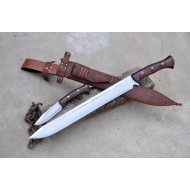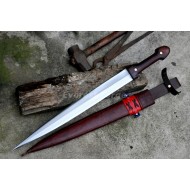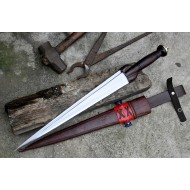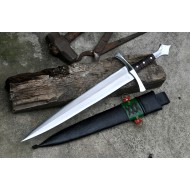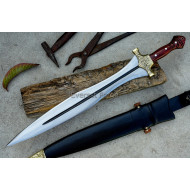


- Model: Quillon Dagger
- Product Code: WheelPommel17
- Location: Kathmandu,Nepal
Available Options
What Is a Quillon Dagger?
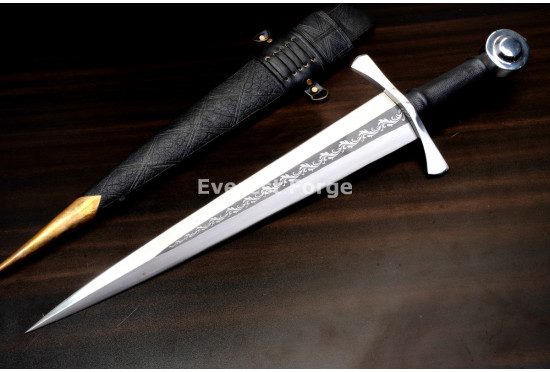
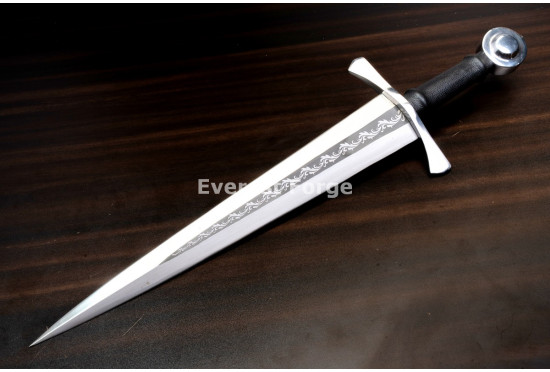
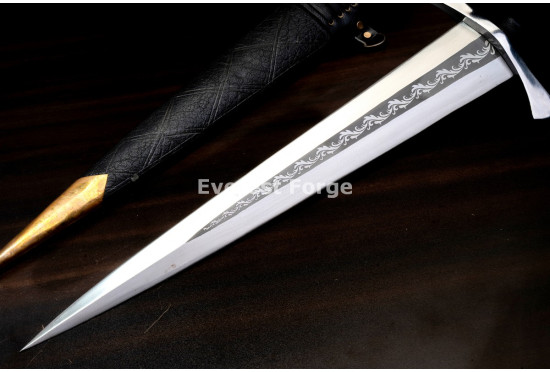
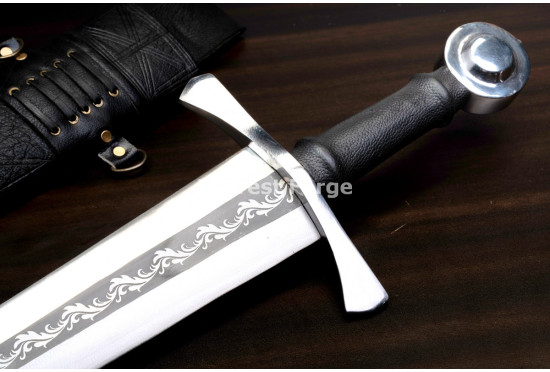
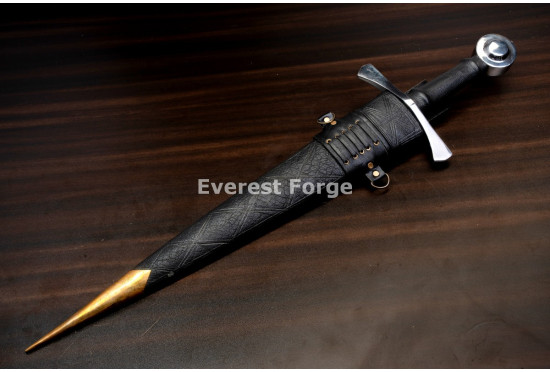
A quillon dagger is a medieval dagger built like a sword in miniature: a straight cross guard, a wrapped grip and a proper pommel, in place of the lobes, discs or plain scales found on other dagger forms. It was the knight's sidearm from roughly the 13th century onward, frequently made to match the arming sword hanging on the same belt. This one is hand-forged in Nepal from 5160 high-carbon spring steel, with a 17 inch double-edged blade, a 7 inch hilt, a 24 inch overall length, an etched foliate panel down each face and a black leather scabbard finished with a long brass chape.
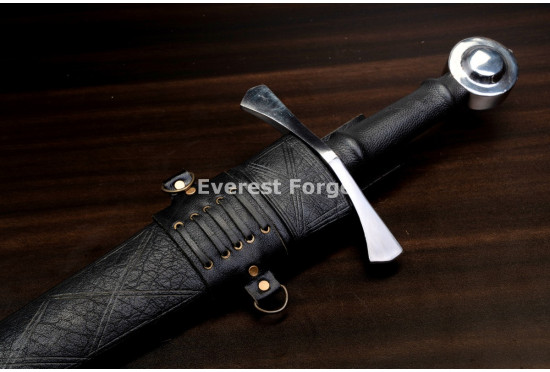
The hilt is the whole point of the type. A straight steel cross with broad flared terminals, a black leather-wrapped grip over a shaped core, and a large polished wheel pommel with a raised domed boss on both faces. Put it beside a knightly arming sword and the furniture is the same design at two thirds the scale, which is exactly how these were made and worn. Everything below sets out how it is built, what the decoration is, and what it will and will not do.
An honest note. This is a historically informed dagger rather than a copy of a specific find. The hilt furniture is orthodox for a 14th to 15th century quillon dagger and we are comfortable saying so. Two things are ours. The blade is 17 inches, which is at the very top of the range for the type and beyond most surviving examples. And the etched foliate panel is a decorative choice by the workshop, applied in a modern acid etch rather than by any medieval method; period blade decoration of this kind exists, but it was inlaid, engraved or latten-filled, and it did not look like this. If you want a plain blade we will forge one at no extra cost, and if you want the piece shorter and closer to the historical proportion we will do that too.
Please check your local law before ordering. This is a double-edged fixed blade of 17 inches, and both facts carry legal weight. A great deal of knife legislation treats double-edged daggers as a restricted category in their own right, independent of size, and blade length thresholds then apply on top. At 17 inches this piece sits above ordinary knife allowances almost everywhere and may be regulated as a sword or a bladed weapon rather than as a knife. Import rules frequently differ from possession and carry rules, so check all three for your own address. We ship worldwide but we cannot advise on your jurisdiction. If the second edge is the obstacle, we will sharpen one side and leave the other blunt at no extra cost, and a shorter blade brings the piece back inside far more allowances.
Want It Matched to a Sword?
Quillon daggers were made as companions to arming swords, with the same cross, grip and pommel at smaller scale. Send us the sword you own or the one you want and we will forge the pair to match.
Start a Custom Build →Why This Dagger Is Built the Way It Is
Full Specifications
Blade length, blade finish, blade decoration and grip material are selectable on this listing. The figures above describe the standard build as photographed; what you receive will match the options you choose at checkout. Small variations in weight, dimension and finish are normal in hand-forged work.
Build It Your Way
Every option below is forged to order in the same workshop. None of them is a part bought in and fitted afterwards.
What This Dagger Does Well, and What It Does Not
What It Is Good At
- Display. At 24 inches with a mirror polish, an etched blade and a brass-chaped scabbard it carries a wall on its own
- Pairing with a sword. The hilt is orthodox knightly furniture and will sit convincingly beside an arming sword
- Thrusting, which is what the broad forte, the long even taper and the fine point are all for
- Handling. The peened wheel pommel puts real mass behind the hand, so a long blade does not feel nose-heavy
- Costume, film and LARP work, where the silhouette reads as medieval instantly
What It Is Not Good At
- Strict reenactment. The length is beyond most surviving examples and the etch is not a period technique
- Utility work. A double-edged thrusting blade cannot be gripped by the spine or used against a board
- Low maintenance. A mirror polish on high-carbon steel is the most demanding finish we sell
- Carry. At 17 inches it will fall outside ordinary knife allowances in most jurisdictions
- Chopping, batoning or prying. The point is fine by design and it will bend if you lever with it
How to Order a Custom Dagger
Prefer a Different Dagger Tradition?
We forge the bollock hilt in both its period and modern forms, and a range of working fixed blades besides. If the cross-and-pommel hilt is not what you are after, there is plenty else on the bench.
See the Bollock Daggers →Who This Dagger Is For
- Collectors of medieval arms who want the knightly hilt in dagger scale rather than another sword
- Sword owners looking for a companion piece that matches the furniture on a belt
- Display and interior buyers who want a decorated blade rather than a plain one
- Costume, film and LARP buyers who need a medieval silhouette with more blade than a period dagger gives
- Anyone commissioning a matched pair, since this hilt scales up onto a sword blade without redesign
It is not for you if you need strict historical accuracy for reenactment, in which case order it plain and shorter, or if you want something to carry and work with, in which case any of our single-edged knives will serve you better and be legal in more places.
What Is Included
- The hand-forged quillon dagger, sharpened and ready for display or use
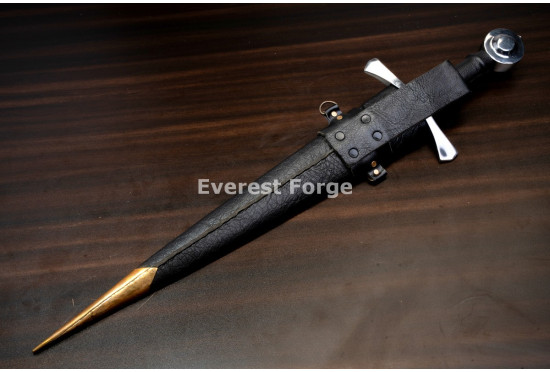
- A tooled black leather scabbard with a cast brass chape, riveted throat panel and twin ring suspension
- A certificate of authenticity from the workshop
- Care instructions for high-carbon steel and polished finishes
- Everest Forge manufacturer warranty against forging and material defects
Other Blades From the Everest Forge Workshop
Shipping, Returns and Care
Dispatch. Stock pieces leave the workshop within 2-3 business days. Custom builds take 4-6 weeks depending on the queue and the complexity of the work, and we will give you the honest date rather than an optimistic one.
Shipping. Tracked worldwide by DHL or FedEx, typically 7-14 business days in transit from Kathmandu. Customs paperwork is completed accurately and in full. At 17 inches and double-edged, this piece attracts more import scrutiny than an ordinary knife; please check your own country's rules before ordering.
Returns and warranty. Covered by the Everest Forge manufacturer warranty against defects in forging and materials. Custom builds made to your own specification cannot be returned for a change of mind, which is exactly why we confirm everything in writing first.
Care. A mirror polish on high-carbon steel needs more attention than any other finish we offer, and there is a great deal of polished surface here between the blade, the cross and the pommel. Skin is mildly acidic, so a fingerprint left on bare polished steel will etch a permanent mark into it within days. Wipe the blade down after every handling and keep a light film of oil on it in storage. Do not leave the dagger sheathed for long periods, because leather holds damp and its tanning agents attack bare steel. Feed the leather grip and scabbard with a leather conditioner once or twice a year, keeping it off the steel.
Quillon Dagger Questions Answered
What is a quillon dagger?
The quillons are the two arms of a cross guard, and a quillon dagger is simply a dagger built with one, in the manner of a sword rather than a knife. That sounds like a small distinction and it is not. Where a bollock dagger, a rondel or a baselard each have their own idiosyncratic hilt, the quillon dagger uses ordinary knightly sword furniture at reduced scale: a cross, a grip over a core, and a pommel peened onto the tang. It was the natural sidearm for anyone who already owned an arming sword, and matching pairs were made deliberately, with the same cross profile and pommel shape on both so they read as a set on the belt. The form runs from roughly the 13th century through to the end of the Middle Ages.
Who was Geoffrey de Mandeville, and is this his dagger?
No, and it is worth being clear about it because the name gets attached to daggers of this shape fairly often. Geoffrey de Mandeville was the 1st Earl of Essex, a genuinely notorious figure of the English civil war of the 1140s known as the Anarchy, who sacked Ramsey Abbey and was excommunicated for it. He died in 1144 and, being ineligible for burial in consecrated ground, his corpse was sheathed in lead and hung from a tree until the Templars interred him in the new Temple Church in London, where his effigy still lies among the knights. He is a superb story and no connection to this piece. His arms would have been mid 12th century: a broad blade of even width and a brazil-nut pommel, not a wheel pommel and an acute taper, which are features of the two centuries after him. We use the correct name for the type instead.
How does this compare with your two bollock daggers?
Three long medieval daggers, separated by hilt rather than by blade. The Bollock Dagger, Fluted Pommel is the period piece: 13 inches, guarded by two lobes carved from the same block of timber as the grip, no cross and no pommel cap. The Bollock Dagger, Steel Lobed Hilt is the fantasy build of the same form at 17 inches, with the lobes forged in polished steel. This one is the knightly alternative: a true cross guard, a leather grip over a core and a wheel pommel, which is a completely different tradition of hilt rather than a variation on the same one. Choose by what you want it to sit beside. If it is going next to a sword, take this. If you want the distinctively medieval civilian dagger, take a bollock. If accuracy is the priority, take the period bollock.
What does the wheel pommel do, and how is the hilt held together?
Structurally, the pommel is the most important component in the whole hilt, and most buyers assume it is ornament. The tang runs the full length of the dagger, passes through the guard, through the grip core and then through a hole in the pommel, and the last portion is heated and hammered over at the butt to form a peen. That peen draws every component down tight against the shoulders of the blade and locks guard, grip and pommel into a single rigid unit under compression. Nothing is glued and nothing relies on friction. It is also why a loose pommel is the classic failure on a sword-hilted piece: once the peen slackens the whole hilt begins to rattle, and it cannot be fixed with adhesive. The buyer's test is to look at the top of the pommel in any seller's photograph. You should be able to see the peen block, a small button of hammered steel sitting proud. If the butt is perfectly smooth with no peen visible, the tang probably stops short and the pommel is threaded, pinned or glued on.
How is the leather grip built, and will it wear out?
It is not solid leather. Underneath there is a wooden core, cut in two halves, hollowed to fit the tang exactly and glued around it, then shaped to the hand and finally covered in leather stretched over and closed along one side. That is the standard construction for a sword grip and it has been for a thousand years, for two reasons. A shaped core can be given a waist and an oval section that solid material cannot easily hold at this thinness, and the covering is a wearing surface separate from the structure. The leather will eventually darken, polish and, after years of handling, wear through at the high points. When it does, it can be stripped and recovered without touching the core, the tang or the peen. A solid one-piece grip offers no such option: when it splits, the hilt comes apart.
What is the etched panel on the blade, and can I have it plain?
It is a running foliate scroll, leaves and tendrils repeating down a panel on the flat of each face, produced by acid etching. Yes, you can have it plain, at no extra cost, and a fair number of buyers do. Two things are worth knowing. First, the panel sits on the forte, the lower third of the blade nearest the guard, where the steel is at its thickest and widest. That is not accidental: decoration wants to be well clear of the edges and well clear of the last few inches where the blade is thinnest and doing the most work. Second, this is a modern technique. Medieval blades of this class certainly carried decoration, but it was inlaid wire, latten filling or cut engraving, and none of it looks like an etched panel. We say so on the page rather than implying a provenance the finish does not have.
Is a mirror polish hard to look after?
Yes, and it is the single thing most likely to disappoint you if nobody warns you first. A mirror polish is not a coating; it is the bare steel surface taken through progressively finer abrasives until the scratch pattern is too small to scatter light. That means there is nothing at all between the steel and the air. Human skin is mildly acidic, so a fingerprint left on a mirror-polished carbon blade will etch itself permanently into the surface within a few days, and it cannot be wiped off afterwards, only polished out. Every mark shows, because a mirror shows everything. If the dagger is going on a wall and you enjoy maintaining it, the polish is the most beautiful finish we do and it displays the etched panel far better than anything else. If you would rather own it than tend it, order the satin finish, which costs the same and hides handling almost entirely.
Is it sharpened on both edges, and how is the blade ground?
Both edges as standard. The blade is broad at the forte and tapers evenly all the way to the point rather than running parallel and then dropping to a tip, which keeps mass and stiffness where the leverage is greatest and puts fineness only in the last few inches. Ground for thrusting first and cutting second, which is what the type was for. At 920 grams over 17 inches this is a noticeably heavier blade per inch than our bollock daggers of the same length, and that is the broader forte accounting for itself rather than a heavier steel or a thicker stock. If a double edge is a problem where you live, we will sharpen one side and leave the other blunt at no extra cost, and the piece looks identical.
Is a blade this long legal where I live?
We cannot answer that for you, and you should be wary of any seller who claims they can. Two separate provisions tend to apply. A great many jurisdictions treat double-edged daggers as their own restricted category regardless of size, and blade length thresholds then apply independently on top of that. At 17 inches this sits above the ordinary knife allowance almost everywhere, which means it may be regulated as a sword or a bladed weapon rather than as a knife, and import rules are frequently different again from possession and carry rules. Check all three for your own address before ordering. If length is the obstacle, an 11 or 13 inch build costs no more and is closer to the historical proportion anyway.
Is this historically accurate?
The hilt is orthodox and the blade is not. A straight cross with flared terminals, a leather grip over a shaped core and a peened wheel pommel with a raised boss are all correct for a 14th to 15th century quillon dagger, and the construction is the period construction rather than a modern imitation of it. What is ours is the 17 inch length, which exceeds most surviving examples of the type, and the acid-etched panel, which is a modern decorative technique. Order it plain and at 11 or 13 inches and you have something a reenactor could carry without argument, at no extra cost. Order it as photographed and you have a handsome display piece that is honest about which parts are which.
What steel is it, and how is it heat treated?
5160 high-carbon spring steel, the same stock our smiths use for kukris and swords, forged down from leaf spring in the Nepali tradition. It is oil-quenched and then tempered back, producing a blade that holds an edge but stays tough rather than brittle. Toughness matters particularly on a long thrusting blade, because a thrust that lands off-line loads the blade sideways, and that is precisely the case where a hard, brittle steel snaps and a properly tempered one flexes and returns. It is not stainless and it will take a patina with use.
Will my dagger look exactly like the photographs?
Close, but not identical, and that is the nature of forged work. The blade profile is drawn out by eye against a pattern, the taper is ground by hand, the cross is forged and filed individually, the grip core is carved to its own tang, and no two peens are formed the same way. The etched panel is masked and applied by hand, so its position will vary slightly along the blade. What does not vary is the specification: length, steel, construction, heat treatment and sharpness are held to the same standard on every piece. Our kukri machete page sets out in more detail what can and cannot differ between two blades from the same bench.
| Specification | |
| Blade: | 17 inches. Hand forged from 5160 carbon steel |
| Total Length: | 24 inches |
| Handle: | 7 inches with a 4.5 inch grip, full-length tang peened over the pommel, straight steel cross with flared terminals, black |
| Weight: | 920 grams the dagger, 1180 grams with the scabbard |
| Note: | handmade variation in weight, dimensions and finish may occur; keep blade lightly oiled when not in use |