Menu
Your Cart

Hand-Forged Medieval Dagger, Cord-Wrapped Grip

Hand-Forged Medieval Dagger, Cord-Wrapped Grip
$224.99
Ex Tax: $224.99
  • Model: Hand forged Dagger
  • Product Code: DAGGER14KO
  • Location: Kathmandu,Nepal

Available Options

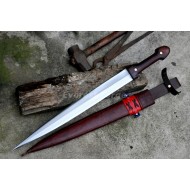
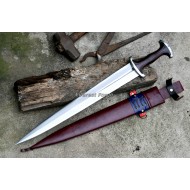
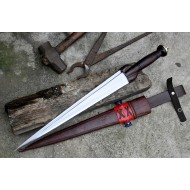
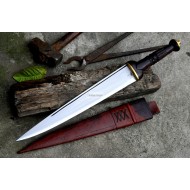
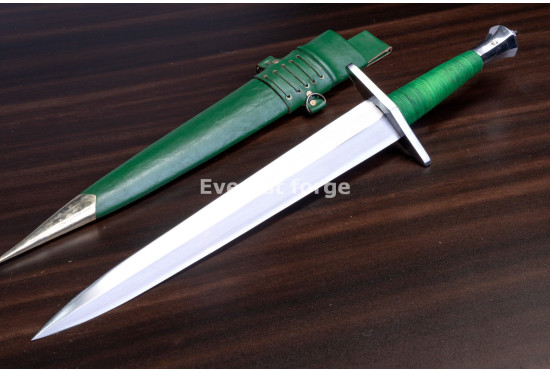
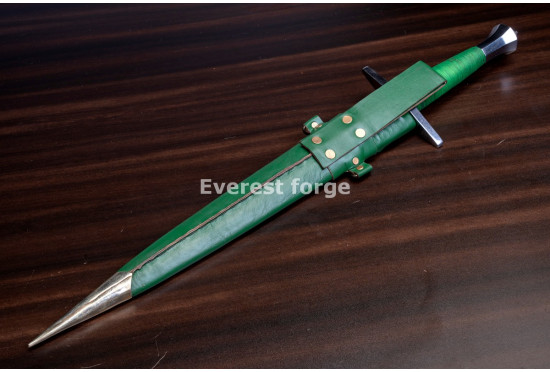
A Hand-Forged Medieval Dagger With a Cord-Wrapped Grip and Green Leather Scabbard

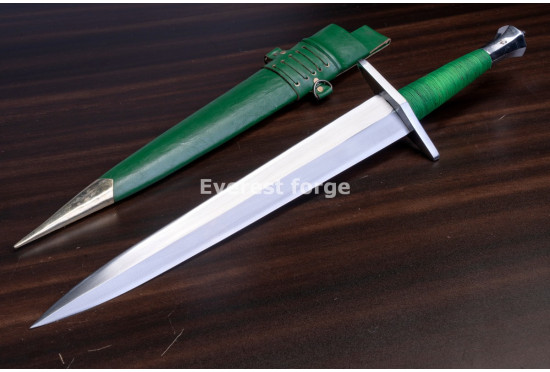
This is a 14 inch hand-forged medieval dagger of the quillon type: a double-edged blade with a raised medial ridge running its full length, a straight steel cross, a cord-wrapped grip and a faceted steel pommel. Overall length is 20 inches and it weighs approximately 640 grams, which is heavier than most daggers and puts it at the upper end of the medieval range — a sidearm rather than a belt knife. The blade is forged from 5160 high-carbon steel, oil-quenched and tempered, and it ships in a green leather scabbard with a polished steel chape and a laced belt frog. Made to order in Tokha-3, Kathmandu, Nepal.

An honest note. At 14 inches of blade this is a long dagger. Surviving medieval quillon daggers run roughly ten to sixteen inches, so it sits inside the historical range, but it is at the top of it — and past about sixteen to eighteen inches a piece stops being a dagger in any useful sense and becomes a short sword. If you want something you can wear discreetly on a belt all day, ask us for a ten or eleven inch blade on the same hilt. If you want it longer than sixteen, be aware you are ordering a sword and it should be built as one, with a longer grip to match.

Made to your specification

Have This Dagger Forged Your Way

Blade length, wrap colour, pommel form and scabbard dress are all decided at the forge before your piece is made. Send a sketch or a description and our smiths will quote it.

Start a Custom Forge Order →

Why This Dagger Is Built the Way It Is

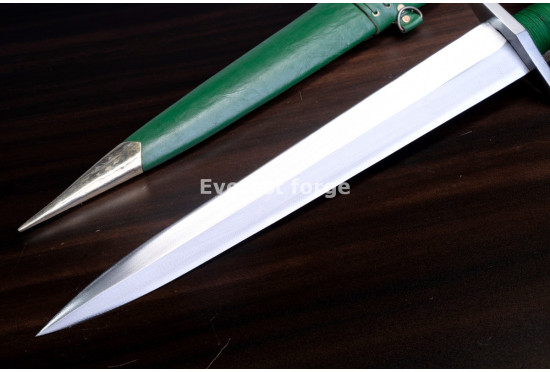
A Stiff Blade, Not a Thin OneThe medial ridge runs from the cross to within an inch of the point, giving a flattened diamond section. That ridge is what keeps a long narrow blade from flexing, which is the whole point of this pattern.
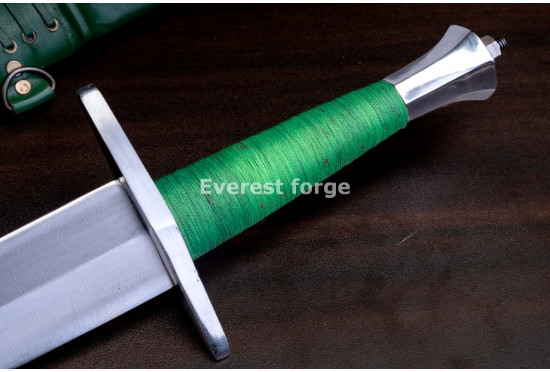
A Grip You Can Actually HoldCord laid on in a tight continuous wrap over a shaped core. It gives the hand something to bite into, it does not go slick, and it can be stripped and re-wrapped in an evening if it ever wears.
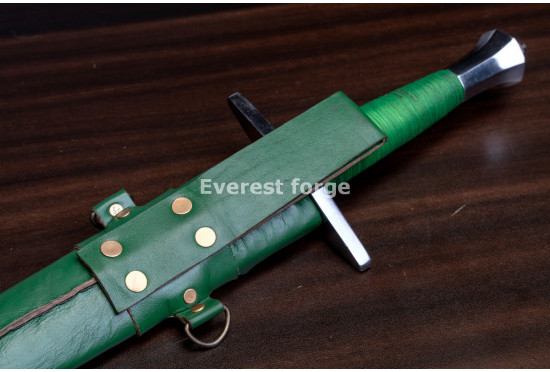
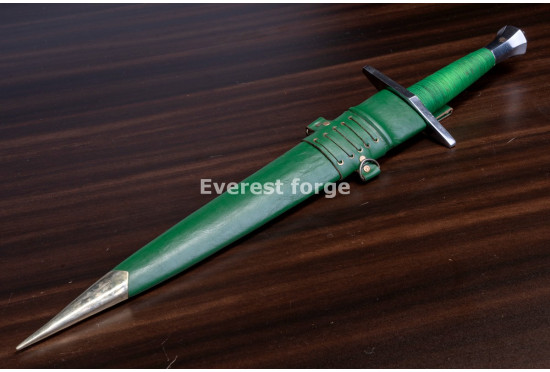
Dressed, Not Just FinishedGrip and scabbard are dyed to match in green, with a polished steel chape and a laced frog. Medieval daggers were coloured objects, and this one is built as one rather than left plain brown.

Specifications

Blade Length14 inches
Handle Length6 inches, of which 4 inches is grip
Overall Length20 inches
Blade Steel5160 high-carbon spring steel, oil-quenched and tempered
Blade ProfileDouble-edged, long even taper to an acute point
Blade SectionFlattened diamond with a raised medial ridge running the full length
GuardStraight steel cross with squared terminals
GripCord wrapped over a shaped core
PommelPolished steel, faceted and flaring
Standard BuildSatin blade, green cord and green scabbard — size and finish are selectable above
ScabbardGreen leather with polished steel chape and laced belt frog
WeightApproximately 640 grams for the dagger, 790 grams with the scabbard
OriginHand-forged in Tokha-3, Kathmandu, Nepal

Build Options

Blade LengthTen or eleven inches for a dagger you can wear all day, or the fourteen shown. Past sixteen inches we will build it as a short sword with a longer grip rather than pretend it is still a dagger.
Wrap ColourGreen as shown, or oxblood, black, natural, blue or a two-colour wrap. The scabbard is dyed to match whatever you choose.
Wrap MaterialCord as shown, or leather over cord, or a plain leather wrap. Cord under leather is the historically common build and gives the most secure grip of the three.
Pommel FormThe faceted pommel shown, a plain wheel, a scent-stopper, or a fishtail flare. All are forged and fitted in the workshop.
Blade FinishSatin as standard. Mirror polish, dark forge finish or a stonewashed working finish are all available without changing the geometry.
Matching SwordThe same cross, pommel, wrap colour and scabbard dress on an arming sword, so the pair reads as a set. This is one of the better things we make.

Is This the Right Dagger for You?

Buy This If You Want

  • A long medieval dagger with a stiff, properly sectioned blade rather than a flat ground strip
  • A piece that is dressed as a set — grip, scabbard and fittings matched, not assembled from whatever was on the bench
  • A grip you can hold in a reverse or forward hand without it turning
  • Something that will hang correctly on a belt with the frog and lacing already fitted
  • A companion piece to an arming sword, built to match it

Look Elsewhere If You Want

  • A utility or camp knife — a double-edged dagger is the wrong tool for cutting rope, preparing food or working wood
  • A short concealable blade; at 20 inches overall this is a visible sidearm
  • A stainless blade needing no care, since 5160 is carbon steel and will rust if left wet
  • A sparring or HEMA trainer, which needs rolled edges and a rebated point
  • A ring-pommel quillon dagger, which we build as a separate piece
Fifteen years at the anvil

Dagger and Sword, Built as a Pair

Matching a dagger to a sword — same cross, same pommel, same wrap and the same hide for both scabbards — is straightforward for us and almost nobody offers it. Ask us to quote the pair.

Talk to the Forge →

How to Order

Choose your blade length and finish from the options above the description.
Note your wrap colour, wrap material and pommel form in the order comments.
We confirm the build by email and start forging. Custom work takes four to six weeks.
Your dagger ships tracked by DHL or FedEx and arrives in seven to fourteen business days.

Who This Dagger Is For

  • Collectors of medieval arms who want a dagger built to the right section and proportions rather than a decorative copy
  • Re-enactors and living history groups who need a piece that hangs and looks right in kit
  • Film, stage and photography armourers looking for a blade that reads clean and strong on camera
  • Anyone who already owns an arming sword and wants a dagger dressed to match it

What Is Included

  • One hand-forged medieval dagger, sharpened and ready
  • Fitted green leather scabbard with polished steel chape and laced belt frog
  • Certificate of hand-forging from the workshop
  • Everest Forge manufacturer warranty against defects in forging and heat treatment

Explore the Collection

Quillon Dagger, Ring PommelA 13 inch dagger with a ring pommel →
Medieval Sword, Oakeshott Type XIIThe sword to match a dagger to →
Medieval Arming Sword, Celtic KnotworkSingle-hand, green wrap and scabbard →
Bowie Knife, Crossguard HiltA large single-edged working knife →

Shipping, Returns and Care

Stock pieces are dispatched within two to three business days. Custom builds take four to six weeks at the forge before they ship. Everything travels tracked with DHL or FedEx and typically arrives in seven to fourteen business days. Every piece carries the Everest Forge manufacturer warranty against defects in forging and heat treatment.

Double-edged blades are restricted in some countries and in some states and provinces within them, and the rules for a double-edged dagger are often stricter than for a single-edged knife of the same length. It is your responsibility to check that this piece may lawfully be imported and possessed where you live before ordering, because a parcel seized by customs cannot be returned to us and cannot be refunded. Ask us before you buy if you are unsure and we will tell you what we know about your destination.

5160 is a high-carbon steel and it will rust if it is left wet or stored damp. Wipe the blade dry, keep a light film of oil on it, and do not store the dagger in the scabbard for long periods, because leather holds moisture against steel. The cord wrap can be wiped with a barely damp cloth; do not soak it.

Frequently Asked Questions

What kind of dagger is this?

It is a quillon dagger, which is the medieval dagger built like a sword in miniature: a straight cross between blade and grip, a pommel at the end of the tang, and a symmetrical double-edged blade. The name simply comes from the quillons, the two arms of the cross. It is the type a knight would have worn alongside his sword, and it is usually the plainest of the medieval dagger forms because it takes its design language from the sword rather than developing one of its own. We have listed it as a medieval dagger rather than a quillon dagger because we build a second quillon dagger with a ring pommel and we did not want the two competing under the same name. If you are searching for a quillon dagger, you have found one.

Why are the grip and scabbard green?

Because medieval arms were coloured, and modern reproductions almost always are not. Surviving accounts, inventories and manuscript illustrations describe scabbards and grips in red, green, blue, white and black, and the dyes to do it were ordinary trade goods — weld and broom for yellows, woad for blue, and the two overdyed for green, which is why green appears so often. Colour also did work: it marked a livery, a household or a retinue, in the same way a uniform does now. The reason nearly every reproduction dagger you can buy is brown is that undyed vegetable-tanned leather is the cheapest thing to finish, not that brown is authentic. Ours is dyed green through the grip cord and the scabbard together so the piece reads as a dressed object rather than a bare blade with a cover.

Why a cord wrap instead of leather?

Cord is the underlayer of a proper grip, and here it is left exposed. The historically common build is a wooden core, cord laid over it in a tight continuous winding, and then leather stretched over the whole thing while damp so it shrinks down and locks into the ridges the cord makes. That is why the grips on many surviving swords and daggers show a fine spiral texture through the leather. Leaving the cord bare gives you the grip and the texture without the outer layer, and it has one real practical advantage: when a wrap eventually wears, cord can be stripped and rewound in an evening with nothing more than a spool and a little glue at each end, whereas a fitted leather cover has to be cut and stretched again. If you want the full historical build, ask for leather over cord and we will do it that way.

What is the metal tip on the scabbard for?

That is the chape, and it is not decoration. The point of a blade sits at the narrowest part of the scabbard and every time the dagger is drawn or sheathed the tip drags across the same small area of leather. Without protection it wears through in a season of real use and then the point comes out of the bottom of your scabbard, which ruins the scabbard and is genuinely dangerous if you are wearing it. A metal chape takes that wear instead. It also stiffens the tip so the scabbard keeps its shape rather than collapsing, and on a piece worn at the hip it stops the point catching on things as you move. Surviving medieval chapes are found in brass, bronze, iron and silver, and they are one of the commonest metal finds from the period precisely because they outlast the leather they were fitted to.

What does the medial ridge do?

It stops the blade flexing. A dagger blade is long, narrow and tapered, which is exactly the shape that wants to bend, and a flat-ground blade of this length would spring noticeably in the hand. Raising a ridge down the centre and grinding the bevels away from it puts the thickest steel along the spine of the blade, on the axis where bending stress is highest, and gives you the flattened diamond section this blade has. The result is a blade you can put weight behind without it whipping. It is also why the section is right for a dagger and wrong for a chopping knife: a diamond section is stiff but it wedges in a cut rather than slicing cleanly through, which is a fair trade on a weapon and a bad one on a tool.

What steel is it, and how is it heat treated?

5160 high-carbon spring steel, brought to temperature in the forge, quenched in oil and then tempered back so the edges are hard while the body of the blade stays springy. This steel is the traditional stock of Nepali forges because it is tough, it takes a good edge and it forgives a hand sharpening. It is not stainless. That is deliberate: stainless grades that genuinely resist rust tend to give up toughness, and on a long thin double-edged blade toughness is the property that matters most.

How sharp does it arrive?

Both edges are put on by hand at the forge and it arrives sharp and ready. If you want it blunt — for display, for a gift, for stage work, or because of the rules where you live — say so in the order comments and we will ship it unsharpened at no extra cost. We can also rebate the point at the same time. What we cannot do is turn it into a sparring trainer, which needs a thicker rolled edge and a proper flared and blunted tip designed from the start.

How is this different from your Quillon Dagger, Ring Pommel?

They are the same family and worth comparing properly. The ring-pommel dagger has a 13 inch blade, a polished steel ring at the end of the tang, a leather-wrapped grip and a tooled brown scabbard with a laced throat. This one has a 14 inch blade, a faceted flaring pommel, a bare cord wrap and a green scabbard with a steel chape. Both are quillon daggers, both carry a raised medial ridge, and both come out at 20 inches overall. The practical difference is the pommel: a ring gives you somewhere to put a finger or a thong and is the more unusual fitting, while a faceted pommel is the plainer knightly form and sits more comfortably against the heel of the hand in a reverse grip. Choose on which pommel you want to look at and hold. If you want a matched sword-and-dagger set, this one is easier to match because its fittings are conventional.

Is it full tang?

The tang runs the full length of the hilt and the pommel is fitted over it at the end, which is through-tang construction rather than the slab-and-rivet full tang you see on a working knife. That is the correct build for this pattern — a cross, a wrapped grip and a fitted pommel all have to sit on a narrow tang for the hilt to look and handle the way it should. It is not a weaker arrangement when it is done properly, because the cross and pommel clamp the grip core between them and the whole hilt works as one piece under compression. If you would prefer a visible full tang with riveted scales, that is a different hilt design and we would build the dagger around it from the start.

Can you make it shorter?

Yes, and for a lot of buyers we would suggest it. Ten to eleven inches of blade is the sweet spot for a dagger you will actually wear: it hangs properly on a belt, it does not foul when you sit down, and it is closer to the middle of the historical range rather than the top of it. The hilt stays the same, the scabbard is cut to the new blade, and the price moves only a little. Fourteen inches is the right choice if the piece is going on a wall or into a kit where presence matters more than convenience.

Can you match it to a sword?

Yes, and it is the order we most enjoy taking. The same cross profile, the same pommel form, the same colour and material of wrap, and both scabbards cut and dyed from the same hide, so the two pieces read as one set instead of two purchases. Historically that is how they were worn — the dagger was the sword's companion, hung on the same belt, and often dressed to match it. Tell us which sword you have or want, or send a photograph of one you already own, and we will quote the pair or quote the dagger dressed to match a sword you already have.

Where is this made, and by whom?

In our own workshop in Tokha-3 on the northern edge of Kathmandu, Nepal, by around ten smiths, most from families that have forged blades for generations. Everest Forge has operated since 2010. We forge, grind, heat treat, fit and do our own leatherwork in the same building — we do not buy in finished blades and put our name on them. It matters practically as well as commercially: when you ask for a green wrap and a fishtail pommel, the person reading your message can walk to the bench and ask whether it can be done this week.

Specification
Blade: 14 inches. Hand forged from 5160 carbon steel
Total Length: 20 inches
Handle: 6 inches (4 inch grip). Through tang with cord wrapped grip, steel cross and faceted steel pommel
Weight: approx 640g dagger, 790g with scabbard
Note: Some variation in weight, dimensions and finish may occur as each piece is hand forged. Keep the blade lightly oiled when not in use

Write a review

Note: HTML is not translated!
Bad Good
Captcha