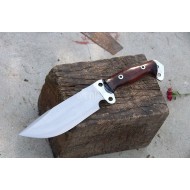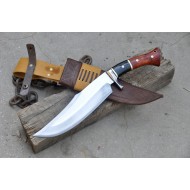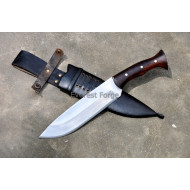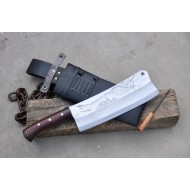
- Model: Hunting and survival knife
- Product Code: KARAMBIT007
- Location: Kathmandu, Nepal
Available Options
A Hand-Forged Karambit With a Full Tang and Ring Pommel
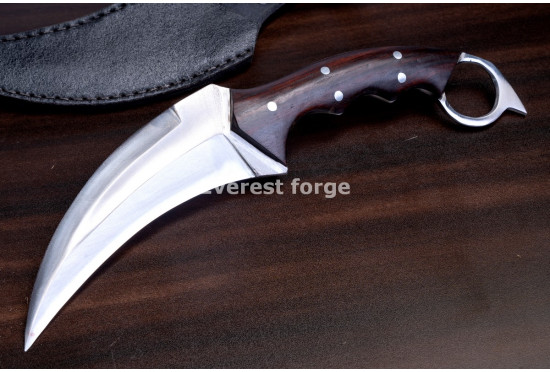
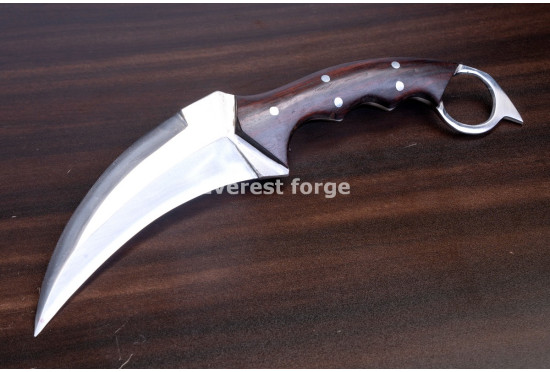
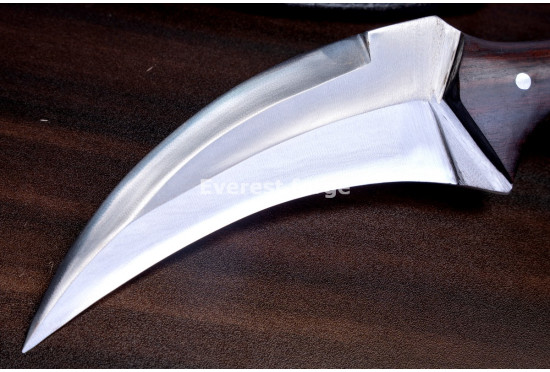
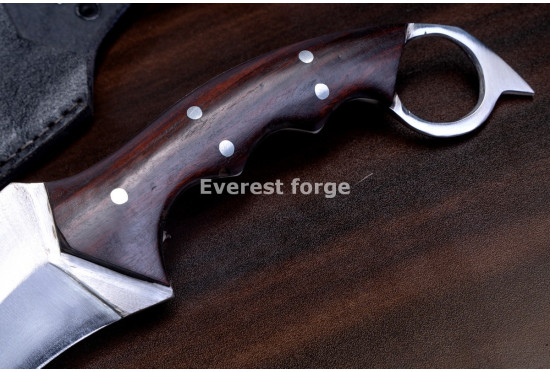
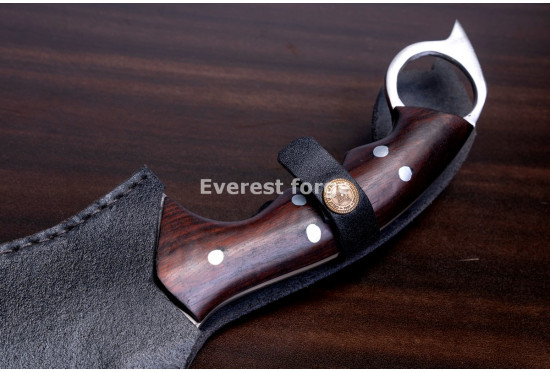
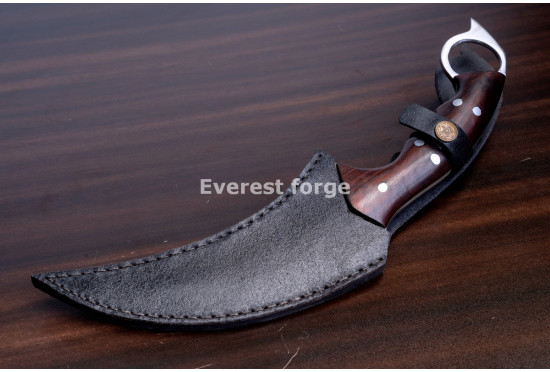
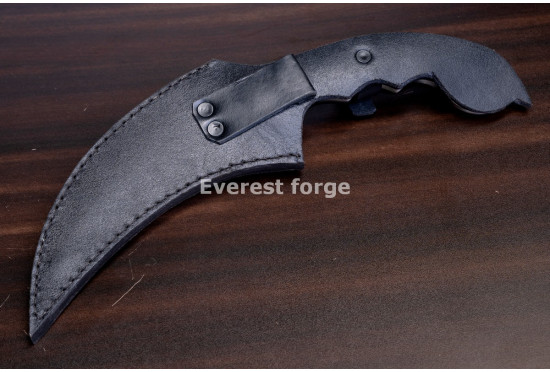
This is a karambit, hand-forged in Tokha-3, Kathmandu, Nepal from 5160 high-carbon steel, oil-quenched and tempered. The blade runs 7 inches, curving hard forward into a talon profile with the edge carried on the inner curve and a faceted step worked into the grind where the blade meets the ricasso. The handle is 7 inches with a 5.5 inch grip: rosewood scales riveted through a full-width tang, finger grooves cut into the underside, and a polished steel ring at the butt finished with a spur. Overall it stands 14 inches. It ships sharpened, in a fitted black leather sheath.
An honest note. This is a large karambit and it is worth knowing that before you buy. A traditional Indonesian kerambit carries two to four inches of blade — it began as a farming tool for raking roots and threshing, small enough to be worn on a cord, and it is still made that size in Sumatra and Java today. At 7 inches this is a modern interpretation at roughly double historical scale, which makes it a striking piece and a capable one but not a reproduction. Second, and more practically: the karambit is one of the most heavily restricted knife shapes in the world, and more places regulate it specifically than regulate an ordinary fixed blade. Please read the shipping section before you order.
Want a Traditional-Scale Kerambit?
Our smiths will forge a 2 to 4 inch blade at historical proportions, with a plain ring, a cord-wrapped grip and a traditional sheath — or build to a specific regional pattern from Sumatra, Java or the Philippines. Send a reference and we will quote it.
Start a Custom Build →Why This Karambit Is Built the Way It Is
Full Specifications
How You Can Configure It
Is This the Right Knife for You?
Buy This If You Want
- A forged full-tang karambit rather than a folder or a stamped blank
- A ring pommel forged as part of the tang, not pinned on afterwards
- Real 5160 with a proper heat treatment
- A striking display and collection piece with genuine hand work in it
- Grip geometry that indexes the edge absolutely, ring plus finger grooves
- The option of a traditional-scale kerambit built to order
Look Elsewhere If You Want
- A traditional kerambit — those run 2 to 4 inches, and we build them
- To carry it — check your local law first, this shape is widely restricted
- A general-purpose utility knife; a hooked blade is poor at ordinary tasks
- A folding karambit; this is a fixed blade with a belt sheath
- A stainless blade that needs no oiling or care
- Identical units; every piece is forged by hand and varies slightly
How to Order
Who This Karambit Suits
- Knife collectors who want a forged fixed-blade karambit rather than the folders that dominate the market.
- Silat and martial arts practitioners in jurisdictions where training with a live blade is permitted, or wanting a display piece alongside a trainer.
- Display buyers after a blade with an unmistakable silhouette.
- Collectors of Southeast Asian arms filling the Indonesian and Malay slot.
- Anyone commissioning a traditional kerambit who wants to see the workshop's hand at a larger scale first.
What Is Included
- One hand-forged karambit, sharpened and ready to use
- Fitted black leather sheath
- Care and oiling instructions
- Everest Forge manufacturer warranty against defects in forging and heat treatment
Other Hand-Forged Blades
Shipping, Returns and Care
Shipping and legal restrictions — please read this before ordering. The karambit is one of the most heavily regulated knife shapes in the world. A number of countries and regions restrict or prohibit knives with finger rings, curved or hooked fixed blades, or both, specifically and by name, and the rules differ from those covering ordinary fixed-blade knives. We cannot advise you on the law where you live, and we are not able to check it for you. Please confirm what applies at your delivery address before you order, because a shipment refused or seized at customs is not something we can recover or refund. If you are unsure, contact us before ordering and we will tell you what we know about shipping to your country. Standard builds dispatch in 2 to 3 business days; custom builds take 4 to 6 weeks. We ship worldwide by DHL or FedEx, 7 to 14 business days, fully tracked.
Returns. Standard builds can be returned unused and in the original sheath within 30 days. Custom builds, altered dimensions and etched pieces are made to your specification and cannot be returned unless there is a fault in forging or heat treatment. Orders refused at customs for legal reasons cannot be refunded, which is why we ask you to check first.
Care. 5160 is a high-carbon steel and it will rust if you neglect it. Wipe the blade dry after use and keep a thin film of oil on it in storage. The inside of the curve is the spot a cloth skips over entirely on a blade shaped like this, so reach into it deliberately with a corner of cloth. Pay attention to the seam where the scales meet the tang and to the rivet heads, and dry the inside of the ring, which traps moisture against steel. Rosewood scales want a light coat of hard wax or furniture oil once or twice a year. Never store it sheathed wet.
Frequently Asked Questions
Is a karambit legal where I live?
We cannot answer that for you, and any seller who tells you a karambit is fine everywhere is either guessing or not being straight with you. What we can tell you is why this shape attracts more attention than most. Legislation in many jurisdictions singles out knives with finger rings, sometimes grouped with knuckle knives and trench knives, and separately singles out curved or hooked fixed blades. A karambit has both features, so it can be caught by two different provisions at once even where an ordinary fixed blade of the same length would be unrestricted. The rules vary enormously — between countries, between states and provinces within a country, and between owning at home and carrying in public, which are almost always treated differently. Before you order, check the law at your delivery address. If you are unsure, contact us first and we will tell you what we know about shipping to your country. A parcel refused or seized at customs is money neither of us gets back.
What is the ring actually for?
Three things, and they compound. RETENTION is the obvious one: your index finger goes through the ring, so the knife is attached to your hand rather than held by grip strength alone. It cannot be dropped, pulled away or knocked loose, and it stays with you when your hands are wet or cold. ROTATION is the second and less obvious: because the knife pivots around the ring, you can spin it deliberately between forward and reverse grip, or let it hang from the finger to free your hand, and pick it up again without looking. The third is INDEXING, and it is the one we would argue matters most for ordinary use. A ring plus finger grooves means there is exactly one way the knife can sit in your hand, so you always know which way the edge is facing without checking. That is the same principle that makes a shaped knife handle better than a round one, taken to its logical end — on a karambit the edge orientation is not just easy to feel, it is mechanically fixed.
Where does the karambit come from?
West Sumatra, most likely among the Minangkabau, and it started as a farm tool rather than a weapon. The kerambit was used for raking roots, cutting through matted growth, threshing and general agricultural work — the hooked blade pulls material toward you and the ring keeps the tool on your hand while both hands are busy. Its shape is usually described as being taken from a tiger's claw, and that reading is old enough to be part of the tradition whether or not it is literally the design origin. It spread across the Malay archipelago and into the Philippines, picking up regional variations along the way, and it became a weapon in the silat traditions of Indonesia and Malaysia, where it is used mainly in reverse grip. Historically these were small: two to four inches of blade, worn on a cord or tucked into a sarong. The large tactical karambit familiar from modern knife catalogues is a Western development of the last few decades and is not what a Sumatran farmer carried.
Why is this one so much bigger than a traditional kerambit?
Because it is built as a collection and display piece rather than as a reproduction, and at 7 inches the blade shows the talon profile and the faceted grind far better than a 3 inch blade would. That is an honest aesthetic choice rather than a functional one: nothing about the karambit's original job needs a blade this long, and a traditional kerambit is arguably the better tool for what the design was actually for. If you want historical proportions, our smiths will forge a 2 to 4 inch blade with a plain ring and a traditional sheath. It is one of the more satisfying small commissions we take, and it is a genuinely different object in the hand.
What steel is it and how is it heat treated?
5160 high-carbon spring steel, oil-quenched and then tempered back. 5160 takes a keen edge and bends under abuse rather than chipping, which matters on a hooked blade because the inside of a curve is a natural stress point. It is the steel family Nepali smiths have traditionally drawn from vehicle leaf spring, so our forge reads it by colour and by sound at the anvil. Every blade is inspected before it is packed, and if a piece reaches you with a fault in the forging or the heat treatment we will replace it or refund you.
Does it arrive sharp?
Yes. It ships with a working edge along the inner curve, sharpened by hand and ready out of the sheath. Sharpening a hooked blade is more awkward than a straight one, so it is worth knowing the technique before the edge needs work: you cannot lay it flat on a bench stone in the usual way, and most people use a round or tapered rod, a ceramic rod, or the corner of a stone, working the curve in short sections. If you want it blunted for display, ask in the order note before we ship.
Is the tang full length, and is the ring forged or welded?
The tang runs the full length and width of the handle with the rosewood scales riveted through it — you can see the rivet heads in the photographs. The ring is formed as part of the same piece of steel rather than being welded or pinned on afterwards, which matters more here than it might sound: the ring is the point through which every load on the knife passes back into your hand, so a ring joined to the tang by a weld is putting a joint at the single most stressed location on the whole piece. Forging it integral removes that failure point entirely. This is the main reason a forged karambit and a stamped one are different objects.
Is it any good as a working knife?
Honestly, not for general use, and we would rather say so. A hooked blade with the edge on the inside is excellent at anything you pull toward you — cutting cord, rope, webbing, seatbelts, matted vegetation, or opening packaging — and rescue workers use hooked blades for exactly that reason. It is poor at anything you push, slice flat, or need a point for: it will not carve, it will not prepare food comfortably, and it cannot be used flat against a surface. If you want one knife that does everything, take a straight fixed blade instead. If you want a blade that is superb at pull cuts and striking to look at, this is a good one.
Can I have a plain ring instead of the spurred one?
Yes. The spur is the small pointed projection off the ring on this build; it adds to the silhouette and gives the thumb something to register against. A plain ring is the traditional form, sits more comfortably against the hand over long handling, and is less likely to catch on clothing or a pocket. Both are available — say which you want when you order. If you are commissioning a traditional-scale kerambit we would generally suggest the plain ring, since that is what the historical pieces carry.
Is the sheath included?
Yes. A fitted black leather sheath comes with the knife, cut around this specific blade profile. A hooked blade is genuinely awkward to sheath safely — the curve means it cannot simply slide into a straight pouch — so the sheath is made around the piece rather than being generic. If you change the blade length on a custom build the sheath is made to the new dimensions.
How do I look after it?
Treat it like any high-carbon blade, with two spots that need deliberate attention rather than a general wipe. The inside of the curve is the first: a cloth passed along the blade bridges straight over it, so reach in with a corner of cloth every time. The inside of the ring is the second, because it traps moisture against steel and sits right where your hand sweats. Beyond that, wipe the blade dry after use, keep a thin film of camellia, mineral or light gun oil on it in storage, watch the seam where the scales meet the tang and the rivet heads, and give the rosewood a hard wax or furniture oil once or twice a year. Never store it sheathed wet.
Where is it made and by whom?
Hand-forged in Tokha-3, Kathmandu, Nepal, by our own smiths. Everest Forge is a working forge rather than a reseller putting a name on imported blanks — the steel is cut, drawn over the anvil, the ring formed, the blade quenched, tempered and ground, the scales shaped and riveted, and the sheath cut and stitched, all under one roof. Forging a ring integral with the tang is fiddly work and it is the part of this knife that most clearly separates a forged piece from a stamped one.
| Specification | |
| Blade: | 7 inches. Hand forged from 5160 carbon steel |
| Total Length: | 14 inches |
| Handle: | 7 inches total with a 5.5 inch grip, full-width tang with scales riveted through, finger grooves and a polished steel ring forged as part of the tang |
| Weight: | 610 grams approx, as shipped with the sheath |
| Note: | handmade variation in weight, dimensions and finish may occur; keep blade lightly oiled when not in use |