Menu
Your Cart

Hand-Forged Hunting Tanto Knife

Hand-Forged Hunting Tanto Knife
$144.99
Ex Tax: $144.99
  • Model: Hunting and survival knife
  • Product Code: TANTOO11
  • Location: Kathmandu, Nepal

Available Options

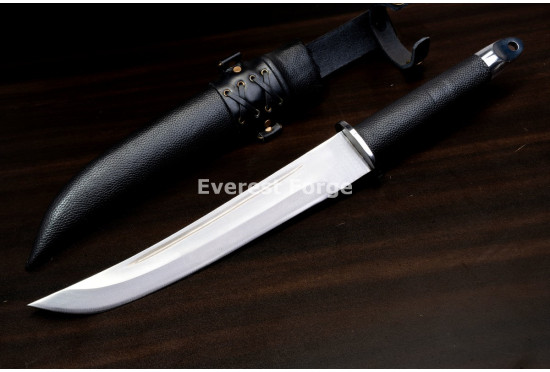
A Hand-Forged Hunting Tanto

This is an 11 inch tanto-form blade built for use rather than display. It weighs 510 grams, which over 11 inches works out at 46.4 grams per inch of blade — the lightest figure of anything we make, lighter than our bushcraft kukri and lighter than every dagger and chopper in the range. On a blade this long that is unusual, and it is the whole character of the piece: length and reach without the weight that normally comes with them.

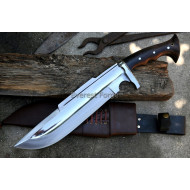
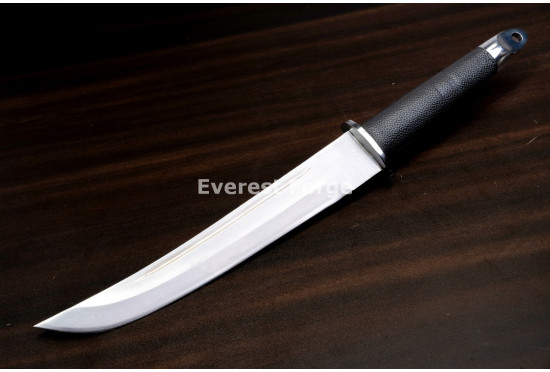
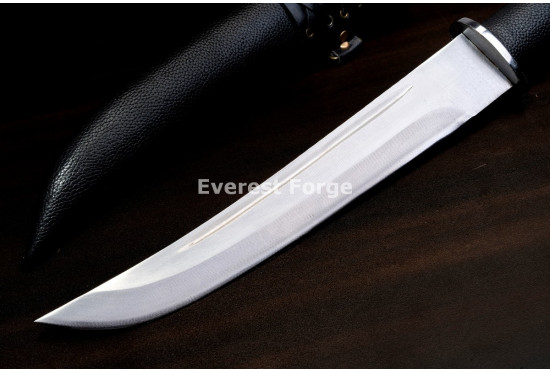
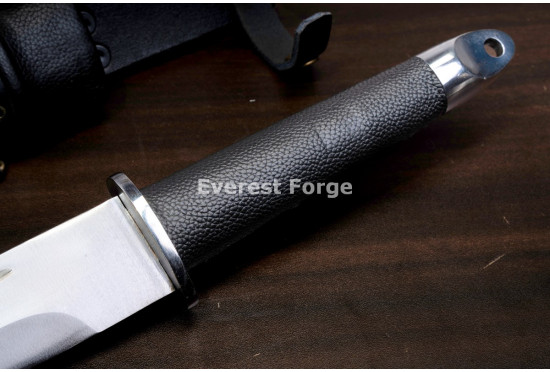
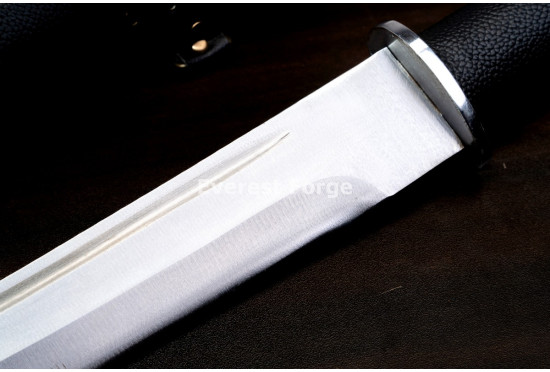
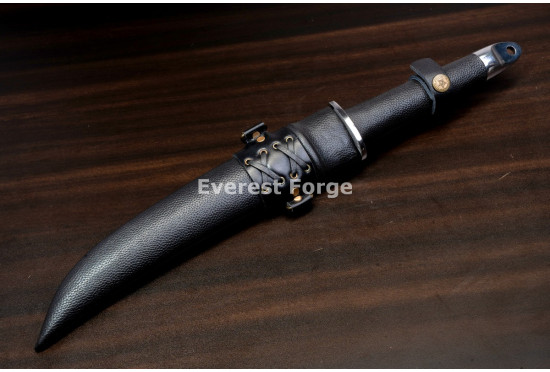
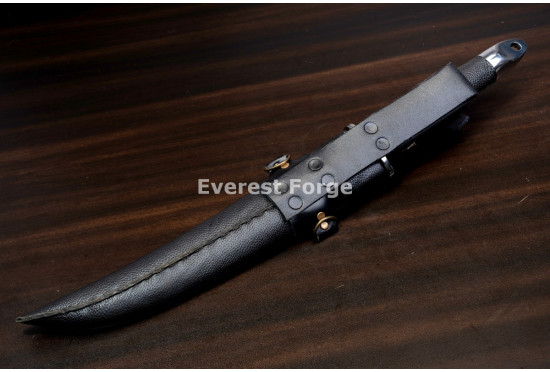
The blade is hand-forged from 5160 high-carbon steel, oil-quenched and tempered, with a long gentle curve running to a sweeping point and a shallow groove near the spine. A steel collar sits at the ricasso in place of a guard. The 7 inch grip — the longest we fit — is wrapped in textured black leather over the tang, closed with a polished steel pommel cap drilled for a lanyard. It ships in a black leather scabbard with a laced throat section and a snapped belt frog.

An honest note about the word tanto. It means two different things depending on who is using it, and buyers arrive expecting whichever one they know. In Japanese, tanto describes a length — a short blade, historically under about twelve inches — and says nothing at all about the shape of the tip. In the American knife trade since the 1980s, "tanto point" has come to mean a specific angular tip with a flat forward edge meeting the spine at a hard corner. This blade is the first kind, not the second. It has a long flowing curve to a sweeping point, not an angular chisel tip. If the angular point is what you are after, this is not it, and we would rather tell you now than have you open the parcel and find out.

Custom Forge

Want This Built Your Way?

An angular tanto point, a different blade length, another grip material, a shorter handle, or your own drawing entirely. Our smiths in Kathmandu forge to specification and quote before any work begins.

Start a Custom Build

What Makes It Work in the Field

Lightest Blade We Make46.4 grams per inch, below anything else in the range at any length. An 11 inch blade that carries like a much smaller one.
Long Sweeping PointA continuous curve to the tip rather than an angular corner. It slices along its whole length and enters cleanly, which is what field dressing actually asks of a blade.
Seven Inch GripThe longest hilt we fit. Room for a large or gloved hand, room to move your hold, and enough handle to get a second hand on for heavy work.
Wrapped LeatherTextured leather wrapped over the tang. It grips when your hands are wet or bloody, which is the condition that matters most on a hunting knife.
Steel Collar, No GuardA collar at the ricasso rather than a crossguard, so nothing projects to catch on a sheath, a pack or brush.
Lanyard PommelPolished steel cap drilled through. A wrist loop matters on a blade used wet, at odd angles, or over water.

Standard Build and Specifications

Blade Length11 inches
Handle Length7 inches
Total Length18 inches
Blade WeightApprox. 510 grams
Total WeightApprox. 660 grams
Blade Steel5160 high-carbon spring steel, oil-quenched and tempered
Blade ProfileTanto form — long curve to a sweeping point, single edged
Blade GrooveShallow groove ground near the spine
FinishPolished (standard build — selectable)
CollarPolished steel at the ricasso. No guard
GripTextured black leather wrapped over the tang (standard build — selectable)
PommelPolished steel cap with lanyard hole
ScabbardBlack leather with laced throat section and snapped belt frog
EdgeSharpened and ready to use
OriginHand-forged in Tokha-3, Kathmandu, Nepal

Blade length, blade finish and grip material are selectable, so the figures above describe the standard build rather than every version. Because each piece is forged, ground and wrapped by hand, weights and dimensions vary slightly between examples.

Build Options

Point ShapeThe sweeping curved point is standard. If you want the angular American-style tanto tip, with a flat forward edge meeting the spine at a corner, we will grind it — it is a genuinely different knife and worth deciding deliberately.
Blade Length11 inches as standard. Shorter is easier to carry and handle for close work; longer gives more reach at the cost of the lightness that defines this piece.
Grip MaterialWrapped leather as standard. Horn, rosewood, micarta and stacked leather are all available. Wrapped leather grips best when wet; micarta ignores humidity entirely.
Handle LengthSeven inches as standard, which suits large or gloved hands and allows a two-handed hold. If your hands are on the smaller side, say so and we will shorten it.
Blade FinishPolished as standard. Satin cuts glare and hides working marks, which many hunters prefer on a blade used in daylight around animals.
ScabbardBlack leather with frog as standard. Brown leather, a fixed belt loop, a dangler or a leg strap can all be fitted instead.

Is This the Right Knife for You?

Choose This One If

  • You want reach and blade length without carrying the weight that usually comes with it
  • You hunt, and want one blade that handles both field work and camp work
  • You have large hands, or work in gloves
  • You want a grip that holds when it is wet
  • You like the tanto form as a shape rather than as a tactical style

Look Elsewhere If

  • You want the angular American tanto point — ask us to grind it, because this is not that shape
  • You want a chopper — at 46.4 grams per inch this is built light, and our kukris hit far harder
  • You want a dedicated skinner — a deep-bellied game knife does that better, and our double chirra ships with one
  • You want low maintenance — wrapped leather needs care and must not be stored wet

How to Order

Decide Which Tanto You WantThe curved sweeping point is standard. If you were picturing the angular tip, tell us at the point of order — it cannot be reground once the blade is finished.
Choose Your BuildBlade length, handle length, finish, grip material and scabbard.
Check Your Local LawBlade laws differ by country, state and province, and an 18 inch package is restricted in some places regardless of what it is for. Check before you order — we cannot advise on your jurisdiction and we cannot refund a seizure.
We Forge and ConfirmStock builds dispatch in 2-3 business days. Custom builds take 4-6 weeks. We photograph the finished piece before it ships.

Who This Knife Is For

  • Hunters who want one long blade for dressing, camp work and clearing rather than a specialist for each
  • Anyone carrying a big knife all day — this is the lightest long blade we make and it shows by evening
  • People with large or gloved hands who find standard grips cramped
  • Collectors of the tanto form who want a forged blade rather than a stamped tactical one
  • Buyers who work in the wet and want a grip that does not turn slick

What Is Included

  • One hand-forged hunting tanto, sharpened and ready to use
  • Black leather scabbard with laced throat and snapped belt frog
  • Everest Forge manufacturer warranty
  • Care instructions

More From the Everest Forge Collection

Shipping, Returns and Care

Stock builds dispatch from our workshop within 2-3 business days. Custom and made-to-order builds take 4-6 weeks from confirmation, and we photograph the finished piece before it leaves us. We ship worldwide with DHL and FedEx, fully tracked, typically 7-14 business days in transit. Every blade carries the Everest Forge manufacturer warranty against defects in forging and construction.

Blade laws vary by country, state and province and it is the buyer's responsibility to check local restrictions before ordering. We cannot advise on your jurisdiction and we cannot refund a blade seized in transit.

5160 is a high-carbon steel and it will rust if you let it. Wipe the blade dry after use, keep it lightly oiled, and give the groove near the spine a moment with a cloth corner, since a cloth drawn along the flat bridges it without touching the bottom. The wrapped leather grip needs different care from the steel: a light leather conditioner two or three times a year, and it must never be put away wet, because moisture trapped under a wrap has nowhere to go. If you use this on game, clean both blade and grip promptly — blood is salty and acidic, it marks carbon steel within hours, and it soaks into leather and stays there.

Made in Nepal

Forged by Hand, Not Assembled

Every blade we sell is forged, ground, heat-treated and fitted by our own smiths in Kathmandu. If you want something we do not list, we will make it.

Talk to Our Smiths

Frequently Asked Questions

What does tanto actually mean?

Two different things, and the confusion is worth clearing up before you buy. In Japanese, tanto is a length classification: a short blade, historically under about twelve inches, as distinct from the longer wakizashi and katana. It describes size and says nothing whatever about the shape of the point — historical tanto came with all sorts of tips, most of them curved. In the American knife trade since the 1980s, "tanto point" has come to mean something much more specific: an angular tip where a flat forward edge meets the spine at a hard corner rather than curving into it. That shape was a modern design decision, not a traditional Japanese one, though it is now what most Western buyers picture when they hear the word. This blade is a tanto in the first sense and not the second: it is a short blade with a long flowing curve to a sweeping point.

Why does this weigh so little for its length?

Because it is ground thin rather than having material removed after the fact. There are several ways to lighten a blade: grind a fuller, cut material out of it, or simply forge and grind the whole thing to a slimmer section. This piece takes the third route, which is why 11 inches of blade comes in at 510 grams, or 46.4 grams per inch — the lowest figure of anything in our range, below even our bushcraft kukri. The trade-off is honest and unavoidable: a thinner section means less mass behind the edge, so this will not chop the way a kukri does and it is more vulnerable if you drive it into something hard at full swing. What you get in exchange is a long blade you will actually carry all day, and a knife that slices considerably better than a heavy one.

Why is the point curved rather than angular?

Because a curved point is better at what this knife is for. The angular tanto tip is genuinely strong — the corner puts a lot of steel directly behind the very end of the blade, which is why it survives being driven into hard material. But that same corner means the edge changes direction abruptly, so the blade cuts in two separate sections rather than one continuous sweep, and it is awkward for any job needing a smooth draw. Field dressing, skinning and general camp cutting all want the opposite: a continuous curve that slices along its whole length and a point that enters cleanly without a corner to snag. That is what this blade has. If you want the angular point we will grind it, but be clear you are trading cutting ability for tip strength.

What is the groove near the spine?

A shallow fuller, ground into the flat close to the spine. It removes a small amount of material from the part of the blade doing the least work, which contributes a little to the lightness, and it gives the flat some visual definition. On a blade already ground as thin as this one, the weight it saves is modest and we would rather say so than overstate it. What it is not is a blood groove. There is no such thing: the idea that a groove breaks suction or channels blood is a persistent myth with no basis, and any seller telling you otherwise is repeating something they have not checked. The one practical consequence is maintenance — a groove holds moisture where a cloth drawn along the flat will not reach.

Why is the handle seven inches long?

Room, and options. Seven inches is the longest hilt we fit on anything, and on an 11 inch blade it gives you an unusually generous handle-to-blade ratio. Three things follow from that. A large hand fits comfortably, which is not true of most knife handles. A gloved hand fits, which matters if you are working in cold weather — and a glove adds more bulk than people expect. And there is enough handle to get a second hand on it for a heavy cut or a controlled push, which on a light blade is how you make up for the mass it does not have. The cost is length: 18 inches overall is a substantial thing to wear on a belt. If your hands are on the smaller side, we will shorten the grip.

What is the leather wrap, and how is it different from a stacked grip?

Different construction entirely, though both are leather. A wrapped grip is a continuous piece of leather bound around the tang and closed at the ends, so the surface is one skin with its natural texture showing. A stacked grip — which we fit on one of our kukris — is dozens of separate washers threaded onto the tang and compressed into a solid column, then turned true. Stacked is thicker, absorbs more shock and can be shaped into a contoured handle. Wrapped is slimmer, lighter, and keeps the grip diameter closer to the tang, which suits a light knife where you do not want the handle bulking out the balance. Both grip well when wet, which is the main reason to choose leather over a hard material on a hunting knife.

Why is there no guard?

Because a guard would cost more than it gives on a knife like this. What sits at the ricasso instead is a steel collar: a band that caps the front of the grip, seals the joint where the tang enters the leather, and gives the hand a positive stop without projecting sideways. The benefit of leaving off a full crossguard is that nothing sticks out to catch — on a sheath as you draw, on brush as you move through it, or on a pack strap. The cost is real and worth stating: there is no lateral protection, so if your hand slips forward under a hard thrust there is nothing but the collar and friction between it and the edge. For cutting and dressing work that almost never comes up. If you want a guard, we will fit one.

What steel is it?

5160 high-carbon spring steel, oil-quenched and tempered. It is the family of steel used for vehicle leaf springs, which is the origin of the Nepali practice of forging blades from them, and it is chosen for toughness rather than for maximum hardness. On a blade ground as thin as this one that matters more than usual: a slim section in a very hard, brittle steel is exactly the combination that snaps, whereas 5160 at a working temper will flex and come back. The trade-off is that it wants sharpening a little more often than a harder alloy. It is not stainless and it will rust if neglected, which is worth remembering on a knife you intend to use on game.

Can I use it for camp work as well as hunting?

Yes, within the limits of a light blade. Eleven inches gives you real reach, so clearing light brush, cutting cord, preparing food and general camp tasks are all comfortable, and the long grip lets you put a second hand on for anything needing force. What it will not do is chop the way a kukri does, and it should not be batoned hard — a thin section wedges and flexes where a thick one splits. If your day involves reducing wood to fire-size, take our EDC chopper or a bushcraft kukri alongside it, or instead of it. Think of this as a long cutting knife with camp capability rather than a chopper that also cuts.

How do I sharpen it?

Straightforwardly, and the curve is the only thing to watch. Lay the bevel on a bench stone, hold the angle and work along the length, rolling the blade gradually as you follow the curve toward the point so the angle stays constant rather than steepening as the edge turns. That rolling motion is the part people rush, and rushing it leaves the last inch blunter than the rest, which on a hunting knife is precisely where you need it sharp. There is no recurve to reach into and no convex bevel to feel your way around, so a medium stone followed by a fine one does everything. Keep the stone off the groove near the spine, which is not an edge.

How do I look after the leather grip?

Like leather rather than like a knife handle. A light conditioner two or three times a year, worked in by hand, is enough to keep it from drying and cracking at the edges of the wrap. The critical rule is that it must never be put away wet: moisture trapped under a wrap has nowhere to evaporate to, and it will rot the leather from underneath and rust the tang beneath it where you cannot see either happening. If it gets soaked, unbuckle it from the scabbard and let it dry slowly at room temperature, never near a heater. And clean it promptly after use on game, because blood soaks into leather and does not come back out.

Can I have a different size or point shape?

Both. The angular American-style tanto point is the most common request and we grind it happily — just be clear that it is a genuinely different knife with different strengths, and it cannot be changed after the blade is finished. On size, we forge this profile shorter and longer. Shorter suits close work and carries far more easily; longer gives more reach but starts to lose the lightness that is the point of this piece, since you cannot keep thinning the section indefinitely without giving up strength. Handle length, grip material, finish and scabbard can all be specified alongside. Tell us how you actually hunt or camp and we will tell you what we would build.

Specification
Blade: 11 inches. Hand forged from 5160 carbon steel. Tanto form with a long curve to a sweeping point, single edged, shallow groove near the spine
Total Length: 18 inches
Handle: 7 inches, textured black leather wrapped over the tang, polished steel collar at the ricasso, steel pommel cap with lanyard hole. No guard
Weight: Approx. 510 g blade, approx. 660 g total
Note: The leather wrap must never be put away wet - moisture trapped under a wrap has nowhere to evaporate to. Clean promptly after use on game.

Write a review

Note: HTML is not translated!
Bad Good
Captcha