

- Model: Scottish Dirk
- Product Code: DIRK0015
- Location: Kathmandu,Nepal
Available Options
What Is a Himalayan Dirk?
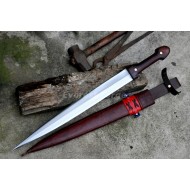
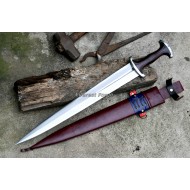
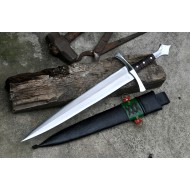
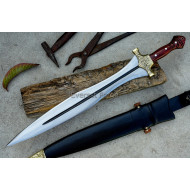
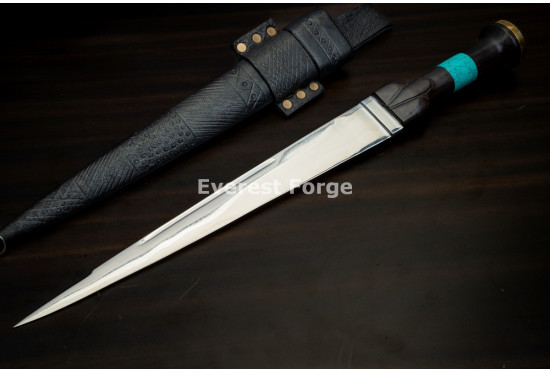
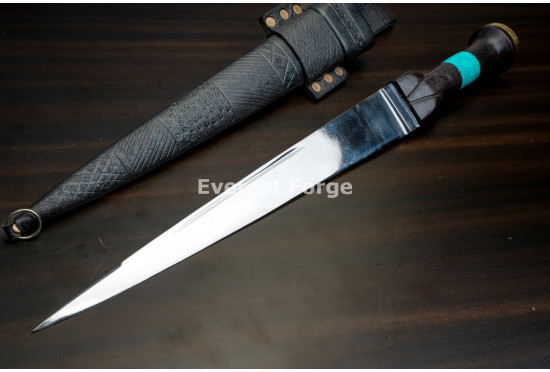
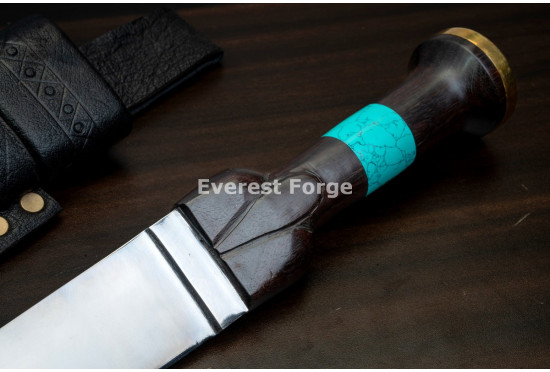
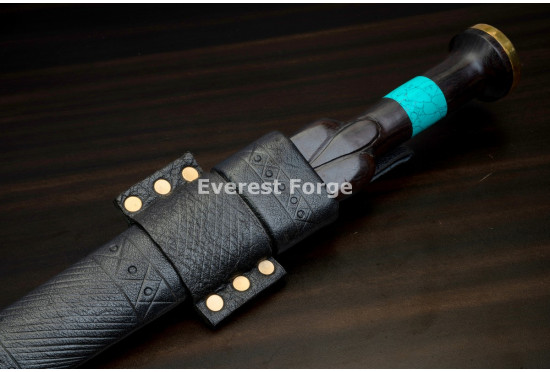
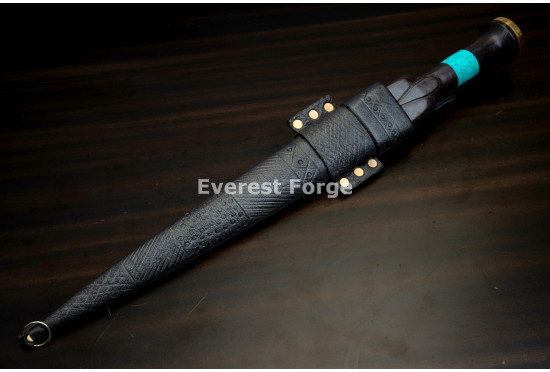
A dirk is a long single-edged dagger with no guard, a carved grip that waists and swells to fill the hand, and a disc cap closing the butt. It is a Scottish form by origin, and this one is built to it faithfully in everything except the decoration, which is entirely Nepali: a band of turquoise set into the grip, a carved leaf collar below the bolster, and a black leather sheath tooled in geometric patterns rather than Celtic interlace. The blade is 15 inches with a long narrow fuller, the piece runs to 21 inches overall, and it is hand-forged in Nepal from 5160 high-carbon spring steel.
We are calling it a Himalayan dirk because that is honestly what it is: a Scottish shape wearing Himalayan clothes. It is not a Highland dress dirk and it will not pass as one, for reasons set out plainly below. What it is instead is an unusually elegant piece that nobody else makes, and at 610 grams it is the lightest blade of its length we produce.
An honest note on the turquoise. The stone photographs as an even blue with dark web veining, which is the appearance of stabilised or reconstituted turquoise rather than high-grade natural stone. That is entirely standard across the Himalayan trade and there is nothing wrong with it: stabilised turquoise is real turquoise impregnated with resin so it can be cut and polished without crumbling, and it is what almost every set stone in this price range actually is. But you should be told rather than left to assume. If you want natural untreated stone we will source and set it as a custom commission and quote separately, because the material cost is significantly higher and the colour will be less uniform.
An honest note on the dirk question. This will not do for Highland dress. A formal dirk has a straight grip covered in Celtic interlace basketweave, a flat pommel usually set with a cairngorm, and a scabbard carrying a byknife and fork in fitted pockets. None of that is here. Anyone who knows the form will see immediately that this is something else, and we would rather say so on the first screen than have it discovered at an event. If a dress dirk is what you need, we forge those to commission.
Please check your local law before ordering. At 15 inches this blade is above the everyday carry allowance almost everywhere, and in a number of places a blade of this length is regulated as a sword or a bladed weapon rather than as a knife. Import rules frequently differ from possession and carry rules. We ship worldwide but we cannot advise on your jurisdiction. If length is the obstacle, a 10 or 12 inch build costs no more and is closer to the historical dirk proportion anyway.
Want a Proper Highland Dirk Instead?
Interlace-carved grip, flat pommel cap set with a stone, and byknife and fork pockets in the scabbard. It is a different piece and we build it to commission. Tell us the setting and we will quote.
Commission a Dress Dirk →Why This Dirk Is Built the Way It Is
Full Specifications
Blade length, blade finish and grip material are selectable on this listing. The figures above describe the standard build as photographed; what you receive will match the options you choose at checkout. Small variations in weight, dimension and finish are normal in hand-forged work, and set stone varies more than most.
Build It Your Way
What This Dirk Does Well, and What It Does Not
What It Is Good At
- Display. A 21 inch mirror-polished blade with a set stone is a striking object and nobody else makes this combination
- Handling. At 610 grams it is the lightest blade of its length we forge, and it feels it
- Slicing and general cutting, which is what a long single edge with a straight spine does well
- Costume and film work, where the silhouette reads as a dirk without belonging to a specific nation
- Gifting. The turquoise makes it a considerably more personal object than a plain blade
What It Is Not Good At
- Highland dress. It is not a dress dirk and will not pass as one
- Thrusting hard. There is no guard, and a point that stops dead has nothing between it and your fingers
- Rough handling. A set stone is the most vulnerable component on any knife; see the question below
- Chopping or batoning. The blade is long, slender and fullered, which is the opposite of a chopping section
- Carry. At 15 inches it is above the allowance nearly everywhere and may count as a sword
How to Order a Custom Dirk
Want the Ancestor of This Form?
The dirk descends from the medieval bollock dagger, and we forge that in both its period and modern builds. The lineage is genuinely direct and the two look good side by side.
See the Bollock Daggers →Who This Dirk Is For
- Display and collection buyers who want something genuinely unlike anything else on a shelf
- Buyers drawn to Himalayan decorative work and set stone rather than to European plainness
- Costume and film buyers needing a dirk silhouette without a specific national claim
- Anyone buying a significant gift, since a set stone makes a knife personal in a way steel alone does not
- Collectors of hybrid forms, which is a small but real interest and badly served
It is not for you if you need a dress dirk, in which case commission the Highland build, or if you want a working knife, in which case our camp knife is far better suited and considerably tougher.
What Is Included
- The hand-forged dirk, sharpened and ready for display
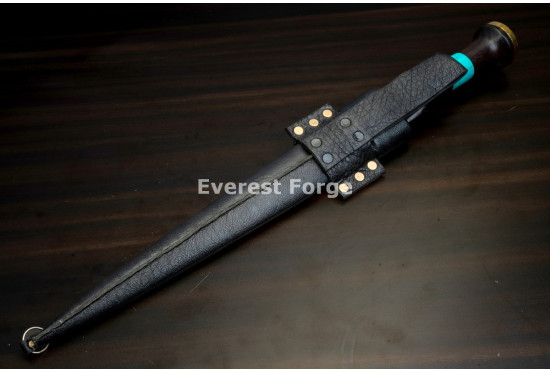
- A hand-tooled black leather sheath with riveted straps and a suspension ring
- A certificate of authenticity from the workshop
- Care instructions for high-carbon steel, timber and set stone
- Everest Forge manufacturer warranty against forging and material defects
Other Blades From the Everest Forge Workshop
Shipping, Returns and Care
Dispatch. Stock pieces leave the workshop within 2-3 business days. Custom builds take 4-6 weeks depending on the queue, and anything with natural stone sits at the longer end because the material has to be sourced and matched before the grip is carved.
Shipping. Tracked worldwide by DHL or FedEx, typically 7-14 business days in transit from Kathmandu. Customs paperwork is completed accurately and in full. At 15 inches this piece attracts more import scrutiny than an ordinary knife; please check your own country's rules before ordering.
Returns and warranty. Covered by the Everest Forge manufacturer warranty against defects in forging and materials. Custom builds made to your own specification cannot be returned for a change of mind, which is why we confirm everything in writing first.
Care. Three materials and the stone is the one people get wrong. The blade is mirror-polished high-carbon, so wipe it after every handling and keep a light film of oil on it; our wheel pommel dagger page explains why a mirror finish is the least forgiving we sell, and pay attention to the inside of the fuller, which a cloth drawn along the flat never reaches. Oil the timber once or twice a year. Keep oil off the turquoise. Stabilised turquoise is porous stone held together with resin, and oils, solvents and alcohol all darken it permanently over time, which is why the usual advice to wipe a whole knife down with an oily rag is wrong on this one. Clean the stone with a dry cloth only, and if it needs more, a barely damp one. Store the dirk out of the sheath.
Questions Answered
Is this a real dirk?
By form, yes, and we have been careful about that word because we have refused it on other knives. A dirk is defined by a long single-edged blade, no guard, a carved grip that waists in the middle and swells at both ends, and a flat cap closing the butt. Run that list against this piece and every item is present. What makes it a Himalayan dirk rather than a Scottish one is everything decorative: a Highland dirk carries Celtic interlace basketweave carving, and this carries Nepali leaf work and a set turquoise band. So the shape is Scottish and the clothes are Nepali. We think that is a more interesting object than either would be alone, but it is a hybrid and we would rather name it as one.
Can I wear it with Highland dress?
No, and this is the thing most likely to disappoint you if nobody says it. A formal dress dirk has three features this does not: a straight grip covered in interlace basketweave, a flat pommel usually set with a cairngorm, and a scabbard with fitted pockets carrying a byknife and a fork. Those are not optional details, they are what the piece is, and anyone at a Highland event who knows dirks will register the difference at a glance. It would read roughly the way a medieval sword would at a Regency ball: handsome, obviously wrong. What we can do is forge you a proper dress dirk to commission, and if you like the carving on this one our smiths can carry the same hand into it.
Is the turquoise natural or stabilised?
Stabilised, on the standard build, and we would rather tell you than let the photographs imply otherwise. Nearly all turquoise sold anywhere in the world is stabilised, because natural turquoise of a hardness that can be cut, set and polished without crumbling is genuinely rare and correspondingly expensive. Stabilisation means real turquoise impregnated under pressure with a clear resin, which hardens it and deepens the colour. It is not fake, it is not dyed plastic, and it is standard practice throughout the Himalayan trade and the American southwest alike. What it does mean is a more even colour than natural stone, and the uniform blue with dark web veining on this piece is characteristic of it. Natural untreated stone is available as a commission: expect a less uniform colour, more variation between pieces and a materially higher price, and we will quote before starting.
Will the turquoise come loose or wear?
It is the most vulnerable component on the knife and it should be treated as such. The band is let into a channel cut in the grip and bedded there, and it will stay put through normal handling and display indefinitely. What it will not survive is impact: turquoise is a soft stone, around five to six on the Mohs scale where steel is six and a half, so it will scratch against anything harder and it will chip if the knife is dropped onto a hard floor or knocked against a stone edge. It is also chemically vulnerable in a way steel is not, which is the part people miss. Oils, solvents, alcohol and skin acids all penetrate stabilised turquoise over time and darken it, usually unevenly. That is why the care note above tells you to keep oil off it. If a stone is ever damaged, send the knife back and we will re-cut and re-set the band; it is a repair rather than a write-off.
Why is there no guard?
Because the dirk never had one, and the grip does the work instead. A dirk handle is shaped rather than straight: it swells at the bolster end, narrows to a waist in the middle where your palm sits, and swells again into the pommel cap. Your hand seats between those two swellings and cannot travel in either direction without opening. That is a genuinely effective arrangement for cutting and for retention, and it is why so many traditional knives across Scotland, Scandinavia and the Himalaya are guardless. The limit, and it is the same limit as on our camp knife, is thrusting: if the point stops dead against something hard, there is nothing between your hand and the edge. Treat it as a slicer and it is well designed. Do not drive the point into anything.
What does the fuller do on a blade like this?
It takes weight out of the middle of the blade's thickness, where the material contributes least to stiffness, and the effect on this particular knife is unusually easy to see in the numbers. At 610 grams for a 15 inch blade, this is the lightest piece of its length we make by a wide margin, and the fuller plus the absence of any steel guard or pommel is where that weight went. A dirk is a slicing weapon rather than a chopping one, so lightness and a long clean edge matter more than mass. Our deep-fullered kukri page sets out the structural argument properly, and our fullered bowie page explains how to tell a forged fuller from a ground one, which is worth knowing on any fullered blade you are considering.
Where does the dirk come from?
From the same place our bollock daggers do, which is the pleasing part. The Highland dirk is a direct descendant of the medieval bollock dagger, which arrived in Scotland with the rest of Northern Europe and then stayed in fashion there for centuries after the Continent had moved on. Over the seventeenth and eighteenth centuries the two lobes of the bollock hilt shrank and migrated upward until they survived only as the gentle swellings of a dirk grip, the blade became single-edged and was frequently cut down from a broken sword, and the interlace carving and companion knife and fork arrived. That is why a dirk has no guard: it never had one, because its ancestor never had one either. Put this beside our period bollock dagger and the family resemblance in the grip is easy to see.
Is it sharpened on both edges?
No, single-edged, which is correct for the form. The spine runs straight and full thickness from the bolster most of the way to the point, and the taper is on the edge side, with the fuller set low on the face rather than centred. That gives a long clean cutting edge and a stiff spine, and it also keeps the knife legally simpler than a double-edged dagger of the same length in a good many jurisdictions, which is worth knowing. We can sharpen a short false edge along the last few inches of the spine on request, but please check what that does to the classification where you live before asking for it.
Is a blade this long legal where I live?
We cannot answer that for you. At 15 inches this is above the everyday carry allowance almost everywhere, and in a number of places a blade of this length stops being regulated as a knife at all and is treated as a sword or a bladed weapon, which brings different rules with it. Being single-edged helps: many of the harshest provisions target double-edged daggers specifically, and this is not one. But length thresholds apply regardless, and import rules are frequently different again from possession and carry rules. Check all three for your own address before ordering. If length is the obstacle, a 10 or 12 inch build costs no more and is closer to the historical dirk proportion anyway.
What steel is it, and how is it heat treated?
5160 high-carbon spring steel, the same stock our smiths use for kukris and swords, forged down from leaf spring in the Nepali tradition. It is oil-quenched and then tempered back, producing a blade that holds an edge but stays tough rather than brittle. Toughness matters on a blade this slender: a long thin section loaded sideways is precisely where a hard, brittle steel snaps and a properly tempered one flexes and returns. It is not stainless and it will take a patina with use.
Should I get the mirror polish or a working finish?
For this piece, the polish is defensible in a way it is not on our working knives. This is a display and collection object rather than a tool, the fuller reads far better on a reflective surface than on a matt one, and the polished steel sets off the turquoise in a way a forge finish would not. The cost is maintenance: bare polished carbon steel takes a fingerprint mark within days and every wipe shows. If the dirk is going into a case or onto a wall and you will handle it occasionally, take the polish. If it is going to be handled often, the satin finish costs the same and will look better after a year.
Will my dirk look exactly like the photographs?
Less so than most of our knives, because of the stone. Turquoise varies from piece to piece even within a single batch: the depth of blue, the density of the web veining and the exact pattern are all individual, and no two bands will match. That is true of stabilised stone and much more true of natural. Beyond that, the usual applies: the blade is drawn out by eye against a pattern, the fuller is cut individually, the grip is carved by hand and rosewood differs board to board. What does not vary is the specification: length, steel, construction, heat treatment and sharpness are held to the same standard on every piece. Our kukri machete page explains in more detail what can and cannot differ between two blades from the same bench.
| Specification | |
| Blade: | 15 inches long Blade is Hand forged from 5160 carbon steel. |
| Total Length: | 21 inches long in total. |
| Handle: | 6 inches long Handle is Beautifully crafted from Rosewood. |
| Weight: | 475 Grams approx. |
| Note: | Each dirk is individually hand-forged, and minor variations in size, weight, and finish are part of its unique character. Built for both collectors and real-world users. |