

- Model: EDC Knives
- Product Code: KARAMBITMINI
- Location: Kathmandu,Nepal
Available Options
A Proper Karambit, With a Working Finger Ring
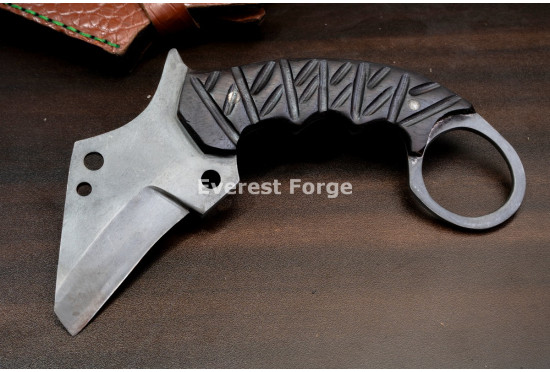
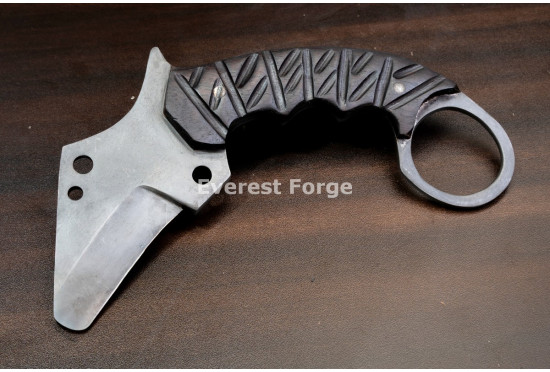
Most knives sold as karambits are not really karambits. They have a curved blade and a ring somewhere near the back, and that is where the resemblance stops — because the ring is too small to take a finger, or the handle is too long for the grip to work, so the ring ends up as decoration bolted onto a normal knife. This one is built the way a karambit is supposed to be built: the ring is large enough to take your index finger properly, and the handle is short enough that when your finger is through it, your hand closes around the grip exactly where it should.
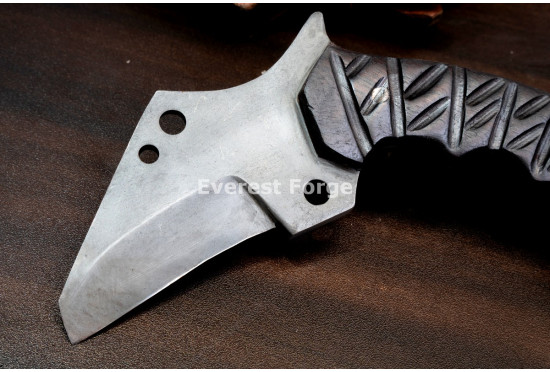
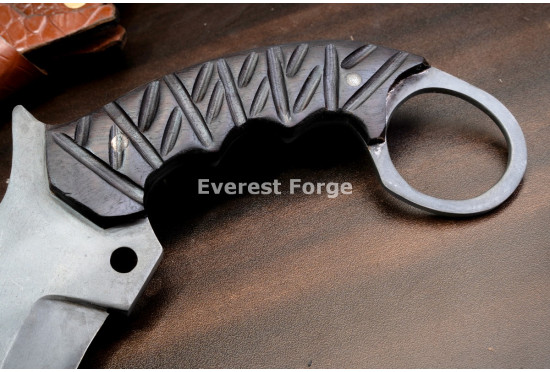
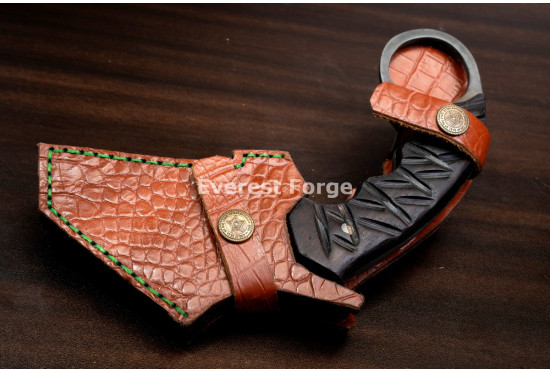
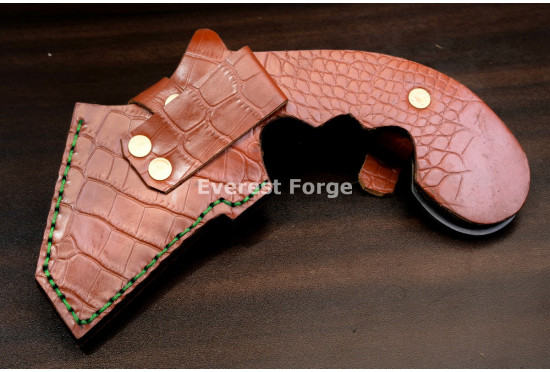
The blade is 4.5 inches, hand-forged from 5160 high-carbon steel, oil-quenched and tempered, with an angular hawkbill profile and two holes drilled through the flat. It is finished dark, with the forge surface left on and the edge brought bright. The 5 inch grip is rosewood, deeply carved in a chevron pattern, scalloped underneath for the fingers and pinned through a full tang that continues into a large integral steel ring at the end. It ships in a crocodile-embossed leather sheath in tan, stitched in green, with studded straps and an opening cut to clear the ring.
An honest note. A karambit is a specialist and it is worth understanding what you are buying. The ring gives you retention that almost nothing can take away, and a grip you can find by feel without looking — those are real advantages. What it also gives you is a knife that is awkward to use in any conventional way: you cannot easily choke up on it, you cannot use it comfortably on a cutting board, and the ring will catch on things. The other honest point concerns fit. A ring that does not match your finger is worse than no ring at all, because it either will not go on or will not come off. Ours is cut to a standard size that suits most adult hands, and if yours are larger or smaller than average, tell us and we will size it to you.
Want This Built Your Way?
A ring sized to your finger, a different handle material, another blade finish, a different scabbard, or your own drawing entirely. Our smiths in Kathmandu forge to specification and quote before any work begins.
Start a Custom BuildWhat Makes It a Real Karambit
Standard Build and Specifications
Handle material, blade finish and scabbard are all selectable, so the figures above describe the standard build rather than every version. Because each piece is forged, ground and carved by hand, weights, dimensions and the exact carving vary slightly between examples.
Build Options
Is This the Right Knife for You?
Choose This One If
- You want a karambit that actually works as one rather than a curved knife with a ring on it
- You value retention above almost everything — a finger through a ring is very hard to lose
- You cut cord, webbing and packaging, where a hooking blade beats a straight one
- You want a compact blade: 9.5 inches overall, and it disappears in a closed hand
- You are willing to learn a grip rather than pick it up and use it like a knife
Look Elsewhere If
- You want a general-purpose knife — this is a specialist and awkward at anything conventional
- You want to choke up for fine work — the ring geometry does not allow it
- You want a larger claw blade in a forward grip — our claw karambit is built that way
- You are unsure about the ring — a ring that does not fit is worse than no ring at all
How to Order
Who This Karambit Is For
- Buyers who know the form and have been disappointed by karambits with rings too small to use
- Silat and martial arts practitioners who want a forged blade rather than a stamped one
- Anyone who cuts cord or webbing where retention matters — working at height, on water, on a rig
- Collectors of blade forms who want a karambit built to work rather than to look the part
- People with hands outside the average — a ring sized to you is worth more here than on any other knife
What Is Included
- One hand-forged finger ring karambit, sharpened and ready to use
- Crocodile-embossed leather sheath cut to clear the ring
- Everest Forge manufacturer warranty
- Care instructions
More From the Everest Forge Collection
Shipping, Returns and Care
Stock builds dispatch from our workshop within 2-3 business days. Custom and made-to-order builds take 4-6 weeks from confirmation, and we photograph the finished piece before it leaves us. We ship worldwide with DHL and FedEx, fully tracked, typically 7-14 business days in transit. Every blade carries the Everest Forge manufacturer warranty against defects in forging and construction.
Blade laws vary by country, state and province and it is the buyer's responsibility to check local restrictions before ordering. We cannot advise on your jurisdiction and we cannot refund a blade seized in transit.
5160 is a high-carbon steel and it will rust if you let it, and the dark forge finish is not protection — scale is not a coating. Wipe the blade dry after use and keep it lightly oiled, paying attention to three places a cloth drawn along the flat will skip: the inside of the curve, which is concave and never gets touched by an ordinary wipe; the two holes through the blade; and the inside of the ring where it meets the grip. The chevron carving on the handle holds dirt in its cut lines and wants a brush rather than a wipe. If you cut anything green or acidic, clean it promptly, because sap collects inside the curve where you cannot see it.
Forged by Hand, Not Assembled
Every blade we sell is forged, ground, heat-treated and fitted by our own smiths in Kathmandu. If you want something we do not list, we will make it.
Talk to Our SmithsFrequently Asked Questions
What makes this a real karambit rather than a curved knife with a ring?
Fit, and it is a bigger difference than it sounds. A karambit is defined by a working relationship between three things: a ring large enough to take your index finger down to the base knuckle, a handle short enough that your remaining fingers close around it while that finger is through the ring, and a blade positioned so the whole assembly balances in that grip. Get any one wrong and the ring becomes decoration. Most knives sold as karambits get at least one wrong — usually the ring is undersized, so it will only take a fingertip, or the handle is too long, so your hand ends up stretched out of position. This one is built to the correct proportions: 4.5 inches of blade, a 5 inch grip, and a ring that takes a finger properly. That is what you are paying for.
How do I actually hold it?
Index finger through the ring, in either of two grips. For the reverse grip — the one most people picture — lay the knife across an open palm with the spine toward your body and the tip pointing away, slide your index finger into the ring, and close your remaining fingers around the handle. The blade then sits below your fist, curving back. For the forward grip, the same thing with the knife the other way round, so the blade points forward as it would on a normal knife. Forward grip is what you want for everyday cutting and anything needing control; reverse is the traditional fighting arrangement. The important detail either way: the ring should sit right down at the base of your finger, close against your palm, not perched on the first knuckle. Perched high, the blade can travel toward your own forearm.
What does the finger ring actually do?
Three things, and retention is the big one. With a finger through the ring, the knife is attached to your hand in a way no grip strength can match — you can open your fingers completely and it stays. That matters if you are working wet, at height, over water, or anywhere dropping a knife is expensive. Second, indexing: keep your finger in the ring as you draw and the knife seats itself in your grip on the way out, without you having to look or adjust. Third, leverage — a karambit cuts by being pulled, and the ring gives you something to pull against rather than relying on friction between your palm and the handle. That last point is why the ring belongs on this shape specifically rather than being a general improvement.
What if the ring does not fit my finger?
Then the knife is worse than useless, which is why we would rather size it than have you find out. A ring that is too small will not admit your finger past the first knuckle, so you end up gripping it wrong, with the blade able to swing toward your own arm. A ring that is too large lets your finger move inside it, which loses you the retention and the indexing that are the entire point. Ours is cut to suit most adult index fingers, and for most buyers the standard is right. If your hands are noticeably large or small, measure around the base knuckle of the index finger on the hand you would use, send us the figure, and we will cut the ring to you at no extra cost. It is the one measurement on this knife worth taking.
What is the blade shape?
An angular hawkbill: a curved blade that hooks, but with the curve resolving into a chisel-like tip rather than tapering to a needle. That is a deliberate departure from the traditional form and a sensible one. A classic karambit tip is very fine, which makes it good at piercing and extremely easy to break — and a broken tip on a blade this small takes a lot of the knife with it. The angular tip here has real steel behind it, so it will take work that would snap a fine point, while the curve ahead of it still hooks and holds material the way a karambit should. What you give up is some piercing ability. For a knife most people will use on cord, packaging and webbing, that is the right trade.
What are the two holes in the blade?
Weight and appearance, and we would rather be straight about the proportions of each. Drilled through the flat near the spine, well away from the edge, they remove a small amount of material from the part of the blade doing the least work. On a blade this size the weight saved is genuinely marginal — a few grams — so anyone claiming holes transform how a small knife handles is overstating it. They are principally a design feature, and that is a legitimate reason for them to exist. The one practical consequence is maintenance: two holes means four internal edges and two bores that a cloth wiped along the flat will pass straight over, and on carbon steel those are places rust starts unseen.
What is the dark finish?
The forge surface left on the blade, with the edge ground bright beneath it, so the two meet in a clear line. It is the surface the steel came off the anvil with rather than something applied afterwards. Two honest points. It is not rust protection — forge scale is iron oxide, not a coating, and this blade needs oiling exactly like a polished one, so treat any seller telling you otherwise with suspicion. And it hides working marks, which is a genuine practical benefit: a dark blade looks better after a year of use than a mirror-polished one, because scuffs disappear into it instead of standing out. If you would rather have a clean blade we will polish it throughout.
What steel is it?
5160 high-carbon spring steel, oil-quenched and tempered. It is the family of steel used for vehicle leaf springs, which is where the Nepali practice of forging blades from them comes from, and it is chosen for toughness rather than for maximum hardness. On a small blade used with pulling force that is the right call: the tang runs into a ring that takes the whole load of a pull, and a brittle steel is exactly what you do not want at a transition like that. A tough steel deforms slightly under stress where a hard one cracks. The trade-off is that it wants sharpening a little more often, which on a curved edge is more of an imposition than usual. It is not stainless and will rust if neglected.
Is it a working knife?
Yes, but a narrow one, and it is worth being clear-eyed about that. Where it earns its place is anything a hooking blade suits: cord, rope, bale twine, webbing, strapping, packaging, hose, vine. In those jobs the curve traps material that a straight blade would push away, and the ring means you can apply real pulling force without the handle shifting. Where it is poor is everything else. You cannot use it comfortably on a board, you cannot choke up on it for detail work, you cannot baton it, and the ring will catch on pockets and sheath mouths. It is a specialist, and a specialist is only worth owning if you have its speciality. If you want one knife for general use, almost anything else we make is a better answer.
How do I sharpen a curved blade?
With a round or oval rod rather than a flat stone, and this is the real cost of the shape. Lay a curved blade on a bench stone and the stone touches the two high points at either end and bridges the concave section between them, so you sharpen the parts that need it least. What works is a ceramic rod, a round diamond rod or a tapered steel small enough to sit inside the curve, worked in short strokes while you rotate the blade to keep the angle constant along the arc. Our claw karambit sets this out in more detail and the same method applies here, though the shorter blade makes it quicker. The angular tip is a small mercy: it can be worked flat on a stone rather than needing the rod.
How do I look after it?
Carbon steel care with three places a normal wipe will miss entirely. The inside of the curve is concave, so a cloth drawn along the blade as you would clean a straight knife simply passes over it — wrap the cloth around a finger and work it into the hollow deliberately. The two holes have internal bores that hold water. And the inside of the ring, where it meets the grip, is a tight junction that traps moisture against two materials at once. The chevron carving on the handle wants a brush rather than a wipe, since the cut lines hold dirt. Beyond that: dry after use, oil lightly, do not store it sheathed for long periods in a damp climate, and clean promptly after anything green or acidic.
How does it compare to your claw karambit?
Different knives despite the shared name. Our claw karambit is considerably larger — a 6 inch blade on a 6.5 inch grip — with a deep smooth claw curve, a conventional forward grip and a ring at the butt that functions as a retention and hanging point rather than as a finger ring. It handles like a knife. This one is compact at 4.5 inches, has a working finger ring you actually put a finger through, an angular tip rather than a fine one, and it handles like a karambit, which is to say it takes learning. If you want the shape and the presence in something that works like a normal knife, take the claw. If you want the real thing and are prepared to learn the grip, take this.
| Specification | |
| Blade: | 4.5 inches. Hand forged from 5160 carbon steel. Angular hawkbill closing to a chisel-like tip, two holes drilled through the flat |
| Total Length: | 9.5 inches |
| Handle: | 5 inches, carved rosewood, chevron cut and scalloped, full tang running into a LARGE INTEGRAL FINGER RING |
| Weight: | Approx. 280 g blade, approx. 380 g total |
| Note: | Ring is cut to suit most adult index fingers. If your hands are larger or smaller than average, measure around the base knuckle and we will size it to you at no extra cost. |