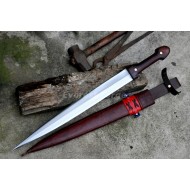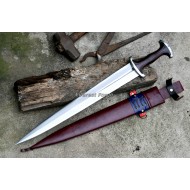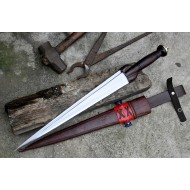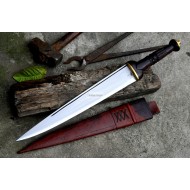
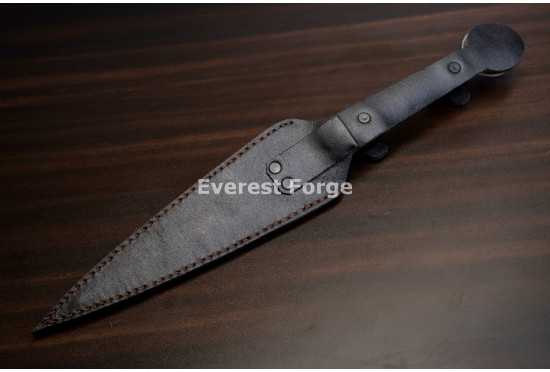
- Model: Hand forged Dagger
- Product Code: KUNAIDAGGER010
- Location: Kathmandu,Nepal
Available Options
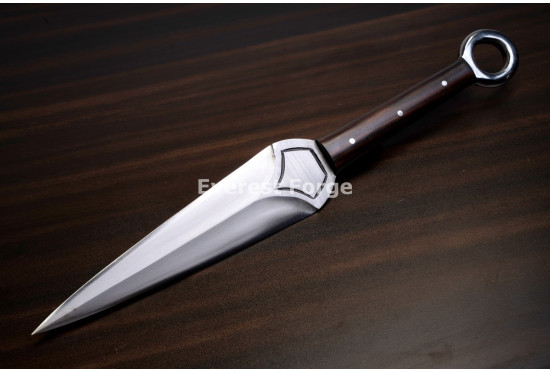
A Hand-Forged Fantasy Kunai Dagger With a Ring Pommel and Rosewood Grip
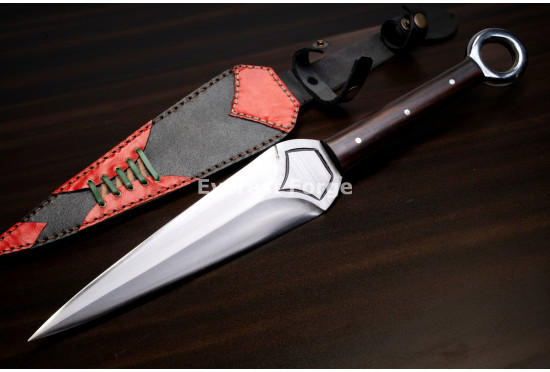
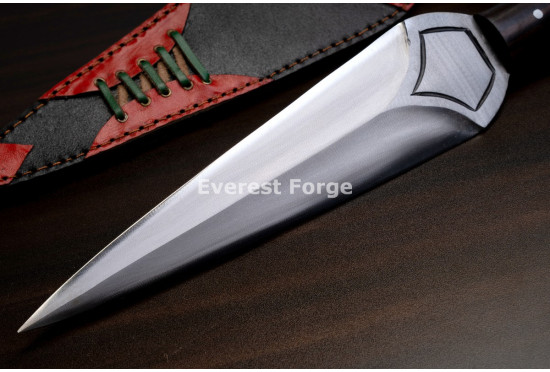
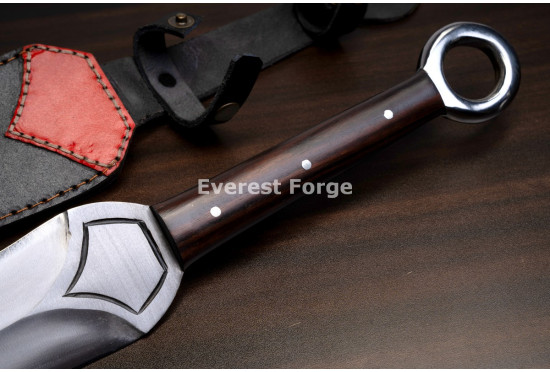
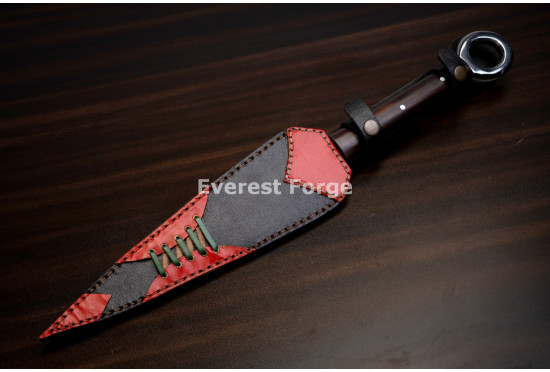
This is a 10 inch hand-forged kunai dagger built as a fantasy piece: a broad leaf-shaped blade with an angular faceted ricasso, tapering in a long clean line to a fine point, in a satin finish. The hilt is a slim rosewood grip pinned through a full tang, 6 inches of it on an 8 inch handle, finishing in a polished steel ring. Overall length is 18 inches and it weighs approximately 620 grams. Forged from 5160 high-carbon steel in Tokha-3, Kathmandu, and supplied in a black and red leather sheath with green lacing and a snap retaining strap.
An honest note. A real kunai was not a weapon and it was not thrown. It was a mason's and gardener's tool: a thick, roughly finished leaf-shaped blade used to dig, pry, gouge holes in plaster walls and lever things apart, with a ring at the end to take a cord so it could be hung from a belt or tied to a pole. It is heavy, blunt-edged and unlovely, and there are museum examples that look nothing like anything on a shop wall. The kunai as a sharpened throwing weapon comes almost entirely from twentieth-century fiction. That is why this page says fantasy in the title: we have built the thing people picture, sharpened and finished as a knife, rather than the tool the word originally meant. If you want a working tool-form kunai, thick and blunt and correct, we will forge that instead and it is the first option below.
Have This Kunai Forged Your Way
Blade length, thickness, ring size and the sheath are all decided at the forge. Matched sets are straightforward and are the most common request on this design.
Start a Custom Forge Order →Why This Kunai Is Built the Way It Is
Specifications
Build Options
Is This the Right Knife for You?
Buy This If You Want
- A kunai that is a genuinely forged knife rather than a stamped stainless prop
- Full tang construction, which almost nothing in this category has
- A ring large enough to take a real cord or a finger
- A distinctive costume or display piece that would survive being handled
- A matched set, which is what this design is really for
Look Elsewhere If You Want
- A throwing knife — this is not one and the answer below explains why we will not sell it as one
- The historical tool, which is thick, blunt and unlovely; we will forge it, but it is not this
- A cheap prop for a single event, since a forged carbon-steel blade costs more than a stamped one
- A stainless blade needing no care, since 5160 is carbon steel and will rust if left wet
- Something discreet; at 18 inches overall this is a large knife
Matched Sets, Forged Together
Kunai were never carried singly and they look wrong alone on a wall. Two, three or five made in one batch so the blades, grips and rings match. Tell us how many.
Talk to the Forge →How to Order
Who This Kunai Is For
- Costume and cosplay builders who want forged steel rather than resin or stamped stainless
- Collectors of fantasy blades looking for a shape that is instantly recognisable
- Film, stage and photography armourers needing something that reads correctly on camera and survives handling
- Anyone building a matched set, which is what this design is designed around
What Is Included
- One hand-forged kunai dagger, sharpened and ready
- Fitted black and red leather sheath with green lacing and snap strap
- Certificate of hand-forging from the workshop
- Everest Forge manufacturer warranty against defects in forging and heat treatment
Explore the Collection
Shipping, Returns and Care
Every piece is prepared at the forge in seven to ten days, and shipping adds a further seven to ten days. Orders to the USA and Canada travel with FedEx; everywhere else ships on a DDP service, which means duties and taxes are settled before the parcel moves so there is nothing to pay on delivery. Every piece carries the Everest Forge manufacturer warranty against defects in forging and heat treatment.
Fixed blades are restricted in some countries and in some states and provinces within them, and a few jurisdictions treat anything marketed as a throwing weapon differently again. We do not sell this as a throwing knife, but if the rules where you live turn on that question it is worth checking before you order, because a parcel seized by customs cannot be returned to us and cannot be refunded. Ask us before you buy if you are unsure.
5160 is a high-carbon steel and it will rust if left wet or stored damp. Wipe the blade dry, keep a light film of oil on it, and pay attention to the inside of the ring and the angles of the faceted ricasso, which are the two places a cloth will not reach. Do not store the kunai in the sheath for long periods. The rosewood scales take an occasional coat of oil.
Frequently Asked Questions
What was a kunai actually used for?
Digging, prying and gouging. The kunai was a mason's and gardener's tool in Japan, and surviving examples look very little like the sharp black knives the word now brings to mind: they are thick, heavy, roughly finished, blunt along the edges, and made in a leaf or trowel shape with a ring at the end of the tang. The ring took a cord, so the tool could be hung from a belt, tied to a longer handle to extend reach, or lashed to something. The work it did was practical — opening holes in plaster and daub walls, levering out stones, digging, chiselling. There is a reasonable case that it was also used by people who needed to get through a wall quietly, which is where the association with covert work comes from, and a tool is a useful thing to be caught carrying precisely because it is a tool. But it was not a fighting knife, it was not sharpened like one, and the throwing weapon is a twentieth-century invention that arrived through fiction, film and games rather than through any historical source.
Can I throw it?
Please do not, and we will not sell it as a throwing knife. Three reasons, all practical. Purpose-built throwing knives are made from softer, thicker stock with rounded or blunt edges and no fine point, precisely because they are expected to hit steel-hard targets end-on, tumble, bounce and land on stone; a properly hardened cutting blade with a fine point chips and snaps under exactly that treatment. Second, this one has a rosewood-scaled hilt: throwing loosens pinned scales over time no matter how well fitted, and a handle that works loose on a thrown knife is dangerous to whoever picks it up. Third, the ring makes it worse rather than better, because it catches on release and sends the knife off-axis. If you want something to throw, buy a set made for it, which will cost less and last far longer. This is a knife with a ring on it.
Why is it called a fantasy kunai?
Because it is the modern idea of the object rather than the historical one, and we would rather say so in the title than argue about it in the small print. What people picture when they hear kunai is a sharpened, slim, blackened blade with a ring, thrown in handfuls — and that picture comes from manga, anime, games and film, not from any Japanese tool chest. We have built that picture properly: forged carbon steel, full tang, heat treated, sharpened, with a ring big enough to be real. What we have not done is pretend it is a historical reproduction. Our catalogue has pages where we reconstruct a documented weapon and pages where we build a modern design well, and the difference between the two is the most useful thing we can tell you. This is the second kind. The first kind is the tool-form kunai in the build options above.
Why does the grip take up so much of the length?
Because the proportions come from the tool, and it is one of the few things about this design that is genuinely period. On a kunai the tang is long, often close to the length of the blade, because the tool was meant to be gripped in different places depending on the job, choked right up for careful gouging or held at the end for leverage when levering. Ours keeps that: 6 inches of grip on a 10 inch blade, where a knife of this size would normally give you four. The result handles unlike anything else in the catalogue — it feels closer to a small prybar than a dagger, which is exactly right. If you want it to feel like a knife instead, order a shorter grip and we will rebalance it, though you will lose the silhouette that makes the shape recognisable.
What is the ring for?
On the original, a cord. The ring is not a pommel in the sword sense and it was not there for the hand; it existed so the tool could be tied to something — a belt, a wrist, a pole to extend its reach, a rope to lower it or retrieve it. On this build it does three useful things. It takes a lanyard, which is genuinely worth having on a knife with a slim grip. It gives you somewhere to hang the piece for display, which matters because a kunai looks wrong lying flat and right hanging point-down. And it takes a finger, which changes how the knife handles in a reverse grip. Ours is forged and finished to a size that will actually accept a cord or a finger, because a token ring too small to thread is one of the giveaways on cheap versions of this design.
Should I buy more than one?
For this design, probably. A kunai alone on a wall reads as an odd single object; two or three read as a set and look like what they are meant to be. That is true in the fiction the shape comes from and it is true visually. Ordering them together also gets you pieces that genuinely match: forged in one batch from the same bar, the same grind, scales cut from the same board so the grain and colour agree, and rings shaped to the same size by the same hand. Order singly across months and they will not match, because hand forging varies and rosewood varies more. A set costs less per piece than the same number bought separately, and it is the most common request we get on this design. Tell us the number at the start rather than adding to a set later.
What steel is it, and how is it heat treated?
5160 high-carbon spring steel, brought to temperature in the forge, quenched in oil and tempered back so the edge is hard while the body stays springy. That is the same steel and the same treatment we use on our working knives, which is worth saying because most of what is sold in this shape is stamped stainless sheet with a cast ring, unhardened, and functionally decoration. It is not stainless, deliberately, for the same reason as every other blade we make: the stainless grades that genuinely resist rust give up toughness, and we would rather sell a knife that needs oiling than one that will not hold an edge.
Is it full tang?
Yes. The tang is the full width and shape of the grip with rosewood scales pinned through it, and the ring is forged as part of the same piece of steel rather than welded or fitted on afterwards. That matters more on this design than on most, because the ring invites people to hang it, swing it from a cord or pull on it, and a ring that is a separate component attached to a narrow tang is the obvious failure point. Almost nothing else in this category is built this way. If you see a kunai where the ring is a different colour or finish to the tang, it was made separately and joined.
How sharp does it arrive?
Sharp and ready, with the edges put on a stone by hand at the forge. If you would prefer it shipped blunt — for display, for costume or convention use, for a gift, or because of the rules where you live — say so in the order comments and we will send it unsharpened at no extra cost and rebate the point as well. Many conventions require exactly that, and on a piece bought largely for how it looks it costs you nothing.
What is the faceted section above the blade?
An angular ricasso, cut with flats where the blade meets the tang. It gives the eye a clean transition between a wide blade and a slim grip instead of the abrupt step you get on a stamped version, and it is a place your thumb can sit if you choke up on the blade for close work. On the historical tool this area is usually a plain thick shoulder with no shaping at all, so the faceting here is ours rather than period — a detail that makes the piece look considered, which is the point of it. It is also, incidentally, one of the hardest parts to keep free of rust, since the angles collect moisture that a cloth wipes straight over.
Can you make the historical tool version?
Yes, and it is more interesting than most people expect. A tool-form kunai is thicker through the blade, blunt or nearly blunt along the edges, rougher in finish with the forge marks left visible, and carries a heavier ring. It is a genuinely useful object — it will dig, lever, gouge and pry, and it does those jobs better than any knife because it is not trying to be one. It also looks nothing like what people expect, which is exactly why collectors of Japanese tools want them. Tell us in the order comments or through the custom forge page. We would suggest ordering one alongside the fantasy version rather than instead of it, because the pair together tells the whole story of how a mason's tool became a fictional weapon.
Where is this made, and by whom?
In our own workshop in Tokha-3 on the northern edge of Kathmandu, Nepal, by around ten smiths, most from families that have forged blades for generations. Everest Forge has operated since 2010, and we forge, grind, heat treat, fit the scales and cut the leather in the same building. A Japanese-derived shape made in Nepal deserves the same word we give our bowie, our seax and our kopis: this is not our own tradition and we do not pretend it is. What our smiths bring is the forging, and forging the ring as part of the tang rather than adding it afterwards is the part of this design that actually takes skill.
| Specification | |
| Blade: | 10 inches. Hand forged from 5160 carbon steel, satin finish |
| Total Length: | 18 inches long |
| Handle: | 8 inches (6 inch grip). Full tang with rosewood scales pinned through, forged steel ring pommel |
| Weight: | approx 620g dagger, 770g with sheath |
| Note: | Some variation in weight, dimensions and finish may occur as each piece is hand forged. Keep the blade lightly oiled when not in use |