Menu
Your Cart

Hand-Forged Iberian Falcata

Hand-Forged Iberian Falcata
$244.99
Ex Tax: $244.99
  • Model: Iberian Falcata
  • Product Code: FALCATA22
  • Location: Kathmandu,Nepal

Available Options

What Is an Iberian Falcata?

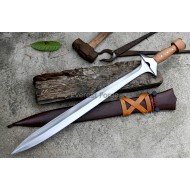
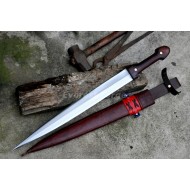
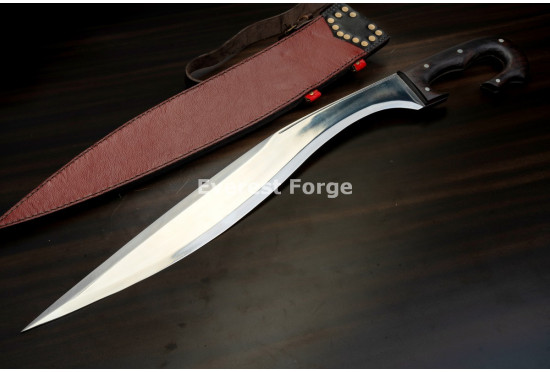
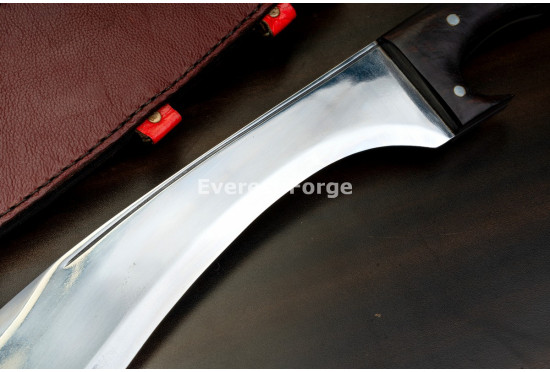
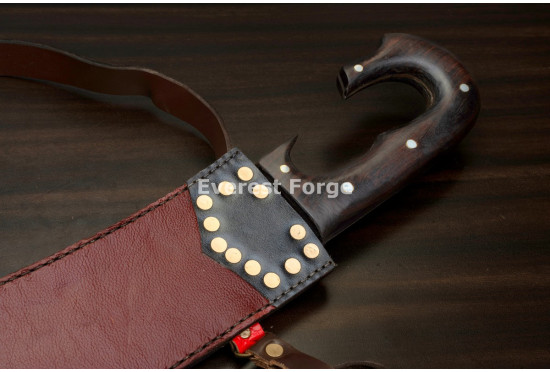
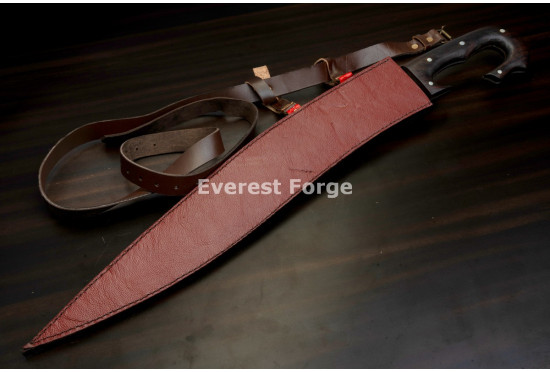
The falcata is the sword of pre-Roman Spain: a forward-curving single-edged blade that widens toward the point, on a hilt that hooks back over the hand. It was carried by the Iberian and Celtiberian peoples from roughly the fifth century BC, and it is the weapon Carthaginian and Roman armies met when they fought their way across the peninsula. This one has a 22 inch blade, a 7 inch hooked grip in dark hardwood with a stepped bolster, and 29 inches overall. It is hand-forged in Kathmandu from 5160 high-carbon spring steel, mirror polished, and carried in an oxblood leather sheath on an adjustable shoulder baldric.

At 1010 grams it is a substantial object, and the weight is where it should be: the widest part of the blade sits well forward of the hand, which is the whole idea. Everything below explains what that arrangement does, where the design came from, and what it will and will not do for you.

An honest note. This is a falcata built to the type rather than a copy of an excavated example. Surviving falcatas vary considerably in size and finish, many carry decorative inlay or damascened work at the hilt, and the originals were made in iron rather than modern spring steel. Ours is honest modern work in the old shape: the profile, the proportions and the hooked hilt are orthodox, and the material and the polish are not what a fourth-century BC smith would have produced. If you want a piece closer to an archaeological reproduction, tell us what you are working from and we will quote.

Please check your local law before ordering. At 22 inches this is a sword rather than a large knife, and it will be regulated as one almost everywhere. Sword provisions are a different body of law from knife provisions, with different rules and different penalties. Rules for owning one at home, carrying one and importing one across a border are frequently three separate questions with three different answers. Check all three for your own address, because a parcel stopped at your border cannot be recovered.

Custom Forge

Building a Classical Set?

We forge the kopis, the machaira and the falcata, and the family resemblance between them is the point. Commission two or three together and our smiths will match the finish and the fittings.

Commission a Set →

Why This Falcata Is Built the Way It Is

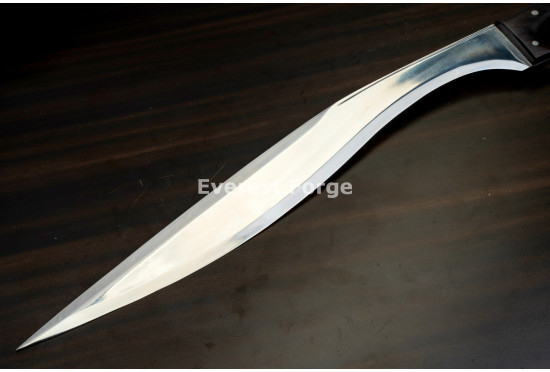
Forward WeightThe blade broadens through the last two thirds, so the mass sits ahead of your hand. That is what lets a sword of this length cut like something considerably heavier.
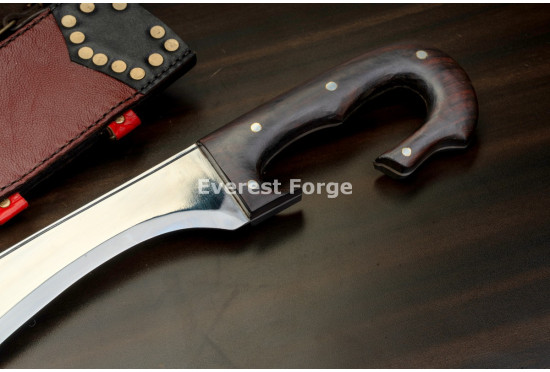
Hooked GripThe hilt curls back over the hand and finishes in a hook. It is not decoration: it stops the sword leaving your grip at the end of a cut, which matters on a forward-weighted blade.
Single Edge, Thick SpineAll the steel that is not doing cutting work stays in the back of the blade, which is what keeps a wide-bellied sword rigid enough to chop without folding.
Stepped BolsterA squared steel collar seats the blade against the hilt, giving a flat shoulder to bear against rather than a wedge that works itself loose.
5160 Spring SteelOil-quenched and tempered back. On a chopping sword toughness matters more than hardness, because the edge will meet things it was not aiming at.
Baldric CarryAn adjustable shoulder strap rather than a belt frog. A kilo of forward-weighted steel hangs far better across the torso than off a waistband.

Full Specifications

TypeFalcata, Iberian form, single-edged forward-curving
Period ReferencePre-Roman Iberia, roughly the 5th to 1st centuries BC
Blade Length22 inches
Handle Length7 inches
Overall Length29 inches
Blade Steel5160 high-carbon spring steel, oil-quenched and tempered
Blade ProfileForward-curving, single-edged, broadening through the last two thirds to a fine point
HiltHooked grip in dark hardwood, pinned, with a stepped steel bolster
FinishMirror polish
Weight1010 g the falcata, 1680 g with the sheath and baldric
SheathOxblood leather, stitched and shaped to the curve
CarryAdjustable leather shoulder baldric with buckle
SharpnessShips working sharp, hand-finished on stones
OriginHand-forged in Tokha-3, Kathmandu, Nepal

Blade length, blade finish and grip material are selectable on this listing. The figures above describe the standard build as photographed; what you receive will match the options you choose at checkout. Small variations in weight, dimension and finish are normal in hand-forged work.

Build It Your Way

Blade LengthShorter at 16 or 18 inches, which brings the weight down substantially and is legal in more places. The curve is redrawn rather than scaled.
Grip MaterialDark hardwood as standard. Water buffalo horn and bone are both available, and horn raises no CITES question.
Blade FinishMirror polish as photographed, satin, or a dark forge finish. An antiqued finish reads far closer to an excavated piece.
Carry ArrangementShoulder baldric as photographed, or a belt frog if you would rather wear it at the waist. Read the carry question below first.
Sheath LeatherOxblood as standard, or black, brown or natural. Stitch colour is yours to choose and we will match or contrast.
Matched Classical SetKopis, machaira and falcata built together with matching fittings and finish. Quoted as a group.

What This Falcata Does Well, and What It Does Not

What It Is Good At

  • Cutting. Forward mass on a curved edge is the most efficient chopping arrangement in the ancient world
  • Display. At 29 inches the silhouette is unlike anything else and reads as ancient at a glance
  • Retention. The hooked hilt keeps the sword in your hand where a straight grip would not
  • Costume and film work set anywhere in the classical Mediterranean
  • Carrying, given the baldric. A kilo of steel is manageable across the shoulder

What It Is Not Good At

  • Thrusting. The curve puts the point where your hand does not expect it and there is no guard
  • Archaeological accuracy. It is built to the type rather than copied from a find
  • Extended use. At 1010 grams with the weight forward, your forearm will tire
  • Carry anywhere. At 29 inches overall this is a sword and will be regulated as one
  • Low maintenance. Mirror-polished carbon steel marks if you look at it

How to Order a Custom Falcata

Decide whether this is for display or for handling. It changes the finish and the blade length more than anything else.
Pick your remaining options on this page, or use the custom forge form for anything outside them.
Tell us your jurisdiction if the length is a concern, and we will build a shorter version at no extra cost.
We confirm the specification in writing and quote before any steel is cut. Nothing is charged until you agree it.
Our smiths forge and grind the blade, shape and fit the hooked hilt, then cut and stitch the sheath and baldric to the finished piece.
It ships tracked by DHL or FedEx from Kathmandu, with the customs paperwork made out correctly for your country.
The Family

Kopis, Falcata, Khukuri

Three forward-curving blades separated by two thousand years and five thousand kilometres, and the resemblance is not a coincidence. Our origin article traces the whole line.

Read the Lineage →

Who This Falcata Is For

  • Collectors of ancient arms, for whom the falcata is one of the most distinctive forms of the classical world
  • Buyers interested in the forward-curving family, which runs from the kopis to the khukuri by way of this
  • Costume and film buyers working in the Punic Wars, Iberia or the wider Mediterranean
  • Display buyers who want a silhouette nothing else in a collection will resemble
  • Anyone commissioning a matched set across the classical curved blades

It is not for you if you need a thrusting weapon, in which case any of our straight double-edged blades will serve you better, or an archaeological reproduction, in which case tell us what you are working from and we will quote for it properly.

What Is Included

  • The hand-forged falcata, sharpened and ready for display or use
  • An oxblood leather sheath shaped to the curve of the blade
  • An adjustable leather shoulder baldric with buckle
  • A certificate of authenticity, care instructions, and the Everest Forge manufacturer warranty

Other Blades From the Everest Forge Workshop

Shipping, Returns and Care

Dispatch. Stock pieces leave the workshop within 2-3 business days. Custom builds take 4-6 weeks depending on the queue, and we will give you the honest date rather than an optimistic one.

Shipping. Tracked worldwide by DHL or FedEx, typically 7-14 business days in transit from Kathmandu. Customs paperwork is completed accurately and in full. This is declared as a sword rather than a knife, which attracts considerably more scrutiny; please check your own country's rules before ordering.

Returns and warranty. Covered by the Everest Forge manufacturer warranty against defects in forging and materials. Custom builds made to your own specification cannot be returned for a change of mind, which is why we confirm everything in writing first.

Care. Mirror-polished high-carbon steel is the least forgiving finish we sell, and our wheel pommel dagger page explains why in detail. Wipe the blade after every handling and keep a light film of oil on it, paying particular attention to the inside of the curve, where a cloth drawn straight along the blade skips over the concave section. Oil the timber grip once or twice a year and feed the sheath and baldric leather at the same interval, keeping conditioner off the steel. Store the falcata out of the sheath: leather holds damp against steel, and a sheath shaped this tightly to a curve dries slowly.

Questions Answered

What is a falcata, and who carried one?

It is the characteristic sword of pre-Roman Spain, carried by the Iberian and Celtiberian peoples from around the fifth century BC until Roman rule displaced it. The defining features are a single-edged blade that curves forward and widens through its length rather than tapering, and a hilt that hooks back over the hand, often finished as a stylised horse or bird head. Surviving examples come mostly from graves, where they were frequently ritually bent or broken before burial, and they vary a good deal in size and decoration; many carry silver or copper inlay at the hilt. The name is modern. Nineteenth-century scholars coined "falcata" from a Latin phrase describing a curved sword, and what the Iberians themselves called it is not recorded.

What does the hooked hilt actually do?

It keeps the sword in your hand, and on this shape of blade that is not a small matter. A falcata has no guard and its weight sits well forward, which means that at the end of a hard cut the momentum is trying to carry the whole weapon out of your grip. A straight handle resists that with friction alone, which fails exactly when your hand is tired or wet. The hook curls back over the base of the thumb and the heel of the hand, so the grip cannot slide backwards without your hand opening completely. Many originals also carried a light chain or strap running from the hook to the bolster, adding a second point of retention and, incidentally, a knuckle guard of sorts. It is a solution to the same problem the flared butt solves on a khukuri, arrived at independently and answered differently.

Is the falcata related to the Greek kopis and the khukuri?

Yes, and the relationship is one of the more interesting things in the history of edged weapons. The forward-curving single-edged blade appears in Greece as the kopis and the machaira from roughly the sixth century BC, spreads through the Mediterranean with Greek colonists and traders, and turns up in Iberia as the falcata. The same principle, arrived at by a route scholars still argue about, appears in the Indian subcontinent and eventually in Nepal as the khukuri. Whether that is transmission or convergence is genuinely debated: the geometry solves an obvious problem so well that more than one culture may have found it independently. What is not in doubt is that a falcata, a kopis and a khukuri laid side by side look like relatives. Our origin of the kukri article traces that whole line properly, and we are one of very few workshops forging blades from both ends of it.

Did the Romans really fear it?

They took it seriously enough to write about it, which is more than they did for most barbarian weapons. Roman accounts of the Iberian wars describe swords capable of splitting shields and helmets, and the reputation of Spanish blades was high enough that Rome adopted a Spanish sword pattern for its own legions, the gladius hispaniensis. The falcata itself was in the hands of the Iberian troops Hannibal recruited for the Second Punic War, so Roman armies met it repeatedly across two decades and on both sides of the Mediterranean. We would add a note of caution, because this subject attracts a great deal of exaggeration online: ancient authors were not neutral reporters, and stories about swords cleaving helmets are the kind of thing that grows in the retelling. What can be said with confidence is that the falcata was a genuinely effective cutting weapon and that its reputation among the people fighting it was real.

Why the baldric rather than a belt?

Because 1010 grams with the weight forward is unpleasant on a waistbelt. A belt frog hangs a sheath from a single point at the hip, which is fine for a knife but poor for a sword: the weight drags the belt down on one side, the sheath swings as you walk, and a forward-weighted blade makes both worse because the mass sits at the far end of the lever. A baldric puts the load across the opposite shoulder and holds the sheath against the body, spreading the weight over a much larger area and stopping it swinging. It is also how swords of this class were generally carried in the ancient world. The scale of it is worth knowing: the sheath and baldric together weigh 670 grams, which is two thirds again on top of the sword and by a wide margin the heaviest carry system on anything we make. Almost all of that is the strap, and almost all of the benefit is that the strap is what stops you noticing the rest. The trade is that a baldric is slower to put on and take off, and it is less discreet. If you would rather have a belt frog we will build one; it is worth handling the sword first if you can.

Can I use it, or is it a display piece?

It is forged, hardened, tempered and sharpened, so it will cut, and it will cut well: forward weight on a curved edge is one of the more efficient chopping arrangements anybody has devised. What it will not do is anything requiring finesse. There is no guard, the curve puts the point somewhere your hand does not expect, and 1010 grams held out at arm's length tires a forearm quickly. It is also not a tool: it is too long for camp work and too specialised for the jobs a knife does. Most people who buy a falcata display it, and given the silhouette that is a perfectly good reason to own one. If you want something to work with, our khukuris do the same job in a more practical package.

Is the blade sharpened along the back edge?

No, single-edged as standard, which is correct for the type. Some surviving falcatas carry a short sharpened section along the upper edge near the point, and we will grind one on request, but please check what it means where you live first: in a number of jurisdictions any sharpened back edge reclassifies a blade as double-edged, which moves it into a much more restricted category. Since almost nobody needs it, we leave the spine blunt by default and let buyers who want it ask.

How is the hilt attached?

The tang runs into a shaped hardwood grip pinned through, with a stepped steel bolster seating the blade against the hilt at the shoulder. The bolster is doing real work rather than decorating: it gives the blade a flat surface to bear against instead of a wedge, which on a chopping weapon matters because every impact drives the blade back against the hilt and a wedged joint gradually works itself apart. The originals used a variety of arrangements, some with the tang riveted through and the hilt built up in plates, some with a hollow cast hilt fitted over the tang. Ours is the straightforward robust method rather than an imitation of any particular find.

Is a blade this long legal where I live?

We cannot answer that for you and you should be careful of any seller who claims they can. At 22 inches of blade and 29 overall, this is not a long knife that might fall under sword rules; it is a sword, and it will be treated as one in essentially every jurisdiction. That is a different body of law from knife legislation, and in a number of countries it means ownership is straightforward while carrying in public is not, or that import requires paperwork a knife would not. Rules for owning, carrying and importing are three separate questions with three different answers. Check all three for your own address before ordering. If length is the obstacle, a 16 or 18 inch build costs no more and brings the weight down substantially.

What steel is it, and how is it heat treated?

5160 high-carbon spring steel, forged down from leaf spring in the Nepali tradition, oil-quenched and then tempered back. On a chopping weapon toughness matters considerably more than outright hardness, because the edge will meet things it was not aiming at and a blade that rolls and can be trued back is far more useful than one that chips out. The originals were made in iron of variable quality, sometimes with the edge steeled and sometimes not, and by any metallurgical measure modern spring steel is a better material. That is worth knowing rather than glossing over: this is a better blade than an ancient one, and it is not what an ancient one was.

Should I get the mirror polish or a working finish?

If the falcata is going on a wall, the polish is the right choice and it shows the curve better than any other finish. If you intend to handle or use it, take the satin or the dark forge finish; both cost the same. A mirror polish is bare steel taken to a scratch pattern fine enough to stop scattering light, so there is nothing between the steel and the air, and on carbon steel a fingerprint left overnight etches in. There is also an argument on authenticity: an antiqued or forge finish reads far closer to an excavated piece than a mirror does, and if the appeal of a falcata for you is its age, the polish works against that.

Will my falcata look exactly like the photographs?

Close, but not identical. The curve is drawn out by eye and hammered rather than cut from a template, so the exact sweep and the point at which the blade begins to broaden vary from piece to piece; on a shape this distinctive that is the difference you are most likely to notice. The hooked hilt is shaped by hand and timber differs board to board in colour and figure. The sheath is stitched to the individual blade. What does not vary is the specification: length, steel, construction, heat treatment and sharpness are held to the same standard on every piece. Our kukri machete page explains in more detail what can and cannot differ between two blades from the same bench.

Specification
Blade: 22 inches. Hand forged from 5160 carbon steel
Total Length: 29 inches
Handle: 7 inches. Hooked hardwood grip, pinned, with a stepped steel bolster
Weight: 1010 grams the falcata, 1680 grams with the sheath and baldric
Note: Handmade variation in weight, dimensions and finish may occur. Keep blade lightly oiled when not in use.

Write a review

Note: HTML is not translated!
Bad Good
Captcha