Menu
Your Cart

Hand-Forged Claw Karambit

Hand-Forged Claw Karambit
$124.99
Ex Tax: $124.99
  • Model: Hunting and survival knife
  • Product Code: CLAWKARAMBIT
  • Location: Kathmandu, Nepal

Available Options

A Large Hand-Forged Claw Karambit

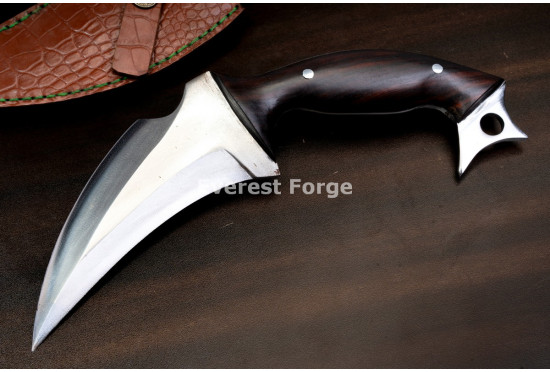
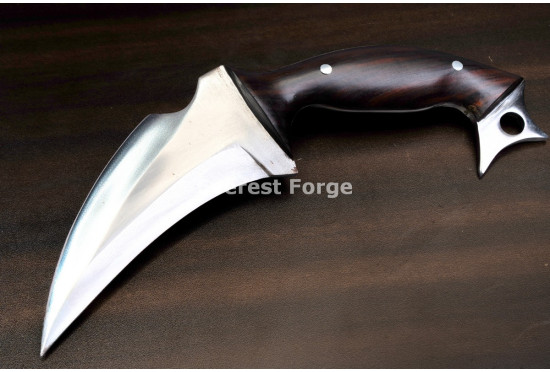
The karambit began as a farming tool in Southeast Asia, taking its shape from a tiger's claw: a deep curved blade that hooks into whatever you are cutting and does its work as you draw it back toward you. Everything about the form follows from that one idea. This is a large 6 inch hand-forged interpretation of it, mirror polished, on a contoured rosewood grip with a steel ring pommel.

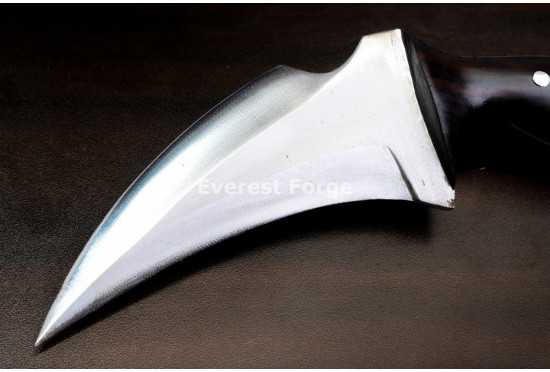
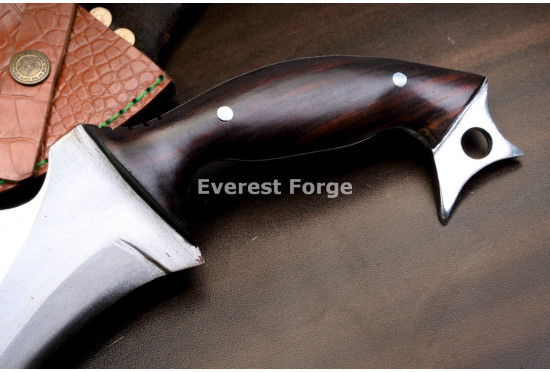
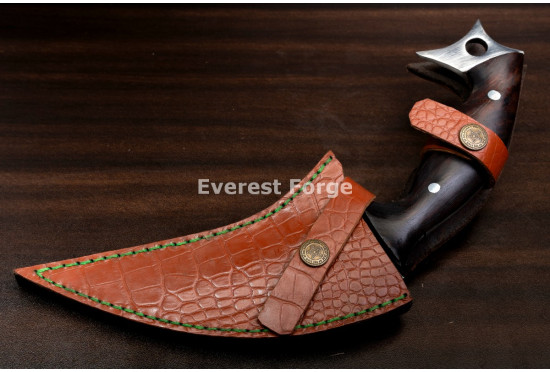
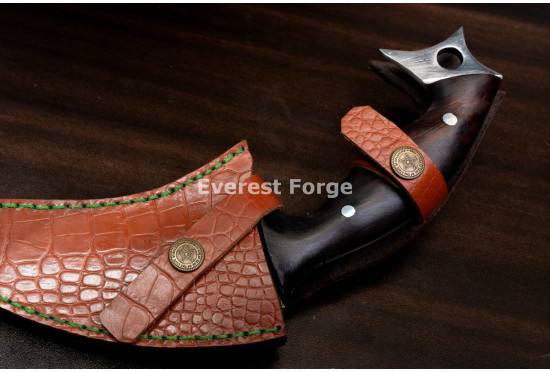
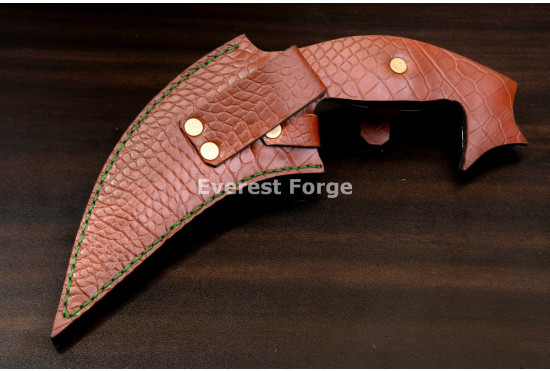
The blade is forged from 5160 high-carbon steel, oil-quenched and tempered, wide and thick at the base and sweeping down through a deep curve to a fine point. It weighs 420 grams, which is a great deal of steel for six inches, and that mass sits back toward the hand where the blade is widest. The 6.5 inch grip is rosewood on a full tang, pinned with two rivets and shaped with a swell that fills the palm. At the butt is a flared steel ring pommel with a hole through it. The sheath is crocodile-embossed leather in tan, stitched in green, cut to the curve and closed with two studded straps.

An honest note about how this is held. A traditional karambit has its ring at the front of the grip, right behind the blade, and is held in reverse with the index finger through the ring so the blade curves back out of the bottom of your fist. This one is not built that way. The ring here is at the butt end, and the grip is conventional and forward-facing, so you hold it like an ordinary knife with the blade curving down and away. That makes it a different tool from a traditional karambit and, for most people, a considerably more useful one — forward grip is how you actually cut cord, open a bale or work through a vine. But if you were expecting to hook your index finger through a ring behind the blade, this is not that knife, and we would rather say so now.

Custom Forge

Want This Built Your Way?

A traditional forefinger ring, a different blade length, another grip material, a plain leather sheath, or your own drawing entirely. Our smiths in Kathmandu forge to specification and quote before any work begins.

Start a Custom Build

What the Shape Does

Hooks and HoldsA deep curve traps whatever you are cutting inside it instead of letting it slide off the edge. Rope, vine, webbing and hide all stay put where a straight blade pushes them away.
Cuts on the PullThe geometry works as you draw the blade toward you, which is a stronger motion than pushing and gives you far more control over how deep the cut goes.
Mass at the Base420 grams over six inches, with the width and weight sitting back near the hand rather than out at the point. It feels planted rather than whippy.
Fine PointThe curve closes to a genuinely acute tip, which is what lets it start a cut anywhere on a surface rather than only at an edge.
Ring PommelFlared steel at the butt, drilled through. Retention, a lanyard point, and a hard stop behind the hand on a knife with a curved blade pulling backward.
Full Tang, Two PinsSteel running the length of the grip. On a blade used with pulling force, the tang is doing more work than it would on a push cut.

Standard Build and Specifications

Blade Length6 inches
Handle Length6.5 inches
Total Length12.5 inches
Blade WeightApprox. 420 grams
Total WeightApprox. 570 grams
Blade Steel5160 high-carbon spring steel, oil-quenched and tempered
Blade ProfileDeep hawkbill curve, wide at the base, closing to a fine point
Grip OrientationConventional forward grip. Ring at the butt, not a forefinger ring
FinishPolished (standard build — selectable)
ConstructionFull tang, two pins through the grip
GripContoured rosewood with a palm swell (standard build — selectable)
PommelFlared steel ring, drilled through
SheathCrocodile-embossed leather, green stitched, two studded straps
EdgeSharpened and ready to use
OriginHand-forged in Tokha-3, Kathmandu, Nepal

Blade length, blade finish and grip material are selectable, so the figures above describe the standard build rather than every version. Because each piece is forged, ground and fitted by hand, weights and dimensions vary slightly between examples.

Build Options

Ring PositionRing at the butt as standard, with a conventional forward grip. If you want the traditional arrangement — forefinger ring behind the blade, held in reverse — we will build it, and it is a genuinely different knife in the hand.
Blade Length6 inches as standard. Shorter tightens the curve and makes it more of a utility hook; longer opens the curve out and starts to behave more like a conventional knife.
Grip MaterialContoured rosewood as standard. Water buffalo horn, micarta and stacked leather are all available. Micarta ignores humidity entirely; leather grips best when wet.
Blade FinishPolished as standard, which suits the curve. Satin cuts glare and hides working marks. A dark forge finish is available and reads considerably more agricultural.
SheathCrocodile-embossed leather as standard. Plain leather, other colours, different stitching or a belt loop in place of the straps can all be made.
EngravingInitials, a name or a date cut into the flat at the base of the blade, which is the only part wide enough to carry it. Send us the text and we will show you the layout.

Is This the Right Knife for You?

Choose This One If

  • You cut a lot of cord, webbing, bale twine or vine, where a hooking blade beats a straight one
  • You want the karambit shape in a forward grip rather than the reverse-grip traditional form
  • You like the form as an object — it is the most distinctive shape we make
  • You want mass in a small package: 420 grams of blade in six inches
  • You want a fine point that will start a cut anywhere on a surface

Look Elsewhere If

  • You want a traditional reverse-grip karambit — ask us to build one, because this is not that
  • You want a general camp knife — a curved blade is poor on a board and cannot be batoned
  • You want easy maintenance — a fully curved edge is the most awkward kind to sharpen
  • You want a robust point — this one is fine, and fine points are the first thing to go

How to Order

Decide Which Grip You WantThe forward grip with a butt ring is standard. If you want the traditional forefinger ring behind the blade, say so at the point of order — the whole handle is built differently.
Choose Your BuildBlade length, finish, grip material and sheath.
Check Your Local LawBlade laws differ by country, state and province. Check before you order — we cannot advise on your jurisdiction and we cannot refund a seizure.
We Forge and ConfirmStock builds dispatch in 2-3 business days. Custom builds take 4-6 weeks. We photograph the finished piece before it ships.

Who This Knife Is For

  • Anyone who cuts cord and webbing regularly — riggers, sailors, farmers, anyone opening bales
  • Gardeners and smallholders — the hook is close to a pruning blade and works the same way on green growth
  • Collectors of blade forms who want a forged karambit rather than a stamped tactical one
  • Buyers drawn to the shape — it is the most striking thing in our range and that is a fair reason
  • Anyone who has used a hawkbill and understands what a pulling cut does

What Is Included

  • One hand-forged karambit, sharpened and ready to use
  • Crocodile-embossed leather sheath with two studded straps
  • Everest Forge manufacturer warranty
  • Care instructions

More From the Everest Forge Collection

Shipping, Returns and Care

Stock builds dispatch from our workshop within 2-3 business days. Custom and made-to-order builds take 4-6 weeks from confirmation, and we photograph the finished piece before it leaves us. We ship worldwide with DHL and FedEx, fully tracked, typically 7-14 business days in transit. Every blade carries the Everest Forge manufacturer warranty against defects in forging and construction.

Blade laws vary by country, state and province and it is the buyer's responsibility to check local restrictions before ordering. We cannot advise on your jurisdiction and we cannot refund a blade seized in transit.

5160 is a high-carbon steel and it will rust if you let it. Wipe the blade dry after use and keep it lightly oiled, paying particular attention to the inside of the curve, which is the concave face where a cloth drawn along a flat blade never quite reaches, and to the inside of the ring where it meets the grip. The point wants care of a different kind: it is fine, and fine points are what break, so do not use it to pry, lever or turn anything. If you cut anything acidic or green, clean it promptly — sap and juice sit in the inside of a curve where you cannot see them.

Made in Nepal

Forged by Hand, Not Assembled

Every blade we sell is forged, ground, heat-treated and fitted by our own smiths in Kathmandu. If you want something we do not list, we will make it.

Talk to Our Smiths

Frequently Asked Questions

What is a karambit?

A curved knife from Southeast Asia, originally an agricultural tool from the Indonesian and Malay world, and one of the few blade shapes that is genuinely modelled on something in nature — the name and the form both come from a tiger's claw. It began as a farming implement for cutting roots, threshing and harvesting, and the shape is entirely practical: a deep curve hooks into what you are cutting rather than sliding off it, and the blade does its work as you draw it back toward yourself. It later acquired a reputation as a martial weapon in the region, and more recently a rather louder reputation in the Western tactical market, but the shape is an agricultural one first. Ours is forged as a working blade in that older sense.

How is this held? Is the ring for my finger?

No, and this is the most important thing to understand before ordering. On a traditional karambit the ring sits at the front of the grip, immediately behind the blade, and the knife is held in reverse with the index finger through it so the blade emerges from the bottom of a closed fist curving backward. That is a specific and rather specialised way to hold a knife. This piece is built the other way: the ring is at the butt end, behind your hand, and the grip is conventional and forward-facing, so you hold it exactly as you would hold any knife and the blade curves down and away from you. For cutting cord, opening bales, pruning or working through vine, the forward grip is considerably more useful. If you specifically want the traditional reverse-grip arrangement, we will build it, but tell us at the point of order because the entire handle differs.

What is a hawkbill blade actually good for?

Anything that would otherwise slide off a straight edge. That is a longer list than most people expect: rope and cord, bale twine, webbing and strapping, cardboard and packaging, vine and green growth, hide and hose. A straight blade pushes those materials away as you press into them, so you end up chasing the cut; a curved blade traps them in the hollow of the curve and holds them there while the edge works. The same geometry is why pruning knives, linoleum knives, rope knives and carpet knives have all independently ended up hawkbilled. Where it is poor is anything flat: you cannot use it on a cutting board, you cannot slice cleanly with it, and it will not chop. It is a specialist, and knowing which speciality is the difference between loving it and never picking it up.

Why does it cut better on the pull?

Two reasons, one geometric and one anatomical. Geometrically, as you draw a curved blade back the material slides along the edge into the tightening part of the curve, so the effective cutting angle keeps changing and the material is progressively squeezed against the sharpest available section rather than resting on one spot. That is a slicing action rather than a pressing one, and slicing needs far less force. Anatomically, pulling is simply stronger and more controlled than pushing for most people — you are using your back and shoulder rather than just your arm, and you can feel exactly how much force is going in. Together they mean a hawkbill cuts rope with a fraction of the effort a straight blade needs, and stops exactly where you decide to stop.

Is it a working knife or a display piece?

A working knife with a narrow speciality, which is a different thing from a display piece. The steel, the heat treatment and the edge are the same as everything else we forge, and if your work involves cord, webbing or green growth this will earn its place immediately. What it will not do is general knife work: it is useless on a board, it cannot be batoned, you cannot use the spine, and slicing anything flat is awkward. So it is not a camp knife and we would not sell it as one. Plenty of people also buy it because the shape is striking, and that is a perfectly reasonable thing to buy a forged blade for — we would simply rather you knew which of the two you were doing.

How do I sharpen a fully curved edge?

With a round or oval rod, and this is the real cost of the shape. A flat bench stone is useless here: lay this blade on one and the stone touches the heel and the point and bridges everything between them, so you sharpen the two parts that matter least. What you need is a ceramic rod, a round diamond rod or a tapered sharpening steel small enough to sit inside the curve, worked along the edge in short strokes while you rotate the blade to keep the angle constant. It takes longer than sharpening a straight blade and it takes practice. Our fantasy knife has a recurved section with the same problem over part of its length; here the entire edge is one continuous concave arc, so there is no flat section to fall back on at all.

What is the ring pommel for?

Retention first. On a knife that cuts by being pulled, every working stroke is trying to drag the handle out of your hand, which is the opposite of a normal knife where the force pushes the grip into your palm. The flared steel ring sits behind your hand as a hard stop against exactly that, and it is the reason a butt ring makes sense on this blade specifically rather than being decorative. Beyond that it does what rings do: takes a lanyard or a carabiner directly with no separate fitting, and hangs the knife on a hook, a branch or a pack loop. Our ring pommel chopper carries the same idea with the ring cut from the tang, and it is worth a look if you like the arrangement.

What steel is it?

5160 high-carbon spring steel, oil-quenched and tempered. It is the family of steel used for vehicle leaf springs, which is where the Nepali practice of forging blades from them comes from, and it is chosen for toughness rather than for maximum hardness. On a blade with a point this fine, that choice matters: an acute tip in very hard, brittle steel is the classic way to snap a knife, whereas 5160 at a working temper will bend slightly and come back. The trade-off is that it wants sharpening a little more often than a harder alloy would — which on a curved edge is more of an imposition than usual, so it is worth being honest that this is not a low-maintenance knife. It is not stainless and will rust if neglected.

Is the point fragile?

It is fine rather than fragile, and the distinction matters. The tip is genuinely acute, which is what lets it start a cut in the middle of a surface rather than only at an edge, and that is a real capability. But a point is only ever as strong as the steel immediately behind it, and on a tip this narrow there is not much. It will pierce, it will start cuts, and it will handle everything the blade is designed for. What will break it is prying, levering, twisting or using it as a screwdriver or a punch — the same things that break every fine-pointed knife ever made. If you need a tip you can lean on, our spear point dagger has a centreline point supported from both sides and is built for exactly that.

What is the sheath made of?

Crocodile-embossed leather, which means cowhide pressed with a crocodile-skin pattern rather than crocodile skin itself. We say so plainly because plenty of listings do not, and because it is the honest answer: this is good leather with a stamped texture, not exotic hide, and it is priced and made accordingly. It carries no CITES implications and raises no import questions, which real crocodile would. The sheath is cut to follow the curve of the blade, which takes more work and more waste than a straight sheath, and closes with two studded straps. If you would rather have plain leather, or another colour, we will make it.

How do I look after it?

Standard carbon steel care with one shape-specific problem. The inside of the curve is a concave surface, and a cloth drawn along a blade the way you would clean a straight knife simply does not reach into it — so that is where moisture and residue sit unnoticed, and where rust starts on this piece. Wrap the cloth around your finger and work it into the hollow deliberately, every time. The same applies to the inside of the ring where it meets the grip. Beyond that: wipe dry after use, oil lightly, do not store it sheathed for long periods in a damp climate, and clean it promptly after cutting anything green or acidic, since sap collects in exactly the place you cannot see.

Can I have a different size or a traditional ring?

Both. The traditional forefinger ring behind the blade, with the reverse grip that goes with it, is the most common request and we build it — but it is a genuinely different knife in the hand rather than a fitting swap, so it needs specifying at the point of order. On size, a shorter blade tightens the curve and makes it more of a pure utility hook, which suits cord and packaging work; a longer one opens the curve out and it starts behaving more like a conventional knife, which somewhat defeats the point. Grip material, finish and sheath can all be specified alongside. Tell us what you actually intend to cut and we will tell you what we would build.

Specification
Blade: 6 inches. Hand forged from 5160 carbon steel. Deep hawkbill curve, wide at the base, closing to a fine point
Total Length: 12.5 inches
Handle: 6.5 inches, full tang with two pins, contoured rosewood with a palm swell, flared steel ring pommel drilled through
Weight: Approx. 420 g blade, approx. 570 g total
Note: Clean the inside of the curve deliberately - a cloth drawn along the blade never reaches into a concave face, and that is where rust starts on this shape.

Write a review

Note: HTML is not translated!
Bad Good
Captcha