Menu
Your Cart

Hand-Forged Cinquedea Short Sword

Hand-Forged Cinquedea Short Sword
$189.99
Ex Tax: $189.99
  • Model: Short sword
  • Product Code: cinquedea018
  • Location: Kathmandu, Nepal

Available Options

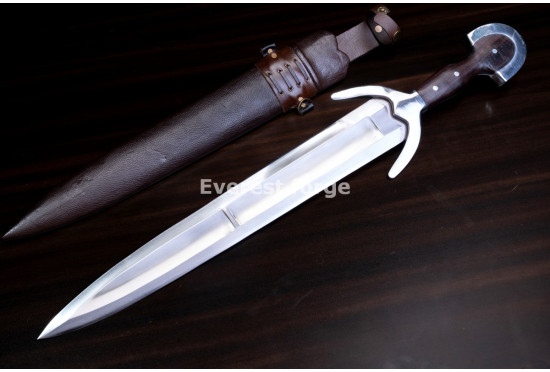
A Hand-Forged Cinquedea Short Sword With an Arched Guard and Fullered Blade

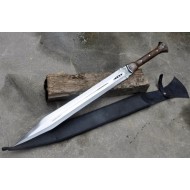
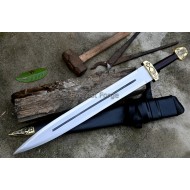
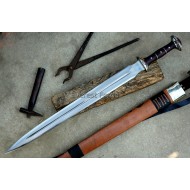
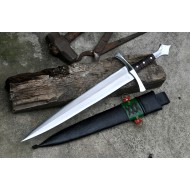
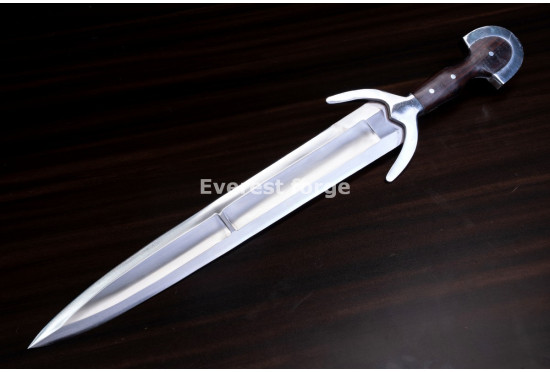
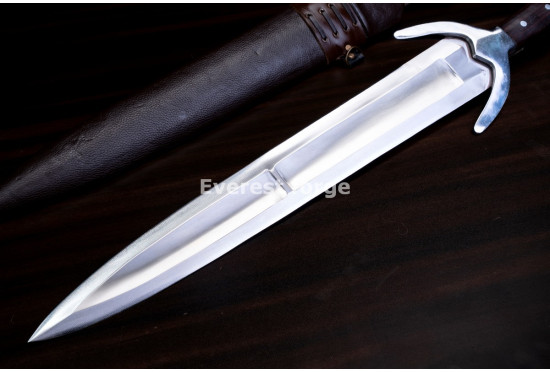
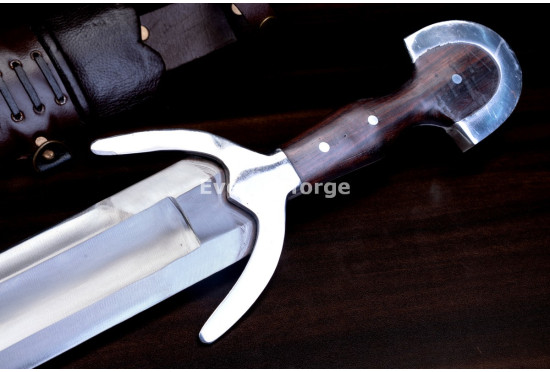
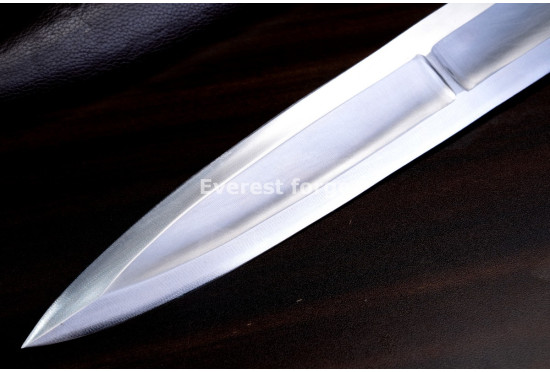
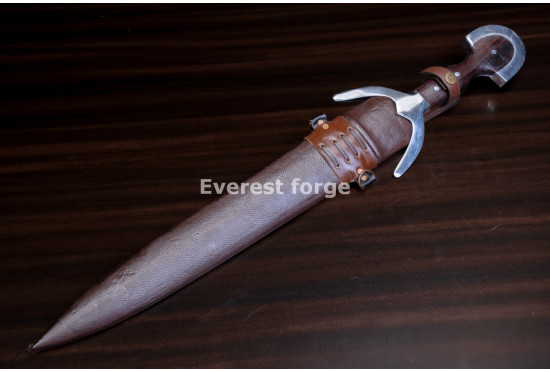
This is an 18 inch hand-forged cinquedea, the broad short sword of Renaissance Italy. The blade is double-edged and wide at the shoulder, tapering evenly to an acute point, with broad flat fullers running down each face in the stepped arrangement the type is known for. The hilt carries the cinquedea's characteristic architecture: a deeply arched guard sweeping forward toward the blade and a curved arc-shaped pommel cap, with rosewood scales pinned through the tang between them. Overall length is 26 inches. Forged from 5160 high-carbon steel in Tokha-3, Kathmandu, and supplied in a brown leather scabbard with a laced belt panel.

An honest note. The name cinquedea means five fingers, and it refers to the width of the blade where it meets the guard: a full example measures roughly three and a half to four inches across at the ricasso, which is dramatically wide and is the whole point of the type. Ours is broad but not that broad, so this is a cinquedea in hilt architecture, blade section and proportion rather than a blade-width reconstruction. Everything else is right — the arched guard, the arc pommel, the stepped fullers, the length. If you want the full five-finger width, our smiths will forge it and it is the first option below; it is a strikingly different object in the hand and it is the version a collector of the type will want.

Made to your specification

Have This Sword Forged Your Way

Blade width, length, fuller arrangement and etched decoration are all decided at the forge. Send a description or a photograph of a museum piece and our smiths will quote it.

Start a Custom Forge Order →

Why This Sword Is Built the Way It Is

An Arched Guard, Not a CrossThe guard sweeps forward in a deep arc rather than sitting straight across. It is the single feature that identifies a cinquedea at a glance and it is forged rather than fabricated from bar.
Stepped Fullers Across the FaceBroad flat channels running down the blade in ranks. On a wide blade these do real work, taking weight out of the middle where it contributes least while leaving raised ribs that stiffen the section.
Built to Be Looked AtThe cinquedea was a civilian status object rather than a battlefield weapon, and it is one of the few historical arms whose job was partly to be seen. We have built it accordingly.

Specifications

Blade Length18 inches
Handle Length8 inches, of which 4.5 inches is grip
Overall Length26 inches
Blade Steel5160 high-carbon spring steel, oil-quenched and tempered
Blade ProfileDouble-edged, broad at the shoulder, tapering evenly to an acute point
FullersBroad flat fullers in a stepped arrangement down each face
GuardDeeply arched steel guard sweeping forward toward the blade
GripRosewood scales pinned through the tang
PommelCurved arc-shaped steel cap
Standard BuildSatin blade, rosewood scales — size, finish and grip material are selectable above
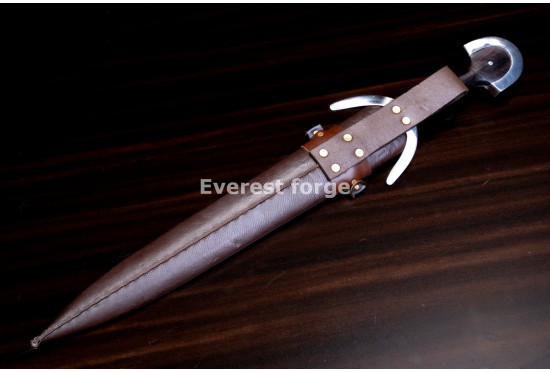
ScabbardBrown leather with a laced belt panel and brass fittings
OriginHand-forged in Tokha-3, Kathmandu, Nepal

Build Options

Full Five-Finger Blade WidthWidened at the ricasso to the three and a half to four inches a true cinquedea carries. This is the change that makes it a reconstruction, and it transforms how the piece reads.
Etched DecorationThe surviving cinquedeas are among the most decorated blades in European arms, with classical scenes, foliage and gilt worked into the fullers. We etch by hand; send us a subject.
Blade LengthTwelve to twenty inches. The type runs from large dagger to genuine short sword and all of it is historical, so this is a real choice rather than a size preference.
Grip MaterialRosewood as standard. Horn, bone or a fitted one-piece grip in the period manner, all cut in the same workshop.
Blade FinishSatin as standard. Mirror polish suits a display piece and shows the fullers better; a dark forge finish suits a working look.
Horizontal Carry RigWorn flat across the small of the back, which is how these were actually carried. Tell us and we will build the scabbard and straps for it.

Is This the Right Sword for You?

Buy This If You Want

  • One of the most distinctive silhouettes in European arms, and one almost nobody else forges
  • The arched guard and arc pommel that identify the type at a glance
  • A blade that carries etched decoration better than any other historical form
  • A Renaissance civilian piece rather than another battlefield weapon
  • The base for a properly wide five-finger reconstruction

Look Elsewhere If You Want

  • A full-width cinquedea out of the box — ask for the five-finger blade as a custom build
  • A dagger; at 26 inches overall this is a short sword and our dagger pages are the right place
  • A battlefield reconstruction, since this was a civilian weapon and the record says so
  • A stainless blade needing no care, since 5160 is carbon steel and will rust if left wet
  • A sparring or HEMA trainer, which needs rolled edges and a rebated point from the first heat
Fifteen years at the anvil

Etched to Your Design

No historical blade carries decoration like a cinquedea. Classical figures, foliage, an inscription or a coat of arms, cut into the fullers by hand. Tell us the subject.

Talk to the Forge →

How to Order

Choose your blade length, finish and grip material from the options above the description.
Note whether you want the full five-finger blade width and any etched decoration in the order comments.
We confirm the build by email and start forging. Preparation takes seven to ten days.
Your sword ships tracked and arrives a further seven to ten days later.

Who This Sword Is For

  • Collectors of Renaissance arms who want a form that is rarely made properly and rarely made at all
  • Re-enactors and living history groups covering fifteenth and sixteenth century Italy
  • Film, stage and photography armourers needing a silhouette nobody will mistake for anything else
  • Anyone commissioning an etched piece, for whom this blade is the best canvas in European arms

What Is Included

  • One hand-forged cinquedea short sword, sharpened and ready
  • Fitted brown leather scabbard with laced belt panel
  • Certificate of hand-forging from the workshop
  • Everest Forge manufacturer warranty against defects in forging and heat treatment

Explore the Collection

Shipping, Returns and Care

Every piece is prepared at the forge in seven to ten days, and shipping adds a further seven to ten days. Orders to the USA and Canada travel with FedEx; everywhere else ships on a DDP service, which means duties and taxes are settled before the parcel moves so there is nothing to pay on delivery. Every piece carries the Everest Forge manufacturer warranty against defects in forging and heat treatment.

Long double-edged blades are restricted in some countries and in some states and provinces within them, and the rules for a double-edged weapon are often stricter than for a single-edged blade of the same length. It is your responsibility to check that this sword may lawfully be imported and possessed where you live before ordering, because a parcel seized by customs cannot be returned to us and cannot be refunded. Ask us before you buy if you are unsure and we will tell you what we know about your destination.

5160 is a high-carbon steel and it will rust if left wet or stored damp. Wipe the blade dry, keep a light film of oil on it, and pay particular attention to the fullers, which are broad and shallow and hold moisture that a cloth passes straight over. Do not store the sword in the scabbard for long periods. The rosewood scales take an occasional coat of oil. If you order etched decoration, oil it as you would the rest of the blade; etching cuts into the surface and gives corrosion somewhere to start.

Frequently Asked Questions

What is a cinquedea?

A broad, short, double-edged sword made in northern Italy from roughly the middle of the fifteenth century into the sixteenth, associated particularly with Verona and Venice. The name means five fingers and describes the blade's width at the ricasso: a full example is broad enough to lay five fingers across where it meets the guard, which is dramatically wider than any other European blade of comparable length. The rest of the form is just as distinctive — a guard that arches forward toward the blade rather than crossing it, an arc-shaped pommel cap, and ranks of broad flat fullers stepped across each face. It exists across a size range, from pieces short enough to be called daggers up to genuine short swords like this one, and the whole range is historical. Very few makers attempt it, which is the main reason most people have never seen one outside a museum.

Is this one full width?

No, and it is the one place this piece departs from the record, so we would rather lead with it than bury it. A true cinquedea measures roughly three and a half to four inches across the blade at the ricasso. Ours is broad but not that broad. Everything else is correct: the arched guard, the arc pommel, the stepped fullers, the proportions and the length are all right, so it reads as a cinquedea and is recognisably one. What it is not is a blade-width reconstruction. We build the full five-finger version to order, and the difference is not subtle — a properly wide cinquedea is a startling object, far more so in the hand than in a photograph, and if you know the type it is the version you want. It is the first build option above and it costs surprisingly little more, since the work is in the forging rather than the material.

Was it a battlefield weapon?

No, and this is the most interesting thing about the type. The cinquedea was a civilian weapon and a status object, carried in Renaissance Italian cities by merchants, officials, gentlemen and their sons. It went with civilian dress rather than armour, it was worn where it would be seen, and a great many surviving examples are lavishly decorated with etched and gilded classical scenes, foliage, mottoes and coats of arms — work that would be absurd on something intended for a battlefield. In a period when carrying a sword in the street was regulated, a broad short blade sat in a useful legal and social space: unmistakably a weapon, obviously expensive, and not a soldier's arm. It is one of the very few historical weapons whose job was partly to be looked at, and understanding that explains everything about how it is shaped and finished.

What do the stepped fullers do?

Real work, unusually for decorative-looking fullering. On a narrow blade a fuller removes metal from the centre where it contributes least to stiffness, and one fuller does nearly all of that job. A cinquedea blade is exceptionally wide, so there is a great deal of relatively idle metal spread across the face, and cutting several broad channels in ranks removes a meaningful amount of it while leaving raised ribs between them that stiffen the blade like the flutes in sheet metal. The result is a blade far lighter than its width suggests and stiffer than a plain flat blade of the same section. That is why the arrangement appears on this type and almost nowhere else: it is a solution to a problem only very wide blades have. It also happens to give the etcher a framed panel to work in, which is not a coincidence.

Why does the guard arch forward?

Partly protection and partly proportion. A cinquedea blade is so wide at the shoulder that a conventional straight cross would have to be very long to project past it, and would look wrong and catch on everything. Arching the guard forward follows the line of the blade instead, so the arms reach out over the widest part and cover the hand without the guard being oversized. It also puts the arms where they can catch a blade sliding down toward the hand rather than shedding it off the ends, in the same way forward-curved quillons do on a medieval dagger. Visually it ties the hilt and blade together into one shape, which is a large part of why the type is so recognisable in silhouette. Ours is forged rather than cut from bar stock, which is why the arms taper and thicken along their length.

How was it carried?

Horizontally, flat across the small of the back, hung from the belt so the hilt sat near the right hip and fell to hand naturally. A blade that wide does not hang vertically on a belt without being awkward, and horizontal carry keeps it out of the way when sitting, riding or walking through a crowded street. It also has the effect of displaying the scabbard, which on a decorated piece is part of the point. This one ships with a belt panel that will hang either way. If you want the historical horizontal arrangement, tell us and we will build the scabbard and straps for it, which is a different set of fittings rather than an adjustment.

Is it a sword or a dagger?

At 18 inches of blade and 26 inches overall this is a short sword, and we list it as one. The type spans the boundary: cinquedeas were made from around ten inches of blade up to around twenty, and the small ones are properly called daggers. Our own rule across the catalogue is that past roughly sixteen to eighteen inches a piece stops being a dagger in any useful sense and should be built as a sword with a grip proportioned to match, which this one has at 8 inches with a 4.5 inch grip. If you want the dagger end of the range, order twelve to fourteen inches and we will shorten the hilt with it. That is genuinely the same weapon in a different size rather than a different product.

Can you etch it?

Yes, and no historical blade repays it like this one. The surviving cinquedeas are among the most decorated arms in Europe: classical figures, grotesques, foliage, inscriptions and heraldry worked into the fullers, frequently gilded, sometimes across the whole face of the blade. The stepped fullers give an etcher framed panels to work in, which is why the tradition attached to this type rather than to some other. We etch by hand in our own workshop. Send us a subject, an inscription, a coat of arms or a reference image and we will quote it. It adds to the lead time and it is the single change that most transforms the piece, particularly on the full-width blade where there is simply more canvas.

What steel is it, and how is it heat treated?

5160 high-carbon spring steel, brought to temperature in the forge, quenched in oil and tempered back so the edges are hard while the body stays springy. On a blade this wide the tempering matters in a specific way: a broad flat section has a great deal of surface and relatively little thickness, so it wants to be springy rather than hard through, and a blade tempered too far would take a set under lateral load instead of returning. The originals were made from the finest steel available in fifteenth century Italy, which was genuinely good and genuinely variable; a modern homogeneous alloy is stronger and far more predictable. It is not stainless, deliberately.

Is it full tang?

Yes. The tang is the full width and shape of the grip with rosewood scales pinned through it, and the line of steel shows between the scales along the outline of the handle. That is also how the surviving examples are built: cinquedea hilts characteristically use riveted grip plates over a broad flat tang, often with the tang itself pierced in patterns and the scales shaped around the piercings, rather than a narrow tang with a fitted pommel. So on this point the construction follows the record rather than departing from it. If you want the pierced tang, that is a custom order and it is a striking detail on a piece that is already about being looked at.

How sharp does it arrive?

Sharp and ready, with both edges put on a stone by hand at the forge. If you would prefer it shipped unsharpened — for display, for a gift, for a group where a live edge is not permitted, or because of the rules where you live — say so in the order comments and we will do it at no extra cost, and rebate the point as well if you need it. Given that this type was a display weapon as much as a fighting one, a blunt cinquedea is a perfectly authentic thing to own, and a good many buyers of decorated pieces order it that way.

Where is this made, and by whom?

In our own workshop in Tokha-3 on the northern edge of Kathmandu, Nepal, by around ten smiths, most from families that have forged blades for generations. Everest Forge has operated since 2010, and we forge, grind, heat treat, fit the hilts, etch and cut the leather in the same building. An Italian Renaissance sword made in Nepal deserves the same word we give our bowie, our seax and our kopis: this is not our own tradition and we do not pretend it is. It is worked from the record, which is why this page tells you plainly which measurement ours does not match and offers to correct it.

Specification
Blade: 18 inches. Hand forged from 5160 carbon steel
Total Length: 26 inches
Handle: 8 inches (4.5 inch grip). Full tang with rosewood scales pinned through, arched steel guard, arc pommel cap
Weight: 940 Grams Approx
Note: Some variation in weight, dimensions and finish may occur as each piece is hand forged. Keep the blade lightly oiled when not in use

Write a review

Note: HTML is not translated!
Bad Good
Captcha