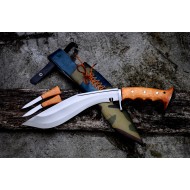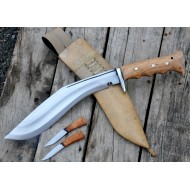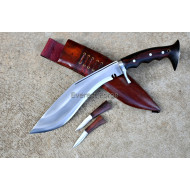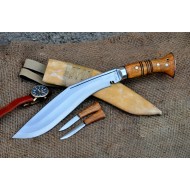
- Model: Hybrid Kukri
- Product Code: HYBRID0013
- Location: Kathmandu, Nepal
Available Options
A Hand-Forged Chirra Kukri With a Single Fuller and Back-Edged Tip
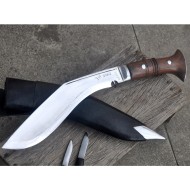
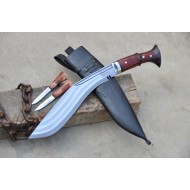
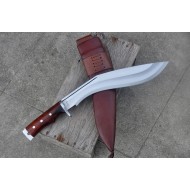
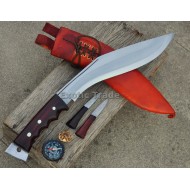
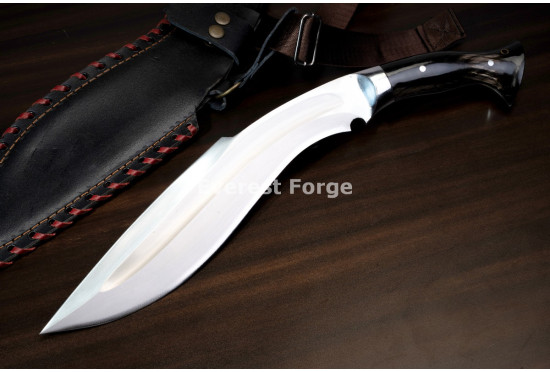
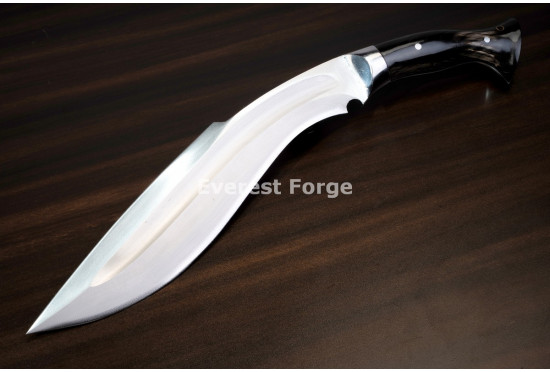
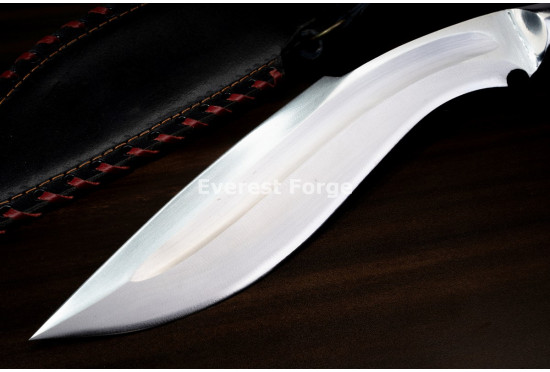
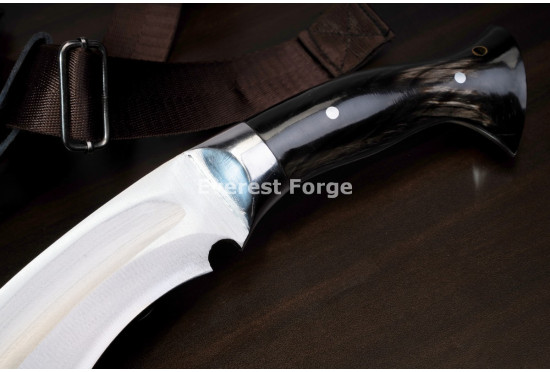
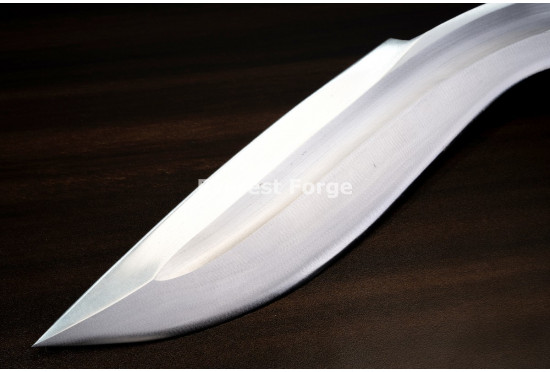
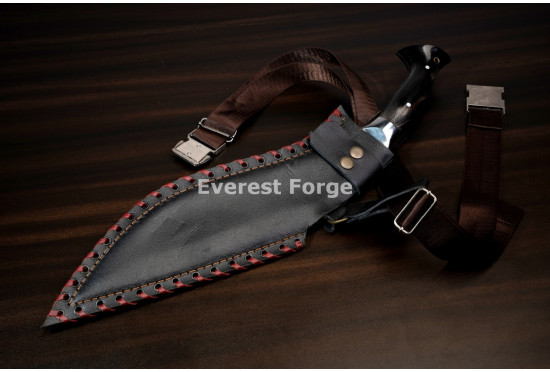
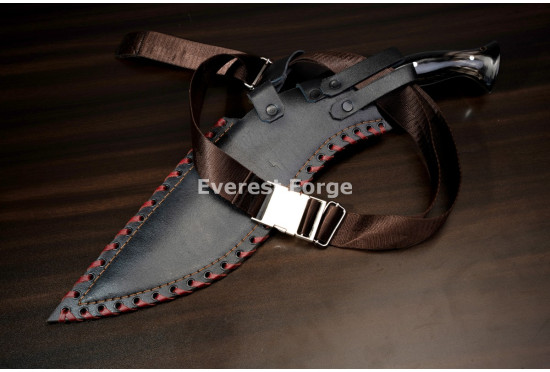
This is a 13 inch hand-forged kukri with a single broad chirra — the Nepali fuller — ground down the length of the blade, a deep belly through the working section, and a hand-cut cho at the base of the edge. The forward section of the spine carries a sharpened back edge, so the point will cut on the way out as well as the way in. The hilt is polished black horn with a fitted steel bolster and a flared butt, pinned through a full tang. Overall length is 19 inches and it weighs approximately 740 grams. Forged from 5160 high-carbon steel by our own kami in Tokha-3, Kathmandu, and supplied in a black leather sheath, red-laced and saddle-stitched, on an adjustable nylon harness.
An honest note. Read the back edge before you order. The spine on this kukri is sharpened over its forward section, and in several countries, states and provinces the legal test that matters is whether a blade carries a second sharpened edge at all — not how long that edge is or how sharp. That means this piece can fall under double-edged restrictions that our plain-spined kukris do not, in places where the rules turn on that question. It also has a practical cost: there is no flat spine to strike over the sharpened section, so you cannot baton the forward half. We will forge it with a plain spine at no extra charge and it is the first option below. We would rather you chose deliberately than discovered either of those after the parcel arrived.
Have This Kukri Forged Your Way
Blade length, spine thickness, chirra count and whether the back edge is sharpened are all decided at the forge. Tell us the job and our kami will tell you what to order.
Start a Custom Forge Order →Why This Kukri Is Built the Way It Is
Specifications
Build Options
Is This the Right Kukri for You?
Buy This If You Want
- A kukri with a genuinely usable point, which most of the pattern does not have
- A single broad chirra ground deep enough to see the work in it
- Black horn, the traditional hilt material, on a full-tang build
- Harness carry, so the weight sits on your shoulders rather than a belt
- A sheath laced and saddle-stitched by hand rather than run through a machine
Look Elsewhere If You Want
- To baton along the whole spine — order the plain spine, since the sharpened section leaves nothing flat to strike
- Certainty about double-edged rules where you live; the plain spine build removes the question
- A fully double-edged kukri, which is a different blade and we build one
- The karda and chakmak, which do not come with a harness rig
- A stainless blade needing no care, since 5160 is carbon steel and will rust if left wet
Ask Our Kami What to Order
Chirra count, spine thickness and whether that back edge is sharpened should follow the work and the rules where you are. Describe both and the smiths will tell you.
Talk to the Forge →How to Order
Who This Kukri Is For
- Buyers who want a kukri that thrusts as well as chops, which is unusual on this pattern
- Collectors of Nepali blades who want to see a deep single chirra done properly
- Campers and smallholders carrying on a rig rather than a belt
- Anyone who already owns a plain working kukri and wants something with more in the front third
What Is Included
- One hand-forged chirra kukri, sharpened and ready to use
- Fitted black leather sheath, red-laced and saddle-stitched, with press-stud strap
- Adjustable nylon harness
- Certificate of hand-forging from the workshop
- Everest Forge manufacturer warranty against defects in forging and heat treatment
Explore the Collection
Shipping, Returns and Care
Every piece is prepared at the forge in seven to ten days, and shipping adds a further seven to ten days. Orders to the USA and Canada travel with FedEx; everywhere else ships on a DDP service, which means duties and taxes are settled before the parcel moves so there is nothing to pay on delivery. Every piece carries the Everest Forge manufacturer warranty against defects in forging and heat treatment.
Large fixed blades are restricted in some countries and in some states and provinces within them, and a blade with any sharpening on the spine may be classified differently from a single-edged knife of identical size. It is your responsibility to check that this kukri may lawfully be imported and possessed where you live before ordering, because a parcel seized by customs cannot be returned to us and cannot be refunded. If the rules where you are turn on whether a blade is double-edged, order the plain spine and say so in the comments. Ask us before you buy if you are unsure.
5160 is a high-carbon steel and it will rust if left wet or stored damp. Wipe the blade dry after use and keep a light film of oil on it, working a brush rather than a cloth down the chirra and into the cho, which are the two places a wipe will skip. Do not store the kukri in the sheath for long periods. Give the horn hilt a wipe of mineral oil two or three times a year, particularly if you live somewhere dry. The nylon harness washes and air-dries; keep the leather out of water.
Frequently Asked Questions
What does the sharpened back edge change?
Three things, and two of them are costs. What it gives you is a point that works in both directions: with the forward spine sharpened, the tip cuts on the withdrawal as well as the entry, and it will pierce and open a cut rather than simply pushing material aside. On a kukri that is genuinely unusual, and the next answer explains why. The first cost is that there is no flat spine over the sharpened section, so you cannot baton the forward half of the blade — you would be hammering a wooden baton onto an edge. The second is legal. In several countries, states and provinces the test is whether a blade carries a second sharpened edge AT ALL, not how long it is, so a partial back edge can bring the knife under double-edged restrictions that a plain-spined kukri escapes. Our spear-point camp knife page goes into that legal question in more detail, since it is the same problem on a different blade. Order the plain spine and both costs disappear.
Why do most kukris have a useless point?
Because it is not what the tool is for, and this is worth understanding before you decide whether the back edge matters to you. A kukri is a chopper: everything about it is arranged to put mass forward of the hand and drive an edge into wood at speed. The point is simply where the belly and the spine eventually converge, and on a traditional blade the spine at that convergence is still thick, unsharpened and blunt-shouldered. You can stab something with it in the sense that a heavy blunt spike will go in, but it will not pierce cleanly, it will not cut on the way out, and it takes a great deal of force. That is not a fault; a farmer clearing scrub has no use for a piercing tip, and thinning the spine there would weaken the part of the blade doing the hardest work. Sharpening the forward spine, as here, converts that convergence into a real point at the cost of some thickness and some spine you can hit. It is a deliberate trade toward a fighting knife and away from a farming one.
How is this different from your double-edged kukri?
By how much of the back is sharpened, and it is a real distinction rather than a matter of degree. Our Double-Edged Kukri carries a working edge along essentially the whole of its back, which makes it a genuinely two-edged blade: it cuts in both directions across the full length, it has no unsharpened spine at all, and it is unambiguously double-edged for any legal purpose. This one is sharpened over the forward section only, so the rear two-thirds of the spine is still thick, flat and usable — you can rest a hand on it, strike it with a baton, and choke up on the blade safely. In practice the partial edge gives you most of the point benefit with far less of the loss. In law, unfortunately, the two may be treated identically, which is why the honest note leads with that rather than burying it.
What is a chirra?
The Nepali word for the fuller ground into a kukri blade, and the name kukris are described by: a single chirra like this one, or two, three or five on more elaborate work. What it does is remove metal from the section of the blade nearest the hand, where it contributes least to the cut. Because a kukri is deliberately forward-biased, taking weight out of the rear sharpens that bias rather than balancing it, which is the opposite of what a fuller does on a straight sword. Past two or three chirras the extra grooves are decorative rather than structural, and each one is a separate pass of hand grinding on a curved surface, which is why chirra count tracks price. This blade carries one broad deep chirra rather than several narrow ones, which is the harder of the two to grind cleanly — the next answer explains how to tell whether it has been done properly.
How can you tell a well-ground chirra from a poor one?
Look into it, not at it. A chirra is ground with a wheel into a curved blade, which means the grinder is working a concave channel along a convex surface, and it is the hardest single operation on a kukri to do cleanly. On a good one the channel is even in width and depth along its length, the walls are smooth, the ends fade out rather than stopping abruptly, and the polish inside matches the polish on the flat of the blade. On a poor one the channel wanders in width, one wall is steeper than the other, and the inside is left rough because polishing into a concave groove is fiddly and time-consuming and nobody sees it in a photograph. That last point is the useful test: hold the blade to the light and look down the length of the chirra. If the inside is dull and scratched while the rest of the blade is bright, the maker stopped where the camera stops. Ours are polished into the groove.
Why is the sheath laced as well as stitched?
Because the two do different jobs and a kukri sheath benefits from both. The saddle stitching along the seam holds the two faces of leather together; the lacing around the edge, threaded through punched holes, does something else entirely. It lets the maker build a thicker edge into the sheath, so the sharpened blade sits against a rolled or doubled leather margin rather than against a stitched seam. That matters on a kukri more than most knives, because the edge is on the inner curve and the blade is drawn along that inside edge every time it comes out. A stitched seam alone will eventually be cut through by the blade it is holding. Lacing puts a sacrificial barrier in the way, is easily replaced if it ever wears, and happens to look striking in a contrasting colour. Ours is red against black, and it is done by hand along with the stitching.
What is the notch near the handle?
The cho, also called the kaudi, filed by hand into the edge just ahead of the bolster. It arrests cracks running back out of the edge into the tang, it keeps sap and fluid off the grip, and in Nepal it carries symbolic readings as well, variously a trident, a cow's hoof or a mark of the divine depending on who you ask. It is cut individually on every kukri we make. If you are looking at a kukri anywhere and there is no cho at all, or the cho is a perfectly identical stamping across every example in a listing, it did not come from a Nepali forge.
Is black horn a good hilt material?
Yes, and it is the traditional one. Water buffalo horn is dense, hard-wearing, cool in the hand, does not swell when wet the way some woods do, and takes a deep polish that improves rather than wears off. It is worked by heating until it softens and then pressing and cutting it to shape, which is a skill in its own right. The one caveat, which our kukri set page covers in full, is that horn is organic and responds to humidity: taken somewhere very dry it can shrink slightly over months and occasionally show fine surface cracks. Oiling it two or three times a year prevents nearly all of that. If you would rather not think about it, rosewood is the alternative and asks nothing of you.
What steel is it, and how is the edge hardened?
5160 high-carbon spring steel, the same alloy family as the vehicle leaf springs Nepali kamis have forged kukris from for generations. The edge is hardened differentially rather than the blade being through-hardened, so the cutting edge is hard while the spine and belly stay soft and springy and absorb the shock of chopping. On this blade the differential treatment covers the main edge; the sharpened back section is thinner and less hard than the main edge by design, because a hard thin spine on a chopping blade is where a crack would start. It is not stainless, deliberately, because the stainless grades that genuinely resist rust give up the toughness this tool depends on.
Is it full tang?
Yes. The tang is the full width and shape of the grip with black horn pinned through it, and a fitted steel bolster sits at the shoulder. That is stronger than the traditional Nepali arrangement, where the tang narrows into a solid one-piece grip secured at the butt cap, and we say so rather than claiming the older build is better because it is older. What the traditional hilt gives you is a cleaner look and a lighter handle; what this gives you is a hilt that will not loosen at the shoulder under years of hard chopping. Both are made here and the turned traditional hilt is a build option.
Can I baton with it?
Over the rear of the spine, yes. Over the forward section, no — that part is sharpened, and hammering a wooden baton onto an edge will destroy the baton and roll the edge. Strike behind the sharpened section where the spine is thick and flat, keep the blade square in the cut, and use wood rather than a rock. If batoning is a regular part of what you do, this is not the build to buy: order the plain spine, which gives you a clean striking surface along the whole length at no extra cost, or take our kukri machete, which has a flat spine and jimping instead.
Who makes these?
Our own kami, in our own workshop in Tokha-3 on the northern edge of Kathmandu. Kami is the Nepali word for smith, and most of ours came from families that have forged blades for generations. Everest Forge has operated since 2010, and we forge, grind, heat treat, cut and polish the horn, and cut, lace and stitch the leather in the same building. The chirra is the part of this blade that shows the hand most: grinding a clean concave channel along a curved blade is the operation that separates a smith who has done ten thousand from one who has done ten.
| Specification | |
| Blade: | 13 inches. Hand forged from 5160 carbon steel, single broad chirra |
| Total Length: | 19 inches |
| Handle: | 6 inches. Polished black horn pinned through a full tang, fitted steel bolster and flared butt |
| Weight: | Approx 740g kukri, 1120g with sheath and harness |
| Note: | karda utility knife, chakmak burnisher, fitted leather scabbard Some variation in weight, dimensions and finish may occur as each piece is hand forged. Keep the blade lightly oiled when not in use |