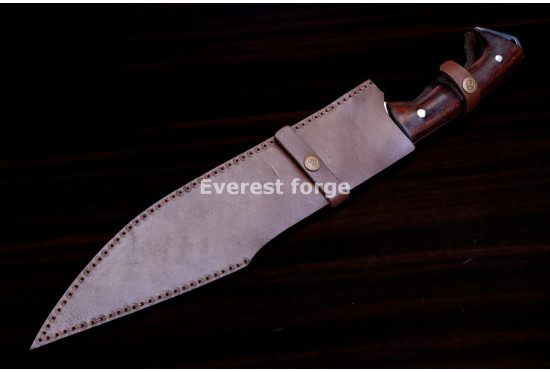
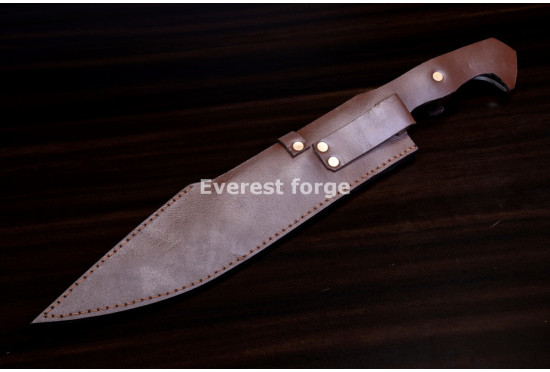
- Model: Forged Bowie
- Product Code: Spearpoint013
- Location: Kathmandu,Nepal
Available Options
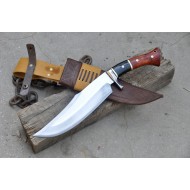
A Hand-Forged Spear Point Camp Knife With a Full Tang and Exposed Butt
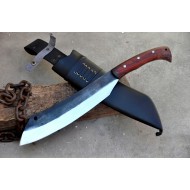
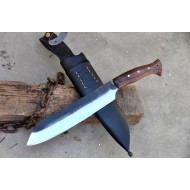
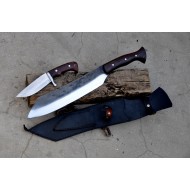
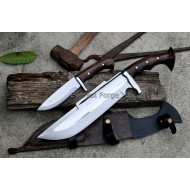
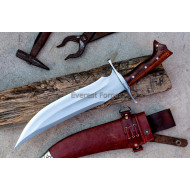
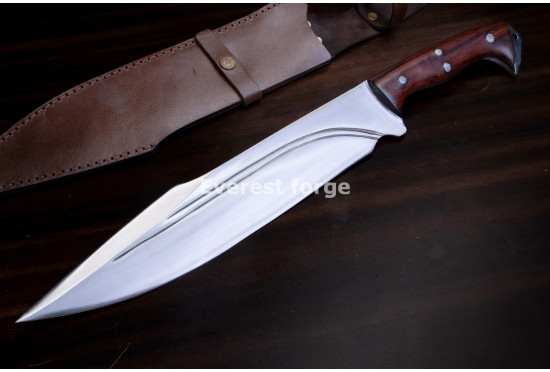
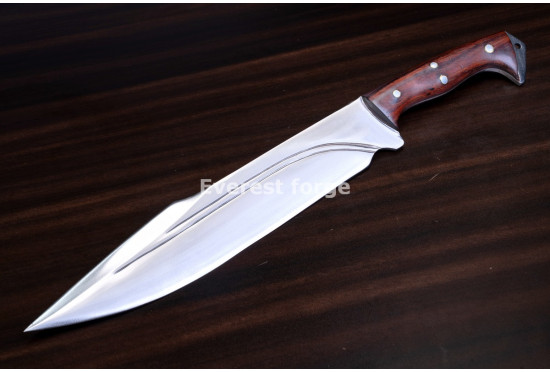
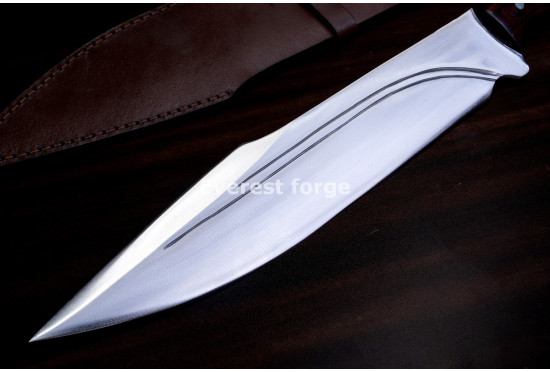
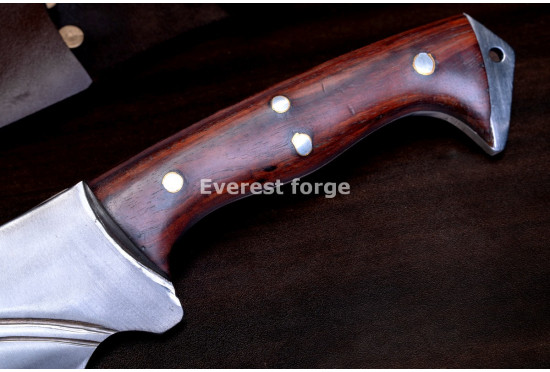
This is a 13 inch hand-forged camp knife with a spear point: a symmetrical blade whose edges converge to a point sitting on the centre line, with a long swedge running down the upper edge and a pair of fine narrow fullers along each face. The blade steps into an angular ricasso at the shoulder, and the hilt is contoured rosewood pinned through a full tang in four places, finishing in an exposed steel butt with a hook and a lanyard hole. Overall length is 19.5 inches and it weighs approximately 780 grams. Forged from 5160 high-carbon steel in Tokha-3, Kathmandu, and supplied in a stitched brown leather belt sheath with a press-stud strap.
An honest note. We are not calling this a bowie, and it is worth saying why since the shape invites it. A bowie is defined by its clip point — a straight spine cut away toward the tip so the point drops onto the centre line. This blade is symmetrical: both edges sweep evenly to a point that was always on the centre line, which is a spear point and a different thing. Our coffin-handle bowie page explains that distinction at length and our crossguard bowie page states plainly that it is not a true bowie for the same reason, so calling this one a bowie would have us contradicting ourselves twice on our own site. The second thing to know is that the upper swedge is partially sharpened rather than fully sharp or fully blunt. That is a real decision with consequences, and the answer below sets them out.
Have This Knife Forged Your Way
Blade length, spine thickness, whether the swedge is sharpened or left blunt, and the grip are all decided at the forge. Send a sketch or a description and our smiths will quote it.
Start a Custom Forge Order →Why This Knife Is Built the Way It Is
Specifications
Build Options
Is This the Right Knife for You?
Buy This If You Want
- One big knife that will do most camp jobs adequately rather than one job perfectly
- The strongest point geometry available at this size
- Full tang with an exposed steel butt you can hammer with
- A lanyard hole, for work where dropping the knife would lose it
- A forged carbon-steel blade you can bring back with a stone anywhere
Look Elsewhere If You Want
- A bowie — this is a spear point and our coffin-handle bowie is the real pattern
- A skinning or field-dressing knife; 13 inches with little belly is wrong for that work and our 9 inch field knife is right
- A dedicated chopper for firewood, where a kukri does far more per stroke
- A guard between hand and edge, since this knife has only the ricasso step
- A stainless blade needing no care, since 5160 is carbon steel and will rust if left wet
Tell Us What You Are Cutting
Blade length, spine thickness and whether that upper edge is sharp should follow the work and the rules where you live. Describe both and our smiths will tell you what to order.
Talk to the Forge →How to Order
Who This Knife Is For
- Campers and bushcrafters who want one large blade covering shelter, fire and camp work
- Hunters carrying a second knife for the heavy jobs a skinner cannot do
- Collectors of large forged blades who want a spear point rather than another clip point
- Anyone who works over water or at height, for whom the lanyard hole is the reason to buy it
What Is Included
- One hand-forged camp knife, sharpened and ready to use
- Fitted brown leather belt sheath with press-stud strap
- Certificate of hand-forging from the workshop
- Everest Forge manufacturer warranty against defects in forging and heat treatment
Explore the Collection
Shipping, Returns and Care
Every piece is prepared at the forge in seven to ten days, and shipping adds a further seven to ten days. Orders to the USA and Canada travel with FedEx; everywhere else ships on a DDP service, which means duties and taxes are settled before the parcel moves so there is nothing to pay on delivery. Every piece carries the Everest Forge manufacturer warranty against defects in forging and heat treatment.
Large fixed blades are restricted in some countries and in some states and provinces within them, and a knife with any sharpening on the upper edge may be classified differently from a single-edged knife of identical size. It is your responsibility to check that this knife may lawfully be imported and possessed where you live before ordering, because a parcel seized by customs cannot be returned to us and cannot be refunded. If the rules where you are turn on whether a blade is double-edged, order the fully blunt swedge and tell us in the comments. Ask us before you buy if you are unsure.
5160 is a high-carbon steel and it will rust if left wet or stored damp. Wipe the blade dry, keep a light film of oil on it, and pay attention to the fullers and to the exposed steel at the butt, which is bare metal with no finish protecting it. Do not store the knife in the sheath for long periods. The rosewood scales take an occasional coat of oil.
Frequently Asked Questions
Is a semi-sharpened swedge a problem?
It can be, and it is the one thing on this knife we would want you to think about before ordering. In several countries, states and provinces the legal test that matters is whether a blade is double-edged, and the definitions usually turn on whether a second edge is sharpened rather than on how sharp it is or how much of it is done. A partially sharpened swedge sits in the gap: it may be enough to bring the knife under a double-edged restriction, while not being sharp enough along its whole length to give you a reliable back cut. In other words the awkward case can collect the disadvantages of both. If the rules where you live turn on that question, order the fully blunt swedge, which we will forge at no extra cost and which changes nothing else about the knife. If you specifically want the back cut and it is lawful where you are, order it fully sharpened so at least it works. We ship semi-sharpened as standard because that is how this pattern is made, not because it is the option we would pick for you.
What is a spear point, and why not a clip point?
A spear point is symmetrical: both edges sweep evenly toward a tip that sits on the centre line of the blade. A clip point gets to roughly the same place by a different route, cutting the spine away near the tip so the point drops down from the top line. The practical difference is strength and belly. A spear point keeps steel on both sides of the tip all the way to the end, which makes it the strongest point shape at this size and the best of them for thrusting, because force travels straight down the centre line instead of levering the tip. What it gives up is belly: a clip or drop point leaves more curved cutting edge low on the blade, which is what you want for skinning and for long slicing cuts. So this is a knife built to be driven and to survive being driven, rather than one built to slice. If you want the clip point, our coffin-handle bowie is that knife and it is the historical article.
What actually is a camp knife?
It is a category defined by size and by compromise rather than by shape. A camp knife sits between a hunting knife, which is short and made for detail work on an animal, and a machete or kukri, which are long and made for cutting vegetation or wood. At around eleven to fourteen inches of blade it will do a bit of everything: split kindling, notch and shape wood, prepare food roughly, cut cord, drive tent pegs and clear a small amount of growth. What it will not do is any of those as well as the dedicated tool. That is the honest description of the category, and it is why the answer to "what one knife should I take" is usually a camp knife plus a small knife rather than a camp knife alone. Ours is at the upper end of the size range and correspondingly better at the heavy jobs than the light ones.
What is the exposed steel at the butt for?
Hammering, mainly, and it is one of the more useful things on this knife. The tang runs the full length and comes out at the back as a bare hooked butt, which gives you a hard flat steel surface to drive tent pegs, crack bone, tap a chisel or break something. A knife with a wooden or capped butt cannot do any of that without damage. The hook also stops the hand sliding off the back under a hard swing, which matters more here than usual because there is no guard at the front. The one cost is corrosion: that is bare high-carbon steel with nothing covering it, it sits against your palm, and hands are wet and salty. Oil it when you oil the blade. If you would rather have a capped butt in brass or steel we will fit one, and you lose the hammering surface.
What is the lanyard hole for, and should I use it?
It is for not losing the knife, and the honest answer to the second half is: sometimes. A cord through the butt is genuinely valuable where a dropped knife is gone for good — working from a boat, over water, at height, on a steep slope, in deep snow or undergrowth. It also lets you hang the knife rather than sheathing it while you work. What we would be careful about is the common advice to loop it round your wrist while chopping. On a light knife that is fine. On a 780 gram blade, if it turns or bounces out of your hand, a wrist loop keeps a heavy sharp object attached to you and swinging, and you cannot let go. A better arrangement is a loop long enough to go round the wrist loosely or to be held in the palm under the fingers, so it retains the knife without trapping your hand.
Why is it not called a bowie?
Because it does not have a clip point, and because we say on two other pages that a clip point is what defines the pattern. Our coffin-handle bowie has a true concave clip and its page explains the geometry. Our crossguard bowie has a drooping sabre profile and its page states plainly that it is not a true bowie for exactly this reason, while keeping the trade name because the piece occupies the bowie role. If we then attached the word to a symmetrical spear point as well, the term would mean nothing on our own site and neither of those two honest pages would be worth reading. The word has commercial value, so this is a real cost to us. We would rather pay it than have three pages disagreeing about what a bowie is.
What steel is it, and how is it heat treated?
5160 high-carbon spring steel, brought to temperature in the forge, quenched in oil and tempered back so the edge is hard while the body stays springy. It is the leaf-spring steel our smiths have worked for generations and a good match for a knife that will be batoned and hammered: tough enough to take repeated impact, and soft enough at our temper that the edge rolls rather than chipping when it finds grit or a nail. A rolled edge is straightened in a minute with a steel or a file; a chip is a repair. It is not stainless, deliberately, because the stainless grades that genuinely resist rust give up that toughness.
Can I baton with it?
Yes, with one caution specific to this blade. The tang is full width with four pins and the steel is thick, which is everything batoning needs. The caution is the swedge: the upper edge is partially sharpened for a good portion of its length, so you do not have a clean flat spine along the whole blade to strike. Strike over the rear section where the spine is square and full thickness, keep the blade level in the cut, and use a wooden baton. Do not strike over the sharpened section, both because it will chew the baton and because you are hitting a bevel rather than a flat. If you order the fully blunt swedge, you get a proper striking surface along the whole length and this stops being a consideration.
Is it full tang?
Yes, and on this knife you can see it without taking anything apart. The tang is the full width and shape of the grip with rosewood scales pinned through it in four places, and it emerges at the back as the exposed butt, so the steel is visible at both ends and along the outline of the handle. That is the strongest way to build a knife of this weight. The alternative, a narrow tang glued or peened into a solid handle, works loose at the shoulder under the repeated shock of chopping and hammering, and it is the standard failure point on inexpensive large knives.
How sharp does it arrive?
Sharp and ready to work on the main edge, put on a stone by hand at the forge, with a working edge rather than a razor polish because a camp knife meets wood, grit and bone. The upper swedge arrives partially sharpened as described above. If you would prefer the whole knife shipped blunt — for display, for a gift, or because of the rules where you live — say so in the order comments and we will send it unsharpened at no extra cost.
What are the two fine lines along the blade?
A pair of narrow fullers ground into each face, running most of the length of the blade. On a blade this thick they remove a small amount of weight and stiffen the section slightly by leaving a raised area either side of each groove, but their main effect is visual, and we would rather say so than dress it up. They are ground by hand, which is why they are never quite identical from one knife to the next and never perfectly parallel to the edge. If you want a plain blade, that is a free change; if you want a single deep fuller instead, we will do that too.
Where is this made, and by whom?
In our own workshop in Tokha-3 on the northern edge of Kathmandu, Nepal, by around ten smiths, most from families that have forged blades for generations. Everest Forge has operated since 2010, and we forge, grind, heat treat, fit the scales and cut the leather in the same building. This is a modern working design rather than a traditional pattern from anywhere, and we would rather say that than imply a heritage it does not have. What it does have is a forge behind it where large chopping and camp blades are made and used every day.
| Specification | |
| Blade: | 13 inches. Hand forged from 5160 carbon steel |
| Total Length: | 19.5 inches |
| Handle: | 6.5 inches. Full tang with contoured rosewood scales pinned through in four places, exposed hooked steel butt with lanyard hole |
| Weight: | approx 780g knife, 1000g with sheath |
| Note: | Some variation in weight, dimensions and finish may occur as each piece is hand forged. Keep the blade lightly oiled, including the exposed steel at the butt |