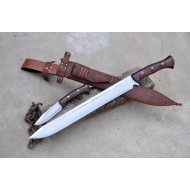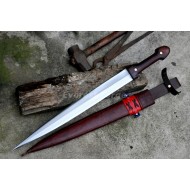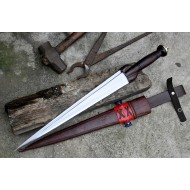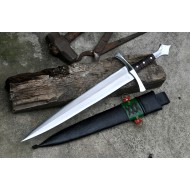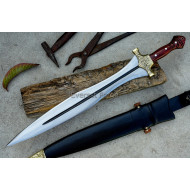


- Model: Bollock Dagger
- Product Code: Bollock17
- Location: Kathmandu,Nepal
Available Options
What Is a Steel Lobed Hilt Bollock Dagger?
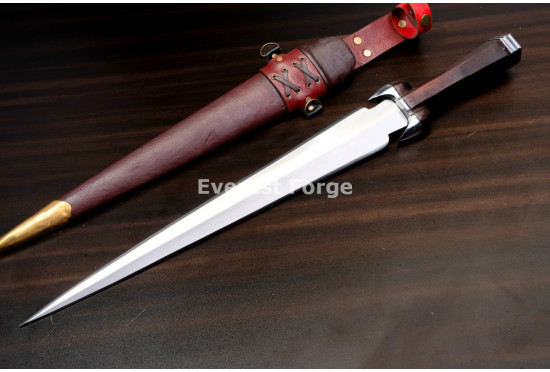
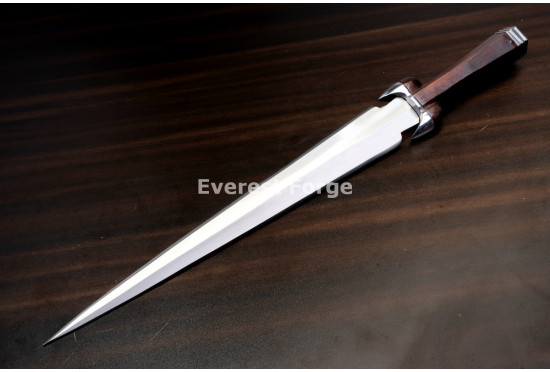
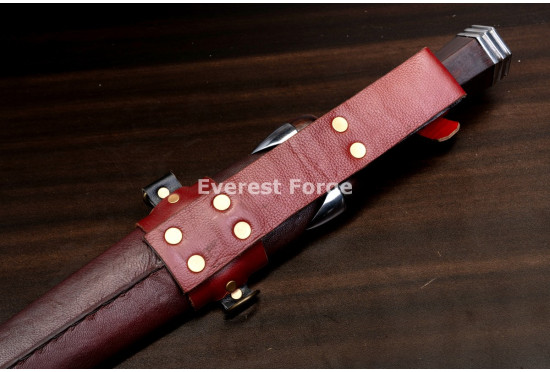
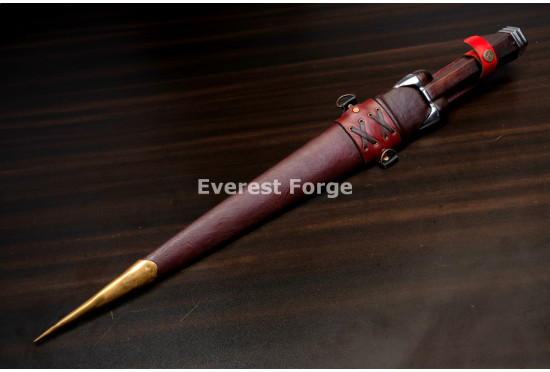
A bollock dagger is guarded by a pair of rounded lobes at the base of the grip instead of a crossguard, and it was one of the most widely carried weapons in Northern Europe from roughly 1300 to 1600. This is that hilt built in steel rather than timber, on a 17 inch double-edged blade with a 6 inch faceted grip and a 23 inch overall length. It is hand-forged in Nepal from 5160 high-carbon spring steel, mirror polished, and carried in an oxblood leather scabbard with a long brass chape, a riveted throat panel and twin belt loops.
It is a fantasy piece and we would rather say so on the first screen than bury it. The lobed hilt is entirely real; a 17 inch blade on one is not, and neither are lobes forged in polished steel and drawn out into points. What you get is the silhouette of a medieval bollock dagger scaled up into something with far more presence, and the honest note below sets out exactly which parts are historical and which are ours. If you want the period version, we build that too and it is linked throughout this page.
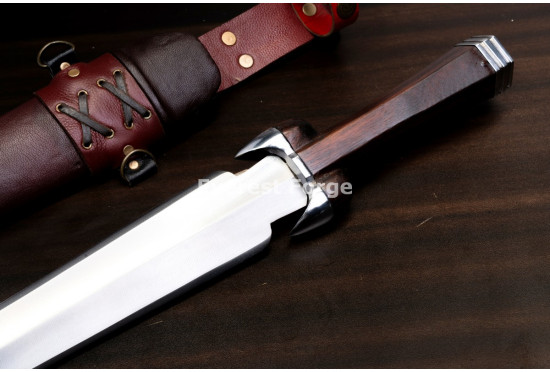
An honest note. Three things on this dagger are modern. The lobes are steel, where every surviving example we know of has them carved integral to a wooden or horn grip. They are also drawn out into downward points, where period lobes are left rounded. And the blade is 17 inches, which is longer than any bollock dagger ever made, most of which ran between six and twelve. The faceted grip and stepped steel pommel cap are workshop design choices as well, not copies of a find. None of that makes it a worse object; it makes it a modern interpretation rather than a reproduction, and a reenactor or a strict collector should buy our period bollock dagger instead, which has the lobes carved from the same block as the grip.
Please check your local law before ordering. This is a double-edged fixed blade of 17 inches, and both of those facts matter legally. A great deal of knife legislation treats "double-edged" as a category in its own right, restricting daggers sharpened on both sides in places where a single-edged knife of the same size is unremarkable. Blade length thresholds then apply on top, and at 17 inches this piece will fall outside ordinary knife allowances almost everywhere and may be classified as a sword or a bladed weapon rather than a knife. That is not a reason not to own it, but it is a reason to check before you order, because import rules and carry rules differ and a parcel stopped at your border cannot be recovered. If the second edge is the obstacle we will sharpen one side and leave the other as a blunt false edge at no extra cost, and we will build the blade shorter if that helps.
Want This Scaled to Your Own Specification?
Shorter blade, single edge, carved wooden lobes instead of steel, a different pommel, or the period build outright. Our smiths forge to order in Kathmandu and quote in writing before any steel is cut.
Start a Custom Build →Why This Dagger Is Built the Way It Is
Full Specifications
Blade length, blade finish and grip material are selectable on this listing. The figures above describe the standard build as photographed; what you receive will match the options you choose at checkout. Small variations in weight, dimension and finish are normal in hand-forged work.
Build It Your Way
Every option below is forged to order in the same workshop. None of them is a part bought in and fitted afterwards.
What This Dagger Does Well, and What It Does Not
What It Is Good At
- Display. At 23 inches with a mirror polish and a brass-chaped scabbard it holds a wall or a case on its own
- Costume, LARP and film work, where the silhouette reads as medieval instantly and the length photographs well
- Thrusting, which is what the diamond section, the even taper and the fine point are all for
- Handling. The steel lobes and steel pommel cap put mass behind the hand, so it does not feel blade-heavy
- Collecting the bollock form, if you want the oversized modern take alongside a period one
What It Is Not Good At
- Historical accuracy. No bollock dagger was ever made at this length or with steel lobes
- Utility and camp work. A double-edged thrusting blade cannot be gripped by the spine or used against a board
- Chopping, batoning or prying. The section is stiff but the blade is narrow and the point is fine
- Carry. At 17 inches it will be outside ordinary knife allowances in most jurisdictions
- Highland dress. This is not a dirk, whatever the proportions suggest
How to Order a Custom Dagger
Prefer the Period Build?
Carved wooden lobes on a one-piece hilt, a shorter blade and a plain butt is what a surviving bollock dagger actually looks like. We forge that as a standing product and as a commission.
See the Period Bollock Dagger →Who This Dagger Is For
- Display and collection buyers who want the bollock form at a size that carries a room rather than a shelf
- LARP, costume and film buyers who need a medieval silhouette with more blade than a period dagger gives
- Collectors of the form who already own a period example and want the modern interpretation beside it
- Buyers who like visible steel furniture, in guard, pommel cap and polish, rather than a hilt that is all timber
- Anyone commissioning a longer thrusting piece who wants to start from a shape rather than a blank sheet
It is not for you if you want a historically accurate bollock dagger, in which case buy the period build, or if you want something to carry and work with, in which case any of our single-edged knives will serve you better and be legal in more places.
What Is Included
- The hand-forged bollock dagger, sharpened and ready for display or use
- An oxblood leather scabbard with a brass chape, riveted throat panel, twin belt loops and a retaining strap
- A certificate of authenticity from the workshop
- Care instructions for high-carbon steel
- Everest Forge manufacturer warranty against forging and material defects
Other Blades From the Everest Forge Workshop
Shipping, Returns and Care
Dispatch. Stock pieces leave the workshop within 2-3 business days. Custom builds take 4-6 weeks depending on the queue and the complexity of the work, and we will give you the honest date rather than an optimistic one.
Shipping. Tracked worldwide by DHL or FedEx, typically 7-14 business days in transit from Kathmandu. Customs paperwork is completed accurately and in full. At 17 inches and double-edged, this piece attracts more import scrutiny than an ordinary knife; please check your own country's rules before ordering.
Returns and warranty. Covered by the Everest Forge manufacturer warranty against defects in forging and materials. Custom builds made to your own specification cannot be returned for a change of mind, which is exactly why we confirm everything in writing first.
Care. High-carbon steel with a mirror polish is the least forgiving combination we sell, and there is a lot of polished surface here. Fingerprints etch it if left, so wipe the blade after handling and keep a light film of oil on it in storage. Do not leave the dagger sheathed for long periods, because leather holds damp and the tanning agents in it attack bare steel. The steel lobes and the stepped pommel cap need the same attention as the blade, and the steps in the cap trap moisture in exactly the way the fluting on a carved pommel does.
Bollock Dagger Questions Answered
Is this really a bollock dagger?
Yes, by the only test that defines the type. A bollock dagger is a dagger guarded by two rounded lobes at the base of the grip rather than by a crossguard, and that is exactly what this has. Everything else about the type varied enormously in period, from short stout blades to long slender ones and from boxwood grips to horn. What makes this one a modern interpretation rather than a reproduction is the length and the material of the lobes, not the arrangement of the hilt. If you are used to seeing the form at dagger size, the proportions here will look unfamiliar; the hilt itself is orthodox.
How is this different from your other bollock dagger?
They are deliberately a pair, one historical and one not. The Bollock Dagger, Fluted Pommel is the period build: a 13 inch blade, lobes carved from the same block of timber as the grip, an integral flared and fluted butt, and no steel furniture beyond one small langet. This one is 17 inches with polished steel lobes swept to points, a faceted grip and a stepped steel pommel cap. Buy the period build if you are a reenactor, a strict collector, or you want the piece to be defensible to somebody who knows the type. Buy this one if you want the form at a size and a finish that no medieval smith would have made, and you would rather have the presence than the pedigree. They share a family and almost nothing else.
Why are the lobes steel instead of carved wood?
It is a workshop design choice and not a historical one, and it has one real advantage. On a period hilt the lobes are carved integral to the grip and stand proud on a short neck of timber, which is the weak point of the whole construction: a knock across the grain can shear a lobe off at that neck, and it is the most common damage on surviving examples. Forged in steel that failure is simply not available, and steel also lets the lobes be drawn out into the downward points you see here, which cannot be done in wood at all without leaving them fragile. The costs are that it is not period, and that it adds mass at the guard, which changes how the piece hangs in the hand. If you want the carved wooden arrangement, it is a free option on this listing and it is also how our period build is made as standard.
At 17 inches, is this a dagger or a short sword?
By its hilt it is a dagger, and by its blade it is arguably not. There is no agreed threshold, and the historical vocabulary is genuinely blurred: cinquedeas and large quillon daggers ran well past a foot, Scottish dirks sat around twelve to fourteen inches, and the line between a long dagger and a short sword was never drawn by anybody who used them. What separates them in practice is how they are held and what they are for. A dagger is gripped in one hand with no expectation of parrying, has a short grip and a guard that stops the hand rather than protecting it, and this piece has all three of those. We call it a dagger for that reason. Be aware, though, that legal definitions frequently do use a blade length figure, and at 17 inches this will be classed as a sword or a bladed weapon rather than a knife in a good many places.
Why is the grip faceted rather than round?
So the hand can tell which way the edges are pointing without looking at them. On a single-edged knife the spine tells your thumb everything you need to know. On a double-edged blade there is no spine, and a round grip lets the whole thing rotate a few degrees in the hand without you noticing, which on a thrusting blade means the edges arrive at an angle you did not choose. Flats fix that: the hand seats on them the same way every time and the blade is indexed to the grip. It is the same reasoning behind the faceted pommel cap, which continues the flats to the butt so the shape is consistent from one end to the other. The visual effect is a happy side effect rather than the point.
What is the squared step at the base of the blade for?
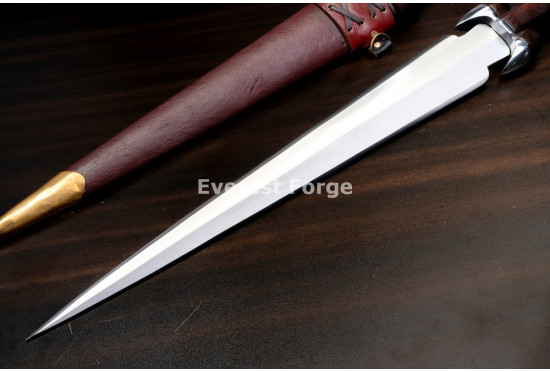
That is the ricasso, a short section left at full width and full thickness and deliberately not sharpened before the taper begins. It does three quiet jobs. It gives the guard a flat shoulder to seat against instead of a wedge, which makes for a tighter fit that does not gradually drive itself apart. It gives the two edges a defined place to start, so the grind ends in a clean shoulder rather than running out into the guard where it cannot be sharpened. And it puts a small amount of unsharpened steel where a finger might end up if a thrust drives the hand forward. On a blade with edges on both sides, that last one is not a trivial consideration.
Is it sharpened on both edges, and how is the blade ground?
Both edges as standard. The section is a flattened diamond: a ridge runs down the centre of each face with four flat surfaces falling away to the two edges. That geometry resists bending in every direction, which is what a thrusting blade needs, and it is why you will not find a fuller on a dagger ground this way. The taper is long and even from the ricasso to the point rather than running straight and then dropping to a tip, which is what gives the blade its stiffness for most of its length and its fineness in the last few inches. If a double edge is a problem where you live, we will sharpen one side and leave the other blunt at no extra cost, and the piece looks identical.
Is a blade this long legal where I live?
We cannot answer that for you, and this is the piece in our range where the question matters most. Two separate provisions tend to apply. First, a great many jurisdictions treat double-edged daggers as their own restricted category regardless of size. Second, blade length thresholds apply on top, and at 17 inches this sits above the ordinary knife allowance almost everywhere, which means it may be regulated as a sword or a bladed weapon rather than as a knife. Import rules are frequently different again from possession and carry rules. Check all three for your own address before you order. If length is the obstacle, an 11 or 13 inch build brings the piece back inside far more allowances and costs no more.
How does the scabbard carry?
On two points rather than one, which is the correct answer for a scabbard of this length. A single frog holds a short dagger fine, but a 20 inch scabbard hung from one loop pivots around it and swings, catching on everything and working the leather at the suspension point until it tears. Twin loops set apart along the body hold the scabbard against the belt at two heights so it stays where you put it. The throat is reinforced with a riveted panel because the mouth takes all the wear from drawing and sheathing, and the cross-lacing on the face draws the two edges of the panel together so the load spreads across the rivets rather than sitting on one. A strap over the grip closes it. Draw by releasing the strap first, then lifting straight.
What steel is it, and how is it heat treated?
5160 high-carbon spring steel, the same stock our smiths use for kukris and swords, forged down from leaf spring in the Nepali tradition. It is oil-quenched and then tempered back, producing a blade that holds an edge but stays tough rather than brittle. Toughness matters more than usual at this length, because a long thin blade loaded sideways is exactly the case where a hard, brittle steel snaps and a properly tempered one flexes and returns. It is not stainless and it will take a patina with use.
Is this a display piece, or can I use it?
It is forged, hardened, tempered and sharpened, so it is a functional weapon rather than a wall-hanger, and it will do everything a long thrusting blade was ever asked to do. What it will not do is stand in for a knife. The double edge means you cannot put a thumb on the spine or choke up on the blade, the fine point will bend if you lever with it, and 17 inches of polished steel is unwieldy for any ordinary cutting task. Most buyers display it or use it for costume and film work, and those are perfectly good uses. If you want something to work with, buy one of our single-edged knives and buy this because you want the object.
Will my dagger look exactly like the photographs?
Close, but not identical, and that is the nature of forged work. The blade profile is drawn out by eye against a pattern, the diamond section is ground by hand, the lobes are forged and filed individually so no two pairs match exactly, and rosewood varies board to board in colour and figure. What does not vary is the specification: length, steel, section, heat treatment and sharpness are held to the same standard on every piece. Our kukri machete page sets out in more detail what can and cannot differ between two blades from the same bench.
| Specification | |
| Blade: | 17 inches. Hand forged from 5160 carbon steel |
| Total Length: | 23 inches |
| Handle: | 6 inches with a 4.5 inch grip, full-length tang, two polished steel lobes swept to downward points, faceted rosewood grip and a stepped steel pommel cap |
| Weight: | 780 grams the dagger, 980 grams with the scabbard |
| Note: | handmade variation in weight, dimensions and finish may occur; keep blade lightly oiled when not in use |