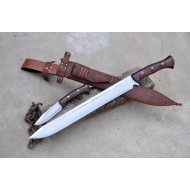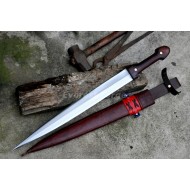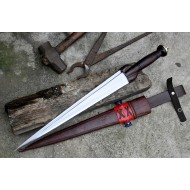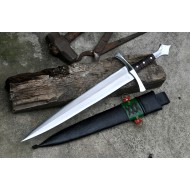


- Model: Bollock Dagger
- Product Code: Bollock13
- Location: Kathmandu,Nepal
Available Options
What Is a Bollock Dagger?
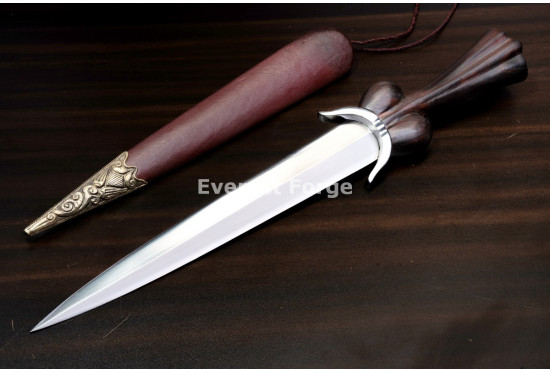
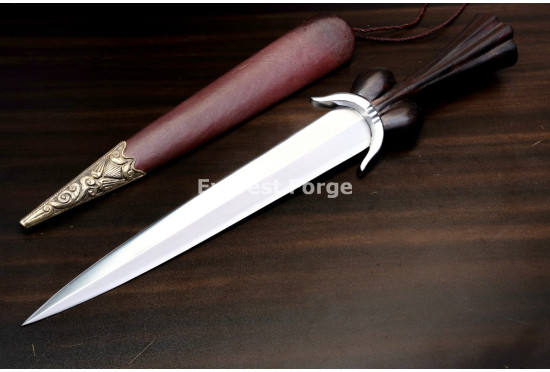
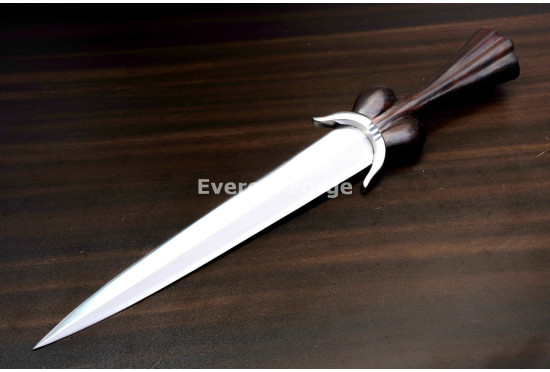
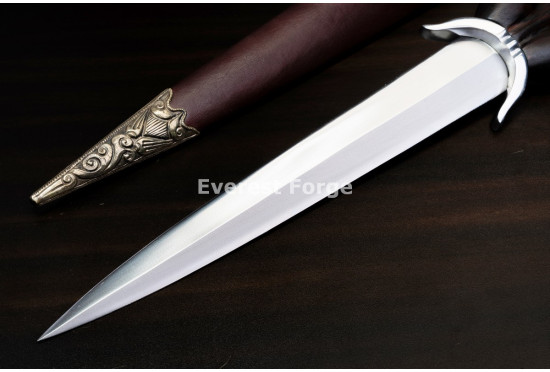
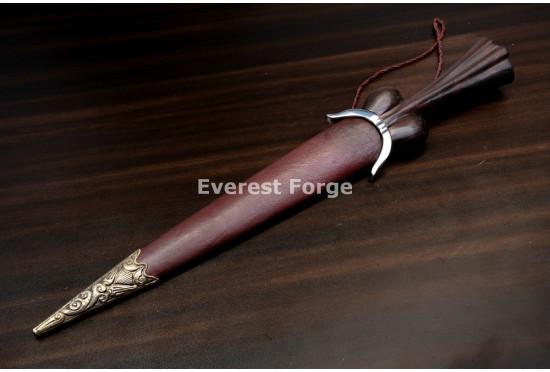
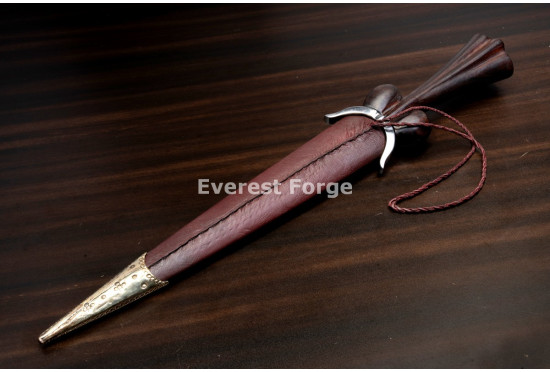
A bollock dagger is a medieval European dagger guarded by a pair of rounded lobes at the base of the grip instead of a crossguard. It was one of the most widely carried personal weapons in Northern Europe from roughly 1300 to 1600, worn by soldiers, merchants, farmers and gentlemen alike, and dozens were recovered from the wreck of the Mary Rose alongside the archers who carried them. This one is hand-forged in Nepal from 5160 high-carbon spring steel, with a 13 inch double-edged blade, a 7 inch carved hilt, a 20 inch overall length and a wet-moulded leather scabbard finished with a cast brass chape.
The form is instantly recognisable and almost nobody makes it properly any more. Most of what is sold under the name is a cast stainless letter-opener with two beads glued to a stick tang. This is a forged blade with a hand-ground diamond section, a hilt carved from a single block of timber around the tang, and a scabbard shaped wet to the blade rather than sewn from flat panels. It is a collector's and historical-interest piece first, and the page below says exactly what it is and what it is not.
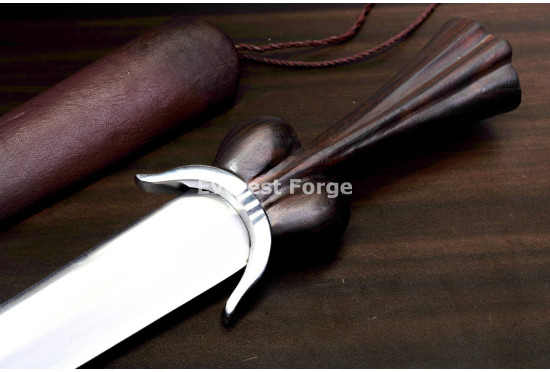
An honest note. One element on this dagger is not period-correct and we would rather tell you than let you find out. The polished steel crescent fitted at the shoulder of the blade is a modern addition by our smiths. A genuine bollock dagger has no guard at all beyond the two lobes, which is the defining characteristic of the whole type, and no surviving example carries a langet of this kind. It is well made and it does the blade no harm, but if you want the historically correct hilt we will build it without the crescent at no extra cost, and for a reenactor or a serious collector that is the version we would recommend. The flared fluted pommel is likewise a design choice by the workshop rather than a copy of a specific find; period bollock daggers usually finish in a plain flat or slightly domed butt.
Please check your local law before ordering. This is a double-edged fixed blade, and double-edged blades are treated as a separate category in a great deal of knife legislation. A number of countries, and a number of states and provinces within countries, restrict the sale, carry or import of daggers sharpened on both edges regardless of length, in places where a single-edged knife of the same size is unremarkable. Rules vary widely, and import rules differ again from carry rules. We ship worldwide but we cannot advise on your jurisdiction, and confirming that this piece is legal to own and receive where you live is the buyer's responsibility. If a second sharpened edge is the problem, we will forge the same dagger with one edge sharpened and the other left as a blunt false edge, at no extra cost.
Want the Period-Correct Build?
No crescent, a plain flat pommel, a single-edged blade, a byknife pocket in the scabbard, or a full Highland dirk instead. Tell us what you are trying to end up with and our smiths will forge it to order in Kathmandu.
Start a Custom Build →Why This Dagger Is Built the Way It Is
Full Specifications
Blade length, blade finish and grip material are selectable on this listing. The figures above describe the standard build as photographed; what you receive will match the options you choose at checkout. Small variations in weight, dimension and finish are normal in hand-forged work.
Build It Your Way
Every option below is forged to order in the same workshop. None of them is a part bought in and fitted afterwards.
What This Dagger Does Well, and What It Does Not
What It Is Good At
- Display and collecting. It is a striking, unusual form and the polish shows the hand-ground section clearly
- Historical study and reenactment, particularly in the period-correct build without the crescent
- Thrusting, which is what the diamond section, the long taper and the fine point are all for
- Being held. The lobes stop the hand travelling forward without a crossguard getting in the way of a belt
- Photography and film props, where the silhouette reads instantly as medieval
What It Is Not Good At
- Utility and camp work. A double-edged thrusting blade cannot be gripped by the spine or used against a board
- Chopping, batoning or prying. The section is stiff but the blade is narrow and finely pointed
- Highland dress. This is the medieval ancestor of the dirk, not the 18th century dress piece
- Everyday carry in most jurisdictions. Please read the legal note above before ordering
- Rough handling of the point. The last inch is fine by design and it will bend if you lever with it
How to Order a Custom Dagger
Looking for a Highland Dirk Instead?
A proper dirk is a different piece: single-edged, interlace-carved grip, flat pommel cap, byknife and fork in the scabbard. We forge those to commission. Send us a reference and we will quote honestly.
Talk to the Forge →Who This Dagger Is For
- Collectors of medieval arms who want a forged example of a common form rather than a cast reproduction of a famous one
- Reenactors and living history groups working in the 14th to 16th centuries, for whom the period-correct build option matters
- Students of the Scottish dirk who want the ancestor of the form alongside the descendant
- Prop and costume buyers who need a silhouette that reads as medieval on sight
- Anyone who likes a hilt carved from one piece of timber and can tell the difference between that and a stack of fitted parts
It is not for you if you want a working utility knife or something to carry day to day. Any of our single-edged hunting or bushcraft knives will serve you better and will be legal in more places, and we would rather sell you one of those than have this sit in a drawer.
What Is Included
- The hand-forged bollock dagger, sharpened and ready for display or use
- A wet-moulded leather scabbard with a cast brass chape and a twisted leather suspension cord
- A certificate of authenticity from the workshop
- Care instructions for high-carbon steel
- Everest Forge manufacturer warranty against forging and material defects
Other Blades From the Everest Forge Workshop
Shipping, Returns and Care
Dispatch. Stock pieces leave the workshop within 2-3 business days. Custom builds take 4-6 weeks depending on the queue and the complexity of the work, and we will give you the honest date rather than an optimistic one.
Shipping. Tracked worldwide by DHL or FedEx, typically 7-14 business days in transit from Kathmandu. Customs paperwork is completed accurately and in full. A number of countries restrict the import of double-edged daggers specifically; please check before ordering, because a parcel seized at your border cannot be recovered.
Returns and warranty. Covered by the Everest Forge manufacturer warranty against defects in forging and materials. Custom builds made to your own specification cannot be returned for a change of mind, which is exactly why we confirm everything in writing first.
Care. This is high-carbon steel with a mirror polish, which is the least forgiving combination we sell. Fingerprints etch it if left, so wipe the blade down after handling and keep a light film of oil on it in storage. Do not leave the dagger in the leather scabbard for long periods: the leather holds damp and the tanning agents in it attack bare steel. Oil the timber once or twice a year, and pay attention to the fluting on the pommel, where a cloth drawn over the surface does not reach the bottom of the grooves.
Bollock Dagger Questions Answered
What is a bollock dagger?
It is a dagger whose guard consists of two rounded lobes carved at the base of the grip rather than a crossguard. That single feature defines the type; everything else varies. Blades run from short and stout to long and needle-pointed, single or double-edged, and hilts were made in boxwood, walnut, horn and bone. It was in continuous use across England, Scotland, the Low Countries, Germany and Scandinavia from roughly 1300 to 1600, which makes it one of the longest-lived weapon forms in European history. It was also genuinely common rather than aristocratic: the excavation of the Mary Rose produced them in quantity, carried by ordinary crew.
Why is it called a bollock dagger?
Because of the obvious anatomical resemblance of the two lobes, and the name is not a modern joke. It appears in period inventories and there is no evidence medieval owners regarded it as anything other than a plain description. The Victorians, who catalogued most of the surviving collections, found the word unusable in print and substituted "kidney dagger", which is why both terms are still in circulation today. Modern museum practice has largely gone back to the original: the Royal Armouries and the Wallace Collection both use "bollock dagger" in their catalogues, and so do we, because it is the correct term and because collectors search for it.
Is a bollock dagger the same thing as a Scottish dirk?
No, but one becomes the other, and this is the most interesting thing about the form. The Highland dirk is a direct descendant of the bollock dagger, which arrived in Scotland with the rest of Northern Europe and then stayed in fashion there long after the Continent had moved on. Over the 17th and 18th centuries the two lobes shrank, migrated upward and were absorbed into the swelling of the grip, until they survived only as a pair of gentle bulges near the top of a dirk hilt. At the same time the blade became single-edged, frequently cut down from a broken sword blade, the grip acquired the interlace basketweave carving everyone associates with the type, and the scabbard gained pockets for a byknife and fork. So if you look at a Georgian dirk and a 15th century bollock dagger side by side, the family resemblance is there in the hilt profile and nowhere else. This piece is on the bollock dagger side of that line: double-edged, lobes fully formed and separate, no interlace. If you want the dirk end of the story, we forge those to commission.
I want a dagger for Highland dress. Is this the right piece?
Probably not, and it is better to say so now. Formal Highland dress calls for either a sgian dubh worn in the hose or a full dress dirk worn at the belt, and both have an established appearance that this dagger does not match: single-edged blade, straight interlace-carved grip, flat pommel cap often set with a cairngorm, and companion knife and fork in the scabbard. Turning up with a bollock dagger will look wrong to anyone who knows, in the same way a 14th century sword would at a Regency event. What we can do is forge you a proper dirk or sgian dubh to commission, and if you like the carving on this hilt we can carry the same hand into that piece.
Is the hilt carved from one piece, and does the grain direction matter?
One piece, and yes it matters a great deal. The lobes, the grip and the flared pommel are all cut from a single block of timber bored and shaped around the tang, with no pommel cap, ferrule or collar fitted anywhere. That is how the originals were made and it means there are no components to work loose. The trade-off is that the timber has to do all the structural work, and the lobes are the vulnerable part, because they stand proud of the body of the grip on a short neck of wood. The grain must run along the length of the hilt so that each lobe is supported by continuous fibre; if it runs across, a knock can shear one off at the neck. It is worth knowing as a buyer's test on any wooden hilt of this shape. Look at the grain lines on the photographs and follow them: they should run from the blade to the butt and continue visibly through the lobes rather than crossing them.
What is the steel crescent at the base of the blade?
It is a langet, a small fitted steel piece at the shoulder of the blade, and we should be straight with you: it is our smiths' addition and not a period feature. Bollock daggers do not have guards. The absence of one is the definition of the type, and no surviving example we are aware of carries a langet like this. It is nicely made, with three filed lines at the centre and an asymmetric sweep, and it does the dagger no harm structurally. But if you are buying this for historical accuracy rather than for looks, order the build without it. There is no extra charge and no delay.
Is it sharpened on both edges, and how is the blade ground?
Both edges, as standard. The section is a flattened diamond: a single ridge runs down the centre of each face and four flat surfaces fall away from it to the two edges. That geometry is chosen because a thrusting blade is loaded from unpredictable directions and a diamond section resists bending in all of them, where a flat blade with a fuller is stiff in one plane and flexible in the other. It is also why you will not find a fuller on a dagger of this kind: there is no material in the middle of the section to remove, because the ridge is the middle of the section. If a double edge is a problem where you live, we will sharpen one side and leave the other as a blunt false edge, which changes nothing about the section or the look.
Is a double-edged dagger legal where I live?
We cannot answer that for you, and you should be careful of any seller who claims they can. What is worth knowing is that a great deal of knife law treats "double-edged" as a category in its own right, separate from blade length, so a dagger sharpened on both sides can be restricted in places where a single-edged knife of the same size is completely unremarkable. That applies in parts of the United States at state level, across much of Europe, and in several Australian states, and the rules governing import are frequently different from the rules governing carry. Check both for your own address. If the second edge is the obstacle, the single-edged build costs nothing extra and is a phone call rather than a problem.
What does the brass chape do, and how is the scabbard made?
The chape is the fitting at the point of the scabbard, and it is the one part of a scabbard that earns its keep. The tip of the blade bears against the bottom every time the dagger is sheathed and every time it is worn, and leather alone wears through there long before it fails anywhere else. Ours is cast in brass and engraved with foliate scrollwork over a fluted shell motif. The body of the scabbard is wet-moulded rather than sewn from flat panels: the leather is soaked, formed around the blade itself and allowed to dry to shape, so it holds the dagger by fit along its whole length instead of relying on a retaining strap. That is how a medieval scabbard was made, and it is why a well-fitted one can be worn point-down without the blade falling out. It also means a new scabbard is stiff at first and loosens slightly over the first few weeks of use.
What steel is it, and how is it heat treated?
5160 high-carbon spring steel, the same stock our smiths use for kukris and swords, forged down from leaf spring in the Nepali tradition. It is oil-quenched and then tempered back, which produces a blade that holds an edge but stays tough rather than brittle. Toughness matters more than usual on a thrusting weapon, because a thrust that lands off-line loads the blade sideways and a hard, brittle blade snaps where a tough one bends and comes back. It is not stainless and it will take a patina with use.
Is this a display piece, or can I actually use it?
It is forged, hardened, tempered and sharpened, so it is a functional weapon rather than a wall-hanger, and it will do everything a dagger of this pattern was ever asked to do. What it will not do is stand in for a utility knife. The double edge means you cannot put a thumb on the spine or grip the blade to choke up, the fine point will bend if you lever with it, and the polished finish marks if you look at it. Most buyers display it, and that is a perfectly good use for it. If you want something to carry and work with, buy one of our single-edged knives and buy this because you want a bollock dagger.
Will my dagger look exactly like the photographs?
Close, but not identical, and that is the nature of forged and carved work. The blade profile is drawn out by eye against a pattern, the diamond section is ground by hand, the hilt is carved individually and rosewood varies board to board in colour and figure, so the lobes and the fluting on your piece will not be a perfect match for the ones photographed. What does not vary is the specification: length, steel, section, heat treatment and sharpness are held to the same standard on every piece. Our kukri machete page sets out in more detail what can and cannot differ between two blades from the same bench.
| Specification | |
| Blade: | 13 inches. Hand forged from 5160 carbon steel |
| Total Length: | 20 inches long in Total |
| Handle: | 7 inches, full-length tang through a one-piece carved hilt, two lobes at the base and an integral flared fluted pommel, with a fitted steel crescent langet at the blade shoulder |
| Weight: | 620 grams the dagger, 740 grams with the scabbard |
| Note: | handmade variation in weight, dimensions and finish may occur; keep blade lightly oiled when not in use |