Two-Handed Machetes: Built for Serious Vegetation and Heavy Clearing
In real field conditions, not all machetes are equal. Once you move beyond light vines and grass into dense brush, bamboo, thick saplings, and overgrown trails, a standard one-handed machete begins to lose efficiency. This is where the two-handed machete proves its value.
Do not consider two-handed machetes oversized blades. They are purpose-built clearing tools designed for leverage, controlled power, and repeated impact into stubborn vegetation. When properly forged and balanced, they deliver reach, authority, and efficiency that neither short machetes nor axes fully replicate in dense terrain.
What Defines a Two-Handed Machete?
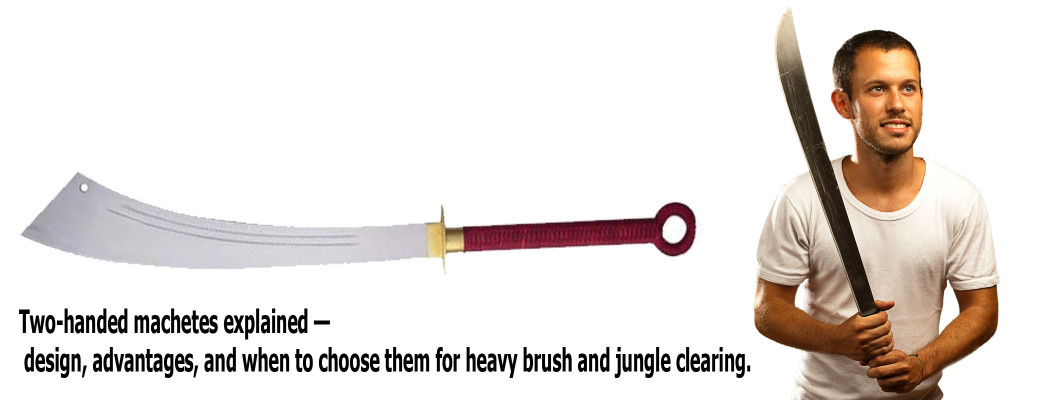
A two-handed machete features an extended grip that allows both hands to engage the handle securely. That additional hand placement changes how the tool performs. Instead of relying heavily on wrist action, power is transferred through the shoulders and core, increasing cutting force while improving stability.
- Extended handle for dual-hand control
- Longer blade profile for deeper reach
- Forward-weighted balance for committed chopping
- Reinforced construction for heavy impact work
It is not simply about size. It is about mechanical advantage and efficiency in demanding environments.
Where Two-Handed Machetes Excel
Two-handed machetes perform best where vegetation has structure and resistance. In fibrous or woody growth, slicing alone is not enough. You need penetration and consistent follow-through.
- Bamboo and cane cutting
- Dense jungle clearing
- Thick brush removal
- Sapling and small tree cutting
- Trail building in overgrown terrain
- Storm debris cleanup
In these situations, the longer grip improves control over each strike, reduces blade deflection, and increases cutting accuracy.
Two-Handed Machete vs Standard Machete
A standard machete is built primarily for speed and slicing. It performs exceptionally well on light vegetation. However, when material becomes woody and resistant, additional leverage becomes essential.
| Feature | Standard Machete | Two-Handed Machete |
|---|---|---|
| Grip | Single hand | Two hands |
| Primary Strength | Fast slicing | Powerful controlled chopping |
| Best Vegetation | Grass, vines, light brush | Bamboo, thick brush, saplings |
| Fatigue Pattern | Wrist-heavy under load | Load distributed through arms and shoulders |
Two-Handed Machete vs Axe
An axe concentrates weight at the head for splitting hardwood and processing stationary timber. A two-handed machete is optimized for clearing vegetation quickly and efficiently.
- Axe advantage: Splitting logs and deep hardwood penetration
- Two-handed machete advantage: Speed, reach, and broad vegetation clearing
In brush-heavy environments, axes often feel slow and restrictive. A two-handed machete resets faster, moves cleaner through mixed growth, and clears a wider working path.
Blade Geometry and Construction
Performance depends heavily on blade geometry and forging quality. A heavy blade without correct balance becomes inefficient and exhausting. A properly designed two-handed machete should feature:
- High carbon steel construction for strength and edge retention
- Oil tempered blade for impact resistance and durability
- Proper spine thickness to withstand repeated chopping
- Full tang handle construction for structural stability
- Balanced forward weight for controlled penetration
The blade should bite decisively without binding, track cleanly, and recover smoothly after impact.
Handle Design and Control
The extended handle allows flexible hand placement. Closer spacing improves control, while wider spacing increases leverage and cutting force. A secure grip is essential in humid or wet conditions.
Comfort directly impacts efficiency. Poor ergonomics lead to fatigue and inconsistent strikes. A properly shaped handle enhances both safety and long-term performance.
Technique for Efficient Clearing
Two-handed machetes work best with controlled, angled strikes rather than uncontrolled swings. Proper technique improves penetration and reduces rebound.
- Strike at an angle for better bite
- Allow forward balance to assist the cut
- Clear vegetation systematically in lanes
- Maintain a safe and controlled swing radius
With disciplined use, a two-handed machete clears faster while minimizing unnecessary strain.
Need a Custom Two-Handed Machete?
Every terrain and user requirement is different. Some need extended blade length, others require thicker spines, reinforced guards, specific finishes, or specialized handle materials.
If you require a custom-made two-handed machete built to your exact specifications, you can submit a request directly through Everest Forge. Define your blade length, spine thickness, weight, steel type, finish, and handle material to match your working environment.
Request a Custom Two-Handed Machete
Choosing the Right Tool for Demanding Terrain
If your work involves light trimming, a standard machete is sufficient. If you are splitting hardwood, an axe is appropriate. But when dealing with dense brush, bamboo, and fibrous growth that resists simple slicing, a two-handed machete offers the correct balance of reach, speed, and authority.
It stands between agility and brute force—built for serious vegetation and built for real-world performance.