The History and Evolution of the Roman Gladius Sword
In short: the gladius was the standard short sword of the ancient Roman legions — a compact, double-edged blade roughly 18 to 27 inches (45 to 68 cm) long, designed for thrusting in close-quarters formation. It evolved through four main types — Hispaniensis, Mainz, Fulham, and Pompeii — between the 3rd century BC and the 3rd century AD, and remains one of the most influential swords in military history.
The gladius sword is one of the most iconic weapons in ancient Roman history, symbolising the discipline, skill, and dominance of the Roman legions. Compact, double-edged, and built for thrusting in close quarters, the Roman gladius was a decisive tool in expanding and protecting the empire. This guide explains what a gladius is, where it came from, its main types, how long it was, what it was used for, and how it is still hand-forged today — written by the smiths at Everest Forge, who forge every gladius type by hand in Kathmandu, Nepal.

What Is a Gladius?
A gladius is the short, straight, double-edged sword carried by the soldiers of ancient Rome. The word gladius is simply Latin for "sword," and it is the root of the English word gladiator — the arena fighters who often fought with versions of this very blade. A typical gladius had a broad, tapering blade of about 18 to 27 inches and a single-handed grip, balanced for fast, controlled thrusts rather than wide swings.
What made the gladius matter was not size but system. Roman legionaries fought shoulder to shoulder behind the large shield called the scutum, stabbing through gaps in the line. A short, stiff, double-edged blade was the perfect tool for that style of fighting, and Roman military discipline turned it into one of the deadliest battlefield weapons of the ancient world.
Origins of the Roman Gladius
The gladius came from the Iberian Peninsula. During Rome's campaigns in Hispania, Roman forces met the short swords of Celtiberian warriors and adopted the design, calling it the gladius Hispaniensis — literally the "Hispanic sword." This early version had a broad, leaf-shaped blade suited to both cutting and thrusting. The Romans refined it to fit the needs of their highly organised military formations.
Spanish Influence on the Gladius
The Celtiberian design inspired the Romans to adopt a sword that excelled in controlled, close-quarter fighting. By tuning the blade length and balance, they created a weapon that could be worked easily behind the scutum, letting legionaries deliver quick, decisive thrusts while staying protected. This Iberian root is why the earliest Roman gladius is still named after Hispania.
Development into the Roman Short Sword
Over time the gladius became shorter and more specialised for thrusting. This suited the Roman legion's disciplined formations, where soldiers had to fight effectively without breaking rank. The shorter length allowed quicker strikes and made the sword ideal for the brutal efficiency of Roman warfare — the reason the gladius is so often described simply as the "Roman short sword."
Types of Gladius
The gladius evolved into four main types over roughly four centuries. They differ in blade shape, length, and point, and each marks a stage in the sword's development from its Iberian origins to the standardised weapon of the Imperial legions.
| Type | Era | Blade shape | Blade length | Point |
|---|---|---|---|---|
| Hispaniensis | 3rd–1st c. BC | Broad, waisted leaf blade | ~60–68 cm (24–27 in) | Long taper |
| Mainz | Late 1st c. BC–1st c. AD | Waisted with curved edges | ~50–55 cm (20–22 in) | Long reinforced point |
| Fulham | 1st c. AD (transitional) | Straight edges | ~50–55 cm (20–22 in) | Long angled triangular |
| Pompeii | 1st c. AD onward | Straight, parallel edges | ~42–50 cm (17–20 in) | Short triangular |

1. Gladius Hispaniensis
The earliest type, adopted from Celtiberian swords, with a long, broad, leaf-shaped blade good for both cutting and thrusting. It was the longest of the four. See our hand-forged Gladius Hispaniensis and the related Hispaniensis-style leaf-blade gladius.
2. Mainz Gladius
An early Imperial pattern with a distinctive waisted blade — curving inward at the centre and flaring to a long, reinforced point built for piercing. Explore our Mainz gladius and the leaf-shaped waisted Mainz.
3. Fulham Gladius
A transitional type that bridges the Mainz and Pompeii forms: straighter edges than the Mainz, but keeping a long, angled triangular point. See our Romisches Fulham gladius.
4. Pompeii Gladius
The most standardised and common Imperial type, with straight parallel edges and a short triangular point — efficient to mass-produce and deadly in formation. Browse our Pompeii gladius and the Pompeian-pattern short sword.
Roman Gladius Swords — Hand-Forged for Collection & Reenactment
Browse our hand-forged Roman gladius swords, made for historical accuracy, functional use, and collectors worldwide.
View Gladius SwordsHow Long Was a Gladius?
Most gladius blades were between 18 and 27 inches (about 45 to 68 cm) long, with an overall length of roughly 24 to 33 inches. Length varied by type: the early Hispaniensis was the longest at around 24 to 27 inches, the Mainz and Fulham patterns sat in the middle at about 20 to 22 inches, and the standardised Pompeii was the shortest at roughly 17 to 20 inches. The whole point of the gladius was that it was short — long enough to reach a man in the next rank, short enough to work behind a shield without fouling the soldiers beside you.
When Was the Gladius Invented?
The Romans adopted the gladius in the 3rd century BC, during the Punic Wars and their campaigns in Hispania, taking the design from Celtiberian short swords. It served as the primary sword of the Roman legions for roughly five centuries, until around the 3rd century AD, when the longer spatha gradually replaced it. The gladius was therefore not invented at a single moment but adopted and refined — from the Hispaniensis, through the Mainz and Fulham, to the Pompeii.
What Was the Gladius Used For?
The gladius was used for close-quarters thrusting in tight infantry formations. Roman legionaries advanced behind the scutum and stabbed through gaps in the shield wall at the enemy's exposed torso and limbs, minimising their own exposure. Its double edge also allowed short cuts when needed, but the thrust was its signature — quick, targeted, and devastating in the disciplined Roman line. It was a soldier's primary sidearm, paired with the pilum (javelin) and the scutum.
The Gladius in Roman Warfare
 The Roman warrior armed with a gladius represents the disciplined fighting style of the legions. The gladius was designed for thrusting in close-quarters combat: soldiers fought in tight formations, using their shields to block and to create openings for quick stabs at vulnerable points. This approach minimised exposure to counterattacks and relied on the gladius's strength in delivering targeted strikes. Combined with Roman training and formation discipline, it made the legions one of the most effective fighting forces in the ancient world.
Evolution from Gladius to Spatha
As the empire expanded and battlefield needs changed, a longer sword — the spatha — began to replace the gladius, first among cavalry and later in the infantry. The key difference: the gladius was a short thrusting sword (around 18–27 in), while the spatha was a longer cutting sword (around 30–39 in) suited to mounted fighting and looser formations. Despite the shift, the gladius remained a symbol of Roman military prowess and stayed in use for centuries in certain roles.
Gladius vs Other Swords
The gladius is often compared with other famous blades. Here is how it stands against the ones people ask about most:
- Gladius vs gladiator sword: they are essentially the same family. "Gladiator sword" is a popular term for the arena blades, most of which were gladius-type short swords. We explain the overlap in detail in our guide, Was the Gladius a Gladiator Sword?
- Gladius vs spatha: the spatha is the longer Roman cavalry sword that succeeded the gladius — more reach, more cutting, less suited to tight formations.
- Gladius vs xiphos: the xiphos is the Greek leaf-bladed short sword that predates and parallels the gladius. We compare them fully in Xiphos vs Gladius.
- Gladius vs katana: entirely different traditions — the gladius is a short, double-edged thrusting sword for formation infantry; the katana is a single-edged cutting sword for the duel. Different problems, different solutions.
What Was the Gladius Made Of?
Historically, gladius blades were forged from iron and early steel, with the better examples pattern-welded or carburised for a harder edge. A modern, functional gladius is forged from spring steel. At Everest Forge, every gladius is hand-forged from 5160 high carbon spring steel — the same steel used in heavy-duty vehicle leaf springs — oil-tempered to a working hardness, with a full tang. That is what separates a real, functional blade from a cast wall-hanger.
Cultural Impact of the Gladius
The gladius has left a lasting mark on military history and on art, literature, and popular media. Films, television series, and historical reenactments have preserved its image as the quintessential Roman sword, forever linked with gladiators and the might of the Roman Empire. For many people, "Roman sword" and "gladius" are the same thing — and that is a fair shorthand.
Buying a Gladius Sword Today
Today, history enthusiasts and collectors can buy both faithful reproductions and modern functional gladius swords. Faithful reproductions follow historical patterns and materials; modern functional versions use spring steel and full-tang construction for cutting practice, reenactment, HEMA, or display. There are also modern "tactical" interpretations that keep the gladius shape with updated grips, finishes, and steel.
At Everest Forge, every gladius is hand-forged in Kathmandu, Nepal — not cast, not stamped — in 5160 spring steel with a full tang and a sharpened working edge (a blunt edge is available for display or training). Whatever type draws you, it can be made to your length, handle, and finish.
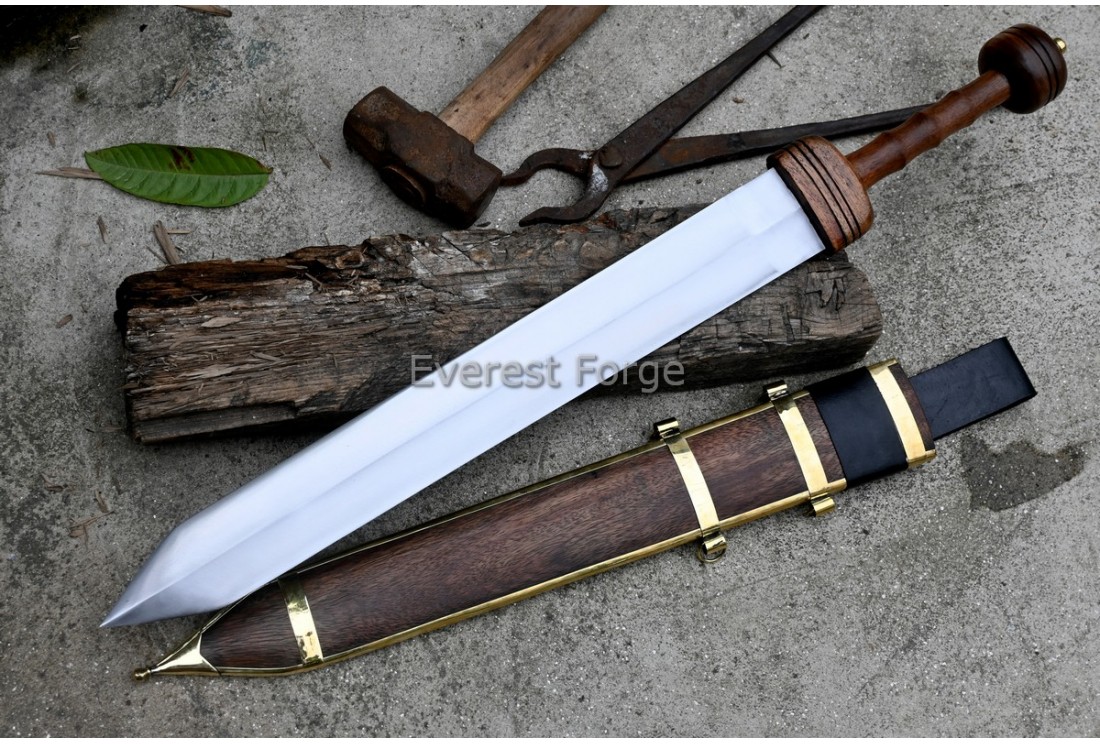 Gladius Hispaniensis
The original leaf-blade Roman sword with wooden scabbard.
Gladius Hispaniensis
The original leaf-blade Roman sword with wooden scabbard.
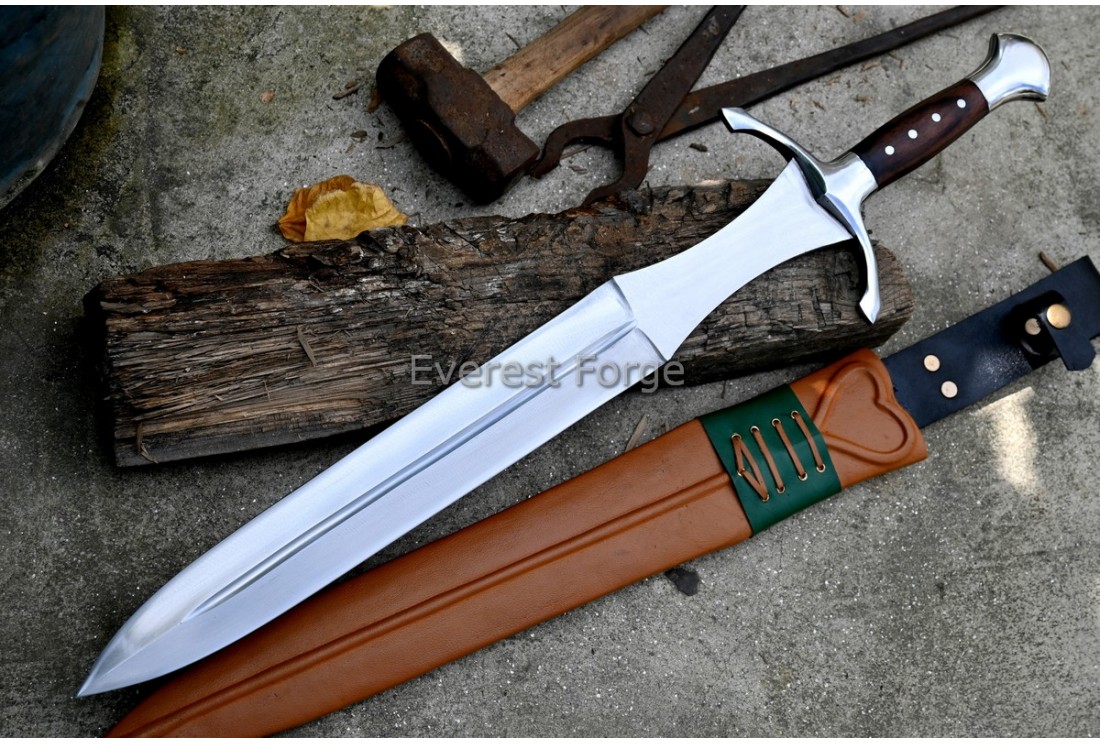 Modern Gladius
A hand-forged Roman cutting blade for training and HEMA.
Modern Gladius
A hand-forged Roman cutting blade for training and HEMA.
Request a Custom Gladius Sword
Want a gladius made to your exact type, size, and finish? Our master smiths can forge a one-of-a-kind piece tailored to you.
Request Your Custom SwordExplore the Everest Forge Gladius Range
Each historical type is represented in our hand-forged collection:
- Gladius Hispaniensis — the original Iberian leaf blade
- Mainz Gladius — the waisted early Imperial pattern
- Romisches Fulham Gladius — the transitional straight-edged type
- Pompeii Gladius — the standardised legionary short sword
- Legionary Gladius — the soldier's everyday sidearm
- Modern Gladius — a cutting blade for training and HEMA
- Roman Pugio — the legionary's companion dagger
- View the full gladius range
Conclusion
The Roman gladius was more than a weapon — it was a strategic tool that shaped the fate of an empire. From its Iberian origins to its refined Imperial forms, the gladius excelled in the hands of disciplined soldiers. Its influence endures in modern sword-making, historical study, and popular culture, making it one of the most significant swords in world history — and one we are proud to still forge by hand.
Frequently Asked Questions
What is a gladius?
A gladius is the short, straight, double-edged sword of the ancient Roman legions. The word is Latin for "sword" and is the root of "gladiator." A typical gladius had a blade of about 18 to 27 inches, built for thrusting in close formation.
What does "gladius" mean?
"Gladius" is simply the Latin word for "sword." It is also the origin of the English word "gladiator," the arena fighters who often used gladius-type blades.
How long was a gladius?
Most gladius blades were 18 to 27 inches (about 45 to 68 cm) long, with an overall length of roughly 24 to 33 inches. The Hispaniensis was the longest; the Pompeii was the shortest.
What are the types of gladius?
There are four main types: the Hispaniensis (earliest, leaf-shaped), the Mainz (waisted, long point), the Fulham (transitional, straight edges), and the Pompeii (standardised, straight parallel edges with a short point).
When was the gladius invented?
The Romans adopted the gladius in the 3rd century BC from Celtiberian swords in Hispania, and used it as the legions' main sword until around the 3rd century AD, when the spatha replaced it.
What was the gladius used for?
It was used for close-quarters thrusting in tight infantry formations. Legionaries fought behind the scutum shield and stabbed through gaps in the line, relying on quick, targeted thrusts.
What was the gladius made of?
Historically, iron and early steel. A modern functional gladius is forged from spring steel. Everest Forge hand-forges every gladius from 5160 high carbon spring steel, oil-tempered, with a full tang.
Is a gladius a gladiator sword?
Largely, yes. "Gladiator sword" is a popular name for the arena blades, most of which were gladius-type short swords. The terms overlap heavily, and the word "gladiator" comes from "gladius."
What is the difference between a gladius and a spatha?
The gladius is a short thrusting sword (about 18 to 27 inches) for formation infantry. The spatha is a longer cutting sword (about 30 to 39 inches) that succeeded it, favoured by cavalry.
What is the difference between a gladius and a xiphos?
The xiphos is the Greek leaf-bladed short sword that predates and parallels the gladius. Both are short, double-edged thrusting swords, but they come from different traditions. See our full Xiphos vs Gladius comparison.
Why was the gladius so effective?
Its effectiveness came from the system, not just the blade. A short, stiff, double-edged sword was ideal for thrusting behind a shield in disciplined formation, which is exactly how the Roman legions fought.
Are Everest Forge gladius swords functional?
Yes. Every Everest Forge gladius is hand-forged from 5160 spring steel, oil-tempered, with a full tang and a sharpened working edge. They are real, functional swords, not cast display pieces. A blunt edge is available for training or display.
Learn more in our related guide: Ancient Egyptian Khopesh Explained.