How Armies Adapted Cutting Tools for Jungle Warfare
In jungle warfare, terrain often becomes a greater obstacle than the enemy. Thick vegetation, tangled roots, monsoon-soaked forests, and rapidly regrowing foliage can stop movement entirely. Before modern engineering vehicles and mechanized clearing equipment, soldiers depended on handheld cutting tools to move, survive, and operate.
Machetes and machete-class jungle blades were never issued for appearance or tradition alone. They were adopted because armies discovered, repeatedly and often painfully, that without constant cutting, a unit could not advance, resupply, or even remain concealed. Across different continents, militaries developed or adopted blades shaped by local terrain, cultural knowledge, and battlefield experience.
What Makes a Blade a Military Machete?
Military machetes are defined by function rather than form. Unlike civilian agricultural tools, these blades were selected or standardized for sustained abuse under combat conditions. Some were formally adopted through official specifications, while others became standard through repeated field use and necessity.
Common characteristics included thick spines, forward-weighted blades for efficient chopping, simple handle construction, and materials that could tolerate humidity, dirt, and neglect. Combat use was never the primary goal, but jungle warfare ensured that these tools could become weapons when circumstances demanded it.
Standard-Issue Military Machetes
United States
M1917 Bolo Machete
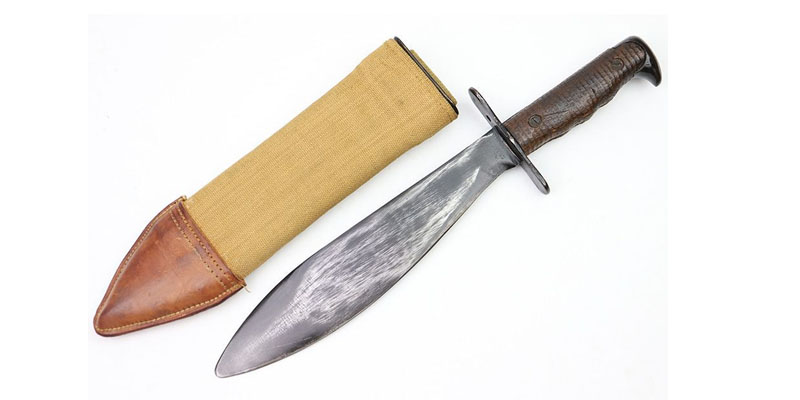
The M1917 Bolo Machete emerged during World War I as the United States searched for a dedicated clearing tool for engineers and infantry operating in rough terrain. Influenced by Filipino bolo blades encountered during earlier colonial campaigns, the design featured a wide, leaf-shaped blade intended to deliver powerful chopping force.
In practice, the M1917 proved effective against light vegetation but awkward in dense jungle. Its broad blade created significant resistance during repeated swings, leading to fatigue. While it was never universally loved, the M1917 represents one of the earliest modern attempts by a Western army to issue a purpose-built jungle blade rather than relying on improvised tools.
M1942 Machete
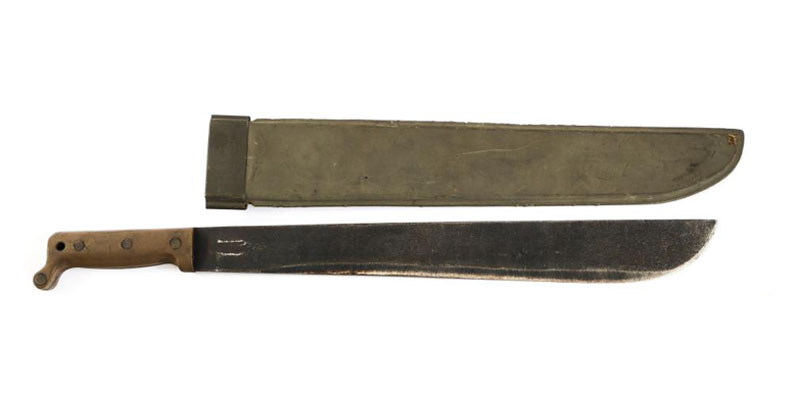
Developed during World War II, the M1942 machete reflected hard lessons learned in the Pacific. Unlike earlier bolo designs, it adopted a long, relatively straight blade optimized for sweeping cuts through vines, bamboo, and dense foliage. Simplicity was central to the design: slab handles, riveted construction, and minimal finishing.
Issued widely to U.S. Army and Marine Corps units, the M1942 became synonymous with jungle warfare. Its effectiveness lay not in refinement but in reliability. It could be mass-produced quickly, maintained easily, and abused without catastrophic failure. For many soldiers, it became as essential as their entrenching tool.
Engineer Bolo Machete No. 1005
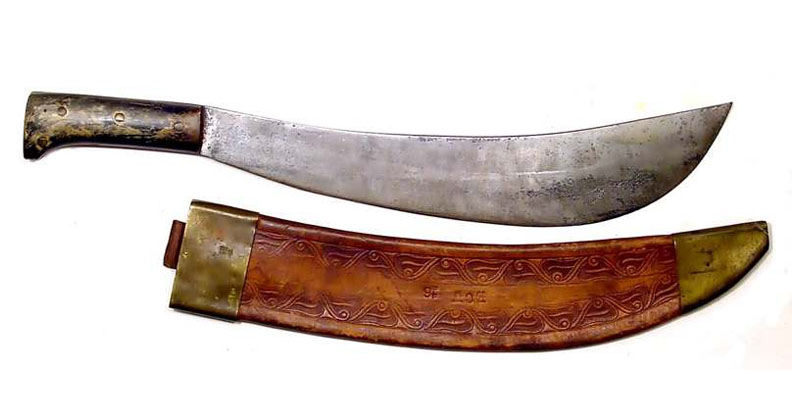
Officially adopted in 1918 for U.S. Army Engineers, the No. 1005 was intended for construction and clearing tasks rather than combat. Its design prioritized robustness over cutting efficiency, resulting in a tool that was durable but often criticized for poor performance in heavy vegetation.
Despite its shortcomings, the No. 1005 is historically significant. It illustrates the trial-and-error process by which militaries learned that jungle cutting tools must balance weight, blade geometry, and user fatigue.
Hospital Corps Machete
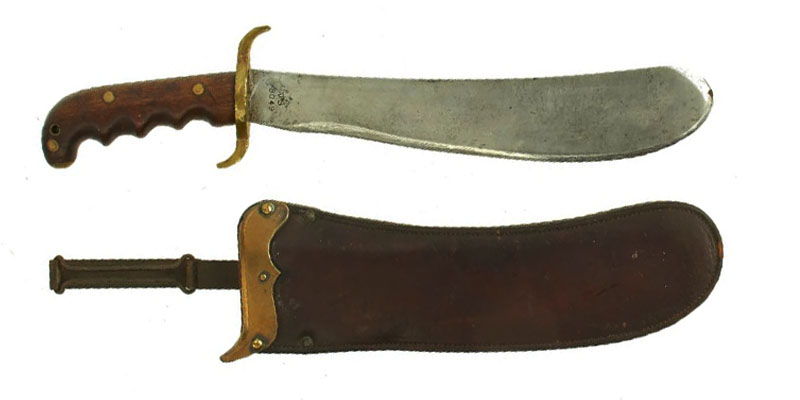
During the American Civil War, medical units were issued heavy machetes for clearing hospital sites and preparing encampments. In an era of limited surgical equipment, these blades occasionally served grim secondary roles during emergency amputations.
While not a jungle machete in the modern sense, its inclusion highlights how large cutting tools were already embedded in military logistics long before tropical warfare forced further specialization.
Commonwealth and Allied Jungle Machetes
Martindale No. 2 Machete (United Kingdom)
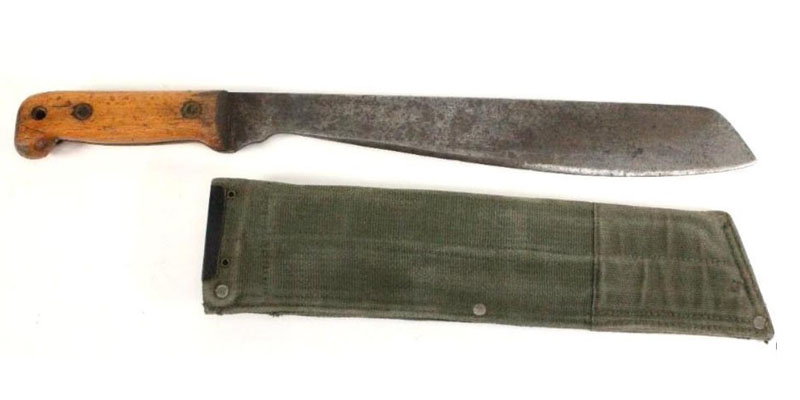
Manufactured in Birmingham, the Martindale No. 2 became one of the most respected jungle machetes of World War II. Issued widely to British and Commonwealth forces, it featured a distinctive triple-fuller design that improved blade stiffness while reducing overall weight.
Its success came from balance. The blade was heavy enough to chop effectively but light enough for prolonged use in humid conditions. The crocodile logo became a mark of trust among soldiers who depended on their tools daily.
British Bolo Pattern (Australia and Commonwealth)
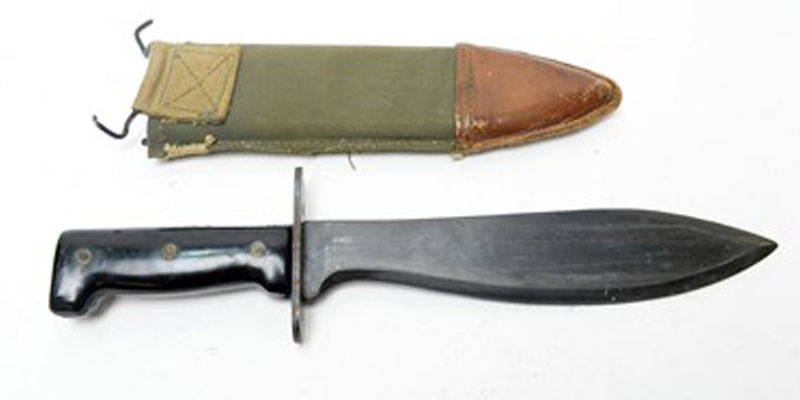
Australian forces fighting in New Guinea and the Pacific encountered some of the densest vegetation of the war. Forward-weighted bolo-style machetes with blade lengths around 36 cm proved ideal for chopping through thick growth.
These blades emphasized cutting power over reach. Shorter length reduced fatigue and improved control, especially when working in close quarters where long machetes became liabilities.
Canadian Jungle Machete
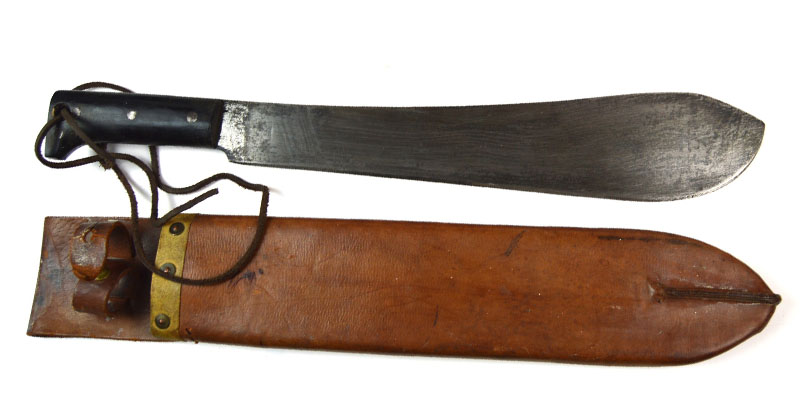
Canadian forces deployed to tropical theaters required tools that could survive extreme humidity and repeated use. The jungle machetes issued were broad, thick, and deliberately overbuilt.
Refinement was secondary. These were working tools designed to last, reflecting the Canadian emphasis on durability in harsh operational environments.
RAAF Survival Machete
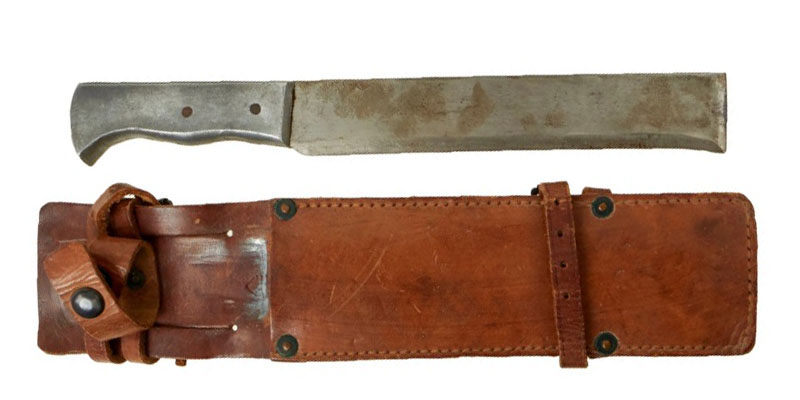
Intended for downed aircrew, the RAAF survival machete prioritized portability without sacrificing utility. Its compact size made it ideal for emergency survival tasks, including shelter building and signaling.
Infantry units often favored it as well, appreciating its balance between weight and cutting ability during extended patrols.
Traditional Blades Adopted for Military Use
Kukri / Khukuri
The kukri stands apart from most military machetes due to its uninterrupted lineage. Carried by Gurkha soldiers for generations, it evolved alongside battlefield experience rather than through centralized military design.
Its inward-curving blade concentrates force near the tip, delivering powerful chops while remaining compact enough for utility work. Unlike many jungle machetes that disappeared after WWII, the kukri continues to serve both functional and symbolic roles in modern military contexts.
Bolo Machete
The bolo originated as an agricultural and self-defense tool in the Philippines, but its effectiveness translated naturally to military use. Compact, forward-heavy, and efficient, it proved well suited to jungle environments where control mattered more than reach.
During later conflicts in Southeast Asia, shorter bolo-style blades were often preferred over long machetes that struggled in tight vegetation.
Golok
The golok is short, thick, and optimized for power. Its design reflects Southeast Asian jungle realities, where dense growth demands forceful, controlled cuts rather than wide swings.
Used during counter-insurgency operations, the golok demonstrated how traditional blades often outperformed imported military patterns in their native environments.
Parang
The parang emphasizes endurance. Longer and heavier than the golok, it excels at sustained cutting against woody vegetation. Soldiers using parangs could clear paths for hours with less fatigue than with lighter blades.
Its adoption by military forces highlights the importance of matching blade geometry to long-term operational needs.
Dome Machete
Associated with the Dahomey Amazons of West Africa, the dome machete represents an earlier military adaptation of a long, slightly curved blade. It was designed for decisive, close-range strikes rather than prolonged clearing.
While its context differs from modern jungle warfare, it remains an example of how blade design reflects specific tactical doctrines.
Colonial, Regional, and Survival-Issued Blades
Panga
The panga became ubiquitous across East and Southern Africa due to its simplicity and effectiveness. Military and paramilitary forces adopted it because it could serve both as a clearing tool and a close-combat blade.
French Colonial Jungle Machetes
French forces operating in Indochina and Africa issued practical jungle machetes optimized for clearing and camp tasks. Rather than focusing on named patterns, functionality defined what became standard.
Portuguese Colonial Machetes
Prolonged bush warfare in Angola and Mozambique forced Portuguese forces to rely heavily on machetes. Availability and effectiveness mattered more than uniform design.
Japanese Pioneer Blades
Japanese engineer and pioneer units used rugged clearing blades intended for route construction and field work. These tools emphasized strength over finish, reflecting wartime production realities.
Chinese Dadao
The dadao occupied a space between machete and short sword. Issued widely during the Second Sino-Japanese War, it served both as a practical chopping tool and a morale symbol during close combat.
The Enduring Role of Jungle Blades
Military machetes were shaped by terrain, necessity, and experience. They existed because jungles demanded constant cutting, and no machine could replace a blade carried by every soldier.
Their influence remains visible today in modern survival tools and outdoor blades. Even as warfare evolves, the logic of the jungle blade endures: when movement depends on cutting through the environment, simplicity and proven design matter more than innovation.