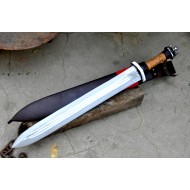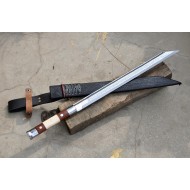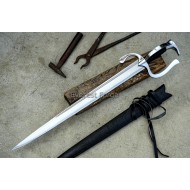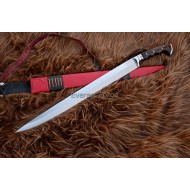




- Model: SINGLE EDGED SWORD
- Product Code: Singleedgesword028
- Location: Kathmandu,Nepal
Available Options
Maciejowski Falchion — Hand-Forged 13th-Century Crusader Cleaver Sword with Umbrella Pommel
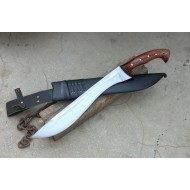
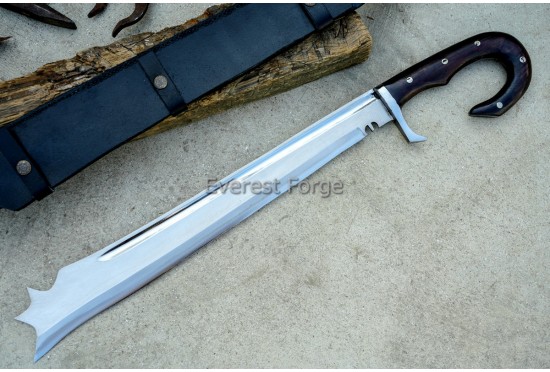
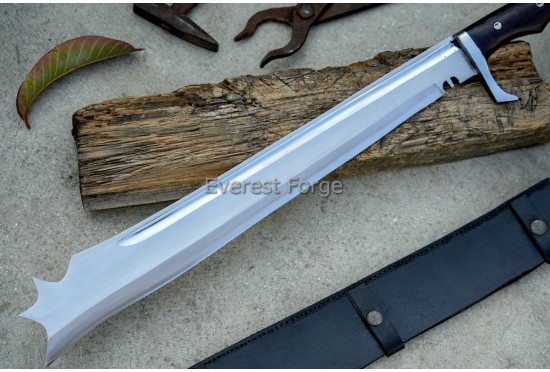
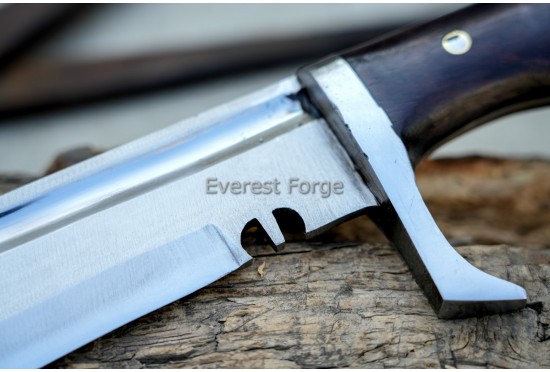
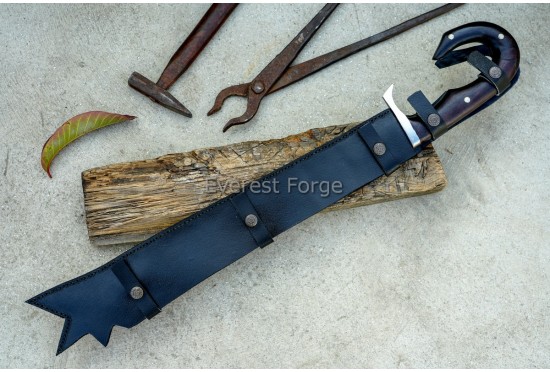
The Maciejowski Falchion from the Everest Forge workshop in Nepal — a hand-forged battle-ready replica of the iconic 13th-century medieval falchion drawn in the famous Maciejowski Bible (also called the Morgan Bible or Crusader Bible). An 18-inch forward-weighted cleaver-style blade in 5160 high-carbon spring steel, full-tang, fitted with a 7-inch rosewood grip and distinctive umbrella-shaped pommel. Part of the broader Kopis-family of forward-curving single-edged swords — the medieval European interpretation of the chopping-blade tradition that runs from the ancient Greek Kopis through the Iberian Falcata to the European falchion.
This is the Maciejowski Falchion sword — also commonly called the Maciejowski sword, the Maciejowski cleaver, the Maciejowski weapon, the Morgan Bible falchion, or the Crusader Bible falchion. All names refer to the same iconic medieval European cleaver-sword design preserved in 13th-century illuminated manuscript artwork. Our hand-forged reproduction captures the historical profile: distinctive cleaver-style straight broad blade, forward-weighted balance for cleaving strikes, and the unique umbrella-shaped pommel that distinguishes Maciejowski-era falchions from later 14th and 15th century falchion variants. Hand-hammered from a single billet of 5160 leaf-spring carbon steel, water-tempered along the edge, full-tang construction, fitted with a leather-wrapped wooden scabbard.
Order Your Maciejowski Falchion — Forged to Your Specs
Pick your blade length (16-22 inches), finish, handle wood, scabbard color, and engraving using the options above. Production typically 2 to 4 weeks. Free text engraving and custom logo upload included.
Scroll Up to Customize See Engraving OptionsWhat Makes the Maciejowski Falchion Different
The Maciejowski Falchion sits in a specific position in the medieval-sword family. Three differentiators define this particular falchion:
Umbrella-Shaped Pommel
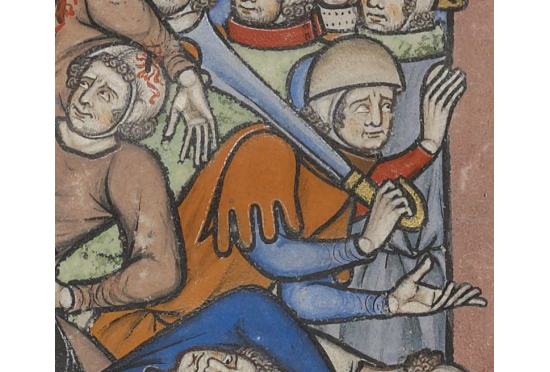
The defining feature — the distinctive hooked or "umbrella" pommel that appears repeatedly in 13th-century illuminated manuscript artwork. Not seen on 14th-century or 15th-century falchions. Identifies this sword as specifically Maciejowski-era / Crusader-era / early-medieval.
Cleaver-Style Broad Blade
Wide, forward-weighted, straight-edged blade designed for cleaving strikes against lightly armored opponents. The blade profile combines the chopping authority of an axe with the reach and grip-control of a sword — making the falchion the medieval European equivalent of the Greek Kopis chopping tradition.
Documented Historical Design
Modelled on the actual 13th-century falchion illustrations preserved in the Maciejowski Bible manuscript (Morgan Library MS M.638) — one of the best-surviving artistic records of medieval European arms. Not invented; not "inspired by"; directly drawn from documented period artwork.
The Most Affordable Falchion in Our Range
At $174.99 this is our entry-tier hand-forged falchion. Step up to the 15th Century Falchion ($224.99) for a later medieval variant, or our Wakefield Hanger Falchion ($249.99) for the late medieval saber-style variant.
Order Maciejowski Falchion All Single-Edge SwordsWho Buys the Maciejowski Falchion
The same physical sword serves multiple distinct buyer types:
- Medieval and Crusader historical collectors — building authentic 13th-century European arms collections. The Maciejowski Bible is the gold-standard documentary source for 13th-century European weaponry; this falchion is among the most-recognizable swords drawn in it.
- HEMA (Historical European Martial Arts) practitioners — adding a documented period-accurate falchion to their training kit. The forward-weighted blade and umbrella pommel match historical fechtbuch references.
- Medieval reenactors — Crusader-era impressions, 13th-century knight kit, mercenary and infantry portrayals. The cleaver-blade falchion was used across class lines in medieval Europe, making it appropriate for officer through common-soldier reenactment.
- Fantasy and RPG buyers — the cleaver-style falchion reads visually as the "barbarian sidearm" or "executioner's blade" in fantasy media. Real hand-forged steel for cosplay, character display, and statement collections.
- Single-edge sword collectors — building a collection across the global single-edge tradition (Kopis, Falcata, Falchion, Khyber, Kukri, Seax). The Maciejowski Falchion is the European medieval entry in that taxonomy.
- Forward-curving blade enthusiasts — collectors interested in the chopping-sword tradition that spans Greek Kopis, Iberian Falcata, European Falchion, Ottoman Yatagan, and Nepalese Kukri. Connecting the dots across cultures.
Customize Your Maciejowski Falchion — Six Configurable Options
Every blade we forge is made to order. Use the option fields above on this product page:
Blade Length
Four blade lengths from 16 to 22 inches. Standard is 18 inches — the most-documented Maciejowski Bible falchion size. Shorter (16") for compact sidearm carry; longer (20-22") for officer-grade reach or modern hand sizing.
Blade Finish
Satin is the standard finish — historically appropriate matte working-blade finish. Upgrade to polished mirror for display; raw forge for the hammered just-off-the-anvil aesthetic; blacked for tactical or dark-fantasy themes.
Handle Material
Three handle options — Rosewood for classical dark-grained hardwood (standard); White-wood Sadhan for a lighter contrasting wood; or Horn (+$10) for a more period-authentic medieval handle material commonly seen on 13th-century falchion finds.
Scabbard Leather Color
Six leather colors, each hand-stitched around a cotton-wood core. Black and brown for period-appropriate medieval kit; the four bolder choices (yellow, red, green, blue) for fantasy collectors and modern collectors who want a contrasting display piece.
Free Blade Engraving
Free text engraving on every Maciejowski Falchion. Names, initials, medieval Latin mottos (Deus Vult, Pax Vobiscum), Crusader-era inscriptions, dates, family mottos, fantasy character names, unit insignia.
Custom Logo & Photo Engraving
Upload your own image file — family crests, knight's heraldry, religious or military insignia, HEMA school crests, fantasy faction emblems, RPG guild logos, commemorative artwork.
Why Buyers Choose the Maciejowski Falchion
Documented History
Drawn from the actual 13th-century Maciejowski Bible illuminations.
Battle-Ready Steel
Full-tang 5160 spring steel. Water-tempered edge. Real sword, real cutting.
Entry Falchion Price
The most affordable hand-forged falchion in our range at $174.99.
Direct From Forge
Hand-hammered by our blacksmiths in Nepal. No middleman, no factory.
Standard Specifications
The standard configuration of the Maciejowski Falchion. Each spec below can be modified using the customization options on this product page.
| Specification | Detail |
|---|---|
| Sword Name | Maciejowski Falchion — 13th-Century Crusader Cleaver Sword |
| Product Code | Singleedgesword028 |
| Blade Steel | 5160 high-carbon spring steel (leaf-spring stock) |
| Standard Blade Length | 18 inches (45.72 cm) — customizable 16" to 22" |
| Standard Finish | Semi-polished / Satin (customizable to polished mirror, raw forge, or blacked) |
| Blade Profile | Single-edged, broad cleaver-style, forward-weighted |
| Pommel | Umbrella-shaped (signature Maciejowski-era design) |
| Tang | Full-tang, hand-riveted |
| Handle Length | 7 inches (17.78 cm) |
| Standard Handle | Rosewood (customizable to white-wood Sadhan or horn +$10) |
| Total Length | Approximately 25 inches (63.5 cm) at standard 18" blade |
| Weight | Approximately 1,100 grams (1.1 kg / 2.4 lbs) |
| Scabbard | Leather-wrapped wooden scabbard, 6 leather color options |
| Heat Treatment | Water-tempered along the edge |
| Edge | Pre-sharpened, ready out of the box |
| Engraving | Free text engraving + custom logo/photo upload |
| Production Time | Forged-to-order — typically 2 to 4 weeks |
| Warranty | Lifetime craftsmanship guarantee |
| Shipping | DHL / FedEx worldwide, tracked and insured |
The Maciejowski Bible — Where This Sword Comes From
The Maciejowski Bible — also called the Morgan Bible, the Crusader Bible, or the Shah Abbas Bible — is a 13th-century illuminated manuscript created in northern France around 1244-1254 AD. Now held by the Morgan Library & Museum in New York (catalogued as MS M.638), it contains some of the best-surviving artistic depictions of medieval European arms and armor. The manuscript depicts Old Testament battle scenes but dresses every figure — soldiers, kings, biblical heroes — in mid-13th-century European military equipment. That makes it one of the most reliable visual sources we have for what real Crusader-era weapons looked like.
Multiple falchions appear throughout the Maciejowski Bible's battle illustrations, and a specific recurring profile shows up: broad cleaver-shaped blade, single-edged, with a distinctive umbrella-shaped pommel. This is the sword design our reproduction is based on. Modern historians and arms scholars often refer to swords matching this profile as "Maciejowski falchions" specifically to distinguish them from later 14th-15th century falchion variants like the famous Conyers Falchion or the Cluny Falchion.
If you're searching for a Maciejowski sword, a Maciejowski cleaver, a Maciejowski weapon, a Maciejowski Bible falchion, a Morgan Bible falchion, a Crusader Bible falchion, or simply a 13th-century falchion or Crusader falchion — they all refer to this same documented medieval European cleaver-sword.
Is the Falchion a Type of Kopis?
The medieval European falchion belongs to the same broader forward-curving / forward-weighted single-edged sword family as the ancient Greek Kopis and the Iberian Falcata. While the falchion developed independently in medieval Europe several centuries after the Kopis disappeared from active use, it solved the same battlefield problem — delivering concentrated chopping force with a single-edged blade — using similar geometric principles:
| Feature | Greek Kopis | Maciejowski Falchion |
|---|---|---|
| Era | 6th-4th century BCE | 13th century AD |
| Origin | Ancient Greece | Medieval France / Northern Europe |
| Blade Profile | Forward-curving, weight in belly | Straight broad cleaver, weight forward |
| Edge | Single-edged | Single-edged |
| Primary Use | Cavalry chopping, infantry sidearm | Infantry sidearm, lightly-armored combat |
| Geometric Principle | Forward-weighted chopping authority | Forward-weighted chopping authority |
| Same Family? | Yes — both forward-weighted single-edged chopping swords | |
If you're a collector of forward-curving single-edged swords across cultures, the Maciejowski Falchion is the natural medieval European entry in your Kopis-family collection. See our full Greek Kopis range for the ancient Greek originals, the Iberian Falcata for the Hellenistic-era Spanish descendant, and the Nepalese Khukuri for the Asian counterpart in the same forward-curving tradition.
Falchion vs Sword — What Buyers Often Ask
Many buyers landing here are researching the difference between a falchion and a "regular" medieval sword. The short answer: a falchion is a single-edged broad-bladed sword, while what most people picture as a "medieval sword" is the double-edged knightly arming sword (or longsword, broadsword, etc.). Key differences:
- Edge count — Falchion: single-edged. Arming sword: double-edged.
- Blade shape — Falchion: wide cleaver-style profile, often broader near the tip than the hilt. Arming sword: narrower, more uniform width, often with a fuller groove.
- Balance — Falchion: forward-weighted for chopping. Arming sword: balanced for thrust-cut combinations.
- Typical user — Falchion: lighter-armored infantry, mercenaries, common soldiers (cheaper to forge). Arming sword: knights and officers (more expensive, prestige-marked).
- Geometric principle — Falchion is closer to a heavy machete or cleaver scaled up to sword size. Arming sword is closer to a longer dagger scaled up.
The Maciejowski Falchion is specifically the 13th-century / Crusader-era variant of the falchion family, with the distinctive umbrella pommel. For later medieval falchion variants see our 15th Century Falchion or our Wakefield Hanger Falchion.
Other Falchions and Single-Edge Swords in the Range
15th Century Falchion Sword
The next step up — a 15th-century falchion variant at $224.99. Different pommel style, slightly later medieval era, mid-tier price between the Maciejowski entry and the Wakefield premium.
View 15th Century FalchionWakefield Hanger Falchion
The premium falchion variant in our range — Wakefield-style hanger / saber falchion at $249.99. Refined late medieval design with leather-wrapped handle.
View Wakefield FalchionThe Kopis — Hand-Forged Ancient Greek Sword
The ancient Greek ancestor of the forward-curving chopping-sword tradition. Same single-edged forward-weighted geometric principle, 1,500 years earlier and from a different culture.
View Greek KopisCeltic Seax Sword
The Germanic single-edged sword tradition. 18-inch Seax with rosewood and bone handle, $154.99 — another entry in the broader single-edge sword family alongside the Maciejowski Falchion.
View Seax SwordBrowse the complete single-edge sword collection or the Viking & Medieval sword category for related blades.
Meet the Blacksmiths Who Forge This Falchion
Every Maciejowski Falchion is hand-hammered by master blacksmiths at our Kathmandu workshop. From 5160 leaf-spring billet to finished medieval falchion with umbrella pommel — every step under one roof.
Watch The Making Meet the BlacksmithsFrequently Asked Questions
What is the Maciejowski Falchion?
The Maciejowski Falchion is a 13th-century medieval European single-edged sword design preserved in the artwork of the Maciejowski Bible (also called the Morgan Bible or Crusader Bible, catalogued as Morgan Library MS M.638). The sword features a broad cleaver-style blade and a distinctive umbrella-shaped pommel. It's most strongly associated with Crusader-era warfare in the mid-1200s AD. Our hand-forged reproduction is modelled directly on the illuminated manuscript artwork — drawn from actual 13th-century period sources, not modern invention.
Is the falchion a type of Kopis?
Both belong to the broader forward-weighted single-edged sword family. The Greek Kopis (6th-4th century BCE) is the ancient Mediterranean ancestor; the medieval European falchion is a much later independent development that arrived at similar geometric solutions to the same battlefield problem — concentrating chopping force at the impact point of a single-edged blade. The falchion isn't a "descendant" of the Kopis in a direct lineage sense (1,500+ years separate them, with no documented continuity), but they're cousins in blade geometry and combat role. Collectors building a forward-curving / single-edged sword collection across cultures naturally include both. See our complete Kopis range for the Greek originals.
What's the difference between a falchion and a regular medieval sword?
The standard "medieval sword" most people picture is the knightly arming sword — double-edged, balanced for both cut and thrust, used by knights and officers. A falchion is fundamentally different:
- Single-edged (not double-edged)
- Broad cleaver-style blade (not narrow uniform-width blade)
- Forward-weighted for chopping (not balanced for thrust-cut combinations)
- Used by lighter-armored infantry, mercenaries, and common soldiers (not exclusively knights)
- Cheaper to forge — required less steel and less precision than the arming sword
The falchion was the medieval European working-class chopping sword. The Maciejowski Falchion specifically is the 13th-century Crusader-era variant with the umbrella pommel.
What is the umbrella-shaped pommel for?
The umbrella or "hooked" pommel that defines the Maciejowski Falchion serves three purposes. First, it provides grip security — the hooked shape catches the bottom of the user's palm and prevents the sword from being knocked out of the hand during forceful chopping strikes. Second, it functions as a counterbalance to the forward-weighted blade, bringing the sword's balance point closer to the hand for better control. Third, it's a period-identifying feature: this specific pommel shape appears almost exclusively in 13th-century European arms artwork and is rarely seen in 14th-century or later falchion variants. The umbrella pommel is what distinguishes a Maciejowski-era falchion from a 15th-century falchion or a Cluny Falchion or a Conyers Falchion.
Is this Maciejowski Falchion battle-ready or display-only?
Fully battle-ready. The blade is 5160 high-carbon leaf-spring steel, full-tang, water-tempered along the edge, and pre-sharpened at the forge — meeting our battle-ready standard. The forward-weighted broad blade is genuinely effective for cleaving cuts — historically the Maciejowski-era falchion was specifically used against lightly-armored opponents in close-quarter medieval combat. Suitable for cutting practice, HEMA training, controlled test cutting, and serious medieval reenactment use.
How long is this falchion and can I customize the blade length?
The standard blade is 18 inches (overall 25 inches with the 7-inch handle). Four blade lengths available via the Blade Length option on this product page: 16, 18, 20, or 22 inches. The 18-inch standard matches the most-documented historical Maciejowski Bible falchion size. 16 inches gives you a compact sidearm-scale falchion; 20-22 inches extends into officer-grade reach.
How much does the Maciejowski Falchion weigh?
Approximately 1,100 grams (1.1 kg / 2.4 lbs) at the standard 18-inch blade configuration. The weight is forward-balanced — most of the mass is in the broad belly of the cleaver-style blade. That gives the falchion its chopping authority while the umbrella pommel counterbalances enough mass back toward the hand for controlled use. Weight scales with blade length: shorter drops it, longer adds it.
What's the handle made from — and what is "horn"?
Three handle options. Rosewood (standard) is dense, dark-grained hardwood — the most commonly used material on our sword line. White-wood Sadhan is a lighter hardwood for contrast. Horn (+$10) is genuine animal horn — the most period-authentic medieval falchion handle material, often used on actual 13th-century historical finds. Horn handles have a slightly translucent quality, develop character with age, and are favored by serious historical reenactors who want the most documentary-accurate kit. All three are full-tang construction with hand-riveted hardware.
Is this falchion suitable for HEMA or medieval combat training?
Yes for solo cutting practice, paired form training, and controlled test cutting. The Maciejowski Falchion is a sharp battle-ready sword, NOT a blunt training sword — so it's not appropriate for live full-contact sparring with another person. For free sparring you'd want a blunted training falchion (which we can produce on custom commission). For tatami mat cutting, kata practice, and structured cutting drills, this falchion performs at battle-ready standard. The forward-weighted blade and umbrella pommel match historical fechtbuch references for medieval sword-use.
Can I get free Latin mottos or a custom heraldic crest engraved?
Yes — every Maciejowski Falchion includes free text engraving AND a custom logo / photo upload option. Two engraving fields on this product page:
- Personalize Your Blade — free-form text for names, initials, medieval Latin mottos (Deus Vult, Pax Vobiscum, In Hoc Signo Vinces), Crusader-era inscriptions, dates, family mottos, fantasy character names
- Custom Logo & Photo Engraving — upload your own image file for heraldic crests, family arms, knight's coats of arms, religious insignia, HEMA school logos, RPG faction emblems
Both engraving methods hand-applied during the finishing stage. Particularly valuable on this Crusader-themed sword for buyers commissioning gifts, presentation pieces, or personalized historical kit.
What steel is the blade made from?
5160 high-carbon spring steel — leaf-spring stock, the same alloy used in heavy-duty vehicle suspension. Tough, springy, holds an edge well. Hammer-forged from a single billet (never welded or laminated), water-tempered along the edge, and hand-finished. This is the same steel used across our entire battle-ready sword range — Kopis, Falcata, Falchion, Khopesh, Khyber, Seax, Viking, Xiphos. The 5160 alloy gives the falchion the right combination of edge retention and impact toughness for the chopping cuts the design is built around.
How long does it take to forge and ship?
This falchion is forged-to-order — production typically takes 2 to 4 weeks depending on engraving complexity and current workshop queue. Custom heraldic logos and complex engraved designs can add 3-7 days. After forging we ship worldwide with tracked, insured DHL or FedEx delivery. See our shipping policy for country-specific delivery estimates and our warranty policy for the lifetime craftsmanship guarantee covering every piece.
Order Your Hand-Forged Maciejowski Falchion
18-inch cleaver-style blade. Umbrella pommel. 5160 spring steel. Customizable 16-22 inches. Free engraving. Lifetime warranty. Worldwide shipping. The most affordable hand-forged falchion in our range — drawn directly from 13th-century Maciejowski Bible artwork, forged by hand in Nepal.
Scroll Up to Customize Browse All Single-Edge Swords| Specification | |
| Blade: | 18 inches long Blade Hand forged from 5160 carbon steel |
| Total Length: | 25 inches long in total |
| Handle: | 7 inches full tang handle made from Rosewood |
| Weight: | 1050 grams Arppoxmatly |
| Note: | Each sword is handcrafted, which means small variations in dimensions, finish, or wood grain may occur. These unique marks of craftsmanship ensure no two swords are exactly alike—each piece is one of a kind and made for real performance. |