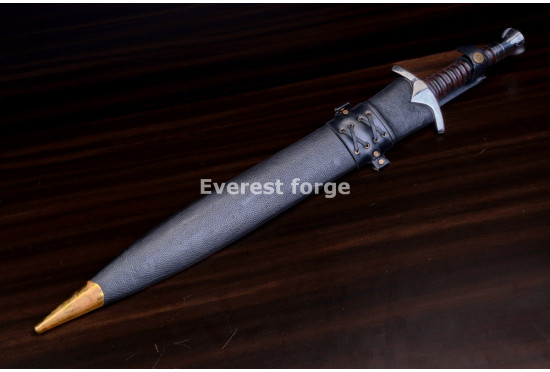
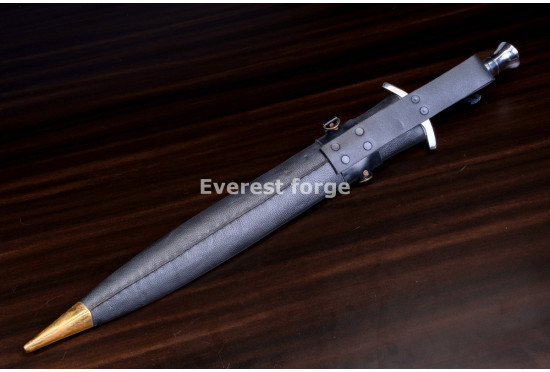
- Model: Greek Xiphos Sword
- Product Code: XIPHOSSS20
- Location: Kathmandu,Nepal
Available Options
A Hand-Forged Greek Xiphos With a Leaf Blade and Raised Medial Ridge
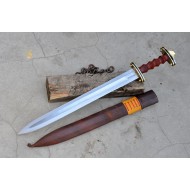
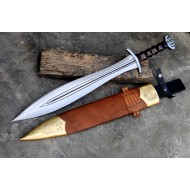
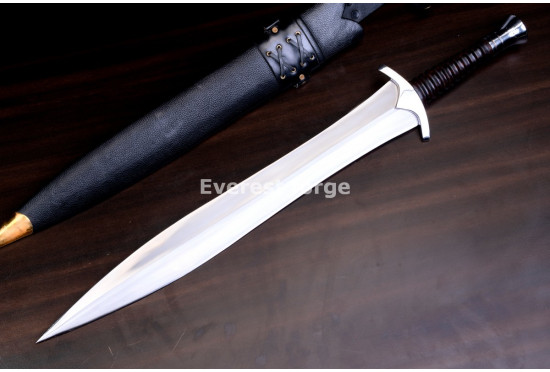
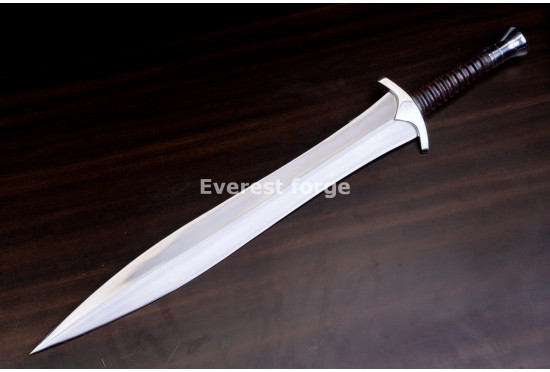
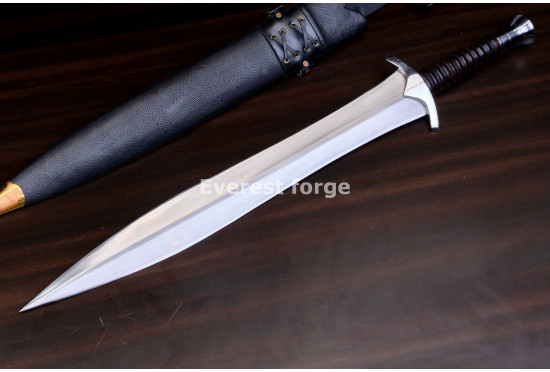
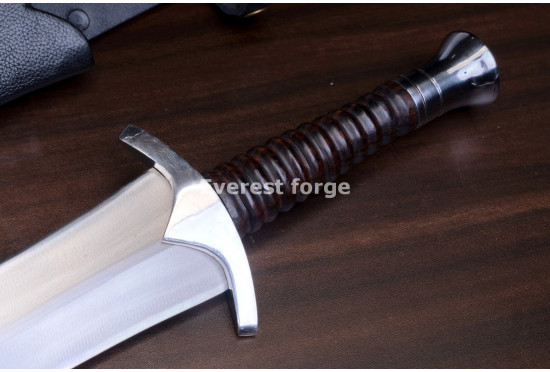
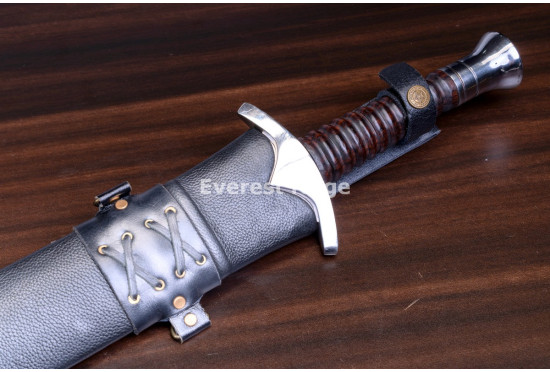
This is a 20 inch hand-forged xiphos, the straight double-edged thrusting sword of the Greek hoplite. The blade is leaf-shaped, widening through the forward third and then drawing out to a long acute point, with a raised medial ridge running its length that gives a diamond section. The hilt is a shaped steel guard sweeping forward, a leather-ringed grip and a flared steel pommel cap. Overall length is 27 inches and it weighs approximately 1130 grams. Forged from 5160 high-carbon steel in Tokha-3, Kathmandu, and supplied in a black leather scabbard with a laced throat panel and a brass-toned chape.
An honest note. Two departures worth stating. This blade is long for the type: surviving xiphoi run roughly thirty to forty-five centimetres, which is twelve to eighteen inches, and Sparta was noted even among Greeks for carrying the shortest of them. At twenty inches ours is longer than nearly every excavated example, which makes it a handsome sword and not a typical one. The shorter historical length is the first build option below and it is what a collector of the type will want. Second, the hilt is modern. A xiphos carries a plain straight cross or a simple flared collar and a cap or knob pommel; ours has a shaped forward-swept guard and a flared trumpet cap, both of which look well and neither of which is period. The blade itself — the leaf, the ridge, the section — is right.
Have This Sword Forged Your Way
Blade length, the width of the leaf, the guard form and the pommel are all decided at the forge. Send a museum reference and our smiths will forge to it.
Start a Custom Forge Order →Why This Sword Is Built the Way It Is
Specifications
Build Options
Is This the Right Sword for You?
Buy This If You Want
- The Greek thrusting sword with the blade geometry actually correct
- A leaf profile and a true medial ridge rather than a flat blade cut to a leaf outline
- A sword almost nobody forges properly, and one you will not see elsewhere
- The base for a full reconstruction, with the length and hilt corrected
- The companion to a kopis, which is the other half of the same choice
Look Elsewhere If You Want
- An accurate reconstruction out of the box — the length and hilt here are both modern
- A cutting sword; the kopis is the Greek answer to that and we build one
- Reach, since the whole point of this type is that it is short
- A stainless blade needing no care, since 5160 is carbon steel and will rust if left wet
- A sparring or HEMA trainer, which needs rolled edges and a rebated point from the first heat
Built to a Museum Piece
Send photographs, measurements or a catalogue entry for an excavated xiphos and our smiths will forge to it: right length, right leaf, period hilt.
Talk to the Forge →How to Order
Who This Sword Is For
- Collectors of ancient Mediterranean arms who want the section right rather than the silhouette approximated
- Re-enactors and living history groups covering the Greek and Hellenistic world
- Film, stage and photography armourers needing a genuinely Greek blade rather than a modern one wearing the name
- Anyone who owns our kopis and wants the other sword a hoplite would have chosen between
What Is Included
- One hand-forged xiphos, sharpened and ready
- Fitted black leather scabbard with laced throat and brass-toned chape
- Certificate of hand-forging from the workshop
- Everest Forge manufacturer warranty against defects in forging and heat treatment
Explore the Collection
Shipping, Returns and Care
Every piece is prepared at the forge in seven to ten days, and shipping adds a further seven to ten days. Orders to the USA and Canada travel with FedEx; everywhere else ships on a DDP service, which means duties and taxes are settled before the parcel moves so there is nothing to pay on delivery. Every piece carries the Everest Forge manufacturer warranty against defects in forging and heat treatment.
Double-edged blades are restricted in some countries and in some states and provinces within them, and the rules for a double-edged weapon are often stricter than for a single-edged blade of the same length. It is your responsibility to check that this sword may lawfully be imported and possessed where you live before ordering, because a parcel seized by customs cannot be returned to us and cannot be refunded. Ask us before you buy if you are unsure and we will tell you what we know about your destination.
5160 is a high-carbon steel and it will rust if left wet or stored damp. Wipe the blade dry and keep a light film of oil on it, paying attention to the angles either side of the medial ridge, which is where a cloth passes over rather than into. Do not store the sword in the scabbard for long periods. The leather grip takes an occasional conditioning.
Frequently Asked Questions
What is a xiphos?
The straight double-edged sword of the Greek hoplite, and the standard sidearm of the classical Greek world. The blade is leaf-shaped: narrow at the hilt, widening through the forward third, then drawing out to a long acute point. Blades commonly run thirty to forty-five centimetres, so the whole sword is shorter than many people expect, and it hung from a baldric under the left arm to be drawn across the body. It was not the primary weapon. A hoplite fought with a spear and the sword came out when the spear broke or the formation collapsed into a press. What makes it a good weapon for that moment is exactly what the leaf shape gives you: enough width forward to cut when there is room, and a point stiff and fine enough to drive when there is not. The other Greek option was the kopis, forward-curved and single-edged, which cut better and thrust worse. Those two were the real choice, and we build both.
Is this one historically sized?
No, and it is the first thing a collector of the type will check. Surviving xiphoi run roughly thirty to forty-five centimetres of blade, which is twelve to eighteen inches, and Sparta had a reputation even among other Greeks for carrying the shortest of them. This blade is twenty inches, so it is longer than nearly every excavated example and the whole sword at twenty-seven inches overall is a substantially bigger object than the original. That makes it a good-looking sword and a good-handling one; it does not make it a reconstruction. If the history is what you are buying, order twelve to eighteen inches and we will shorten the hilt in proportion, which matters because a short blade on a long grip looks wrong immediately. It is the first build option above and it costs no more.
What does the leaf shape actually do?
It solves two problems at once, which is why the shape turns up independently across the ancient world in bronze and in iron. Widening the blade through the forward third moves the centre of mass out toward the point, so a cut arrives with more steel behind it — the same principle that makes a kukri or a falcata cut hard. But unlike those, the xiphos then draws the width back in to a long fine point, so it keeps a tip you can drive into a gap. A straight parallel-sided blade cuts adequately and thrusts adequately; a leaf blade does both better within a short length, at the cost of being harder to forge and grind, because the width has to change smoothly in plan while the section changes at the same time. That difficulty is most of the reason so few people make one properly and so many "leaf blade" swords are flat plates cut to a leaf outline.
Why does it have a ridge down the middle?
Because a short blade that is meant to be driven has to be stiff, and on a wide blade the only way to get stiffness without weight is section rather than thickness. Raising a ridge along the centre and grinding the bevels away from it produces a diamond cross-section, which puts the thickest steel exactly on the axis where bending stress is highest. The result resists flexing under point load in a way a flat blade of the same weight cannot. You can test this on any sword: press the point against something solid and a flat blade will spring visibly while a properly ridged one holds. The trade is cutting, since a diamond section wedges in a cut rather than slicing cleanly through, which is why cutting-focused blades use fullers and flat grinds instead. On a sword designed to thrust in a press, stiffness wins.
Is the hilt authentic?
No, and we would rather set it out than let the word Greek carry an implication. Two things depart. The guard here is a shaped steel piece sweeping forward toward the blade, where a xiphos carries either a plain straight cross or a simple flared collar with no forward sweep at all. And the pommel is a flared trumpet cap in polished steel, where the originals use a plain cap, a rounded knob or a slight flare, generally in the same metal as the rest of the fittings and considerably less pronounced. The leather-ringed grip is closer to plausible — period grips were wood, bone or horn, sometimes wrapped — but the ribbing is a modern treatment. The blade is the part that is right, and it is the part that matters most. The period hilt is a build option and it changes the look of the sword substantially, particularly the pommel.
Xiphos or kopis — which should I buy?
Answer one question: do you want the sword that thrusts or the sword that cuts? The xiphos is straight, double-edged and built around a stiff drivable point, with enough width forward to cut when there is room. The kopis is forward-curved, single-edged and built entirely around the cut, with mass out toward the tip and a point that is really where the edge finishes rather than something you would drive. A hoplite chose between them and both were carried throughout the Greek world, so there is no more authentic answer. If you are buying one sword and want the archetypal Greek weapon, take the xiphos, because it is the one the sources treat as standard. If you already have a straight sword in your collection and want something that does not look like anything else in it, take the kopis. Xenophon, who commanded cavalry, preferred the curved blade for a rider; on foot it is genuinely a preference.
How was it carried?
From a baldric, a strap over the right shoulder with the sword hanging under the left arm, high enough that the hilt sat near the armpit. It was drawn across the body with the right hand. That is a different arrangement to a belt and it follows from the equipment: a hoplite wore a shield on the left arm and a cuirass, and a sword hanging at the hip would foul both. High baldric carry keeps the hilt reachable with a shield up and keeps the scabbard from swinging into the man beside you in formation, which matters more than it sounds in a phalanx. This sword ships on a scabbard that will hang either way. If you want the historical high baldric arrangement, tell us and we will build the strap and mounts for it rather than adapting a belt rig.
What steel is it, and how is it heat treated?
5160 high-carbon spring steel, brought to temperature in the forge, quenched in oil and tempered back so the edges are hard while the body of the blade stays springy. On a short thrusting sword the temper matters in a particular way: the blade is loaded along its length rather than across it, and one tempered too hard would snap under a bind rather than flexing and returning. The originals were bronze in the earlier period and iron later, of quality that varied enormously by workshop and by century; a modern homogeneous alloy is stronger and far more predictable than either, and we would rather say that than imply ancient metallurgy we are not using. It is not stainless, deliberately.
Is it full tang?
The tang runs the full length of the hilt with the pommel cap fitted over the end, which is through-tang construction. That is the correct arrangement for a guard, a fitted grip and a cap pommel, all of which are assembled onto the tang and clamped between guard and cap. Surviving xiphos hilts are built broadly this way too, generally with organic grip plates or a shaped grip over a flat tang, so the construction is closer to the record here than the fittings are. If you want a visible full-width tang with riveted plates, that is a period-plausible variant and we will build it.
How sharp does it arrive?
Sharp and ready, with both edges put on a stone by hand at the forge. If you would prefer it shipped unsharpened — for display, for re-enactment where a live edge is not permitted, for a gift, or because of the rules where you live — say so in the order comments and we will do it at no extra cost and rebate the point as well. Group combat needs a blade built blunt and rebated from the first heat rather than a sharp taken back afterwards, and that is a different forging.
Can you build it to a specific find?
Yes, and on this type it is worth doing, because the difference between a generic leaf blade and a particular one is the whole interest. Send photographs, measurements, a catalogue entry or a museum accession record and we will forge to it: the right length, the right width and position of the leaf, the correct guard and pommel, and the grip material. What we will tell you honestly is where a request cannot be met. We work in modern homogeneous steel and will not claim bronze or ancient iron metallurgy, and we do not cast bronze fittings. Everything about the shape, the section and the proportions is achievable. Send the reference before you order rather than after, because on a leaf blade the profile is set in the first few heats.
Where is this made, and by whom?
In our own workshop in Tokha-3 on the northern edge of Kathmandu, Nepal, by around ten smiths, most from families that have forged blades for generations. Everest Forge has operated since 2010, and we forge, grind, heat treat, fit the hilts and cut the leather in the same building. A Greek sword made in Nepal deserves the same word we give our bowie, our seax and our kopis: this is not our own tradition and we do not pretend it is. What our smiths bring is the forging, and a leaf blade with a true medial ridge is one of the harder shapes to get right, because the width and the section have to change together along the length. It is a good test of a forge.
| Specification | |
| Blade: | 20 inches. Hand forged from 5160 carbon steel |
| Total Length: | 27 inches long in total |
| Handle: | 7 inches (4 inch grip). Shaped steel guard, leather ringed grip, flared steel pommel cap |
| Weight: | Approx 1130g sword, 1460g with scabbard |
| Note: | Some variation in weight, dimensions and finish may occur as each piece is hand forged. Keep the blade lightly oiled when not in use |