Menu
Your Cart

Hand-Forged Thracian Sica Sword, Curved Blade

Hand-Forged Thracian Sica Sword, Curved Blade
$224.99
Ex Tax: $224.99
  • Model: Historical sword
  • Product Code: SICA0020
  • Location: Kathmandu, Nepal

Available Options

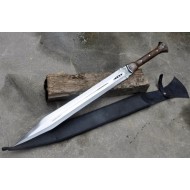
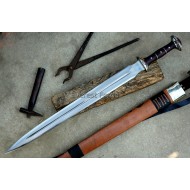
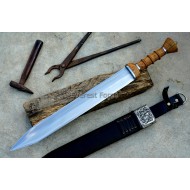
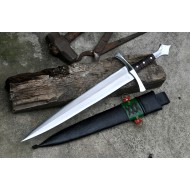
Hand-Forged Thracian Sica Sword — Curved Blade with Wooden Hilt

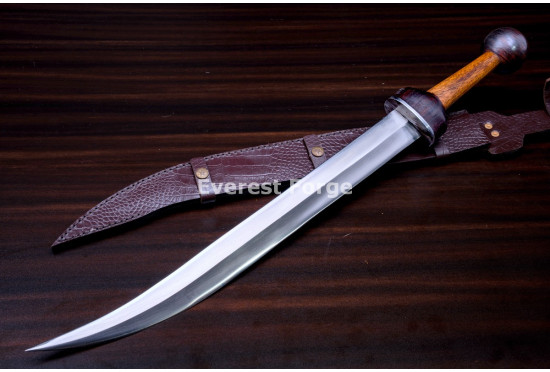
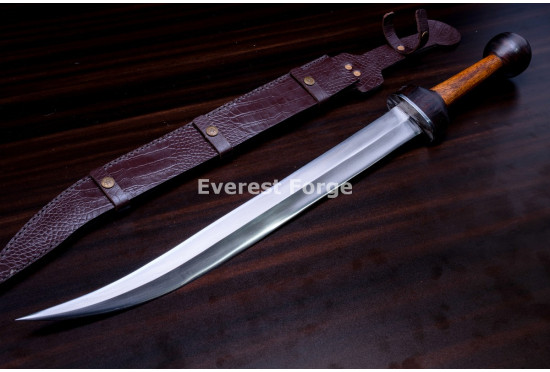
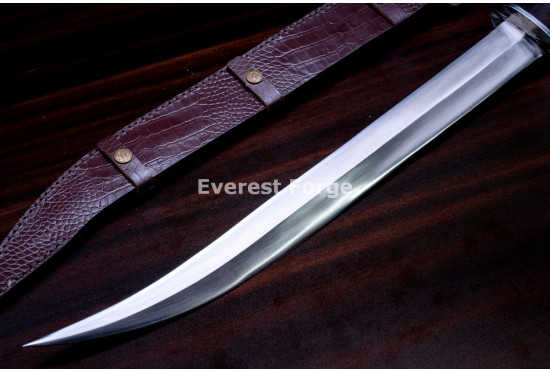
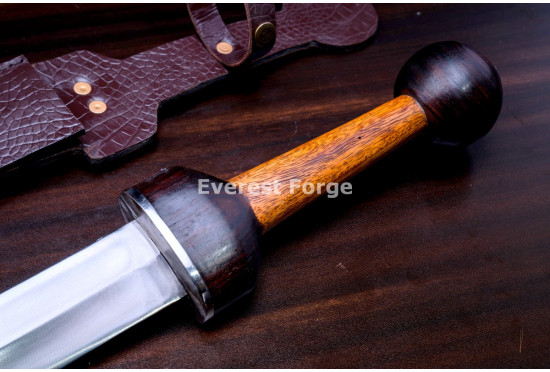
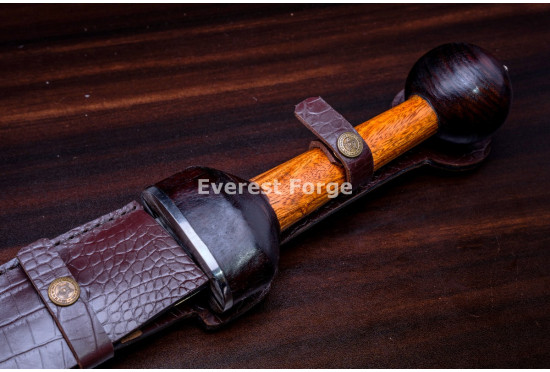
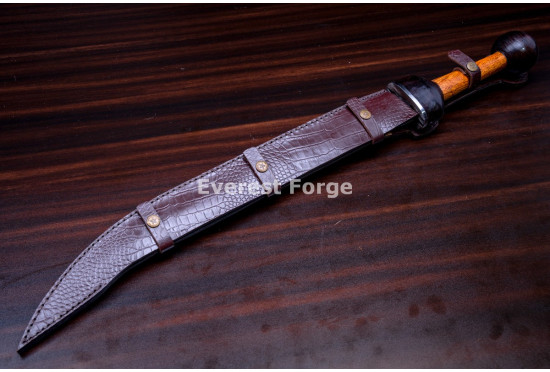
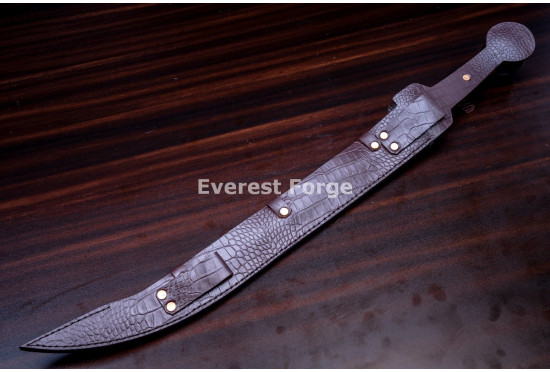
This is a hand-forged, fully functional Thracian sica — the curved short sword of the Balkan Iron Age, forged in Nepal from 5160 high-carbon spring steel, oil-tempered, full tang, and sharpened to a true edge. The blade sweeps in a deep curve to a fine point and is finished satin. The hilt follows the ancient form: no crossguard, a shaped wooden grip behind a steel collar at the blade, and a large turned wooden ball pommel. It ships with a brown leather scabbard with brass studs and belt strapping. Every sword is made to order in your chosen length, finish, and engraving.

The standard blade is 20 inches on a 9-inch hilt with a 4.5-inch grip, for an overall length around 29 inches at about 1.26 kg. That puts it at the large end of the sica range — the type ran from dagger size up to a short sword, and this is the sword. It is a single-hand weapon, light enough to move quickly, and the deep curve is what gives it its character.

An honest note. This is a modern hand-forged interpretation of the sica, not a reproduction of a specific excavated example. The proportions and the guardless hilt follow the ancient form, and the deep curve is genuine to the type. What we have not done is copy a particular find — the dimensions are ours, the steel is modern spring steel rather than the bloomery iron a Thracian smith would have worked, and the finish is brighter than an Iron Age blade would have carried. If you want a specific archaeological example matched as closely as we can manage, send us the reference and we will tell you honestly what we can do.

Bespoke Service

Forge a Sica to Your Own Design

Want a shorter dagger-length sica, a deeper curve, a horn or bone grip, or an archaeological reference matched? Our Custom Forge service builds to your spec, by hand in Kathmandu.

Request a Custom Forge →

What Is a Sica?

The sica is the curved single-edged weapon of the Thracians and Illyrians, in use across the Balkans through the Iron Age and into the Roman period. It ran in every size from a large dagger to a short sword, and its defining feature is the curve — a deep, sweeping bend that let the wielder reach past the edge of an opponent's shield and strike at what was behind it. That single design idea is what makes a sica different from every sabre that came after it. The Romans knew the weapon well: they met it in the Balkans, they gave the name of one of their gladiator types to the men who fought with it, and the word itself passed into Latin as the root of sicarius — a man who kills with a hidden blade, and eventually simply an assassin. Our version is a modern build in the ancient form.

Real Forged BladeHand-forged 5160 spring steel, full tang, oil-tempered and sharpened.
Deep Sica CurveThe sweeping bend that defines the type and gives it its reach around a shield.
Guardless Ancient HiltNo crossguard, as the Iron Age form had — a collar, a grip and a pommel.
5160 Spring SteelTruck leaf-spring steel — tough, shock-resistant, holds an edge.
Turned Ball PommelLarge wooden pommel that keeps the balance back against a curved blade.
Studded ScabbardBrown leather with brass studs and belt strapping.

Specifications

TypeHand-forged Thracian sica, curved single-edged short sword
Blade Length20 inches standard (custom lengths to order)
Handle Length9 inches overall, 4.5-inch grip section
Overall LengthApprox 29 inches at standard blade size
WeightApprox 1260 g total, 890 g blade
Blade Steel5160 high-carbon spring steel (truck leaf spring)
Heat TreatmentOil-tempered — hard edge, flexible spine
Blade StyleDeeply curved single edge, fine point, satin finish, sharpened
GuardNone — steel collar at the blade, as the ancient form
TangFull tang, secured at the pommel
HandleShaped wood with a large turned ball pommel
ScabbardBrown leather with brass studs and belt strapping, included
OriginHand-forged in Tokha-3, Kathmandu, Nepal

Customize Your Sica

Every sword is forged to order. Set your options before you add to cart:

Blade LengthStandard 20 inches, or a shorter dagger-length sica, or longer to your spec.
Blade CurveStandard deep curve, or shallower, or a more pronounced sweep.
Blade FinishSatin as standard, or polished, dark forge finish, or antiqued for an aged look.
Grip MaterialWood as standard, or buffalo horn, bone, or rosewood.
PommelTurned wooden ball as standard, or a steel pommel, or a plain cap.
EngravingAdd a name, date, or your own pattern to the blade or scabbard.

Hand-Forged, Not a Wall-Hanger

This Sica

  • Hand-forged 5160 high-carbon spring steel
  • Oil-tempered, hard edge and flexible spine
  • Full tang secured at the pommel
  • Curve forged in, with a real distal taper behind it
  • Sharpened, balanced, made to your spec

A Wall-Hanger

  • Cast stainless, brittle under load
  • No real heat treatment
  • Rat-tail tang glued into a hollow handle
  • Curve cut from flat bar, no taper, dead in the hand
  • Blunt, display-only

How It Is Made

You set the spec — blade length, curve, finish, grip material, pommel and any engraving.
A smith forges the blade from a 5160 leaf-spring billet and draws the curve and the point.
The blade is oil-tempered, then finished to satin and hand-sharpened along the full edge.
We fit the collar, shape the wooden grip and turn the pommel, secure the tang, make the scabbard, and ship worldwide tracked.

Who It Is For

  • Collectors of ancient and classical arms who want something other than another gladius
  • Anyone interested in Thracian, Illyrian or Dacian history and material culture
  • Reenactors portraying Balkan Iron Age warriors or thraex gladiators
  • Collectors of curved swords looking for the oldest form in the family
  • Larp and costume users, who should order the display-blunt option
  • Gift buyers personalizing a blade with a name, date, or engraving

What Is Included

  • One hand-forged Thracian sica, built to your chosen spec
  • Brown leather scabbard with brass studs and belt strapping
  • Shaped wooden grip with steel collar and turned ball pommel
  • Any personalization or engraving you ordered
  • A satin-finished, sharpened curved blade
  • Everest Forge manufacturer warranty

Explore More Curved Swords

Shipping, Returns & Care

Shipping

In-stock specs dispatch within 2 to 3 business days; fully custom builds take roughly 4 to 6 weeks to forge before dispatch. We ship worldwide by DHL or FedEx in 7 to 14 business days, tracked. Import and blade laws vary by country, so please check your local rules before ordering.

Returns & Warranty

Every blade is backed by the Everest Forge warranty against forging and material defects. If something is wrong with your order, we will repair, replace, or refund it. Personalized and custom-engraved blades are made to order, so please confirm your spec carefully before purchase.

Care

Wipe the blade clean and dry after handling, and apply a light coat of oil before storage to protect the high-carbon steel from moisture. Pay attention to the inside of the curve, which is harder to reach with a cloth and easy to miss. Give the wooden grip and pommel an occasional wipe with oil to stop them drying out, treat the leather scabbard with a conditioner now and then, and do not store the sword inside the scabbard for long periods.

From The Forge

Build a Sica That Is Yours Alone

Beyond the options here, our Custom Forge service will build a dagger-length sica, a deeper curve, an antiqued finish, or a blade matched to an archaeological reference you send us. Roughly 4 to 6 weeks from order.

Start a Custom Forge →

Frequently Asked Questions

What is a sica?

The sica is the curved single-edged weapon of the Thracians and Illyrians, carried across the Balkans through the Iron Age and into the Roman period. It came in every size from a large dagger up to a short sword, and what unites the family is the curve rather than the length. Archaeologically it turns up across Thrace, Illyria and Dacia, often with a hilt that carries no crossguard at all — a collar at the blade, a grip, and a pommel to balance it, which is the arrangement this one follows. It is one of the oldest curved sword forms in Europe and considerably older than any of the sabre traditions that came later.

Why is a sica curved the way it is?

To get around a shield. That is the whole design idea, and it is what separates the sica from the curved swords that came after it. A straight blade meeting a shielded opponent has to go over the top, under the bottom or around the side, and all three are slow. A deeply curved blade can be brought past the edge of a shield with the point already turned inward, so the strike lands behind the guard rather than on it. Ancient sources describe Thracian fighters using exactly this, and it is the reason the thraex gladiator in the Roman arena was matched against opponents with large shields — the pairing was built to make the weapon's advantage visible. The trade-off is that a curved blade of this kind is poor at anything that needs a straight line: it does not thrust well at range and it is awkward in a press. It was a specialist's weapon, not a general-purpose sword.

How does a sica differ from a falx or a rhomphaia?

They are relatives from the same part of the world and they are constantly confused. The sica is the small one — a curved dagger to short sword, used in one hand, the weapon this page is about. The falx is the Dacian development of the same idea at a much larger scale: a heavy curved blade on a long haft, used in two hands, and infamous enough that Roman soldiers campaigning in Dacia are thought to have reinforced their helmets with cross-bracing and added armour to the sword arm in response to it. The rhomphaia is the Thracian equivalent, a long, only slightly curved blade on a long shaft, closer to a polearm than a sword. All three share the same underlying concept and differ mainly in size and how they were held. This one is a sica proper.

Who actually carried a sica?

Thracian and Illyrian warriors first, from well before the Roman period. The Romans then encountered it during their campaigns in the Balkans and it entered their world twice over. In the arena, the thraex — the Thracian — was a gladiator type armed with a curved blade and a small shield, deliberately matched against opponents carrying large shields so that the weapon's shield-reaching advantage was on display. And in ordinary Latin the word became sicarius, meaning a man who kills with a concealed blade: the sica was short enough to hide under a cloak, and the term ended up in Roman law for political murderers. The English word assassin has a different root, but sicarius covered much the same ground.

Is this historically accurate?

In form, largely yes. The deep curve, the single edge, the guardless hilt with a collar and a ball pommel, and the overall proportions all follow the ancient type. What it is not is a reproduction of a specific excavated find — the dimensions are ours rather than copied from a museum piece, the steel is modern 5160 spring steel rather than the bloomery iron a Thracian smith would have worked with, and the satin finish is brighter than an Iron Age blade would have carried. Treat it as a faithful modern build of the type. If you want a particular archaeological example matched as closely as we can manage, send the reference through Custom Forge and we will tell you honestly what we can and cannot do.

How does this compare with your Roman gladius?

They were contemporaries and opposites, which makes them an interesting pair to own. The gladius is short, straight, broad and built to thrust — a sword for a man in a formation behind a large shield, stabbing into gaps. The sica is curved, single-edged and built to reach around a shield rather than through a gap, and it works best in open fighting where you can move around your opponent. One is a formation weapon, the other an individual's. If you collect Roman material, a sica is the natural companion piece — it is what the legions met in the Balkans, and it is the weapon the arena's Thracian gladiator carried against Roman-styled opponents.

Is this a real, functional sword?

Yes. It is hand-forged from 5160 high-carbon spring steel, full tang, oil-tempered, and sharpened to a true cutting edge before it ships. The collar is steel and the tang is secured at the pommel rather than glued into a hollow handle. It handles tatami mats, water bottles and light green targets. Do not use it on bone, metal, seasoned hardwood, or anything you would not put a good knife through.

What steel is it, and is it oil-tempered?

The blade is forged from 5160 high-carbon spring steel, the same alloy used in heavy-duty truck leaf springs, prized for toughness and edge retention. It is oil-tempered for a hard cutting edge backed by a flexible, shock-absorbent spine. On a deeply curved blade that flex matters more than usual, because a curve loads unevenly through a cut and the steel has to take that without setting a bend.

Is it full tang?

Yes. The tang runs the full length of the hilt and is secured at the pommel, so the collar and grip are mechanically captured on the tang itself. There is no rat-tail and nothing glued into a hollow handle. On a guardless sword this matters more than it might seem: with no crossguard taking any load, everything the blade does travels straight into the grip assembly.

Is it one-handed, and how does it handle?

One-handed. The 4.5-inch grip is sized for a single hand and the sword weighs about 1.26 kg all up, which is light for its length. The large ball pommel is doing real work there — a curved blade throws its mass outward and away from the hand, and a heavy pommel pulls the balance back so the sword does not feel like it is running away from you. The result is quicker than the size suggests. It rewards a drawing cut, pulling the edge along the target rather than chopping straight down.

What are the hilt and scabbard made of, and does it arrive sharpened?

The grip and the turned ball pommel are wood, with a polished steel collar where the hilt meets the blade. There is no crossguard, which is correct for the type. The scabbard is brown leather with brass studs and belt strapping, made by hand to fit the blade size you order. The sword arrives sharpened as standard along the full edge, finished by hand; choose the display-blunt option if you need it unsharpened for display or to satisfy import rules where you live, at no extra charge. Buffalo horn, bone and rosewood grips are available, as are steel pommels and an antiqued finish.

Do you ship worldwide, and how long does it take?

Yes. We ship worldwide from Nepal by DHL or FedEx in 7 to 14 business days with tracking. In-stock specs dispatch within 2 to 3 business days; fully custom builds take roughly 4 to 6 weeks to forge first. Import and blade laws vary by country, so please check your local rules before ordering.

Specification
Blade: 20 inches. Hand forged from 5160 carbon steel
Total Length: 29 inches
Handle: 9 inches overall with a 4.5 inch grip section. Full tang secured at the pommel, shaped wood with a turned ball pommel and steel collar, no crossguard
Weight: Approx 1260 grams total (blade approx 890 grams)
Note: As every piece is forged by hand, slight variation in weight, dimensions and finish may occur. Wood grain varies between pieces. Keep the blade lightly oiled when not in use.

Write a review

Note: HTML is not translated!
Bad Good
Captcha